Yes. Ordinary untreated paper is biodegradable because its main structural component, cellulose, can be broken down by microorganisms. But that does not mean every paper product disappears quickly, belongs in a home compost pile, or is accepted by a recycling or composting facility. The finished article may include coatings, adhesives, inks and other layers that behave differently from paper fibers.
If you are asking about notebook paper, a paper bag, waxed paper, a coffee cup or a coated food box, the right answer may differ. The essential questions are what is in the paper product and where it will actually go after use. For another cellulose-based format, see cellophane biodegradability; a paper result cannot establish the behavior of a coated film.
Why does paper biodegrade?
Most paper is made primarily from cellulose fibers derived from wood or other plants. In a suitable biological environment, microorganisms and their enzymes can break down cellulose and use its carbon. Oxygen, moisture, temperature, available nutrients and the physical form of the material all affect how that process proceeds.
Paper’s ability to biodegrade is not a precise disposal-time promise. A thin, damp sheet mixed into active compost does not experience the same conditions as a dry, tightly stacked bundle or a paper item buried in a landfill.
The U.S. Environmental Protection Agency’s home composting guidance lists uncolored, non-glossy shredded paper and shredded cardboard without wax coating, tape or glue among suitable carbon-rich materials. That is a narrower and more useful statement than saying every kind of paper can be composted.
Is every type of paper biodegradable?
Start by separating the fiber core from the finished construction. Some paper products are largely untreated fiber. Others contain a barrier layer designed to resist water, oil, heat or tearing.
| Product | Fiber portion | Important qualification |
|---|---|---|
| Plain, uncoated office paper | Cellulose-based and biodegradable under suitable conditions | Printing and other additives still matter; recycle clean paper where accepted |
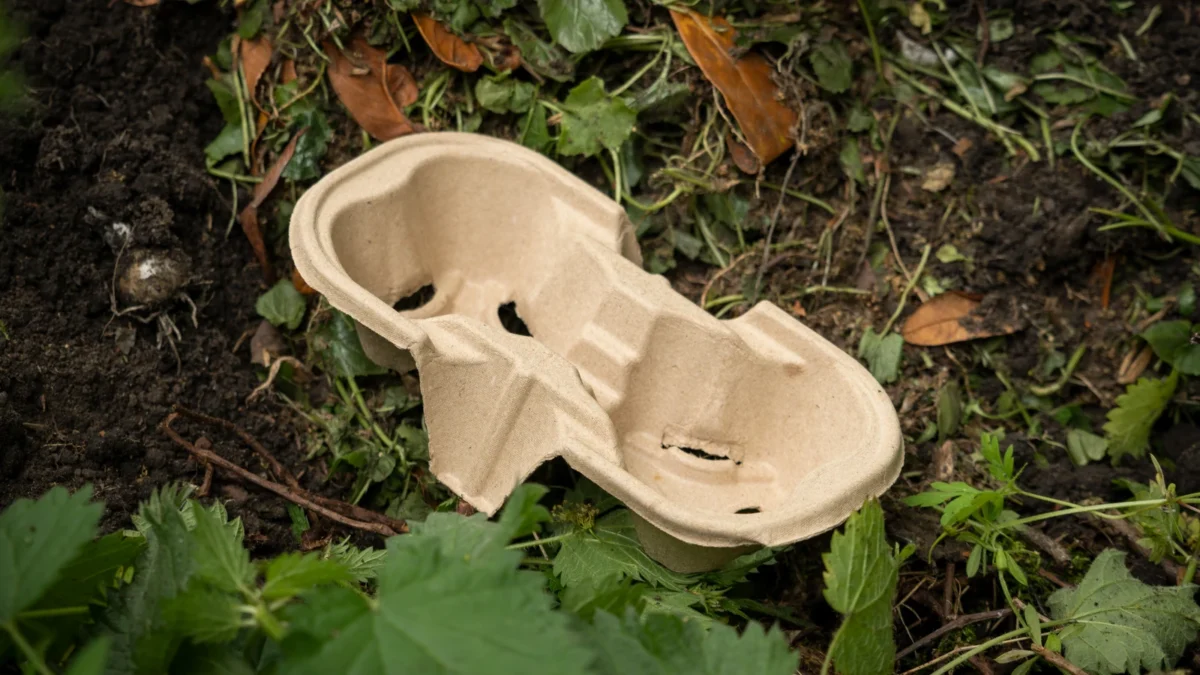
| Uncoated cardboard | Cellulose-based and biodegradable | Remove tape, labels and non-paper components before home composting |
| Glossy or heavily coated paper | Fibers may biodegrade | Coating chemistry is not evident from the shine; avoid assuming home compostability |
| Plastic-lined paper cup | Paper fiber can biodegrade | The lining may not; the entire cup needs construction-specific evidence |
| Wax-treated paper | Fiber can biodegrade | Coating composition and local composting rules matter |
| Certified compostable paper article | Potentially designed for a defined composting route | Verify the certificate covers the whole item and check facility acceptance |
The table describes material possibilities, not verified certifications for a particular brand or product. A paper-looking surface is not enough to identify a lining.
What happens to plastic-coated paper?
Consider a takeaway cup made of paperboard with a moisture-resistant lining. The paperboard may biodegrade in favorable conditions, while the lining follows a different degradation pathway. A conventional polyethylene (PE) lining cannot be assumed to biodegrade simply because it is attached to paper. A polylactic acid (PLA) lining may be designed for industrial composting, but that does not establish home compostability or the compostability of the complete cup. Its grade and the finished item need evidence for the claimed temperature, moisture and treatment conditions.
It is also a mistake to think a water-based coating must be biodegradable. “Water-based” tells you how a coating was applied or dispersed, not what the dry polymer film will do after disposal. Similarly, plant-based does not guarantee biological breakdown. The European Environment Agency explains that biodegradable plastics require particular conditions and that bio-based feedstock is not proof of biodegradability.
The most useful question is whether the complete finished paper item, including coating and additives, has been evaluated for the environment stated in the claim. Biodegradability does not by itself establish food-contact suitability; that needs separate evidence for the intended use. [FDA]
Biodegradable, compostable and recyclable are different
Biodegradable
For biodegradable packaging, the term describes biological breakdown under particular conditions. Without a named environment and timeframe, it says little about how fast an item will disappear after disposal. Disintegration into fragments is not automatically proof of complete biodegradation.
Compostable
Compostability is a more specific claim connected to a composting process and its requirements. Industrial composting and home composting are not interchangeable. A product designed for an industrial system may fail to break down adequately in a backyard pile, which typically runs at different temperatures and processing times.
Recyclable
Recyclability concerns collection, sorting and processing into usable material. Clean and dry plain paper is commonly directed toward paper recycling where facilities accept it. Coatings, contamination and local infrastructure change that answer. The EPA recycling guidance advises checking local recycling providers and notes that wet or food-soiled paper may be appropriate for composting instead.
One material can be biodegradable yet difficult to recycle. Another can be recyclable without being biodegradable. Neither label automatically tells you the better end-of-life route for a particular location.
How long does paper take to decompose?
There is no defensible universal timeline for all paper. Charts promising that “paper decomposes in X weeks” often omit the kind of paper, thickness, moisture, microbial activity, oxygen supply and conditions of disposal. Even two uncoated sheets can behave differently if one is shredded and mixed into active compost and the other remains compacted and dry.
That is why the question “Is paper biodegradable?” is easier to answer than “Exactly how many days will this paper product take to disappear?” A credible numerical claim needs a defined specimen, test environment, endpoint and method.
Does paper biodegrade in a landfill?
Not necessarily quickly. Landfills are not managed compost piles, and their conditions can restrict the moisture and oxygen needed for aerobic biological activity. The FTC’s degradable-claims guidance distinguishes favorable breakdown conditions from customary disposal in landfills, incinerators or recycling facilities.
This also affects environmental advertising. Under the FTC’s Green Guides, section 260.8, an unqualified degradable claim for a product entering customary solid-waste disposal cannot be treated as a free-standing promise without competent evidence. The guidance concerns marketing substantiation; it should not be mistaken for a guarantee that all paper will break down within a particular period.
Can you compost paper at home?
For an ordinary backyard compost pile, the EPA lists shredded, non-glossy, uncolored paper and shredded cardboard without wax, tape or glue as suitable brown materials. Mix them with nitrogen-rich materials and maintain aeration and moisture.
Do not automatically add glossy papers, unknown coated products or compostable foodservice ware. EPA’s backyard-compost guidance explicitly cautions against glossy paper and compostable foodservice ware; commercial facilities may have different capabilities and acceptance rules. Even for a certified product, local program acceptance must be checked before disposal.
What about toilet paper, tissues and paper towels?
The cellulose in these products can biodegrade, but the correct disposal route is a separate question. Used tissues and towels can carry contaminants; local sanitation and organics-collection rules govern what can be composted. Flushing a material, composting it and placing it in municipal recycling are different decisions. Do not use general biodegradability as permission to flush products that are not specifically intended for that purpose.
How to check a paper product’s claim
- Identify the entire construction. Is it uncoated paper, or a multilayer item with a barrier film, adhesive, printing or seal?
- Look for a specified environment. Does the claim refer to industrial compost, home compost, soil or another route?
- Check what was actually tested. Fiber-only evidence does not establish the fate of a finished coated cup or box.
- Check local acceptance. A material may meet a technical criterion yet still be rejected by the collection or processing operator.
- Choose the available route. For clean, accepted paper, recycling may be the practical pathway; for suitable untreated paper, home composting can also be appropriate.
What the material name can tell you
Paper fiber is biodegradable; a paper product is a construction. Plain, uncoated paper is much easier to assess than a printed, glued or lined food package. For a reliable environmental claim, check the whole article, the disposal environment, any supporting evidence and the system that will actually receive it.
Sources
Sources checked 7 November 2026. This is an editorial explanation, not a product test or certification.
- EPA — Composting At Home. What to Add / Avoid Adding to a Backyard Compost Pile; browns, coatings and foodservice ware.
- FTC Green Guides — 16 CFR 260.8: Degradable claims. Paragraphs (a)–(d); whole-item evidence and customary disposal, not a decay-time prediction.
- EPA — Frequent Questions on Recycling. Paper and food/drink containers; clean/dry paper and local program acceptance.
- EEA — Biodegradable and compostable plastics: challenges and opportunities. Key messages and definitions; bio-based versus biodegradable, industrial versus home conditions.
- FDA — Food Packaging and Other Substances: Information for Consumers. Food-contact substances and components; authorization and migration assessment for intended use, separate from end-of-life claims.
Found an error? Read our corrections policy and contact the editors.