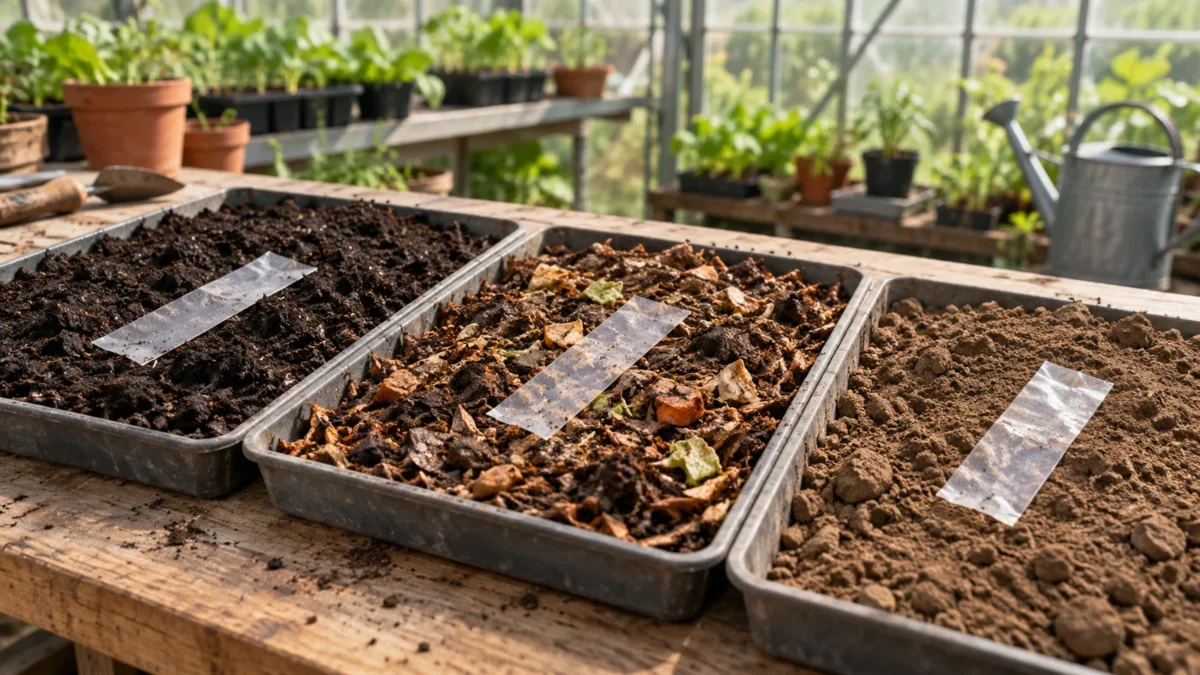
Consider a hypothetical comparison: cut one biodegradable film into three identical starting specimens. This is a thought experiment, not a field trial conducted by this publication.
Put the first into a controlled industrial-composting test around thermophilic temperature. Put the second into a home-composting system operating closer to ambient conditions. Bury the third in soil.
After several weeks or months, the three pieces may look as if they were made from different plastics.
One may soften, fragment and mineralize rapidly. Another may change slowly. The soil specimen may retain much of its original form long after the industrial-compost specimen has lost mechanical integrity.
The starting formulation was the same; the exposure conditions differed. Chemical and structural changes can then develop differently during degradation.
This is the central rule of biodegradable plastics: biodegradability is a material–environment interaction, not an intrinsic stopwatch built into the polymer.
Industrial compost: managed exposure
Industrial compost: heat, moisture, oxygen and microbial activity are deliberately managed
Industrial composting is an engineered biological process.
Controlled composting tests such as ISO 14855 are designed around monitored temperature, aeration and humidity. ISO 14855-1 describes a controlled composting environment in which a plastic is exposed to compost-derived inoculum and the carbon converted to evolved carbon dioxide is measured. The standard is designed to reproduce key features of aerobic composting for organic municipal waste—not uncontrolled outdoor decay. [S3]
BPI’s public FAQ illustrates the thermal difference through its own scheme: commercial biodegradation testing at 58±2 °C and home testing at 25±2 °C, with different test periods. These are scheme conditions, not a universal description of every operating pile. [S6]
That temperature difference can fundamentally alter polymer degradation.
The PLA example: crossing Tg changes the chemistry of access
PLA makes the temperature effect unusually visible.
As explained in the PLA crystallinity and heat-response analysis, the glass transition is grade-dependent. Approaching it increases mobility in amorphous regions; no single Tg range defines every PLA blend.
Higher temperature also accelerates ester hydrolysis.
A 2025 review of home composting explains why the thermophilic stage can be crucial for PLA: elevated temperature increases non-enzymatic hydrolysis, changes chain mobility and can improve access to ester bonds. Once molecular weight falls sufficiently, microorganisms can assimilate smaller degradation products more readily. [S2]
Industrial compost does not make every biodegradable polymer respond rapidly by the same mechanism.
PLA is particularly sensitive to the combination of heat and hydrolysis. PHAs can be attacked more directly by extracellular microbial depolymerases. PBAT and PBS show different enzyme, morphology and environmental dependencies.
Home compost: a variable household system
Home compost: same biology, weaker thermal control
Home composting is not simply a smaller industrial plant.
Small piles and household bins have less thermal mass. Ambient weather has a stronger effect. Moisture and aeration depend heavily on management. Food scraps, dry leaves, turning frequency and bin geometry all change microbial activity.
BPI describes separate commercial and home certification conditions. Its home-compost guidance discusses managed household systems rather than promising that any unmanaged garden pile will reproduce a laboratory test. [S6]
Those are BPI scheme conditions, not universal global definitions, but they illustrate the engineering difference clearly:
home composting asks a biodegradable package to perform with much less thermal assistance.
A home compost bin is also more variable from week to week
A 2025 comprehensive review analyzed 48 experimental studies on biodegradable plastics in home composting. It identified three broad drivers: [S2]
- polymer composition and additives;
- compost-system parameters such as temperature, aeration and volume;
- compost-medium factors such as microbial community and nutrient availability.
The review also found large variability between controlled laboratory home-compost simulations and real household systems.
This makes “home compostable” a more demanding formulation target than simply slowing down an industrial-compost test.
A material has to function under mesophilic and fluctuating conditions where high-temperature hydrolysis cannot be assumed.
Soil: a different biological matrix
Soil: biodegradation without the compost reactor
Soil is a different biological matrix.
ISO 17556:2019 measures ultimate aerobic biodegradability in soil by monitoring oxygen demand or evolved carbon dioxide. The official ISO abstract states that soil humidity is adjusted to support biodegradation and distinguishes between non-adapted soil, which is intended to simulate natural soil biodegradation processes, and pre-exposed soil used to study potential biodegradability. [S5]
But soil is not thermophilic compost.
Temperatures are usually lower. Organic-carbon availability differs. Microbial populations differ. Moisture can fluctuate. Oxygen transport depends on texture and water content. A polymer surface may contact mineral particles and soil aggregates rather than an actively mixed compost matrix.
That changes both hydrolysis and microbial access.
Why “the same microorganisms” is the wrong mental model
Biodegradation depends on organisms capable of producing relevant enzymes and using the resulting molecules.
The microbial population in industrial compost evolves through temperature phases. Thermophilic organisms become important during high-temperature stages. Soil contains different bacterial and fungal communities shaped by pH, organic matter, climate and land use.
Home compost can move between these ecological states but may never sustain a strong thermophilic community.
A 2026 review of microbial and enzymatic PBAT, PLA and PBS degradation identifies polymer structure, microbial strain, enzyme activity, medium and exposure conditions as distinct controls. It does not provide a transferable ranking for every disposal setting. [S11]
This means that a polymer with a chemically hydrolysable backbone still may not mineralize quickly if the local microbial community cannot efficiently use the degradation products.

The three chambers change more than temperature
| Variable | Industrial compost | Home compost | Soil |
|---|---|---|---|
| Temperature | Actively reaches/maintains thermophilic phases in managed systems | Usually mesophilic and strongly climate/bin dependent | Usually ambient and location/season dependent |
| Moisture | Managed for active composting | User-management dependent | Depends on soil, weather and irrigation |
| Aeration | Managed turning/aeration | Depends on pile structure and turning | Controlled by soil texture, compaction and water content |
| Microbial community | Mesophilic + thermophilic compost organisms | More variable, usually mesophilic-dominated | Soil-specific bacterial/fungal community |
| Nutrient environment | Active organic-waste matrix | Variable food/yard-waste mix | Soil organic matter and local nutrients |
| Mechanical mixing | Often active | Intermittent or minimal | Normally none in field conditions |
Source basis: [S2] [S6] [S11]. This table is an editorial comparison, not a product qualification or statutory checklist.
Calling all three environments “biological” therefore hides the variables that matter most.
Evidence and scope: [S2] [S6] [S11]. Comparative tables in this section are editorial synthesis, not a new test.
Polymer and formulation remain important
A 2018 study of environment and blend effects
The original authors’2018 abstract describes tests of neat polymers and blends across seven managed and unmanaged environments. It reports that a PLA/PCL blend behaved differently from neat PLA in home composting; the full formulation and methods were not re-audited here. [S8]
The useful abstract-level finding is environment- and formulation-dependence. Detailed soil or industrial-comparison values are not reproduced from an unread full method.
The result should not be converted into “PLA never biodegrades in soil.”
It demonstrates a narrower and more useful principle:
a polymer can meet a biodegradation criterion in one defined environment and fail to meet the same type of performance expectation in another.
Temperature, specimen form, duration and method belong with the result.
PHA family variation matters too
If environment were the only variable, every biodegradable polymer would rank the same way in all three chambers.
They do not.
PHA describes a family of polymers, not one degradation rate. The existing PHA, PHB and PHBH guide explains the composition distinctions; the present comparison does not rank that family against other polymers from incompatible studies.
So the correct model has two axes:
polymer structure × environment.
Why PBAT can behave differently from PLA even in the same compost
PBAT is flexible and biodegradable, but its aromatic terephthalate units and semicrystalline morphology create a different degradation pathway from PLA.
The same PBAT/PLA/PBS review separates condition-dependent microbial and enzymatic routes. Blend morphology, specimen construction and the actual exposure must accompany a rate claim. [S11]
PBAT is therefore another example of why “compostable polymer” should not be translated into “rapidly biodegradable everywhere.”
The same reasoning applies to PBS.
Water, structure and blend effects
Moisture can accelerate one stage and stop another
Water is required for many biodegradation pathways, especially hydrolysis of ester bonds.
But “more water” is not always better.
In compost, excessive moisture can fill pore space and reduce oxygen availability. Aerobic decomposition can slow or shift toward anaerobic behavior.
In soil, very dry conditions can suppress microbial metabolism and slow hydrolysis. Waterlogged soil can also limit oxygen.
Home composting is especially sensitive because small bins can dry rapidly or become saturated after rain.
The relevant variable is therefore an aerobic moisture window—not simply whether water is present.
Evidence and scope: [S2] [S11]. Comparative tables in this section are editorial synthesis, not a new test.
Surface area changes the clock
A thin film and a thick fork made from the same resin do not present the same degradation geometry.
Thinner specimens provide more surface area relative to mass and shorter diffusion distances for water, enzymes and soluble products.
This affects all three environments, but the consequence can be most visible under slower home-compost or soil conditions.
A thick article may remain physically intact long after a thin film of the same polymer has fragmented.
That difference should not be blamed automatically on material certification. It may be a geometry effect.
Crystallinity can preserve the slow fraction
Amorphous regions of many biodegradable polyesters are more accessible to water and enzymes than densely packed crystalline regions.
As degradation proceeds, the amorphous fraction can be removed preferentially, leaving a residue enriched in more ordered material.
This is why crystallinity can appear to increase during early degradation even while total polymer mass is decreasing.
For PLA, this effect interacts strongly with industrial-compost heat because the elevated temperature accelerates hydrolysis and chain mobility. In cooler soil or home compost, the same crystalline structure can contribute to much slower progress.
The comparison must retain specimen thickness, initial structure and the endpoint being measured, rather than treating the material name as a specification.
Blends create a fourth environment: the polymer next door
Commercial biodegradable packaging is often not a neat resin.
PLA may be blended with PBAT. TPS may be dispersed inside PBAT. PHBH may form one phase inside another polyester. Fillers, plasticizers and compatibilizers can change water uptake and morphology.
This means each polymer is also exposed to the microenvironment created by its neighboring phase.
A hydrophilic starch phase may increase local water uptake. A hydrophobic continuous phase may shield a biodegradable component from microbes. Compatibilization can reduce interfacial defects and slow water penetration.
This is why an ingredient list cannot predict the environmental degradation rate of the finished package.
Why home-compost certification cannot be inferred from industrial certification
This distinction is operational as well as scientific.
BPI currently uses separate commercial and home-compostability certification schemes. Its commercial program is based on ASTM D6400, while the home program is based on the French NF T 51-800 framework and uses lower test temperature and longer test duration. [S6]
The existence of separate schemes reflects the materials problem described in this article:
performance in a thermophilic industrial environment does not automatically predict performance in a mesophilic household environment.
Soil biodegradation is not a substitute for compostability either
A polymer can biodegrade in soil and still fail a compostability specification because compostability includes process-time and finished-product requirements beyond ultimate biodegradation potential.
Likewise, a product can be industrially compostable without being designed for deliberate disposal in agricultural soil.
ISO 17556 is a soil biodegradation method. ISO 14855 is a controlled-compost biodegradation method. They address different environments.
The test environment is part of the claim.
For the related distinction, see disintegration, mass loss and mineralization endpoints.
How to read an environmental degradation paper without overclaiming it
| Field | Why it matters |
|---|---|
| Polymer / exact blend | PLA, PHB, PBAT, PBS and blends follow different pathways |
| Specimen form | Powder, film, pellet and molded article have different surface area |
| Thickness | Diffusion distance and disintegration time change with geometry |
| Crystallinity | Ordered regions can degrade differently from amorphous regions |
| Environment | Industrial compost, home compost and soil are not interchangeable |
| Temperature | Controls hydrolysis, chain mobility and microbial activity |
| Moisture / aeration | Controls both chemical hydrolysis and aerobic biology |
| Inoculum / soil | Microbial community can determine enzyme availability |
| Endpoint | Mass loss, disintegration and CO₂ mineralization are different measurements |
| Duration | A “slow” result at 30 days may not describe behavior at 12 months |
Source basis: [S3] [S5] [S11]. This table is an editorial comparison, not a product qualification or statutory checklist.
What the evidence changes
A useful result identifies the exact formulation, specimen and endpoint alongside environment, temperature, moisture, inoculum and duration. Keep that complete record when comparing industrial compost, managed home compost and soil; a label for one does not establish performance in the others.
Methodology and editorial note
This technical explainer synthesises the identified official guidance, public standard scopes and research records. Study findings remain specific to their reported materials and conditions. Sources checked 19 October 2026; no product testing, factory inspection or independent certification assessment was performed for this article.
The main image is an AI-generated editorial illustration of an unnamed conceptual scene. The explanatory figure is an original editorial synthesis, not a photograph of an experiment, microscopic structure or measured result.
Official sources and reference notes
- [S2] Jules Bellon et al. Challenges and opportunities in home-composting of biodegradable plastics: A comprehensive review. Results in Engineering 28 (December 2025), 107535. Original review abstract/highlights:48 studies and three drivers; research/control heterogeneity. Official publisher-indexed abstract and identified public sections checked; exact individual-study rates not reconstructed. Accessed 19 October 2026.
- [S3] International Organization for Standardization. ISO 14855-1:2012 — Determination of the ultimate aerobic biodegradability of plastic materials under controlled composting conditions — Method by analysis of evolved carbon dioxide — Part 1: General method. Edition 2; reviewed/confirmed 2022; current at source cutoff. Official public abstract. Official public abstract checked; full standard not accessed. Accessed 19 October 2026.
- [S5] International Organization for Standardization. ISO 17556:2019 — Plastics — Determination of the ultimate aerobic biodegradability of plastic materials in soil by measuring the oxygen demand in a respirometer or the amount of carbon dioxide evolved. Edition 3, May 2019; reviewed/confirmed 2024. Official public abstract. Official public abstract checked; full standard not accessed. Accessed 19 October 2026.
- [S8] Tanja Narancic et al. Biodegradable Plastic Blends Create New Possibilities for End-of-Life Management of Plastics but They Are Not a Panacea for Plastic Pollution. Environmental Science & Technology 52(18), 2018, 10441–10452. Original publisher abstract: seven environments and PLA/PCL example. Original authors’ public abstract checked; detailed results/methods not audited. No polymer-wide guarantee. Accessed 19 October 2026.
- [S6] Biodegradable Products Institute. Certification FAQs. Public page checked 19 October 2026. Commercial & Home comparison;58±2°C/25±2°C;NF T51-800 basis. Full relevant public FAQ checked. No claim that certificate equals acceptance by every facility. Accessed 19 October 2026.
- [S11] Selim Ashoor et al. Condition-dependent microbial and enzymatic degradation of PBAT, PLA, and PBS. Applied Biological Chemistry 69,44;22 July 2026. Polymer, enzyme, medium and exposure-condition synthesis. Relevant full public review sections checked; not a universal rate chart. Accessed 19 October 2026.
The public corrections channel is currently inactive. Read our corrections policy.