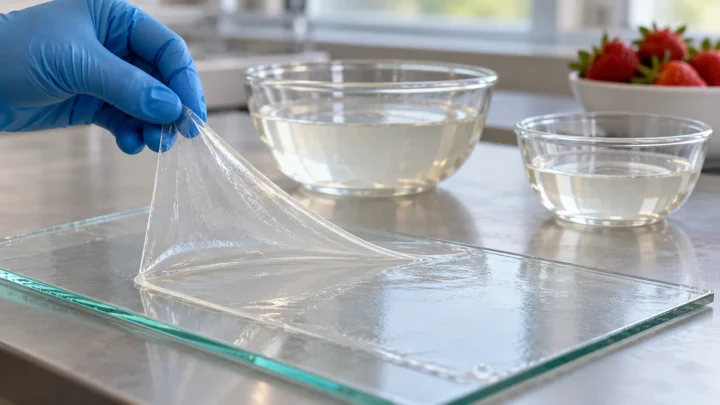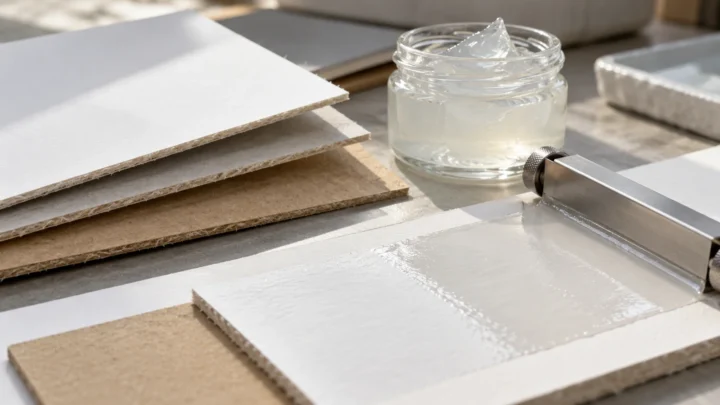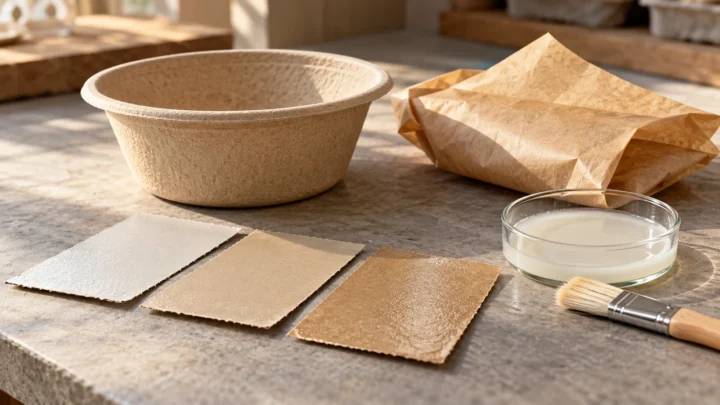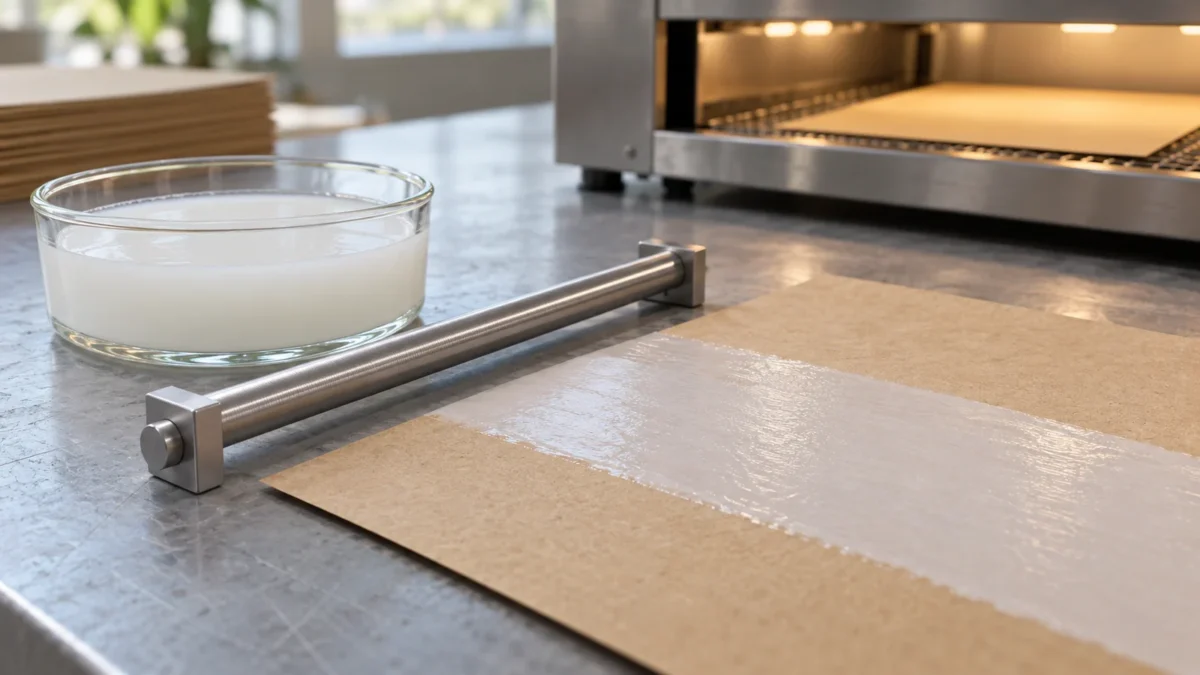
An aqueous dispersion coating uses water as the main liquid carrier for polymer particles and other coating ingredients. After application, the water evaporates and the dispersed particles pack, deform and coalesce into a continuous film. That film can provide grease, liquid-water, water-vapor, oxygen or heat-seal functions depending on its chemistry and construction. But “water-based” does not automatically mean plastic-free, biodegradable, compostable or recyclable.
This distinction is important because aqueous coatings are increasingly presented as alternatives to extrusion-coated or laminated paper. The technology can reduce coating weight and avoid using an organic solvent as the main carrier, but the final dry layer is still determined by the polymer, additives, coat weight, film formation and substrate.
For packaging buyers, the useful questions are therefore: What is dispersed in the water? What barrier does the dried film provide? How much coating remains on the paper? Does it survive converting and use? And how does the complete package behave in the intended recycling or other end-of-life system?
Aqueous dispersion is a coating format, not a material identity
The term aqueous dispersion coating describes how the coating is delivered to the paper. Polymer particles are dispersed in water rather than being supplied as a pre-formed plastic film or dissolved primarily in an organic solvent.
That does not tell you whether the polymer itself is fossil-derived, bio-based, biodegradable or durable. Waterborne systems can be built from acrylics, styrene-acrylics, latexes, polyurethanes, vinyl polymers, polyesters, polyhydroxyalkanoates and other chemistries. They can also contain waxes, pigments, mineral particles, surfactants, thickeners, crosslinkers, defoamers and other formulation components.
It is therefore more accurate to read “water-based” as a delivery and film-formation description, not as an end-of-life claim.
Dispersion is not the same as solution
This distinction matters technically.
In a polymer solution, polymer chains are dissolved at the molecular level in the liquid phase. In a polymer dispersion, discrete polymer particles are suspended in the water. The particles have to come together during drying to create a coherent coating.
4evergreen’s 2026 Circularity by Design Guideline reflects this broader industry distinction by grouping wet polymeric coatings as water- or solvent-based dispersions and solutions, separate from extrusion coatings, film laminations, waxes, metallisation and fluorinated treatments. [S5]
The words can be used loosely in commercial conversations, so a technical specification should state whether the coating is a true dispersion, a solution, an emulsion or a hybrid formulation.
How an aqueous dispersion becomes a dry barrier film
Waterborne polymer film formation is not simply “water dries and plastic stays behind.” It is a multistage physical process.
- Water begins to evaporate. The distance between dispersed polymer particles decreases as the wet coating loses liquid.
- Particles pack together. The polymer particles become increasingly concentrated and approach close packing.
- Particles deform. If the formulation and drying temperature allow film formation, particles deform and reduce the void space between them.
- Coalescence occurs. Adjacent particles merge and polymer chains interpenetrate across particle boundaries.
- A continuous film develops. The final morphology determines how effectively the coating blocks liquids, grease or gases and how well it survives handling and converting.
A 2024 open-access review in RSC Sustainability describes this progression from evaporation to close packing, deformation and polymer-chain interpenetration. The review also emphasizes the importance of the minimum film-forming temperature, or MFFT: below the temperature needed for effective coalescence, a continuous low-defect film may not form. [S1]
That is one reason two coatings with similar polymer chemistry can perform differently when dried on different machines or under different conditions.

Drying temperature is part of barrier performance
Drying affects more than production speed.
If water is removed but polymer particles do not fully deform and coalesce, the coating can retain particle boundaries, voids or defects. Those defects may become pathways for water, grease, oxygen or water vapor.
For a packaging converter, this means the oven profile, web speed, substrate temperature and coat weight can influence the same barrier property that is often discussed only in terms of polymer chemistry.
Why aqueous coatings can use less polymer than some laminated structures
One attraction of dispersion coating is the ability to apply a relatively thin functional layer directly to paper or board using processes such as rod, roll, flexographic, curtain or related coating methods.
The 2024 RSC review notes that waterborne dispersion coatings can support methods such as curtain, dip, bar and roll coating and may use lower dry material amounts than thicker extrusion or film-lamination structures in some applications.
But lower coating mass is not automatically better. A coating that is too thin may leave uncovered fibers, pinholes or an incomplete film. A thicker coat may improve barrier continuity but increase cost, drying load and non-fiber content.
The engineering target is therefore not “minimum possible coating.” It is minimum coating that reliably delivers the required function after converting and use.
What barriers can an aqueous dispersion provide?
| Function | What the dry film must do | Typical limitation to check |
|---|---|---|
| Grease resistance | Reduce penetration or wetting by fats and oils | Hot oil, mixed food chemistry, folds and pinholes may be more demanding than a flat-sheet test |
| Liquid-water resistance | Reduce wetting and water uptake or prevent leakage | Edges, seams, prolonged contact and hot liquids can expose weak points |
| Water-vapor barrier | Reduce moisture-vapor transport | Hydrophilic polymers may lose performance as humidity rises |
| Oxygen barrier | Reduce oxygen transmission through the structure | Some strong dry oxygen barriers weaken at high relative humidity |
| Heat sealing | Soften or bond within an appropriate sealing window | Seal initiation temperature, dwell time, pressure and contamination all matter |
Editorial synthesis of the cited sources. Examples are not product test results; methods, construction and conditions remain part of every claim.
Recent reviews of paper barrier coatings treat grease, liquid water, water vapor and oxygen as separate performance categories. That is important: calling a coating “high barrier” is not enough to know whether it is suitable for soup, fried food, coffee, dry snacks or chilled produce.
See the four barrier measurements for the related distinction.
Water-based does not mean water-soluble
This is another common misunderstanding.
An aqueous polymer dispersion can start as polymer particles suspended in water and then dry into a film that is no longer dispersible or soluble in water. Film formation can produce a continuous hydrophobic structure even though the application medium was water.
The 2024 waterborne-dispersion review describes this explicitly: dispersed particles coalesce as water evaporates and form a homogeneous coated surface. The coating’s resistance to water after drying therefore depends on polymer chemistry and film formation, not on the fact that water was used during application.
Conversely, a water-soluble polymer such as some grades of PVOH behaves differently from an insoluble latex dispersion. The commercial phrase “water-based coating” does not identify which mechanism is present.
See PVOH grade and end-of-life differences for the related distinction.
Water-based does not mean plastic-free
A waterborne coating can contain synthetic polymer particles. Once dried, those particles form a polymer film.
That film may be very thin and may behave differently in recycling from a thick extrusion layer, but the fact that water was the carrier does not erase the polymer chemistry. A synthetic acrylic or styrene-acrylic dispersion remains a synthetic polymer coating after drying.
For the same reason, “water-based” should not be converted automatically into claims such as:
- plastic-free;
- microplastic-free;
- bio-based;
- biodegradable;
- compostable;
- home compostable.
Each claim needs its own definition and evidence for the complete finished construction.
Recyclability depends on the finished paper-based package
Aqueous dispersion coatings are often promoted for paper recycling, but the correct question is not whether a coating is “water-based.” It is whether the finished coated package can be processed effectively in the relevant paper-recycling route.
Cepi’s 2025 Recyclability Laboratory Test Method Version 3 is designed to simulate key steps in a conventional paper-recycling mill, including pulping, screening and sheet formation. 4evergreen’s 2025 Recyclability Evaluation Protocol extends evaluation across conventional, flotation-deinking and specialised recycling routes. [S7] [S6]
Those systems evaluate actual packaging behaviour rather than relying on one label. Coatings can influence fiber yield, screening rejects, stickies, sheet quality and other recycling outcomes depending on their chemistry, amount and construction.
4evergreen’s 2026 Circularity by Design Guideline also treats wet polymeric dispersion/solution coatings as a specific barrier-application category within paper-based packaging design. The existence of that category is useful evidence of a broader principle: coating technology has to be assessed as part of the package, not assumed recyclable because its carrier was water.
Repulpable is not the same as recycled in practice
A laboratory pulping result can establish that fibers can be recovered under a defined method. It does not prove that every local collection system accepts the package, that every mill is configured to process it, or that the package is recycled at scale.
For a commercial claim, at least three questions should stay separate:
- Can the construction be technically recycled under a defined laboratory or mill process?
- Is it collected and sorted into the appropriate paper stream in the target market?
- Do actual receiving mills or programs accept that construction?
Aqueous coatings may improve the design options available to paper packaging, but “water-based” is not a substitute for this evidence chain.
Compostability and biodegradability are separate again
The same caution applies to biological end-of-life claims.
An aqueous carrier can contain a durable synthetic polymer or a biodegradable polymer. After drying, the water is gone; the polymer and other nonvolatile ingredients remain. Compostability therefore depends on what the dry coating is made from, how much is applied, what other layers are present and whether the complete article meets the relevant conditions.
Some research systems use PLA, PHA, PBS, starch, cellulose derivatives or other bio-based/biodegradable materials in waterborne coating approaches. Other commercial waterborne systems use durable synthetic polymers. They should not be placed in the same end-of-life category merely because both were applied from water.
Humidity is a major challenge for some bio-based barrier systems
Paper-barrier research increasingly uses polysaccharides, proteins, nanocellulose, PVOH and other hydrophilic materials because they can create dense films and, under some conditions, strong oxygen or grease barriers.
But moisture can plasticize hydrophilic networks and increase molecular mobility. This can weaken gas-barrier performance or increase water-vapor transmission at high relative humidity.
Multilayer and composite designs distribute functions between layers. The accessible water-borne-coatings review explains why hydrophilic film formers, hydrophobic components and other ingredients cannot be evaluated as if each were an isolated finished coating. [S9]
A coating that looks excellent at 23°C and low humidity should not be assumed to perform identically around hot, moist food.
Film continuity can matter more than the chemistry on a datasheet
Barrier performance depends on whether the applied coating forms a continuous, defect-controlled layer.
A promising polymer can still fail if:
- the coat weight is too low to cover the paper surface;
- the dispersion wets the substrate poorly;
- drying occurs below an appropriate film-forming condition;
- pinholes remain;
- foam creates defects;
- the coating cracks during folding or forming;
- the layer blocks or sticks during winding;
- the package is exposed above its intended temperature or humidity range.
This is why barrier development normally requires both formulation work and process work. A laboratory polymer with excellent intrinsic properties is not automatically an industrial packaging coating.
Coating weight is a trade-off, not a marketing number
Increasing dry coat weight can improve surface coverage and reduce defects, but more polymer can also create new constraints.
| Possible benefit | Possible trade-off |
|---|---|
| Better fiber coverage | Higher material cost |
| Lower probability of pinholes | More drying demand |
| Improved liquid or gas barrier | Higher non-fiber content |
| Stronger heat-seal layer | Potential blocking or stiffness changes |
| Greater robustness after converting | Potentially greater impact on recycling evaluation |
Editorial synthesis of the cited sources. Examples are not product test results; methods, construction and conditions remain part of every claim.
The optimum therefore depends on the actual package. A bakery wrap, soup cup and frozen-food carton do not need the same coating architecture.
What should a buyer request from an aqueous-coated paper supplier?
| Question | Why it matters |
|---|---|
| What is the dry coating chemistry? | “Water-based” describes the carrier, not whether the film is acrylic, polyester, PHA, PVOH, wax-modified or another system. |
| What is the dry coat weight? | Barrier, cost, drying and recycling behavior can all depend on the amount remaining on the paper. |
| One side or two sides? | Different applications need different barrier directions and converted structures. |
| Which barrier data are available? | Grease, liquid water, WVTR and OTR are separate tests. |
| At what temperature and RH? | Humidity and temperature can change coating performance. |
| How is it dried and converted? | Film formation, folding, scoring and forming can create or remove defects. |
| What recycling evidence covers the finished construction? | Water-based application does not prove mill compatibility. |
| What supports any compostability or plastic-free claim? | Those are separate material/end-of-life claims requiring separate evidence. |
Editorial synthesis of the cited sources. Examples are not product test results; methods, construction and conditions remain part of every claim.
What to put in the specification
For packaging procurement, specify the function first: grease, liquid water, WVTR, OTR, heat seal or a combination. Then verify the dry coating composition, test conditions, converted-package performance and end-of-life evidence. That is the difference between buying a “water-based coating” as a label and engineering an aqueous-coated package as a system.
Methodology and editorial note
This technical explainer synthesises the identified official guidance, public standard scopes and research records. Study findings remain specific to their reported materials and conditions. Sources checked 18 October 2026; no product testing, factory inspection or independent certification assessment was performed for this article.
The main image is an AI-generated editorial illustration of an unnamed conceptual scene. The explanatory figure is an original editorial synthesis, not a photograph of an experiment, microscopic structure or measured result.
Official sources and reference notes
- [S1] Kyle Pieters; Tizazu H. Mekonnen. Progress in waterborne polymer dispersions for coating applications: commercialized systems and new trends. First published 25 October 2024. Film formation; Packaging section. Identified publisher-indexed film-formation sections checked; direct full rendition not retrieved. No claim of a complete full-text audit. Accessed 18 October 2026.
- [S5] 4evergreen alliance. Circularity by Design Guideline — Version 4. February 2026. Barrier applications used in paper-based packaging; design recommendations. Identified public record/section access only; detailed experimental or paid-method claims require the underlying text. Accessed 18 October 2026.
- [S6] 4evergreen alliance. Recyclability Evaluation Protocol — Version 1. January 2025 / current protocol page accessed 18 October 2026. Protocol overview; laboratory routes and scoring. Identified public record/section access only; detailed experimental or paid-method claims require the underlying text. Accessed 18 October 2026.
- [S7] Confederation of European Paper Industries (Cepi). Cepi Recyclability Test Method Version 3. February 2025; page published 13 March 2025. Method overview. Relevant public sections checked; source-specific scope retained. Accessed 18 October 2026.
- [S9] Umeileka and Hubbe. Repulpability and biodegradability of paper-based packaging products with water-borne barrier coatings: A review. Identified public edition. Definitions, humidity and complete-formulation discussion. Relevant public review sections checked; no new experiment performed. Accessed 18 October 2026.
The public corrections channel is currently inactive. Read our corrections policy.