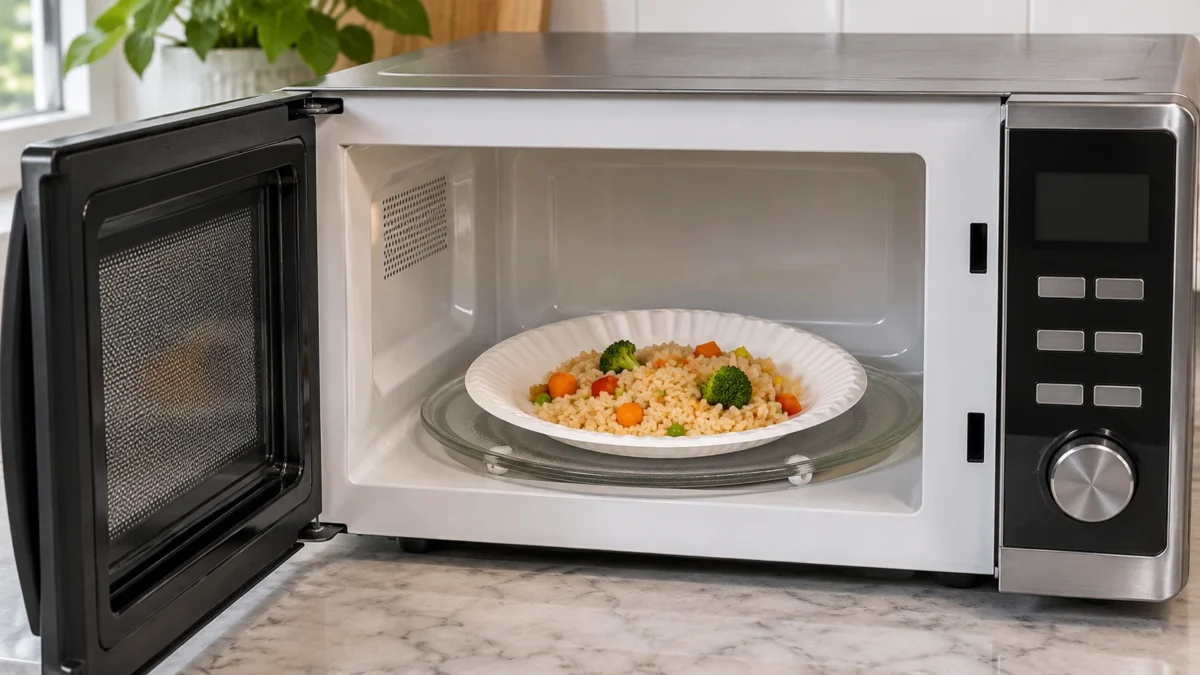
Yes, some paper plates can go in the microwave for short reheating—but not every paper plate is microwave-safe. A plain, unprinted plate intended for microwave use is a more dependable choice than a decorative or unfamiliar disposable plate. If the label does not establish microwave suitability, transfer the food to a microwave-safe glass or ceramic dish instead.
The distinction matters because “paper plate” describes the general appearance, not the complete construction. A plate may contain coatings, inks, adhesives or other layers, and the hot food itself can stress the material even when microwave energy passes through it. For the equivalent base-and-lid checks, see microwaving plastic containers.
Which paper plates can you microwave?
The answer depends on the finished plate, its instructions and the food being heated. Appliance makers including Whirlpool say plain paper plates can generally be microwaved, but they caution that some disposable products are coated with plastic and recommend checking for a microwave-safe label. The GE Appliances utensil guidance identifies white or unprinted paper plates as preferable for warming food, not convection cooking.
| Plate or feature | Practical recommendation | Reason |
|---|---|---|
| Plain white, unprinted plate labeled microwave-safe | Generally suitable within its instructions for short reheating | Intended use is clearer; still monitor the plate and food |
| Plain plate with no instructions or identifiable maker | Use a labeled microwave-safe dish instead | Composition and use limits are unknown |
| Printed, dyed, glittered or metallic decoration | Avoid unless the manufacturer specifically permits microwave use | Decoration and metallic components may introduce extra hazards |
| Plastic-lined, laminated or grease-resistant paper plate | Use only when the finished product is marked suitable | The coating, not just the paper, must tolerate the intended heating |
| Soaked, torn, scorched or very flimsy plate | Transfer food to a sturdier microwave-safe vessel | Failure while lifting hot food can cause spills or burns |
| Plate used under convection or grill mode | Do not assume microwave-mode suitability carries over | Convection and grill functions expose articles to different heat conditions |
Why some paper plates are unsuitable
Coatings and laminates change the product
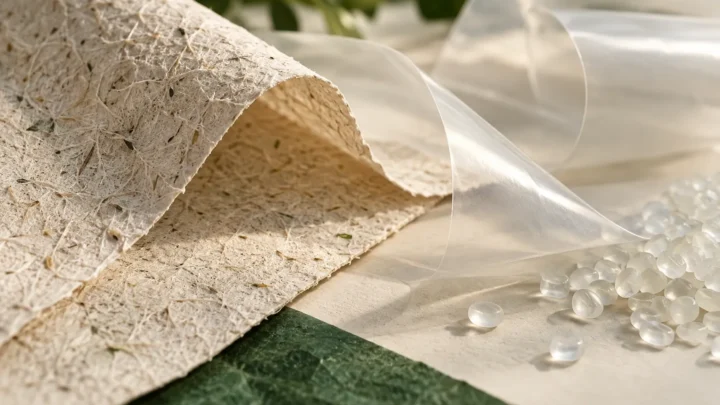
Paper fibers themselves do not settle the question. A water-resistant plate may have a thin polymer layer, surface treatment or other paper-packaging barrier. Some constructions are intended for hot food, some for cold service, and others for limited reheating. Heat resistance, food-contact suitability and microwave use are three different questions. A label such as “paper,” “plant-based” or “compostable” does not answer all three.
For food-contact materials, the FDA distinguishes food types and conditions of use, including refrigerated storage and reheating. A plate that is acceptable for a cold snack is not thereby demonstrated suitable for a hot, greasy meal. The EU has separate requirements for paper and board used in food contact.
Printing and metallic details can matter
Decorative inks and finishes are not automatically designed for high-temperature contact. Metallic foil, metallic trim or other metal decorations are especially unsuitable unless a specific microwave appliance and product explicitly allow them. For everyday reheating, choose plain, unprinted plates whose manufacturer confirms their intended use.
Wet and oily foods test the plate differently
A few crackers are not the same load as a serving of oily leftovers, sauce or soup. Hot liquid can soften some paper constructions, and fat-rich foods can create concentrated hot areas. Even if the food reheats normally, a flimsy plate may bend when lifted. Fiber strength under hot and oily conditions is a separate performance question from microwave suitability. For substantial portions or foods with free liquid, a rigid microwave-safe bowl or plate is the simpler option.
How to reheat food on a paper plate more safely
- Check the package first. Look for explicit microwave-use instructions from the plate manufacturer. An unsupported “eco” or “food-grade” claim is not a substitute.
- Inspect the entire plate. Avoid unknown coatings, metallic decoration, damage and loose attachments.
- Choose the right food. For soups, very greasy meals and large servings, use a microwave-safe rigid dish rather than a thin paper plate.
- Reheat in short intervals. Follow the food and microwave instructions, check the plate between intervals, and stop if it warps, smokes or smells burnt.
- Handle it as hot. Use protection when removing food. A plate can become hot from contact with heated food even when paper does not strongly absorb the microwaves themselves.
These steps do not create a universal safe time or wattage. The appropriate limits depend on the plate, food load and microwave design. Manufacturer instructions take precedence over a generic “30 seconds” or “two minutes” rule.
Does microwave-safe mean food-safe?
Not exactly. Food-contact suitability concerns whether a finished article can be used with specified foods under specified conditions. Microwave suitability adds how the article behaves during the selected heating process. One does not automatically establish the other. An item can be made for food service without being made for microwave reheating.
Likewise, whether the plate is recyclable, biodegradable or compostable does not establish its safe reheating temperature. Those are separate claims about different properties of the finished product.
What about paper bowls, paper cups and cardboard?
Do not extend the answer from a plain plate to every paper container. Disposable cups often include different barrier systems, adhesives and seams. Takeaway boxes may have handles, staples, foils, coatings or closures. If the package does not explicitly permit microwave heating, remove the food and use suitable cookware.
The FDA’s microwave guidance says appliance instructions identify the kinds of containers to use. Ordinary packaging is not automatically microwave cookware.
Common questions about microwaving paper plates
Can a paper plate catch fire in the microwave?
It can under unsuitable conditions, especially with the wrong article, prolonged overheating, or inappropriate metal or combustible components. Do not microwave an empty paper plate or continue heating anything that begins to scorch or smoke. If a microwave fire occurs, stop the appliance and follow its safety instructions.
Can you microwave Dixie or another branded paper plate?
Check the current package instructions for that exact product. A manufacturer may market multiple paper plate lines with different constructions. A statement about one plate should not be generalized to the brand’s full assortment.
Can you microwave paper plates for several minutes?
There is no reliable universal minute limit. The plate’s approved use, microwave mode and food temperature matter more than an arbitrary number. For longer cooking or repeated heating, use microwave-safe cookware intended for that task.
Are biodegradable paper plates microwave-safe?
Biodegradability and microwave safety are unrelated test questions. A product may be designed to break down under certain disposal conditions while having limited heat resistance. Use the finished plate’s microwave instructions, not its environmental claim, to decide.
The practical rule
For a small reheating task, a plain, unprinted, manufacturer-approved microwave-safe paper plate can be convenient. For decorated, coated, unfamiliar or weakened plates—or for hot liquids and extended cooking—the more reliable choice is a labeled microwave-safe glass or ceramic container.
Sources
Sources checked 7 November 2026. This is an editorial explanation, not a product test or certification.
- FDA — Microwave Ovens. Cooking with Microwaves; paper transmission, heat from food and appliance instructions.
- Whirlpool — What You Can and Can’t Put in a Microwave. Paper plates; plain plates, possible plastic coatings and microwave-safe marking.
- GE Appliances — Microwave: Dish and Utensil Guidelines. Identifying dishes; warming versus convection and printed or metallic decoration.
- FDA — Food Types & Conditions of Use for Food Contact Substances. Tables 1 and 2; food types and distinct storage/reheating conditions.
Found an error? Read our corrections policy and contact the editors.