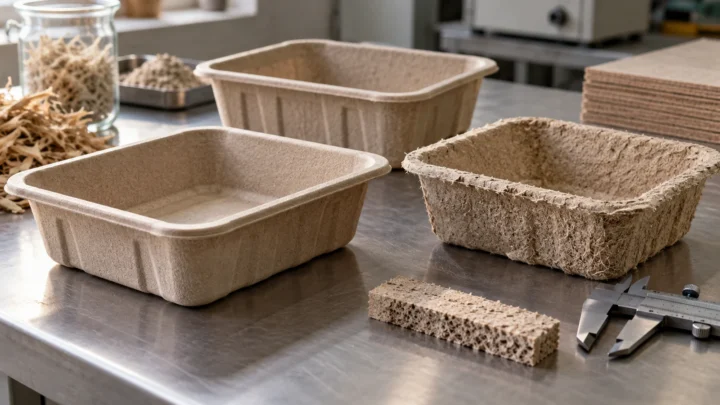
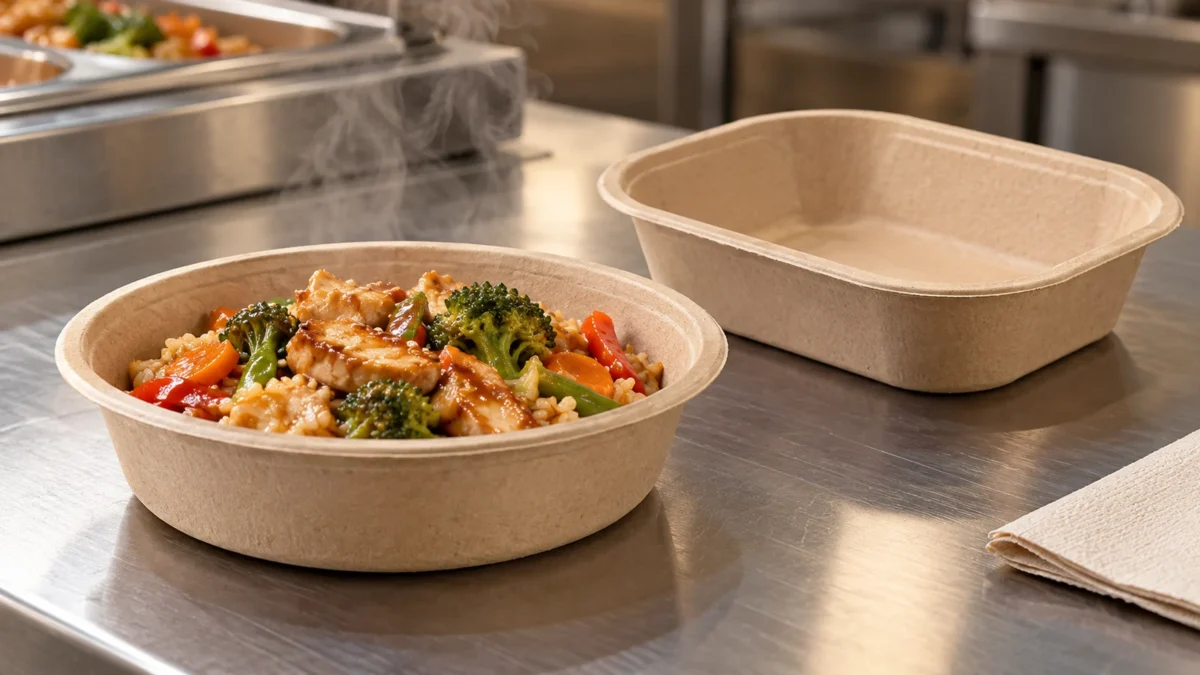
Molded fiber survives hot, oily food only when several systems work together. Dry cellulose fibers are strong because of fiber-to-fiber bonding, but water and steam can weaken those bonds. Hot pressing can densify the network and improve surface continuity. Wet-strength chemistry can help the structure retain strength after moisture exposure. Oil and water barriers reduce penetration. Geometry, wall thickness and formed corners then determine whether the finished bowl or tray still performs in real use.
That means “bagasse,” “bamboo,” “molded pulp” or even “PFAS-free” does not by itself explain why a container holds hot soup, fried food or sauce. The real explanation is a material-and-process system.
For packaging buyers, the correct question is therefore not “Is molded fiber heat resistant?” It is: what temperature, what food chemistry, what contact time, what barrier system and how much wet mechanical strength must the finished article retain?
Heat is not usually the first failure mode—moisture is
Dry heat and hot, wet food expose a fiber network to different stresses. The relevant molded-pulp research separates fiber bonding and dry strength from performance after water exposure; a dry rigidity result cannot stand in for hot-food qualification. [S3]
The more important problem is often moisture. Hot food brings water, steam, oils, dissolved salts and surfactants into contact with a porous fiber network. If liquid water enters the structure, it can disrupt hydrogen bonding between cellulose fibers, swell the network and reduce stiffness and strength.
This is why a molded-fiber tray can remain dimensionally stable in a dry oven-like environment yet soften rapidly when filled with hot soup. “Heat resistance” and “hot wet-food resistance” are not the same material property.
Why dry molded fiber is strong in the first place
Molded fiber is a bonded network of cellulose fibers. During forming and drying, fibers come into close contact. Hydrogen bonding and other intermolecular forces develop across those contact regions.
Fiber length, fibrillation, flexibility and surface chemistry affect contact and bonding. See the comparison of molded-fiber feedstocks for the material differences.
Density matters too. A low-density, porous structure has more void space and fewer fiber-to-fiber contacts per unit volume. Hot pressing can collapse pores and increase contact area, producing a smoother and more consolidated material.
Scientific Reports research on high-strength molded fiber materials illustrates the scale of this structural difference: conventional single-suction molded fiber was described at substantially lower densities than hot-pressed high-strength molded fiber. The exact densities are process-specific, but the engineering principle is clear: pressing changes the network architecture, not just the appearance. [S4]
Hot pressing does more than dry the part
In thermoformed molded fiber, heat and pressure are applied while the wet fiber article is constrained by the mold. This can improve dimensional control, surface smoothness and consolidation.
The 2023 review Advances in Research of Molded Pulp for Food Packaging describes hot-pressed and thermoformed molded pulp as denser than conventional molded pulp. It also notes that heat and pressure can help activate bonding between fibers and some additives. [S2]
Several effects can occur together:
- water is removed from the fiber network;
- fibers are pressed into closer contact;
- void volume is reduced;
- surface roughness can decrease;
- retained lignin or hemicellulose may soften and contribute to bonding in some pulps;
- starch- or resin-based additives can become more effective during drying and pressing.
That does not mean “higher temperature is always better.” Excessive temperature or pressure can damage fibers, create brittleness, cause uneven density or increase energy use. The optimum belongs to the actual furnish, moisture content, mold design and additive system.
Why water destroys ordinary fiber strength
Dry cellulose networks rely heavily on hydrogen bonding. Water molecules can compete for those same hydroxyl groups.
A 2022 ACS Omega study on molded pulp showed this directly. The untreated molded product lost most of its tensile strength under wet conditions. The authors attributed that loss to water disrupting hydrogen bonds between cellulose fibers. [S3]
This is the central reason wet strength has to be treated separately from dry strength.
A tray may look strong and rigid before filling but still fail after steam condenses into the fiber network. For hot-food packaging, the relevant property is often how much strength remains after exposure—not the dry tensile value alone.
Wet-strength chemistry changes the network after it gets wet
Wet-strength agents are designed to help fiber networks remain bonded when water is present.
One studied system is polyamide-epichlorohydrin resin, or PAE. It can introduce additional network bonding during curing. The actual formulation, residues, use conditions and recovery behavior still require assessment; the resin-family name is not a general food-contact approval. [S3]
The 2022 ACS Omega study found that adding PAE sharply increased wet tensile strength in its tested molded-pulp system. Cationic starch was then used with PAE to improve strength further and reduce the amount of PAE required. [S3]
This does not mean every food package should use PAE or that one dosage fits all applications. Food-contact suitability, formulation, migration, repulpability, compostability and local compliance need to be assessed for the actual construction. The important engineering principle is broader: wet strength comes from maintaining network integrity after water enters the material.

Wet strength is not the same as water barrier
A wet-strength resin and a water barrier solve different problems.
Wet strength asks: if water reaches the fibers, does the structure still hold together?
Water barrier asks: how much water reaches the fibers in the first place?
A strong hot-food package often needs both.
| Function | What it protects against | What it does not prove |
|---|---|---|
| Dry strength | Handling and stacking before moisture exposure | Performance after hot water or steam exposure |
| Wet strength | Loss of fiber-network integrity after moisture enters | That water or oil cannot penetrate |
| Water barrier | Liquid-water penetration and absorption | Oil/grease resistance or wet mechanical strength |
| Grease barrier | Oil and fat penetration | Hot-water resistance or long-term vapor barrier |
Editorial synthesis of the cited sources. Examples are not product test results; methods, construction and conditions remain part of every claim.
This is why one Cobb number, one Kit rating or one dry-strength value cannot fully describe a hot-food container.
Grease is a separate transport problem
Oil does not interact with cellulose in exactly the same way as water, but it can penetrate a porous fiber structure through capillary pathways.
Historically, fluorinated grease-proofing chemistry was widely used because it could reduce surface energy and repel oils. PFAS restrictions have pushed the industry toward film-forming and pore-closing systems instead.
Candidate approaches include film-forming coatings, cellulose-based layers and hybrid systems. See PFAS replacement as a barrier-system problem for the distinction between chemistry, performance and recovery claims.
The key point for hot-food performance is that grease resistance depends on both chemistry and geometry. A flat coated sheet may perform well while the formed rim, corner or fold becomes the weak point.
Three-dimensional molded geometry makes coating harder
Molded-fiber bowls and trays are not flat paper.
They contain:
- side walls;
- bottom radii;
- rims;
- corners;
- embossed areas;
- local thickness variation;
- regions stretched or compressed during forming.
That makes uniform barrier coverage difficult. A coating that looks continuous on the center of the base may be thin at a corner or interrupted at a fiber peak.
The recent ethyl-cellulose bowl paper examines one specific three-dimensional coated structure. It illustrates a research approach to coverage and geometry; it is not a verified commercial design rule or a food-contact approval. [S5]
This is useful evidence for the general principle—not proof that ethyl cellulose is the best coating for every molded-fiber package.
Hot water and hot oil should be tested directly
Room-temperature barrier data are not enough for hot-food packaging.
Temperature changes liquid viscosity, polymer mobility, wetting and coating integrity. Steam can also condense inside the container and expose uncoated edges or weak points.
A hot-food specification should state filling temperature, contact duration, food composition and a failure endpoint. A fixed laboratory exposure should not become a universal validation condition for every molded-fiber product.
The exact temperature and duration should come from the intended food, not from a generic marketing benchmark.
Why soup, fried chicken and cold fruit need different designs
| Application | Main stresses | Priority properties |
|---|---|---|
| Hot soup | Hot liquid water, steam, long contact | Liquid-water barrier, wet strength, rim/lid integrity |
| Fried chicken / fries | Hot grease, steam, salt, short-to-medium contact | Grease barrier, wet strength, formed-corner integrity |
| Saucy meal | Water + oil + acid/salt mixture | Combined water/grease barrier and wet strength |
| Cold fruit | Condensation, chilled moisture, moderate load | Water resistance and shape stability |
| Dry bakery | Moderate grease, little free water | Grease resistance and handling strength |
Editorial synthesis of the cited sources. Examples are not product test results; methods, construction and conditions remain part of every claim.
A single “heat resistance” number cannot represent all of these use cases.
Fiber type still matters—but it does not decide the result alone
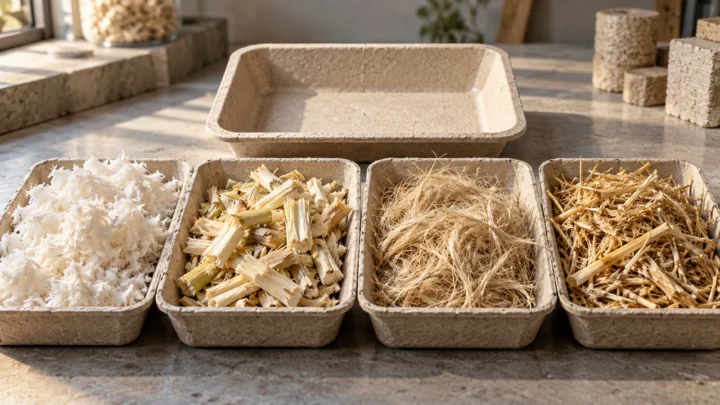
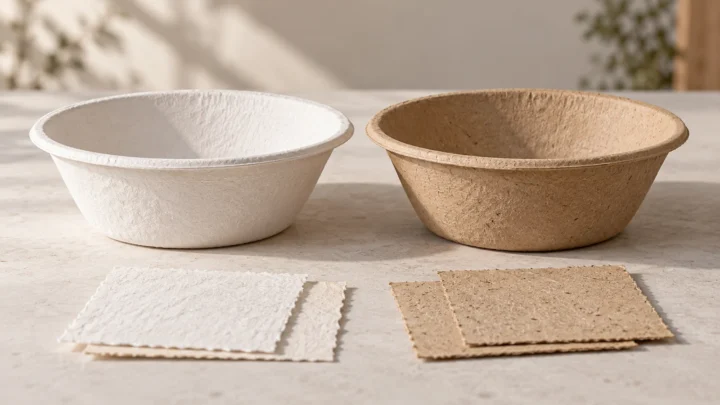
Bagasse, bamboo, wood pulp and straw differ in fiber length, fines content, bonding and processing behavior. Those differences affect the network entering the hot press.
Longer fibers can reinforce the structure. Shorter fibers and fines can help fill spaces and produce a dense surface. Blends can therefore be useful when a converter wants both formation and reinforcement.
But fiber source does not determine the complete hot-food performance. A well-engineered bagasse/bamboo blend with appropriate wet-strength and barrier chemistry may outperform a poorly formed “100% bamboo” package. The finished article should be judged by measured performance rather than the botanical name on the label.
Density helps, but “denser” is not automatically better
Hot pressing generally increases density and fiber contact. This can improve surface smoothness, reduce pore pathways and increase stiffness.
However, higher density can also:
- increase forming pressure and energy demand;
- slow moisture escape;
- change crack behavior;
- increase material mass if thickness is not reduced;
- affect cushioning and thermal-insulation properties.
The correct target is therefore enough consolidation to meet mechanical and barrier requirements without creating unnecessary mass or process cost.
Barrier continuity can matter more than the headline chemistry
A high-performance coating chemistry cannot protect an area it does not cover.
For molded food packaging, the following defects can dominate real performance:
- pinholes;
- thin coverage at corners;
- coating cracks after forming;
- exposed cut edges;
- uneven wall thickness;
- poor adhesion between coating and fiber;
- damage during stacking or transport.
That is why process control and finished-package testing matter as much as resin selection.
What a useful hot-food specification looks like
| Field | What to specify |
|---|---|
| Food type | Water-based, oily, acidic, salty, mixed sauce or dry food |
| Temperature | Actual filling / holding temperature range |
| Contact time | Minutes or hours required before disposal |
| Mechanical load | Stacking, carrying, lid pressure and filled weight |
| Wet-strength target | Strength or shape retention after defined moisture exposure |
| Barrier target | Grease, water, WVTR or other function as needed |
| Converted geometry | Finished bowl/tray, including rims, corners and seams |
| Food-contact evidence | Exact material/coating construction under intended conditions |
| End-of-life route | Paper recycling, composting or another route supported by finished-package evidence |
Editorial synthesis of the cited sources. Examples are not product test results; methods, construction and conditions remain part of every claim.
What to put in the specification
For procurement, stop asking only for “heat-resistant bagasse” or “oil-proof molded fiber.” Specify the food, temperature, contact time, wet mechanical requirement, barrier function and finished-package test. Those are the variables that determine whether the container actually survives service.
Methodology and editorial note
This technical explainer synthesises the identified official guidance, public standard scopes and research records. Study findings remain specific to their reported materials and conditions. Sources checked 18 October 2026; no product testing, factory inspection or independent certification assessment was performed for this article.
The main image is an AI-generated editorial illustration of an unnamed conceptual scene. The explanatory figure is an original editorial synthesis, not a photograph of an experiment, microscopic structure or measured result.
Official sources and reference notes
- [S2] Yifan Liu; Shufeng Ma; Feijie Wang; Liqiang Wang. Advances in Research of Molded Pulp for Food Packaging. Journal of Renewable Materials 11(11), 2023, 3831–3846. Fiber bonding, molding/hot pressing and wet-strength-additive review sections. Relevant public sections checked; source-specific scope retained. Accessed 18 October 2026.
- [S3] Authors as listed in ACS Omega. Improving Mechanical Strength and Water Barrier Properties of Pulp Molded Product by Wet-End Added Polyamide Epichlorohydrin/Cationic Starch. ACS Omega 7(26), 2022. Abstract and Results: PAE/cationic starch tested pulp construction, dry versus wet tensile response. Relevant public sections checked; source-specific scope retained. Accessed 18 October 2026.
- [S4] Authors as listed in Scientific Reports. Effect of light-delignification on mechanical, hydrophobic, and thermal properties of high-strength molded fiber materials. Scientific Reports 8 (2018). Methods and results: light delignification and tested molded-fiber structure. Relevant public sections checked; source-specific scope retained. Accessed 18 October 2026.
- [S5] Authors as listed in ACS Omega. Eco-Friendly Ethyl Cellulose Coating for Molded Kraft Paper Food Packaging with Multifunctional Barriers and Promising Recyclability. Published online 8 October 2026. Identified publisher-indexed coating/geometry discussion; no product safety approval. Identified publisher-indexed sections accessed; complete direct rendition not retrieved. No commercial safety/compliance verdict derived. Accessed 18 October 2026.
The public corrections channel is currently inactive. Read our corrections policy.