A three-scale network, not simply stronger pulp
Liao and colleagues’ 2026 Nature Communications paper reports a laboratory hybrid cellulose paper, or HCP. It was published on 13 March, with a version of record dated 29 April. This is a research analysis, not an announcement of a commercial packaging launch. [1]
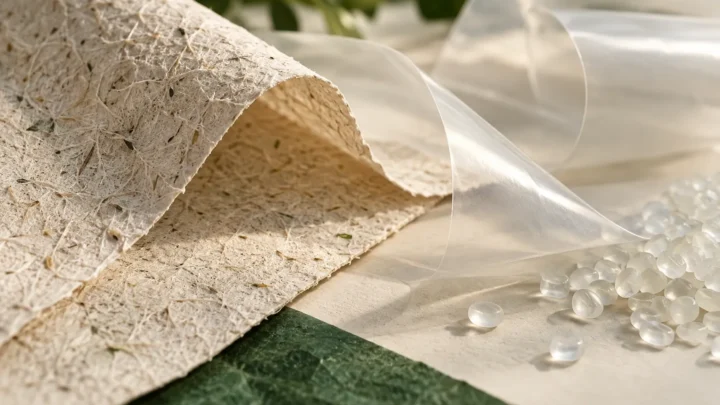
The researchers combined spruce pulp, bacterial-cellulose microgel and TEMPO-oxidized bacterial-cellulose nanofibrils. Their strongest reported formulation used a 1:1:1 weight ratio with pulp at 65° Schopper–Riegler. Microgel filled larger spaces while nanofibrils reinforced smaller gaps; the authors connect densification and interfacial bonding to the resulting strength. [1]
For a material developer, that formulation matters as much as the headline tensile result. A supplier sheet describing only “cellulose paper” would not identify this construction. Before comparing samples, ask for the three component identities, their proportions and the pulp treatment; a similar fibre label is not evidence of a comparable network. [1]
More complete drying did not mean more strength
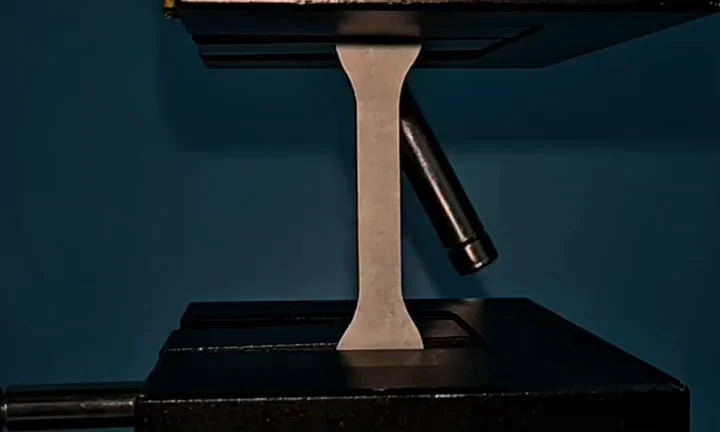
The paper reports tensile strength of 811 MPa for HCP. After vacuum drying at 110°C for about two to three hours to remove bound water, the reported value fell to 167 MPa. The authors associate this loss with removal of tightly bound water and altered interfacial interactions. They separately report weakening at 70% and 90% relative humidity, with strength largely restored after returning those samples to 50% RH. [1]
The engineering consequence is a drying-history specification, not a rule to keep all cellulose products moist. A severe drying step and a reversible humidity excursion are different treatments in this study. Record the drying temperature, duration and atmosphere, then the conditioning humidity and sequence before testing. Otherwise two numbers headed “dry tensile strength” may describe materially different specimens. [1]
The immersed specimen answers another question
After 24 hours in water, HCP’s reported wet tensile strength was 1.3 MPa. The authors describe water uptake and disruption of the dense structure in materials containing the oxidized nanofibrils. This result belongs beside the high dry-state value when considering water-exposed applications. [1]
A converter should therefore define the exposure that could cause failure before choosing a strength target. A humid distribution trial, a short splash and prolonged immersion are not interchangeable qualification tests. The study’s immersion result does not by itself establish performance under the first two conditions, and its high dry tensile result does not answer the immersion question. [1]
Faster laboratory filtration still leaves a throughput question
The preparation used a suspension adjusted to 0.17 wt.% solids, vacuum filtration and sheet-former drying at 105°C for 60 minutes. The reported HCP filtration time was 1.417 hours, compared with 7.79 hours for the nanofibrils alone. These are the study’s laboratory preparation results. [1]
That comparison supports asking whether the hybrid drains faster than its nanofibril control; it does not provide a commercial line speed or total factory energy balance. A scale-up discussion needs solids handling, wet-web integrity and drying duty measured on the proposed process. Quoting the shorter filtration time alone would leave those operating questions unanswered. [1]
Qualify the function that the package must perform
The next useful trial would preserve the formulation and water history while testing the intended converted structure: for example, the crease or joint that must survive handling. A tensile coupon is valuable evidence about a material, but it does not validate a box, seal or contact application. The present evidence also supplies no basis here for declaring food-contact clearance, recycling acceptance or certified compostability. [1]
For procurement, request a matched set of specimens and records: composition; drying and conditioning history; the relevant moisture exposure; and the failure test tied to the proposed packaging function. Progress would be a reproducible result after conversion and exposure, followed by a documented production route—not simply a larger dry-strength headline. [1]
For the separate coating-barrier question, see nanocellulose barriers against oil, oxygen and moisture. The strength analysis here does not establish a coating specification.
Source and evidence boundary
[1] Liao, L. et al., Ultrastrong and tough paper structure from densified hybrids of multiscale cellulose fibers, Nature Communications 17, 3889 (2026). Results, Figures 1–3, preparation methods and Supplementary Movie 1 read/viewed on 24 October 2026. One laboratory study; no independent replication or commercial packaging qualification is claimed. CC BY 4.0; analysis and paraphrase by Degradable Packaging.
Found an error? Read our corrections policy and contact the editors.