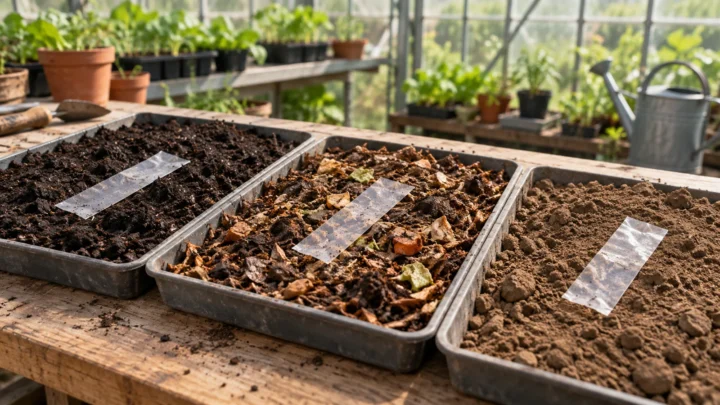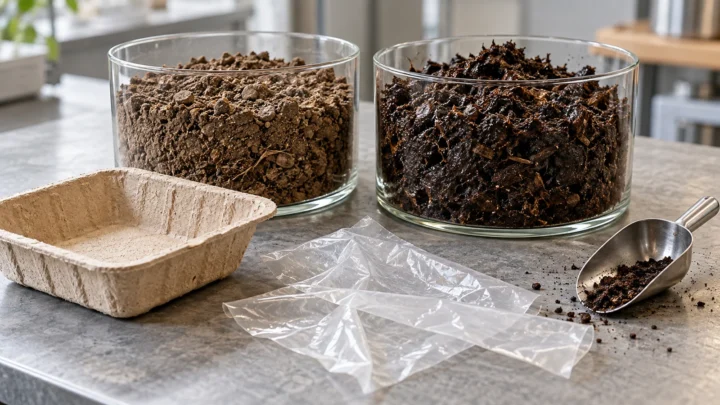
Consider a hypothetical composting test: a cup enters a laboratory reactor and is scarcely recognizable after twelve weeks. This is an illustrative question, not a reported test by this publication.
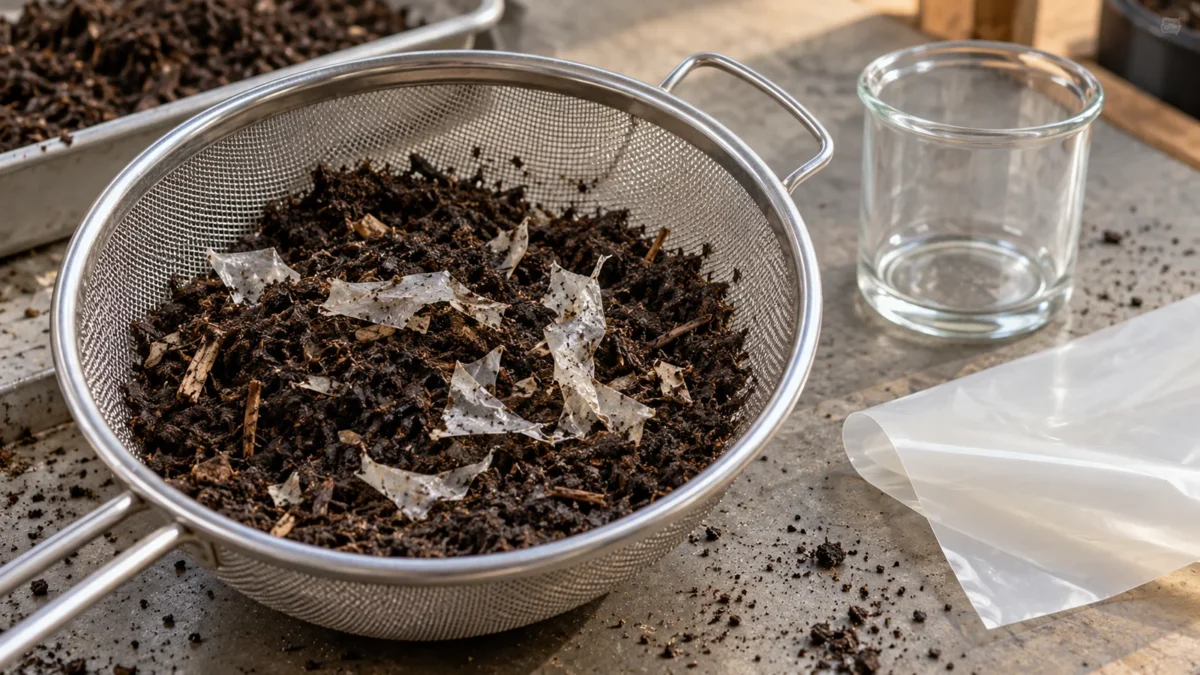
The material may have disintegrated: it has broken into pieces small enough to disappear from visual inspection or pass through a defined sieve. That is important for a composting process—but it is not the same measurement as biodegradation, where microorganisms convert the polymer’s organic carbon into mineral end products such as carbon dioxide under aerobic test conditions.
This distinction is not academic. ISO 20200:2023 states explicitly that its laboratory disintegration method is not applicable to determining biodegradability and that further testing is needed before compostability can be claimed. [S1]
For packaging buyers, regulators and material developers, the correct question is therefore not:
“Did the product disappear?”
It is:
“What exactly was measured: physical disintegration, biological mineralization, compost quality, chemical limits—or all of them?”
What physical breakup can establish
What happened to the visible package?
Disintegration is primarily a physical endpoint.
Under controlled composting conditions, heat, moisture, microbial activity and polymer hydrolysis can weaken a package until it cracks, fragments and becomes too small to recover as an intact article.
ISO 20200:2023 is designed specifically to measure this process at laboratory scale. Its public ISO abstract is unusually clear: the method determines the degree of disintegration under composting conditions, but it does not determine biodegradability. [S1]
The distinction matters because a fragment can become smaller without its polymer carbon having been biologically converted to carbon dioxide.
A disintegration test therefore answers a practical composting question:
Will recognizable pieces of the product remain in the composting stream after the defined test period?
It does not, by itself, answer:
Has the polymer been mineralized?
What does a disintegration result actually count?
Disintegration methods generally recover composted material and separate remaining fragments according to a defined procedure. Depending on the method or certification scheme, retained material above a specified size is weighed or otherwise assessed.
The result therefore depends on:
- the original product thickness and geometry;
- temperature and composting time;
- moisture and aeration;
- mechanical mixing;
- how the sample is recovered;
- the sieve or fragment-size criterion;
- how residual mass is calculated.
A fork, a thin film and a thick coffee capsule can all be made from a biodegradable polymer and still disintegrate differently because their geometry controls exposed surface area and heat/moisture penetration.
This is one reason certification results should remain attached to the tested product form or accepted equivalence rules—not merely to the polymer name.
A 2025 experiment shows why the sieve is not the end of the story
A 2025 Scientific Reports study tested ten commercial biodegradable plastic products under simulated industrial-composting conditions using ISO 20200. Nine products were marketed as compostable, including products carrying industrial- or home-compostability certification. [S7]
Reported disintegration ranged from 75% to 100% after the 90-day experiment. This was a physical endpoint, not a carbon-mineralization measurement. [S7]
After 90 days at 58 °C in the study, the researchers examined compost particles below 2 mm. They observed microplastic-sized fragments in the undersieve material for two of the ten products; the detection procedure and its limits matter to that finding. [S7]
The authors were careful about the analytical limits: extracting and identifying biodegradable microplastic-sized residues from a complex compost matrix is difficult, and aggressive sample preparation can itself damage biodegradable polymers. [S7]
The useful conclusion is therefore not “certified compostables create persistent microplastics.” The study did not establish that.
The stronger conclusion is methodological:
Passing a disintegration screen does not chemically prove that every piece of polymer carbon has already mineralized.
Carbon conversion and its limits
Biodegradation follows the carbon
Biodegradation tests ask a different question.
Under aerobic composting conditions, microorganisms metabolize biodegradable organic material. Polymer chains first become smaller through biological and/or abiotic processes such as hydrolysis. Microorganisms can then assimilate sufficiently accessible molecules and convert their carbon through metabolism.
ISO 14855-1:2012 measures ultimate aerobic biodegradability under controlled composting by analyzing evolved carbon dioxide. The method is designed to calculate the percentage of carbon in the test material that is converted to CO₂ and the rate of that conversion. [S2]
ASTM D5338 uses the same basic logic. Its public scope states that the method determines the degree and rate of aerobic biodegradation under controlled thermophilic composting and yields the percentage conversion of sample carbon to carbon dioxide. [S3]
That is fundamentally different from counting remaining visible fragments.
| Question | Disintegration test | Aerobic biodegradation test |
|---|---|---|
| Primary endpoint | Physical breakup / recoverable fragment mass | Biological conversion of material carbon |
| Typical evidence | Residual pieces, sieve fraction or mass | Evolved CO₂ and carbon conversion over time |
| Can the item look gone? | Yes | Visual appearance is not the primary endpoint |
| Does it prove mineralization? | No | It measures mineralization under the defined aerobic conditions |
| Does it prove real-facility acceptance? | No | No |
Source basis: [S1] [S2] [S3]. This table is an editorial comparison, not a product qualification or statutory checklist.
Weight loss is also not automatically biodegradation
Another common shortcut is to weigh a specimen before and after environmental exposure and call the missing mass “biodegraded.”
That can be misleading.
Mass can disappear because of:
- plasticizer leaching;
- soluble additives leaving the specimen;
- polymer fragments breaking off;
- hydrolysis products dissolving into the surrounding medium;
- material being lost during specimen recovery.
Those mechanisms may be part of a biodegradation pathway, but mass loss alone does not identify the ultimate fate of the carbon.
This is why mineralization methods track CO₂ or another biologically meaningful endpoint rather than relying only on “percent weight lost.”
Evidence and scope: [S8]. Comparative tables in this section are editorial synthesis, not a new test.
Fragmentation can be an intermediate stage, not the final result
A biodegradable polyester often does not jump directly from a package to carbon dioxide.
The sequence can include:
- water penetration;
- hydrolysis or enzymatic chain scission;
- loss of molecular weight;
- embrittlement;
- surface erosion and fragmentation;
- microbial assimilation of smaller molecules;
- mineralization.
Different polymers emphasize different steps.
PLA under thermophilic composting often depends strongly on hydrolysis before rapid microbial assimilation. PHA can be attacked more directly by extracellular microbial depolymerases in suitable environments. PBAT, PBS and starch-containing blends have their own morphology- and enzyme-dependent pathways.
A fragment observed halfway through this sequence is therefore not proof of failure—or proof of complete success.
It is an intermediate state whose persistence has to be measured rather than assumed.
A 2026 full-scale follow-up helps connect disintegration to mineralization
A 2026 Bioresource Technology study addressed exactly this analytical gap.
The 2026 authors’ abstract describes a protocol for extracting and identifying residues from an earlier full-scale industrial-composting experiment. They report near-complete PLA and PBAT degradation and lower PHBV degradation associated with the tested coffee-capsule format; the full experimental methods were not examined for this article. [S10]
The same abstract reports continued PBAT and PHBV mineralization in a subsequent controlled-soil assessment. It does not establish a universal disappearance time, a field-soil result or a complete environmental-safety verdict. [S10]
This study is valuable because it separates three things that are often merged in marketing language:
- the package losing its recognizable form;
- residual polymer fragments being analytically detected;
- those residues continuing toward mineralization.
It does not prove that every compostable product follows the same timeline. It demonstrates why environmental-fate evidence becomes stronger when researchers follow the material beyond visible disappearance.
What a compostability assessment covers

Compostability specifications combine more than one test
A serious compostability specification does not rely on one disintegration test.
The current ASTM D6400-26 specification covers plastics and plastic-containing end items designed for aerobic municipal or industrial composting. Its public scope describes requirements intended to determine whether products compost satisfactorily, including biodegradation and disappearance of intermediate disintegration stages within the composting process. [S4]
EN13432 concerns packaging recoverable through composting and biodegradation. For the separate evidence categories below, BPI’s public explanation is used as a certification-body summary, rather than as a reproduction of unaccessed EN clauses. [S11]
- material characterization / regulated chemical content;
- biodegradation;
- disintegration;
- ecotoxicity / compost-quality effects.
These are separate gates because one result cannot stand in for the others.
Why ecotoxicity belongs beside biodegradation
A material can mineralize substantially and still contain additives, fillers, pigments or degradation products that deserve environmental-safety assessment.
A 2026 critical review in Environmental Science and Pollution Research argues that biodegradation assessments are often too focused on disappearance or carbon conversion and not sufficiently integrated with ecotoxicological endpoints. [S8]
The review emphasizes phytotoxicity and effects on soil systems as complementary evidence of environmental safety.
That does not mean current compostability standards ignore compost quality. Major schemes already contain chemical and ecotoxicity components. The research critique is narrower: future environmental-fate assessment may need to go further than current minimum certification endpoints for some materials and additives.
For a buyer, the practical lesson is:
“Biodegraded” is not the same claim as “left no harmful effect on the receiving system.”
The four evidence boxes in a compostability file
| Evidence box | What it asks | What cannot replace it |
|---|---|---|
| Characterization | What is in the finished material, including regulated constituents? | A resin biodegradation test |
| Biodegradation | Does organic carbon mineralize under the defined composting method? | Weight loss or visual disappearance alone |
| Disintegration | Does the finished item physically break down within the required process window? | Polymer-level CO₂ evolution alone |
| Compost quality / ecotoxicity | Does resulting compost remain acceptable under the scheme’s biological/chemical criteria? | Disintegration or biodegradation alone |
Source basis: [S11]. This table is an editorial comparison, not a product qualification or statutory checklist.
Finished-product structure matters
Why thickness can pass one box and fail another
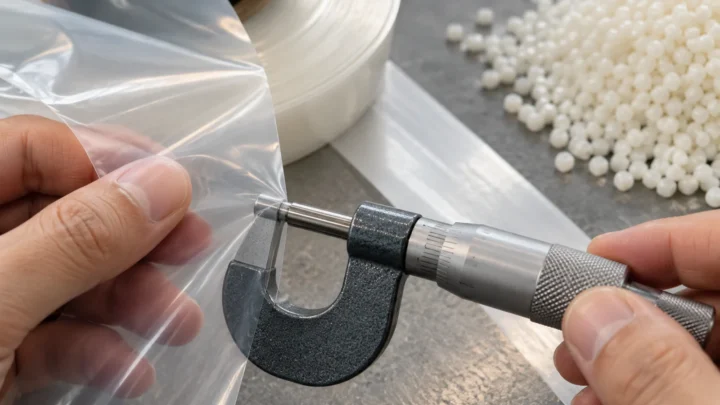
Imagine the same polymer as a 20 μm film and a 2 mm molded part.
The underlying polymer chemistry may have the same potential for biological conversion, but the pathway through the finished article is different.
Thickness changes:
- surface-area-to-volume ratio;
- water penetration distance;
- hydrolysis time;
- thermal equilibration;
- time required for the part to lose structural integrity.
A polymer can therefore show strong biodegradation in a prepared test specimen while a thick finished product disintegrates too slowly for a particular composting process.
This is why product geometry belongs in compostability qualification.
Why crystallinity can separate disintegration from mineralization timing
Crystalline and amorphous regions do not degrade at identical rates.
PLA processing can change crystallinity and hydrolysis behavior. The analysis of heat-resistant PLA and crystallinity explains why initial crystal fraction alone cannot determine the rate.
If amorphous regions hydrolyze and lose mechanical integrity first, a product can fragment while more ordered polymer regions persist longer.
That does not mean the fragments are non-biodegradable. It means that physical failure and ultimate carbon conversion can occur on different clocks.
For blends, morphology makes the timing even more complex.
A laboratory is not a particular facility
Why a composting laboratory is not a particular composting plant
ASTM D5338 itself warns against this interpretation.
Its official significance section states that composting facilities vary widely in construction and operation, so the test is not intended to simulate any particular facility. Instead, it creates a controlled, reproducible thermophilic composting environment. [S3]
This distinction is essential.
A standard laboratory result tells you how a material behaves under the test conditions.
It does not prove:
- that every facility reaches the same temperatures;
- that every facility uses the same residence time;
- that every facility accepts compostable packaging;
- that local collection programs permit the product in organics bins.
Certification and facility acceptance are different questions.
For the related distinction, see industrial and home composting, including facility acceptance.
Industrial compostability is not home compostability
Industrial composting methods generally use controlled thermophilic conditions. Home composting runs at lower and far more variable temperatures.
A product that performs under an industrial thermophilic method should therefore not be assumed to pass a home-composting test.
BPI’s current certification information illustrates the difference directly: its commercial and home programs use different temperatures and test durations, and home certification is assessed under a separate scheme. [S12]
The environmental label has to state the environment.
“Compostable” without that context can hide a major technical difference.
What should a packaging buyer ask a supplier for?
Do not stop at a logo or a line that says “passes compostability test.”
| Question | Why it matters |
|---|---|
| Which specification or certification scheme? | ASTM D6400, EN 13432, home-compost schemes and other standards have different scopes |
| What exact product was tested? | Resin, film and finished thick article are not equivalent specimens |
| What disintegration method? | Shows whether physical breakup was tested and under which composting environment |
| What biodegradation method? | Shows how mineralization/carbon conversion was measured |
| Were additives and coatings covered? | The finished formulation may behave differently from the base polymer |
| Was compost quality/ecotoxicity assessed? | Mineralization alone does not characterize all environmental effects |
| Industrial or home composting? | Temperature and timeframe differ materially |
| Is certification current and for this SKU/construction? | A certificate for another resin or thickness should not be silently transferred |
| Do local facilities accept it? | Technical compostability does not force operational acceptance |
Source basis: [S11] [S12]. This table is an editorial comparison, not a product qualification or statutory checklist.
What the evidence changes
Read a compostability file as several evidence tracks: physical breakup, carbon conversion and compost quality. Then check the finished construction and the receiving facility. A positive result on one track cannot silently complete the others.
Methodology and editorial note
This technical explainer synthesises the identified official guidance, public standard scopes and research records. Study findings remain specific to their reported materials and conditions. Sources checked 19 October 2026; no product testing, factory inspection or independent certification assessment was performed for this article.
The main image is an AI-generated editorial illustration of an unnamed conceptual scene. The explanatory figure is an original editorial synthesis, not a photograph of an experiment, microscopic structure or measured result.
Official sources and reference notes
- [S1] International Organization for Standardization. ISO 20200:2023 — Plastics — Determination of the degree of disintegration of plastic materials under composting conditions in a laboratory-scale test. Edition 3, August 2023; current published version at 18 October 2026. Public abstract. Official public abstract/scope and version record checked; full paid standard not read or reproduced. Accessed 19 October 2026.
- [S2] International Organization for Standardization. ISO 14855-1:2012 — Determination of the ultimate aerobic biodegradability of plastic materials under controlled composting conditions — Method by analysis of evolved carbon dioxide — Part 1: General method. Edition 2, December 2012; reviewed and confirmed 2022. Public abstract. Official public abstract/scope and version record checked; full paid standard not read or reproduced. Accessed 19 October 2026.
- [S3] ASTM International. ASTM D5338-15(2021) — Standard Test Method for Determining Aerobic Biodegradation of Plastic Materials Under Controlled Composting Conditions, Incorporating Thermophilic Temperatures. D5338-15R21, Active at 18 October 2026. Public Scope 1.1–1.3; Significance and Use 5.1–5.2. Official public abstract/scope and version record checked; full paid standard not read or reproduced. Accessed 19 October 2026.
- [S4] ASTM International. ASTM D6400-26 — Standard Specification for Labeling of Plastics Designed to be Aerobically Composted in Municipal or Industrial Facilities. Active; last updated 15 June 2026. Public abstract and Scope 1.1–1.3. Official public abstract/scope and version record checked; full paid standard not read or reproduced. Accessed 19 October 2026.
- [S7] Sevil V. Afshar et al. Disintegration of commercial biodegradable plastic products under simulated industrial composting conditions. Scientific Reports 15, 8569; published 12 March 2025. Abstract;90-day 58°C method; undersieve assessment; sample-preparation and visual-identification limitations. Relevant full open-access method/results checked; no general persistence or certification-failure conclusion. Accessed 19 October 2026.
- [S8] Danielle Cristine Mota Ferreira et al. Environmental fate, biodegradation pathways, and phytotoxicological risks of biopolymer-based packaging: a critical review. Published 6 March 2026; Environmental Science and Pollution Research 33, 4657–4676. Abstract; assessment/endpoints and phytotoxicity discussion. Relevant full public review sections checked; does not establish that standards omit ecotoxicity. Accessed 19 October 2026.
- [S10] Cheick Abou Coulibaly et al. Residual biodegradable microplastics derived from compostable packaging under large-scale industrial composting fully degrade in soil. Bioresource Technology 451 (July 2026), 134496; online 24 March 2026. Original authors’ PubMed abstract: extraction, full-scale residues and subsequent controlled soil. Original abstract checked; full methods not audited, precise degradation percentages and universal fate claims omitted. Accessed 19 October 2026.
- [S11] Biodegradable Products Institute. The Three Benchmarks of Compostability: Disintegration, Biodegradation, and Ecotoxicity Explained. Public scheme explanation checked 19 October 2026. Three distinct benchmarks, metals/chemical scope and environmental limits. Full public explanation checked; certification-body interpretation, not full EN13432 text. Accessed 19 October 2026.
- [S12] Biodegradable Products Institute. Certification FAQs. Public page checked 19 October 2026. Commercial versus home temperature/time and separate schemes. Full relevant FAQ checked; scheme-specific requirements, not universal facility behavior. Accessed 19 October 2026.
The public corrections channel is currently inactive. Read our corrections policy.