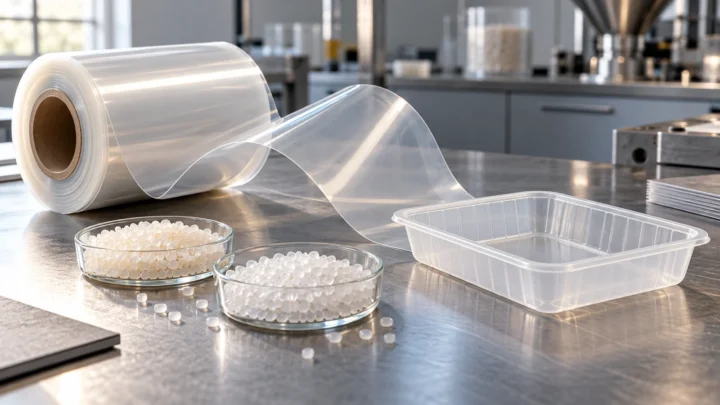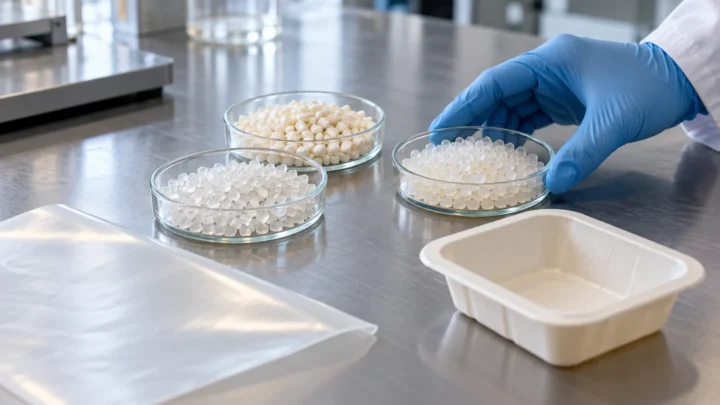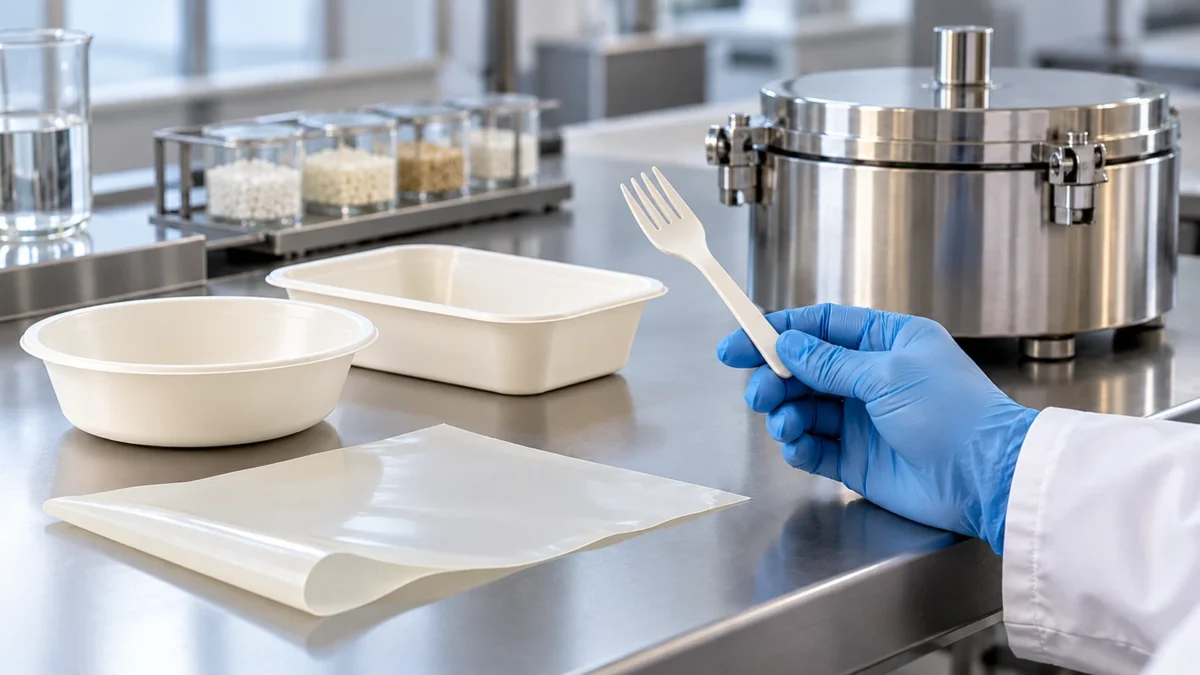
A transparent PLA cup and an opaque heat-resistant PLA fork can start from the same polymer family and behave completely differently around hot food.
The cup may begin to soften or distort well below the polymer’s melting point. The fork may remain dimensionally stable at a much higher service temperature.
That apparent contradiction disappears once four different ideas are separated:
- glass transition temperature;
- melting temperature;
- crystallinity and crystal morphology;
- heat resistance under an actual mechanical load.
This is the core reason “PLA melts around 160°C, so it should be fine at 80°C” is not a valid packaging specification.
Why PLA can deform before it melts
The package deforms long before it melts
PLA is a semicrystalline thermoplastic, but many clear packaging products are processed into a largely amorphous state because PLA crystallizes relatively slowly under conventional high-speed cooling.
In the amorphous regions, polymer-chain mobility changes around the glass transition, Tg. Crystalline regions melt at a higher temperature, Tm. Both depend on the actual PLA structure and formulation; neither is a finished-product service rating.
Those two temperatures describe different events.
Tg is not melting. Around Tg, the mobile amorphous fraction becomes much softer and more able to deform under stress.
Tm is melting. It is associated with loss of crystalline order at a substantially higher temperature.
A thin lid, fork tine or cup wall does not need to melt in order to fail. It only needs to lose enough modulus under its load to bend, shrink or warp.
That is why the melting point alone is a poor predictor of hot-food performance.
Why the amorphous fraction matters
Semicrystalline PLA contains ordered crystalline regions and disordered amorphous regions. Polymer science often describes the amorphous phase further as more mobile and more constrained fractions around crystalline structures.
As temperature approaches and exceeds Tg, the mobile amorphous chains gain mobility. If the product has little crystallinity, much of the load-bearing structure can therefore soften at roughly the same time.
Crystalline regions respond differently. Their ordered chains remain constrained until much higher temperatures. In practical terms, crystals can act as physical anchors that help a part resist deformation above the Tg of the amorphous phase.
This is the basic materials reason crystallized PLA can be more heat resistant than an amorphous clear PLA product.
“more crystalline” is not the whole story
Degree of crystallinity matters, but crystal morphology matters too.
A 2024 review of PLA modification strategies compared heat-treated PLA with nucleated PLA at similar overall crystallinity. The review reported that the heat-treated material could show much higher heat-deflection performance, indicating that crystal size, distribution and completeness of the crystalline morphology also influence thermal deformation. [S4]
The practical boundary is important: equal crystallinity does not guarantee equal deformation behavior.
It is too simple to write:
“X% crystallinity = Y°C heat resistance.”
The result also depends on:
- crystal morphology;
- molecular weight;
- stereochemistry;
- orientation;
- fillers and nucleating agents;
- annealing history;
- part geometry;
- test load and test method.
Crystallinity is an important variable, not a standalone temperature rating.
What does CPLA actually mean?
In foodservice packaging, CPLA is commonly used to mean crystallized PLA or a crystallization-engineered PLA system intended to improve heat performance.
In this article, CPLA describes PLA engineered toward a more crystalline structure. The commercial label is not treated as a distinct, standardized formulation or a measured heat-performance class.
But “CPLA” should not be treated as a complete material specification.
The label by itself does not state:
- degree of crystallinity;
- crystal morphology;
- PLA stereochemistry;
- nucleating-agent type;
- mineral filler content;
- toughening additives;
- annealing history;
- finished-product heat-deflection result.
Two products both sold as CPLA can therefore have different heat performance.
Specification boundary: CPLA is a useful industry description, not a substitute for grade- and product-specific test data.
How processors create more crystalline PLA
There are several routes.
1. Annealing
Annealing holds a formed PLA article in a temperature range where chains have enough mobility to reorganize but the material is not melted. This can allow additional crystallization after initial forming.
Annealing can improve dimensional stability and heat performance, but it can also add cycle time and introduce shrinkage or warpage if the part is not properly constrained.
2. Higher mold temperature or controlled cooling
Injection-molded or thermoformed PLA can be allowed more time to crystallize by using warmer tooling or a controlled thermal cycle.
The challenge is production economics: crystallization that takes seconds or minutes in a laboratory can become a serious cycle-time penalty on a high-output packaging line.
3. Nucleating agents
Nucleating agents provide sites where PLA crystals can begin growing more readily. Reviews published in 2023–2024 identify organic, inorganic and polymeric nucleating systems as major routes for accelerating PLA crystallization. [S3]
Faster nucleation can help achieve useful crystallinity during realistic processing time.
But nucleating agents do not all produce the same morphology or mechanical result. Dispersion and interaction with the polymer matter.
4. Stereocomplex crystallization
PLA stereochemistry creates another route.
Blending suitable poly(L-lactide) and poly(D-lactide) chains can form stereocomplex crystals that are more thermally stable than the conventional homocrystals formed by one enantiomer alone. Reviews of PLA stereocomplexes and recent 2026 packaging literature describe this architecture as a route to substantially higher melting stability and improved heat resistance. [S3]
This is more than ordinary annealing. It changes the type of crystal being formed.
Why CPLA is often opaque
Clear PLA packaging is commonly associated with a largely amorphous structure.
As crystallinity develops, crystalline and amorphous regions can create refractive-index differences and scatter visible light. A 2024 review of PLA nucleation and processing notes that increased crystalline structure can reduce transparency. [S3]
That is why heat-resistant PLA cutlery and lids are often opaque rather than crystal-clear.
This is a useful visual clue, but it is not a measurement.
Opacity does not tell the buyer the degree of crystallinity, additive package or heat rating.
Heat resistance has several different test languages
A major source of bad sourcing decisions is mixing different thermal tests as if they measured the same thing.
| Term | What it describes | What it does not directly prove |
|---|---|---|
| Tg | Change in mobility of the amorphous polymer phase | Maximum product-use temperature |
| Tm | Melting of crystalline regions | Temperature at which a loaded package begins to deform |
| HDT / deflection temperature under load | Temperature at which a test specimen reaches a defined deformation under specified flexural load/heating conditions | Universal maximum service temperature |
| Vicat softening temperature | Temperature at which a specified needle penetrates a specimen by a defined amount under test conditions | Hot-fill, microwave or food-contact performance of a finished package |
| Finished-product hot test | Performance of the actual article under a stated food/load/time condition | Intrinsic polymer property independent of geometry |
Editorial synthesis of the cited sources. Examples are not product test results; methods, construction and conditions remain part of every claim.
ASTM D648 explicitly warns that its deflection-temperature data are not intended to predict endurance at elevated temperature outside comparable time, loading and stress conditions. [S8]
ISO 75-1 makes the same point: deflection-under-load testing is useful for relative comparison, but results do not necessarily represent maximum applicable service temperature. [S9]
ASTM D1525 defines Vicat as a controlled needle-penetration test used to compare thermoplastic heat-softening behavior. [S10]
For procurement, the test name must stay attached to the number.
A 90°C HDT is not the same as “safe at 90°C”
This distinction deserves to be explicit.
If a material datasheet gives an HDT value, that number belongs to:
- a specified specimen;
- a specified loading geometry;
- a specified stress;
- a specified heating rate;
- a specified deformation endpoint.
A spoon stirring soup, a lid under stacking pressure and a thermoformed tray carrying a meal experience different loads.
The relevant engineering question is not:
“What is the CPLA HDT?”
It is:
“Does this finished product remain dimensionally and mechanically acceptable at the intended food temperature, load and contact time?”
Other effects of crystallization
Improving heat performance can change other properties.
PLA crystallinity influences stiffness, tensile behavior, impact response and dimensional stability. Nucleating-agent reviews consistently show that crystallization and mechanical behavior are linked rather than independent.
Higher crystallinity often raises stiffness and thermal dimensional stability, but it can also change toughness and fracture behavior.
This is one reason heat-resistant PLA formulations may include:
- tougheners;
- mineral fillers;
- fibers;
- plasticizers;
- chain extenders;
- other polymers.
The product described commercially as “CPLA” may therefore be a more complex compound than crystallized neat PLA.
Crystallinity also changes food-contact migration behavior
This is a less discussed but important materials point.
A 2023 study compared swelling and additive migration in annealed and unannealed PLA specimens at 40°C and 60°C. Crystallization-related differences were clearer at 40°C and diminished at 60°C except for the identified additive Irgafos168. The result was temperature- and additive-specific, rather than a general safety advantage of crystallized PLA. [S6]
The study does not prove that crystallized PLA is automatically safer for food contact.
It shows that polymer morphology can affect diffusion and migration behavior.
Food-contact compliance still depends on the exact resin, additives, simulant, temperature, time and jurisdiction.
See why formulation- and use-specific food-contact evidence matters for the related evidence distinction.
Crystallinity also changes how PLA hydrolyzes
Crystalline regions are generally less accessible to water than amorphous regions.
A controlled study held PLA specimens at 70°C and 95% relative humidity. Initially amorphous material crystallized rapidly, but its molecular weight decreased faster than that of initially annealed material even after crystallinity became similar. The authors concluded that crystallinity alone did not determine hydrolysis speed. [S7]
This creates a material-engineering trade-off:
the same crystallinity that helps a PLA part retain its shape under heat can also change the rate and pathway of hydrolytic breakdown.
That does not mean heat-resistant PLA is “non-compostable.”
It means finished-product end-of-life evidence cannot be inferred solely from the fact that the base polymer is PLA.
See PLA end-of-life conditions for the related evidence distinction.
Heat-resistant PLA is not always made by the same route
A buyer may encounter several materials described loosely as heat-resistant PLA:
| Route | Primary mechanism | What to verify |
|---|---|---|
| Annealed PLA | Post-forming crystal growth | Crystallinity, warpage, cycle history, finished-part test |
| Nucleated PLA / CPLA | Faster crystallization during molding | Nucleator, filler, morphology, HDT and product performance |
| Stereocomplex PLA | PLLA/PDLA stereocomplex crystals with higher thermal stability | Stereochemical composition, degree of stereocomplex formation, processing route |
| PLA blend/composite | Crystallization plus reinforcement/toughening or a higher-heat second phase | Complete formulation, food-contact status, end-of-life evidence |
Editorial synthesis of the cited sources. Examples are not product test results; methods, construction and conditions remain part of every claim.
These systems should not be collapsed into one generic CPLA property table.

What a buyer should request instead of “heat resistant”
A useful technical request includes:
- exact PLA grade or compound;
- whether the product is amorphous, crystallized, nucleated, annealed or stereocomplex-modified;
- degree of crystallinity if available, with the measurement method;
- DSC thermal data where relevant;
- HDT or Vicat value with the exact test method and specimen condition;
- finished-product temperature, time and load test;
- part thickness and geometry;
- additive/filler package relevant to food contact or compostability claims;
- finished-product end-of-life evidence if compostability is claimed.
The important point is not to collect the largest number.
It is to collect the number that represents the actual failure mode.
Thermal case conclusion
“What thermal structure was engineered into this exact PLA product, and what test shows that the finished article survives the temperature, load and time of my application?”
Methodology and editorial note
This technical explainer synthesises the identified official guidance, public standard scopes and research records. Study findings remain specific to their reported materials and conditions. Sources checked 18 October 2026; no product testing, factory inspection or independent certification assessment was performed for this article.
The main image is an AI-generated editorial illustration of an unnamed conceptual scene. The explanatory figure is an original editorial synthesis, not a photograph of an experiment, microscopic structure or measured result.
Official sources and reference notes
- [S3] Authors as listed in Micromachines. The Effects of Nucleating Agents and Processing on the Crystallization and Mechanical Properties of Polylactic Acid: A Review. Micromachines 15(6), 776, 2024. Crystallization behavior; nucleating-agent classes; mechanical/thermal effects; optical effects. Relevant full public sections checked; source-specific material, method and environment limits retained. Accessed 18 October 2026.
- [S4] Authors as listed in Materials. The Development of Poly(lactic acid) (PLA)-Based Blends and Modification Strategies: Methods of Improving Key Properties towards Technical Applications—Review. Materials 17(18), 4556, 2024. Heat-resistance section: similar crystallinity, differing annealing/nucleation morphology and HDT. Relevant full public review sections checked; no universal numerical rule inferred. Accessed 18 October 2026.
- [S6] Noémi Petrovics et al. Effect of crystallinity on the migration of plastic additives from polylactic acid-based food contact plastics. Volume 36, April 2023, 101054. Original paper abstract and migration/swelling results at40°C and60°C. Author-hosted original paper checked. Effects depended on additive and temperature; not a general food-safety approval. Accessed 18 October 2026.
- [S7] Authors as listed in Polymers. Changes in Crystal Structure and Accelerated Hydrolytic Degradation of Polylactic Acid in High Humidity. 2021. Abstract;70°C/95%RH experiment; molecular weight and crystallinity interpretation. Full public relevant study sections checked; accelerated hydrolysis is not a compostability test. Accessed 18 October 2026.
- [S8] ASTM International. Standard Test Method for Deflection Temperature of Plastics Under Flexural Load in the Edgewise Position. ASTM D648-18; official page still lists it Active as of 18 October 2026. Significance and Use 5.1–5.2; Scope 1.1–1.6. Official public scope/significance checked; complete paid standard not accessed. Not a test procedure. Accessed 18 October 2026.
- [S9] International Organization for Standardization. Plastics — Determination of temperature of deflection under load — Part 1: General test method. ISO75-1:2020, Edition4; current public record checked 18 October 2026. Public abstract 1.1–1.6. Official public scope/significance checked; complete paid standard not accessed. Not a test procedure. Accessed 18 October 2026.
- [S10] ASTM International. Standard Test Method for Vicat Softening Temperature of Plastics. ASTM D1525-25; active; updated 4 March 2025. Scope 1.1–1.6; Significance and Use. Official public scope/significance checked; complete paid standard not accessed. Not a test procedure. Accessed 18 October 2026.
The public corrections channel is currently inactive. Read our corrections policy.