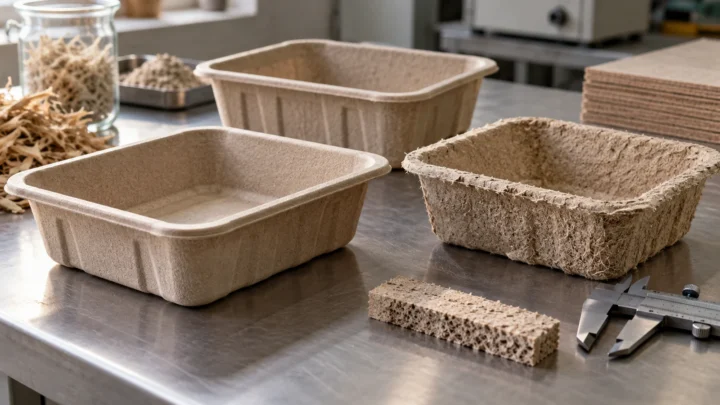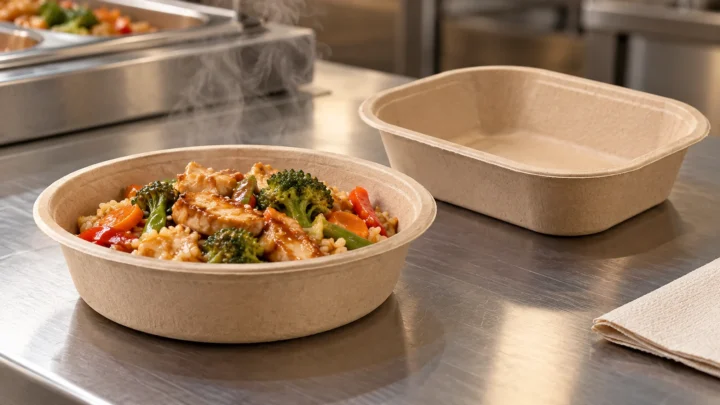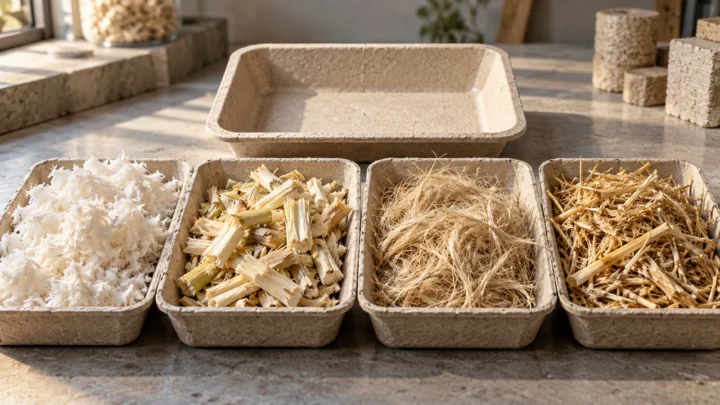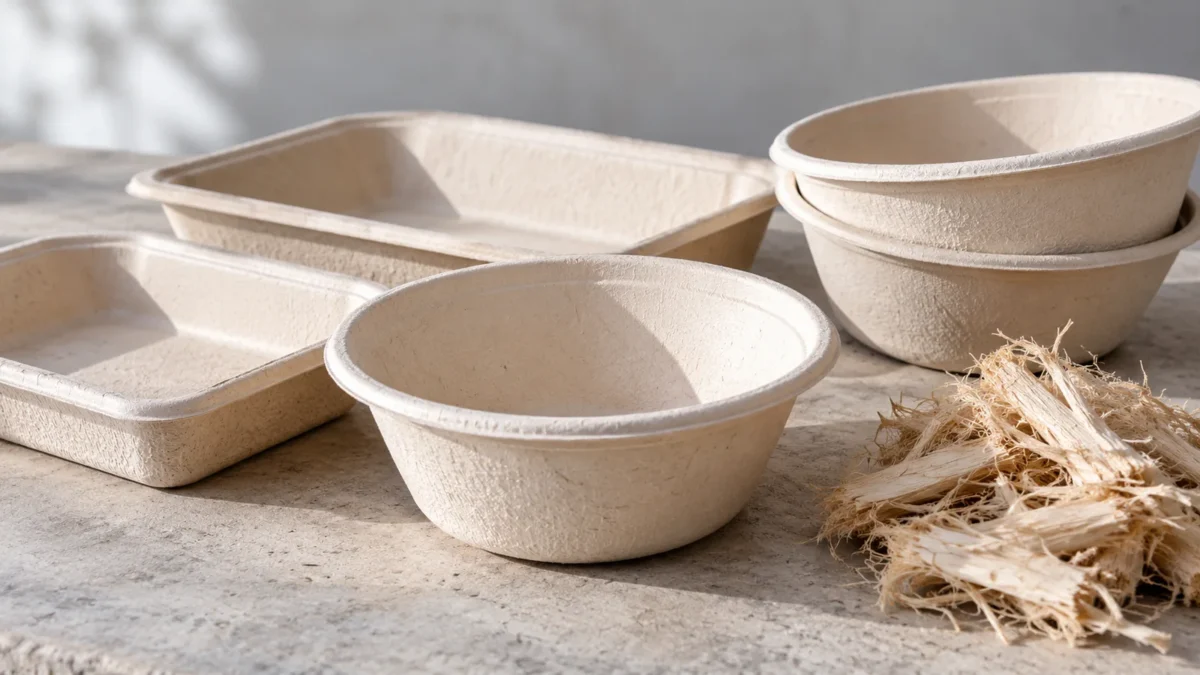
Short answer: Bagasse packaging is usually molded-fiber packaging made from the fibrous residue left after sugarcane is crushed for juice. It can be formed into plates, bowls, trays, clamshells and food containers, but “bagasse” describes the fiber source—not the complete performance, compostability, PFAS status or food-contact compliance of the finished item. Those depend on pulping, fiber blends, additives, coatings, geometry and the recovery system.
Bagasse is attractive because it converts a large agricultural process stream into packaging fiber instead of relying only on wood pulp or fossil-derived plastics. But that does not make every bagasse package environmentally preferable in every use. Molded-fiber production still requires pulping, forming, drying and often heat and pressure; foodservice products may also need wet-strength, grease or water barriers that materially change the finished construction.
For buyers, the useful question is therefore not simply “Is it made from sugarcane?” It is: What is the finished construction, how does it perform with the intended food, and what evidence supports its compostability, PFAS and recovery claims?
What is bagasse?
Bagasse is the lignocellulosic fibrous material that remains after sugarcane stalks are crushed to extract juice. Reviews of bagasse for food packaging describe it as a mixture dominated by cellulose, hemicellulose and lignin, with smaller quantities of ash, waxes and extractives. Exact composition varies with sugarcane variety, growing conditions, milling and analytical method. [R1]
That variability matters. Bagasse is not a purified polymer like PET or PLA. It is a plant-fiber feedstock whose fiber length, fines content, lignin level, bleaching history and pulping treatment influence the molded product.
Bagasse is also not necessarily “waste” in the sense of having no other use. Sugar mills can use it for energy, pulp, board and other products. A packaging sustainability claim therefore needs a real system boundary rather than assuming every tonne of bagasse would otherwise be discarded.
Bagasse and molded fiber are not the same term
Bagasse describes the feedstock. Molded fiber describes the manufacturing route.
Our molded-fibre process guide covers the broader manufacturing family.
Molded fiber—also called molded pulp—can be made from sugarcane bagasse, wood pulp, recycled paper, bamboo, wheat straw and other plant fibers. Bagasse packaging is one important subset of molded-fiber packaging.
| Term | What it describes | What it does not tell you |
|---|---|---|
| Bagasse | Sugarcane-derived fibrous residue used as a pulp feedstock. | The exact molding process, additives, coating, certification or finished-item performance. |
| Molded fiber / molded pulp | Fiber slurry formed into a three-dimensional package using molds, dewatering and drying/pressing. | Which fiber source was used. |
| Bagasse molded fiber | A molded-fiber item in which sugarcane bagasse is a principal fiber feedstock. | Whether the product is 100% bagasse, uncoated, PFAS-free, home compostable or recyclable. |
Editorial synthesis; qualitative comparisons are evidence questions, not measured product rankings. [R1] [R2] [R3]
This distinction is especially important in sourcing. A supplier may describe an item as “sugarcane,” “plant fiber,” “molded pulp” or “bagasse,” but those labels are not interchangeable specifications.
How is bagasse packaging made?
The manufacturing sequence varies by plant, equipment and product quality, but the core process is similar to other molded-fiber packaging.
1. Fiber preparation and pulping
Bagasse is cleaned and processed so that usable fibers can be dispersed in water. Depending on the process, pulping can involve mechanical, thermomechanical or chemical treatment. A 2025 open-access review of bio-based packaging describes plant fibers being chopped or ground, pulped in water and converted into a fiber suspension suitable for molding. [R2]
2. Slurry preparation and fiber blending
The pulp slurry can be adjusted for consistency and blended with other fibers or additives. Bagasse contains a substantial proportion of short fibers and fines; research reviews note that blending it with longer fibers such as bamboo can improve network strength in some molded-pulp constructions. [R3]
3. Forming and dewatering
The slurry is drawn or deposited onto a shaped mold. Water is removed while the fiber mat takes the geometry of the package. This stage controls wall distribution, local density, edges, ribs and other structural details.
4. Drying and hot pressing
The wet fiber shape is dried. Higher-quality foodservice items are often thermoformed or hot-pressed to produce smoother surfaces, tighter dimensions and better structural consistency. Heat and pressure can increase density and improve surface finish, although process settings affect energy use and throughput. [R2]
5. Trimming, surface treatment and quality control
Finished parts may be trimmed, stacked and tested. Depending on the intended application, manufacturers can use wet-strength additives, oil/water-resistance treatments, coatings, pigments or other process aids. Those additions are part of the finished construction and must be included in food-contact, PFAS, compostability and recyclability review.
One manufacturer-side illustration is Bioleader’s custom molded-fibre development workflow, which distinguishes adapting an existing shape from developing new tooling. This is the company’s description, not an independently observed factory trial or validation of its performance claims. Bioleader is a disclosed industry/commercial related party.
Why bagasse works for foodservice packaging
Molded bagasse can create rigid three-dimensional structures without the separate folding and gluing operations used for many paperboard cartons. This is useful for plates, bowls, trays, hinged clamshells and compartmented food containers.
Research on molded-pulp food packaging identifies several relevant functions: stiffness, shape retention, cushioning, thermal insulation and the ability to create complex molded geometries. [R4] But the actual result depends strongly on fiber composition, density, wall thickness and tooling.
| Performance need | Why bagasse can help | What still needs verification |
|---|---|---|
| Rigidity | Molded fiber can form ribs, walls and compartment geometry that distribute load. | Compression strength, hinge life, edge deformation and stack performance of the exact design. |
| Hot-food handling | Cellulosic fiber does not soften in the same way as many low-temperature thermoplastics. | Actual temperature, exposure time, food moisture, lid system and any coating/additive limits. |
| Grease resistance | Dense fiber structure can slow penetration and can be combined with barrier treatment. | Oil holdout, sauce contact time, temperature and whether the barrier chemistry contains restricted substances. |
| Water resistance | Pressing, fiber treatment and coatings can improve wet performance. | Leak time, wet strength, freezer/condensation exposure and coating integrity. |
| Compartment design | Thermoforming can create integrated multi-compartment shapes. | Seal geometry, lid fit and cross-compartment leakage under transport. |
Editorial synthesis; qualitative comparisons are evidence questions, not measured product rankings. [R2] [R3] [R4]
The key procurement lesson is that the material name cannot replace application testing. A bagasse tray for dry bakery food and a bagasse bowl for hot oily soup impose very different requirements on the same fiber platform.
What are the main limitations?
Moisture and grease are difficult for untreated fiber
Cellulosic fiber is hydrophilic. Without sufficient density, sizing or barrier treatment, water and oils can penetrate the fiber structure. The 2024 bagasse review identifies barrier performance as a continuing development challenge, especially where food packaging must resist moisture and grease for extended periods. [R1]
This is why “uncoated” should not automatically be equated with “high performance.” A product may need some form of internal sizing, additive or surface treatment even when no visible plastic film is present.
Fiber variability affects manufacturing
Bagasse pulp can contain short fibers and fine particles. A molded-pulp review notes that those characteristics can reduce mechanical performance when bagasse is used alone and can complicate process control, including deposition and equipment-cleaning demands. [R3]
Manufacturers can address this through fiber refining, screening, blending, process control and tooling, but the buyer should not assume every bagasse pulp source produces identical results.
Drying can be energy intensive
Molded-fiber production begins with a water-rich slurry. Removing that water is one of the major process demands. Reviews of molded-pulp food packaging identify drying time and energy use as important production constraints, even as newer thermoforming and dry-forming technologies improve throughput. [R4]
That is one reason an environmental comparison should consider actual factory energy, fiber sourcing and product mass rather than relying only on the agricultural origin of the feedstock.
Is bagasse packaging compostable?
The fiber itself is lignocellulosic and biodegradable, but a commercial compostability claim belongs to the finished item.
This matters because foodservice bagasse products can contain additives, inks, binders, barrier treatments or polymer coatings. ASTM D6868-21 specifically addresses end items in which plastics or polymers are used as coatings or binders with paper and other compostable substrates. ASTM D6400-26 also covers end items that use plastics or polymers as coatings or binders under municipal or industrial aerobic composting conditions. [R5] [R6]
BPI’s current catalogue lists certified products down to company, product and item number and includes multiple molded-fiber subcategories. That is a useful reminder that certification is not inferred from the word “bagasse.” [R7]
Industrial compostable is not the same as home compostable
An industrial-composting certification does not automatically establish home compostability. Commercial composting uses controlled operating conditions and throughput requirements that can differ substantially from a backyard or home system.
Likewise, certification does not guarantee acceptance by every composting facility. Local collection programs and receiving operators can still exclude foodservice items because of contamination, look-alike plastics or operational constraints.
So the disposal instruction should combine three things:
- finished-item certification or equivalent evidence;
- the intended composting environment; and
- actual local collection/facility acceptance.
What does PFAS-free mean for bagasse packaging?
Bagasse foodservice packaging often needs oil and grease resistance, which is why PFAS became a major issue for molded fiber and paper food packaging.
In the United States, FDA announced in 2024 that PFAS-containing grease-proofing substances were no longer being sold for food-contact use in paper and paperboard packaging. In January 2025, FDA determined that 35 associated food-contact notifications were no longer effective because those uses had been abandoned. [R8]
California goes further for food packaging made substantially from plant-derived fibers. Its AB 1200 framework restricts food packaging containing regulated PFAS, including intentionally added PFAS with a functional or technical effect and PFAS at or above 100 ppm measured as total organic fluorine. [R9]
The EU’s PPWR also addresses food-contact PFAS. Its analytical bases are distinct from the bagasse feedstock. Read the applicable provision and obtain competent assessment rather than treating a fibre-source statement as a compliance result. [R10]
These are different legal frameworks. A supplier should therefore avoid treating “PFAS-free” as one universal certificate. The documentation should identify the finished item, destination market, analytical method, analyte or fluorine scope, units and reporting limits.
What replaces PFAS in grease-resistant bagasse?
PFAS-free barrier design can use different strategies, including fiber refining, densification, mineral or bio-based components, water-borne polymer dispersions and other non-fluorinated treatments. The exact chemistry varies by manufacturer and performance target.
Research on molded-pulp food packaging has explored natural additives, fiber blends and alternative coatings as routes to improve water and oil resistance without relying on fluorochemicals. [R4]
No replacement chemistry should be assumed to be automatically safer, compostable or recyclable. The replacement must be evaluated for its own food-contact status, migration, compostability/recycling compatibility and performance.
Is bagasse packaging recyclable?
Bagasse is a fiber material, so some constructions may be repulpable in paper-recycling processes. But “fiber-based” does not guarantee real-world recycling.
Food residue, wet-strength additives, grease barriers, coatings, high contamination and local mill acceptance all affect the route. Some molded-fiber research also reports strength losses after recycling and notes that repeated fiber recovery can be technically limited by fiber shortening and degradation. [R3]
A technically repulpable bagasse item may still be excluded from local paper collection, especially when heavily food-soiled. Conversely, a certified compostable bagasse item should not automatically be placed in organics unless the receiving program accepts it.
Compare the recycling evidence route with finished-item compostability and local acceptance.
The correct disposal route is therefore market-specific, not material-name-specific.
Bagasse vs paperboard vs plastic: there is no universal winner
Bagasse is often positioned as an alternative to paperboard or plastic food containers, but the better option depends on the application and recovery system.
| Decision factor | Bagasse molded fiber | Paperboard carton/bowl | Plastic container |
|---|---|---|---|
| Shape formation | Strong 3D molding capability, including compartments and ribs. | Efficient folded/convolute formats; often uses seams and coatings. | Very high geometric precision and thin-wall forming options. |
| Moisture/oil barrier | Usually needs density/additive/barrier engineering for demanding foods. | Often relies on PE, PLA, aqueous or other barrier systems. | Polymer itself can provide strong moisture resistance. |
| Transparency | Opaque. | Opaque unless combined with a window. | Can be transparent depending on polymer. |
| Recovery route | Potential composting or fiber-recovery route depending on finished construction and local infrastructure. | Potential paper recycling or composting route depending on barrier/construction. | Potential polymer recycling route depending on resin, design and local collection. |
| Environmental conclusion | Requires a defined application, functional unit, sourcing and real end-of-life system; material name alone is not enough. | ||
Editorial synthesis; qualitative comparisons are evidence questions, not measured product rankings. [R2] [R3] [R4]
Without a comparable life-cycle assessment and equivalent functional performance, it is not defensible to state that bagasse is always more sustainable than paper or plastic. The 2022 molded-pulp review makes a similar point, calling for life-cycle assessment and viable composting/recycling pathways rather than assuming fiber packaging is automatically superior. [R4]

What should a buyer verify?
- Fiber composition. Is the product primarily bagasse, or a bagasse/bamboo/wood-pulp blend?
- Finished construction. Identify additives, coatings, printing, lid material and any film or laminate.
- Application performance. Define food temperature, contact time, oil/water exposure, microwave/freezer use and transport stress.
- PFAS basis. Request the exact declaration and analytical evidence required for the destination market.
- Compostability scope. Check the exact item/SKU, industrial vs home environment and current certification status.
- Food-contact evidence. Match documentation to the actual finished construction and intended use.
- Recovery route. Confirm whether the local system wants the item in organics, paper recycling or residual waste.
Methodology and editorial note
This article is an editorial synthesis of open scientific reviews, official regulatory sources and current certification/standards records. It does not present original laboratory testing or a life-cycle assessment. Performance statements are qualitative unless the cited evidence supports a common test basis. Compostability, food-contact, PFAS and recyclability are treated as separate claims rather than inferred from the bagasse feedstock.
Sources checked 17 October 2026. The main image is an AI-generated editorial illustration; the explanatory figure is an original editorial diagram. Neither is a photograph of an identified product or facility, a laboratory result or an independent environmental assessment.
Official sources and reference notes
- [R1] Stroescu, Marc & Mureșan. A Comprehensive Review on Sugarcane Bagasse in Food Packaging: Properties, Applications, and Future Prospects. Live public source, checked 17 October 2026. Cellulose/hemicellulose/lignin composition; food-packaging applications; barrier limitations; feedstock/processing variability. Public record/abstract or identified section extracts only; no unexamined experimental details used. Accessed 17 October 2026.
- [R2] Bauer, Henkel, Gürer & Lieleg. Bio-Based and Degradable Food Packaging Materials: Where Are They?. Advanced Materials Interfaces 12(6), 2025, 2400645; first online 20 December 2024; DOI 10.1002/admi.202400645. Sections 2.1.1–2.1.3 and 3; relevant text on lignocellulosic materials, PHA, TPS, PLA and bio-PBS. Relevant public text checked; see the stated scope. Accessed 17 October 2026.
- [R3] Liu, Yifan; Ma, Shufeng; Wang, Feijie; Wang, Liqiang. Advances in Research of Molded Pulp for Food Packaging. Live public source, checked 17 October 2026. Introduction process taxonomy; section 2.2.2 sugarcane; section 3 properties and barrier treatments; conclusions. Relevant public text checked; see the stated scope. Accessed 17 October 2026.
- [R4] Semple et al. Moulded pulp fibers for disposable food packaging: A state-of-the-art review. Live public source, checked 17 October 2026. Molded-pulp foodservice requirements; PFAS/additives context; drying/energy challenge; need for LCA and viable recovery infrastructure. Public record/abstract or identified section extracts only; no unexamined experimental details used. Accessed 17 October 2026.
- [R5] ASTM International. ASTM D6868-21. Live public source, checked 17 October 2026. Current active scope for end items with plastics/polymers used as coatings/binders on paper and other compostable substrates. Public catalogue and scope only; paid clauses not accessed. Accessed 17 October 2026.
- [R6] ASTM International. ASTM D6400-26. Live public source, checked 17 October 2026. Industrial/municipal aerobic-composting scope for plastics/end items and coatings/binders. Public catalogue and scope only; paid clauses not accessed. Accessed 17 October 2026.
- [R7] BPI. Find BPI-Certified Products. Live public source, checked 17 October 2026. Certification is product/company/SKU-specific; molded-fiber categories are present. Public catalogue explanation; no named SKU is claimed certified. Accessed 17 October 2026.
- [R8] U.S. FDA. Market Phase-Out of Grease-Proofing Substances Containing PFAS. Live public source, checked 17 October 2026. PFAS grease-proofing phase-out and 35 FCNs no longer effective after abandonment. Relevant public text checked; see the stated scope. Accessed 17 October 2026.
- [R9] California Attorney General. Assembly Bill 1200 Enforcement Advisory. 17 October 2023. pp.1–2. Relevant public text checked; see the stated scope. Accessed 17 October 2026.
- [R10] European Union. Regulation (EU) 2025/40 on packaging and packaging waste. Live public source, checked 17 October 2026. Article 5(5). Relevant adopted Council text checked; original OJ rendition was not directly retrievable. Accessed 17 October 2026.
The public corrections channel is currently inactive. Read our corrections policy.