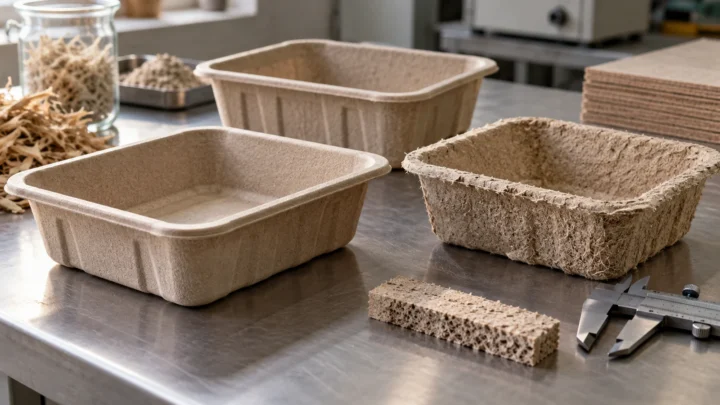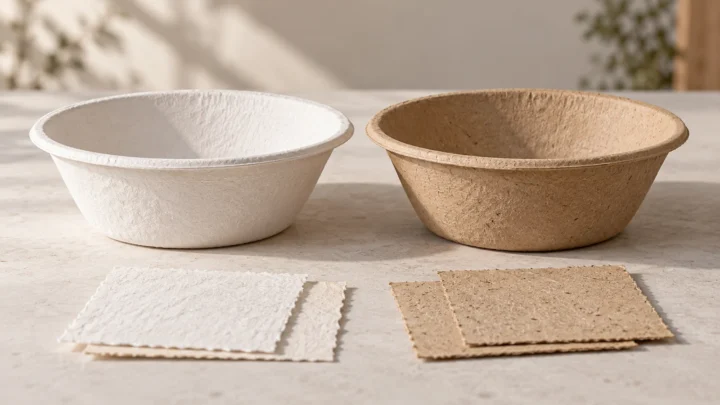
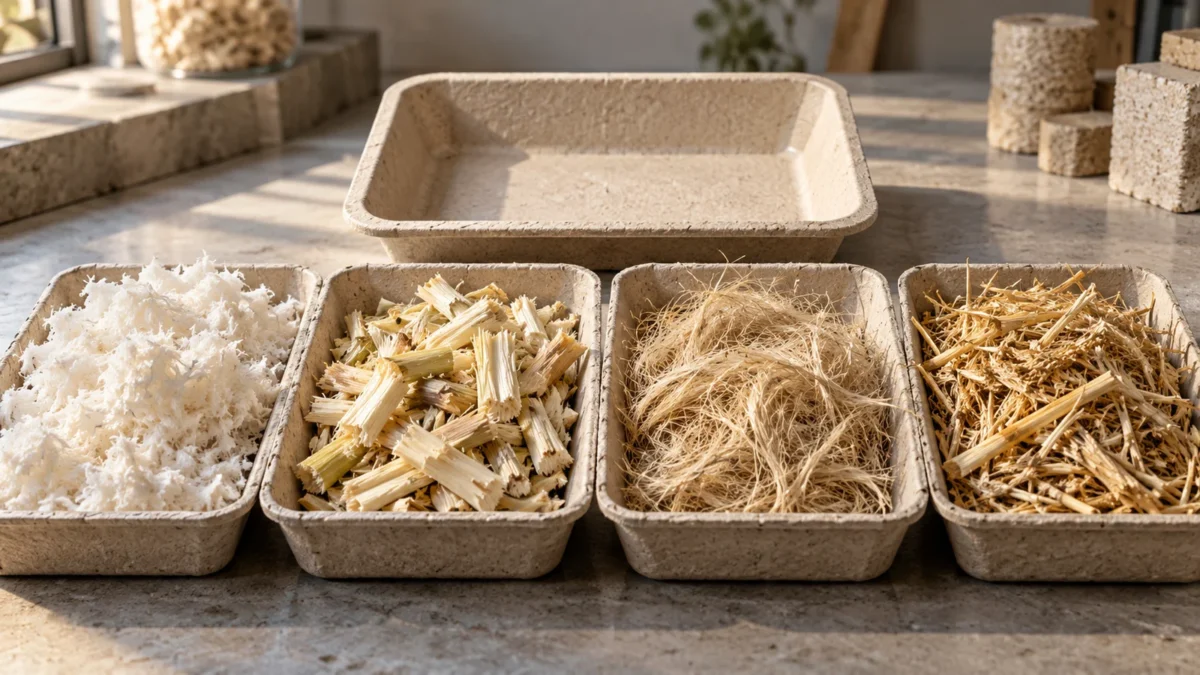
Molded fiber describes a forming process and product family, not one raw material. A molded tray can be made from wood pulp, sugarcane bagasse, bamboo, wheat straw or a blend. Those fibers differ in length, fines content, lignin and hemicellulose, ash, drainage behaviour and response to pulping and hot pressing. As a result, two containers that both look like “molded fiber” can behave differently in strength, surface quality, moisture response and manufacturing.
The feedstocks are not interchangeable specifications. The accessible 2023 molded-pulp review describes wood and non-wood sources and shows how fiber selection, pulping, additives, molding and drying influence the finished product. [S2]
For a packaging buyer, the useful specification is therefore not simply “molded fiber.” It is the fiber source, pulp type, blend, forming process, barrier system and finished-product performance.
Molded fiber is a manufacturing route, not a species of fiber
Molded fiber—also called molded pulp—is made by forming a suspension or web of cellulosic fibers into a three-dimensional shape and then removing water through pressing, drying, thermoforming or related processes. The same basic manufacturing family can produce protective inserts, egg trays, plates, bowls, clamshells and fine-surface food containers.
The fiber entering that process can come from very different plant structures. Wood pulps may be produced from softwood or hardwood using kraft, mechanical or chemi-thermomechanical routes. Bagasse is the fibrous residue remaining after sugarcane is crushed for juice. Bamboo is a non-wood lignocellulosic feedstock with relatively long fibers. Crop straw includes residues such as wheat or rice straw and brings its own pulping and mineral-content challenges.
Calling all of those simply “fiber” hides engineering differences that matter during dewatering, molding, hot pressing and use.
The fiber properties that matter most
No single fiber measurement predicts a finished package, but several characteristics repeatedly appear in pulp and molded-fiber research:
- Fiber length and aspect ratio. Longer fibers can contribute to network reinforcement and tear-related performance, while shorter fibers and fines change packing and bonding behaviour.
- Fiber flexibility and wall thickness. Flexible fibers can conform and create contact area for bonding; thick or stiff walls may respond differently to refining and pressing.
- Fines content. Fine particles can fill voids and influence bonding, but high fines can also slow drainage or complicate processing.
- Lignin and hemicellulose. Their amount depends on feedstock and pulping. They affect fiber surface chemistry, thermal response and bonding during hot pressing.
- Ash and mineral content. This is especially relevant for some agricultural residues and can affect pulping, chemical recovery, deposits and process control.
- Pulping and refining history. The same plant can produce different pulp behaviour depending on chemical treatment, mechanical action, bleaching, refining and fiber damage.
An ACS Omega study of 22 non-wood fiber sources found that fiber length, wall thickness, fines, curl, kink, coarseness and fibrillation all contributed to pulp strength relationships. Its broader lesson is more useful than any single number: raw-material identity alone does not predict performance. [S3]
Comparing the main fiber sources
Wood pulp: the reference point is already several materials
“Wood pulp” is itself too broad to be a complete specification. Softwood fibers are generally longer than hardwood fibers, while hardwood pulps contain shorter fibers and can behave differently in bonding and surface formation. Species and pulping route add another layer of variation.
A controlled study comparing six wood-based pulps in molded pulp products found clear differences among bleached softwood kraft, bleached hardwood kraft, unbleached softwood kraft, bleached chemi-thermomechanical pulp and recycled pulps. The study measured softwood kraft fibers as longer than hardwood kraft fibers, but it also found that molded-product mechanical behaviour depended on more than fiber length. Surface chemistry and the retention or removal of lignin and hemicellulose affected inter-fiber cohesion under heat and pressure. [S4]
This is why a statement such as “virgin wood fiber is stronger” can be too crude. A long softwood kraft fiber, a shorter hardwood kraft fiber and a lignin-containing BCTMP can respond differently to thermoforming. The process can change the ranking.
Wood pulp remains useful because established pulp grades give converters a broad engineering toolbox: long-fiber reinforcement, shorter-fiber formation, different brightness levels and different bonding behaviour. But “wood” does not describe one fixed molded-fiber performance profile.
Bagasse: short fibers, good bonding potential and a lot of process context
Sugarcane bagasse is an agricultural residue left after juice extraction. It contains cellulose, hemicellulose, lignin, vascular fibers and pith-like fine material. That combination makes it attractive for molded food packaging, but it also means bagasse pulp has to be prepared and controlled rather than treated as a uniform agricultural powder.
A 2023 molded-pulp review describes bagasse fibers as relatively short, flexible fibers with good inter-fiber adhesion. The same review notes that bagasse used alone does not necessarily provide exceptional mechanical strength because of its shorter-fiber distribution. In reported molded-pulp work, adding longer bamboo fibers to bagasse created a tighter reinforcing network and improved mechanical performance. [S2]
Fine material matters too. Excess fines and pith can complicate drainage, create deposits and increase cleaning requirements. That is one reason commercial bagasse pulps are screened, depithed, refined and often blended rather than simply ground and molded.
Bagasse therefore should not be specified only by the word “sugarcane.” Buyers should ask whether the product uses virgin bagasse pulp, how the pulp is processed, whether other fibers are blended in and what finished-product tests support the intended application.
Bamboo: longer reinforcement, but species and pulping still matter
Bamboo is often grouped with agricultural fibers, but its morphology can resemble wood more closely than bagasse or straw in some respects. Published reviews report comparatively long bamboo fibers and high aspect ratios, which can make bamboo useful as a reinforcement component in molded fiber networks.
That does not mean every bamboo pulp is automatically stronger. Bamboo species, age, stem region, delignification, bleaching and refining all affect the resulting pulp. The 2023 review describes substantial variation in pulp yield and strength among bamboo species and harvest ages. [S2]
The practical value of bamboo is therefore not a marketing claim that “bamboo is stronger.” It is that a longer-fiber bamboo fraction can be used deliberately to modify a fiber network. The reported bagasse-bamboo example is a good illustration: shorter bagasse fibers provide one part of the network while longer bamboo fibers help reinforce it.
A blend can be more useful than demanding a single-feedstock package.
Wheat straw and other crop straws: useful residues with different pulping problems
Wheat straw is another lignocellulosic residue that can be converted into packaging pulp. It contains usable cellulose and has been studied for paper, molded pulp and cellulose-derived packaging materials.
Straw is a distinct pulping raw material rather than a direct substitute for any wood or bagasse grade. Crop, preparation and pulping conditions influence the resulting furnish. The accessible 2023 molded-pulp review discusses wheat-straw preparation and practical transport, storage and processing constraints; this article does not assign a universal ash content or performance ranking to every straw source. [S2]
The 2023 molded-pulp review also identifies transportation, storage, pulping and bleaching as practical limits for wheat straw. Agricultural residues are seasonal and spatially dispersed, so a feedstock that looks inexpensive at the field level may require baling, drying, storage and transport before it becomes a consistent industrial pulp.
None of this makes straw unsuitable. It means straw pulp is a distinct raw-material system, not a direct drop-in copy of wood or bagasse.
Typical tendencies—not fixed specifications
| Fiber source | Typical material tendency | Potential engineering value | Common control issue |
|---|---|---|---|
| Wood pulp | Wide range: long softwood, shorter hardwood, kraft, mechanical and CTMP/BCTMP grades | Established grades allow strength, formation and surface properties to be engineered | Performance varies substantially with species and pulping route |
| Bagasse | Relatively short fibers with fines/pith and good bonding potential after suitable pulping | Well suited to molded foodware; can form dense structures and blend with longer fibers | Fines, drainage, depithing and strength when used alone |
| Bamboo | Relatively long, high-aspect-ratio non-wood fibers | Useful reinforcement component and possible primary pulp source | Species, age, delignification and pulping variability |
| Wheat straw | Agricultural residue with shorter fibers and variable mineral content | Can provide usable pulp and valorize crop residues | Ash/silica, seasonal supply, storage, purification and pulping consistency |
Editorial synthesis of the cited sources. Examples are not product test results; methods, construction and conditions remain part of every claim.
This table describes tendencies, not purchase specifications. Fiber length ranges from different studies are not always directly comparable because species, pulping, refining, screening and measurement methods differ. A supplier’s actual pulp data and finished-product testing are more useful than a generic textbook number.
Why blends often make more sense than “100% one fiber”
Molded fiber is a network material. The final structure depends on how fibers of different lengths, flexibility and surface chemistry pack and bond together.
That makes blending a normal engineering tool rather than evidence of an inferior feedstock. A short-fiber fraction can improve packing and formation, while a longer-fiber fraction can reinforce the network. The bagasse-bamboo research cited above is one example, but the same principle applies to wood pulp blends and other non-wood combinations.
Blending can also help a manufacturer control natural feedstock variability. Agricultural residues change with harvest, geography and upstream processing. A controlled blend can make the finished pulp more consistent than relying on a single variable stream.
For procurement, an insistence on “100% bagasse” or “100% bamboo” can therefore be less technically useful than specifying the performance that matters: compression strength, wet strength, wall stiffness, surface quality, lid fit, oil resistance or processability.

Processing can matter as much as the plant source
Two manufacturers can start with similar fibers and still produce different molded products because pulping and molding change the fiber network.
Chemical pulping removes more lignin and other non-cellulosic components. Mechanical and chemi-thermomechanical routes retain more of them. Refining can fibrillate fibers and increase bonding area, but excessive refining can shorten fibers and create fines. Hot pressing increases density and contact between fibers. Temperature can soften lignin-containing structures and alter bonding behaviour.
The wood-pulp study cited above is a useful warning against simple material rankings. BCTMP, kraft and recycled pulps did not follow one universal “more purified equals stronger” rule in molded products. Heat, pressure, fiber morphology and retained non-cellulosic components all affected the result.
A molded-fiber specification should therefore record both what the fiber is and what was done to it.
See molded-fiber processes and applications for the related distinction.
Fiber choice does not solve the barrier problem by itself
Bagasse, bamboo, wood and straw are all cellulose-rich fiber systems. Cellulose is hydrophilic, so untreated molded fiber tends to interact with water. Food packaging that must hold soup, oil, sauce or high-moisture food usually needs additional structure, densification, sizing, wet-strength chemistry, surface treatment or a barrier coating.
Changing from wood to bagasse does not automatically create oil resistance. Changing from bagasse to bamboo does not automatically create a moisture barrier. Those functions are separate engineering questions.
This is especially important when buyers compare PFAS-free molded fiber products. Grease resistance can come from different coating or additive systems, and the performance of those systems cannot be inferred from the plant fiber named on the product.
See PFAS-free evidence and claims for the related distinction.
Which fiber is “most sustainable”?
The fiber name alone cannot answer that question.
Bagasse and wheat straw can use agricultural residues. Bamboo can provide a rapidly renewable fiber crop. Wood pulps can come from established forestry and recycling systems. Each route also has impacts from collection, pulping chemicals, water, energy, transport, bleaching, yield, land management and end-of-life infrastructure.
A comparison of finished packaging systems needs a life-cycle boundary as well as a fiber name: comparable function, product protection, material mass, processing and the actual recovery route.
A meaningful comparison needs the same functional unit and the same packaging job. A heavier weak tray that fails in use is not automatically preferable to a lighter tray simply because its feedstock sounds more renewable. Product protection, material mass, manufacturing route and actual disposal pathway all belong in the comparison.
A buyer checklist for molded-fiber material selection
| Question | Why it matters |
|---|---|
| What is the fiber source and blend? | Bagasse, bamboo, wood and straw have different morphology and processing behaviour. |
| What pulp type is used? | Kraft, mechanical, CTMP/BCTMP and other pulping routes change chemistry, bonding and surface behaviour. |
| Is the agricultural pulp depithed, screened or refined? | Fines and non-fibrous material can affect drainage, cleanliness and consistency. |
| What finished-product properties are tested? | Fiber identity does not substitute for compression, wet strength, stiffness, dimensional or barrier testing. |
| What provides water and grease resistance? | The barrier system is separate from the fiber source. |
| What end-of-life route is actually available? | Renewable feedstock does not establish local recycling or composting acceptance. |
Editorial synthesis of the cited sources. Examples are not product test results; methods, construction and conditions remain part of every claim.
What to put in the specification
For sourcing, specify the finished job first. Then ask which fiber system and process achieves that job consistently. “Molded fiber” tells you how the package was formed; it does not tell you everything the package is made from or how it will perform.
Methodology and editorial note
This technical explainer synthesises the identified official guidance, public standard scopes and research records. Study findings remain specific to their reported materials and conditions. Sources checked 18 October 2026; no product testing, factory inspection or independent certification assessment was performed for this article.
The main image is an AI-generated editorial illustration of an unnamed conceptual scene. The explanatory figure is an original editorial synthesis, not a photograph of an experiment, microscopic structure or measured result.
Official sources and reference notes
- [S2] Yifan Liu; Shufeng Ma; Feijie Wang; Liqiang Wang. Advances in Research of Molded Pulp for Food Packaging. Journal of Renewable Materials 2023, 11(11), 3831–3846; issue published 31 October 2023. Section 2 — Source of Fiber for Molded Pulp; Sections 2.1–2.2.3; Section 3. Relevant public sections checked; source-specific scope retained. Accessed 18 October 2026.
- [S3] Taslima Ferdous; Yonghao Ni; Mohammad Abdul Quaiyyum; Mohammad Nashir Uddin; Md Sarwar Jahan. Non-Wood Fibers: Relationships of Fiber Properties with Pulp Properties. ACS Omega 2021, 6(33), 21613–21622. Abstract; Introduction; Results and Discussion; Conclusions. Original-study metadata and indexed methods/results checked; pulp handsheet study, not a test of all molded containers. Accessed 18 October 2026.
- [S4] Claire Dislaire et al. Mechanical and Hygroscopic Properties of Molded Pulp Products Using Different Wood-Based Cellulose Fibers. Polymers 2021, 13(19), 3225. Abstract; fiber morphology Table 6; mechanical and moisture-property results. Relevant public sections checked; source-specific scope retained. Accessed 18 October 2026.
The public corrections channel is currently inactive. Read our corrections policy.