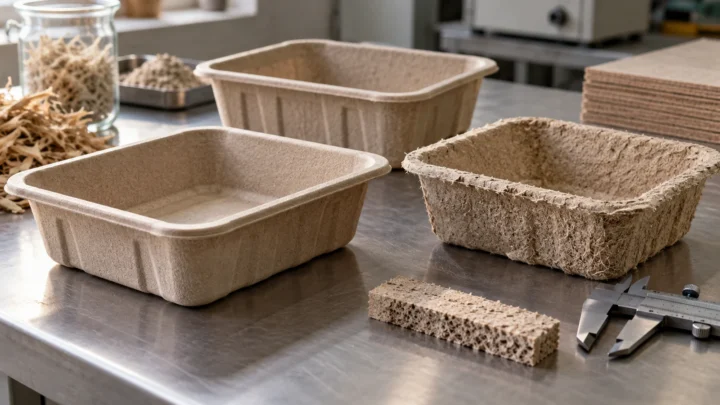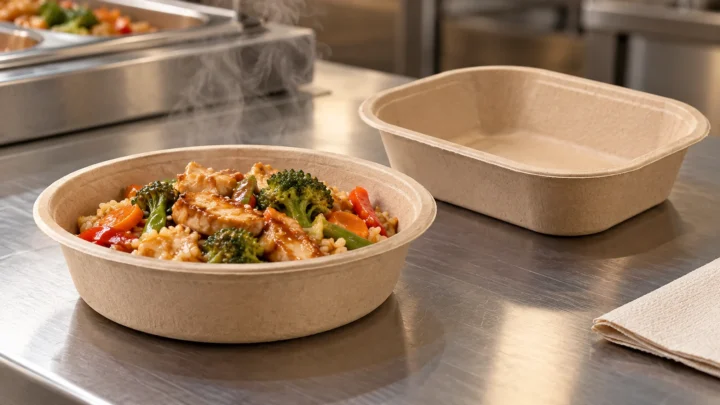
Short answer: Molded fiber packaging is three-dimensional packaging made by forming a suspension or web of cellulose fibers into a shaped part. It can be produced from wood pulp, recycled paper, bagasse, bamboo, wheat straw and other plant fibers. Common formats include egg cartons, produce trays, foodservice bowls and clamshells, electronics inserts, protective end caps and custom industrial components.
The important point is that “molded fiber” describes a material-processing family, not one finished specification. Fiber source, pulp treatment, forming method, wall thickness, density, additives, coatings and tooling all change how the package performs. A rough recycled-fiber tray and a smooth thermoformed food container may both be molded fiber, but they solve different packaging problems.
For buyers and packaging engineers, the right question is therefore not simply “Can we replace plastic with molded fiber?” It is: which molded-fiber process, fiber furnish and structural design can meet the actual product-protection, barrier, production-line and recovery requirements?
What is molded fiber packaging?
Molded fiber—also called molded pulp—is a family of three-dimensional cellulosic packaging made by shaping fibers into a rigid or semi-rigid form rather than folding a flat sheet into a box.
The open molded-pulp review by Liu and colleagues describes a three-dimensional papermaking process involving mold forming and hot-press drying. It is useful to distinguish that route from folding and gluing a flat board blank. [R2]
This distinction explains why molded fiber can create:
- deep cavities;
- integrated ribs and reinforcement;
- rounded corners;
- product-specific support points;
- nested trays;
- hinges and clamshell geometries;
- multi-compartment food containers;
- protective end caps and inserts.
Those features are molded into the part itself. They do not require the same folding and gluing operations used for conventional cartons.
What materials can molded fiber use?
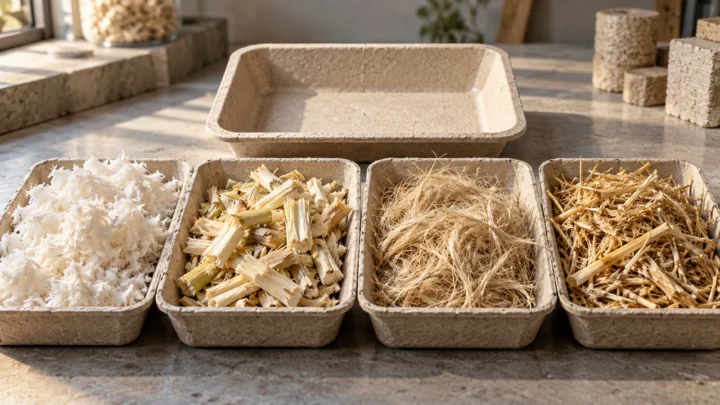
Cellulose fibers can come from both primary and recovered sources. A 2023 open-access review of molded-pulp food packaging identifies wood fiber, bamboo, sugarcane bagasse, crop straw and other plant fibers as potential sources, while broader molded-fiber literature also includes recycled paper and corrugated fiber. [R2]
| Fiber source | Typical role | Useful characteristic | What still needs verification |
|---|---|---|---|
| Wood pulp | Food-contact, industrial and premium molded-fiber applications | Established pulping routes and controllable fiber quality | Fiber grade, bleaching, virgin/recycled status, strength and sourcing requirements |
| Recycled paper / OCC | Protective trays, egg cartons, transport and industrial packaging | Existing recovered-fiber supply | Contaminants, inks, fines, odor, food-contact suitability and loss of fiber strength |
| Sugarcane bagasse | Foodservice containers, plates, bowls and trays | Non-wood agricultural fiber source with good moldability | Short-fiber/fines content, fiber blend, barrier chemistry and food-contact construction |
| Bamboo | Foodservice and blended molded-fiber applications | Relatively long fibers and useful mechanical contribution | Pulping route, fiber consistency, cost and blend ratio |
| Wheat/rice/crop straw | Alternative-fiber trays and experimental/commercial molded products | Potential use of agricultural residues | Pulp yield, storage, transport, pulping chemistry and repeatability |
Editorial synthesis; qualitative comparisons are evidence questions, not measured product rankings. [R2] [R3]
Fiber source matters, but it is not the whole specification. Pulp refining, fiber length distribution, fines content, lignin, fillers, additives and recycled-fiber history can all affect the final part.
How is molded fiber packaging manufactured?
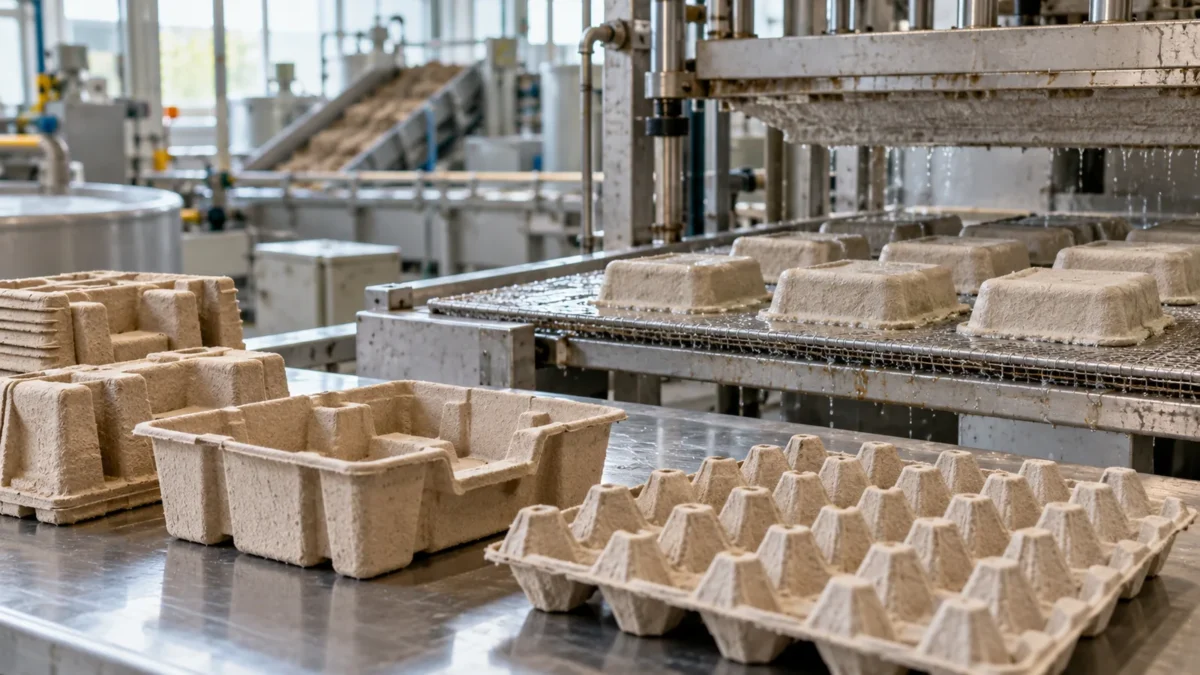
Traditional molded-fiber production is a wet-forming process. The exact equipment differs by plant, but the basic sequence is consistent.
1. Pulp preparation
Fibrous raw material is pulped and dispersed in water. Depending on the feedstock, this can involve mechanical, thermomechanical or chemical pulping, refining and screening. Recycled fiber may require additional cleaning or deinking steps.
The objective is not simply to create “wet paper.” The pulp furnish has to be controlled so that fibers can flow, drain and build a repeatable three-dimensional structure on the mold.
2. Slurry preparation
The pulp is diluted into a fiber suspension. Additives may be introduced to modify drainage, wet strength, water resistance, oil resistance, color or other properties.
At this stage, fiber blending can be important. Research on bagasse-based molded pulp, for example, has shown that combining shorter bagasse fibers with longer bamboo fibers can improve the fiber network in some constructions. [R2]
3. Forming and dewatering
A porous mold is brought into contact with the fiber suspension. Vacuum or pressure draws water away and deposits fibers onto the tool surface. The wet fiber preform takes the shape of the mold.
Tooling controls much of the geometry: cavity depth, ribs, edge radius, draft, stackability, hinges, local thickness and support points.
4. Transfer, drying and hot pressing
The wet part is transferred or retained in tooling while water is removed. Depending on the process, drying can occur in an oven, on heated molds or through a combined pressing/drying cycle.
Thermoformed or “fine molded” processes use heated matched tooling to densify and dry the part more precisely. A 2025 review describes thermoformed molded pulp as a route to relatively smooth, defined packaging structures, while the 2023 molded-pulp review notes that hot pressing creates denser walls and more detailed surfaces than older rough-surface formats. [R3] [R2]
5. Finishing
Parts can then be trimmed, printed, coated, laminated, assembled or inspected. Depending on the application, manufacturers may add barrier chemistry, wet-strength agents, release agents, adhesives or surface treatments.
These finishing steps are not secondary from an evidence perspective. A coating that improves grease resistance may also change compostability, food-contact, recyclability or PFAS documentation.

What are the main molded-fiber process types?
Industry literature commonly separates molded fiber into several process families. The terminology is useful for early specification, although actual plants can use hybrid processes.
| Process family | Typical surface / geometry | Typical applications | Main engineering trade-off |
|---|---|---|---|
| Thick-wall molded fiber | Thicker, relatively rough, less detailed parts | Heavy-duty supports, industrial cushioning, nursery products | Robust structure but lower visual/detail precision |
| Transfer-molded fiber | One smoother surface and better dimensional control | Egg cartons, trays, drink carriers, protective inserts | Good balance of productivity, geometry and cost |
| Thermoformed / thin-wall molded fiber | Smoother surfaces, sharper detail, denser structure | Premium foodservice packs, electronics trays, cosmetics and consumer-goods inserts | Better appearance and precision but more demanding tooling/process control |
| Processed molded fiber | Base molded part receives additional converting or finishing | Printed, coated, laminated, assembled or specialty products | Extra functionality can complicate recovery and compliance |
Editorial synthesis; qualitative comparisons are evidence questions, not measured product rankings. [R2]
The 2023 review attributes this four-part classification to the International Molded Fiber Association and discusses it as a common industry taxonomy. [R2] It should not be treated as a regulatory classification or as proof that every manufacturer uses identical process boundaries.
What is thermoformed fiber?
Thermoformed fiber is a higher-precision molded-fiber route in which heat and matched tooling are used to consolidate and dry the part while controlling surface finish and geometry.
Compared with older rough molded-pulp formats, thermoformed fiber can achieve tighter radii, lower draft angles, cleaner edges, more defined cavities and a surface closer to thermoformed plastic. This makes it useful where packaging appearance, denesting or product-fit precision matter.
The trade-off is that tooling, process control, drying and part geometry become more demanding. A smooth premium tray still has to pass drop, compression, nesting and pack-line tests; appearance alone does not establish protective performance.
What is dry molded fiber?
Not every molded-fibre process uses the same wet-forming sequence. This guide’s illustrated sequence describes wet molding; ask the supplier to identify the actual forming route and process-specific evidence. A dry-forming claim does not by itself establish lower energy use, equivalent geometry or finished-item performance.
How does molded fiber protect a product?
Molded fiber protects by combining material stiffness with geometry.
The fiber wall itself contributes strength, but much of the package behavior comes from:
- ribs;
- corrugations;
- arches;
- corner structures;
- clearance zones;
- controlled crush sections;
- contact points;
- nested wall geometry.
This is why two parts made from the same pulp can perform very differently. Wall thickness alone does not determine shock or compression performance.
Protective packaging
For electronics, appliances, bottles and industrial products, molded fiber can be used as a locating insert, corner protector, end cap or cushioning component. The design task is to keep the product away from damaging carton walls, distribute loads and control movement during handling.
A package that looks “thick” can still fail if it supports the product at the wrong location. Conversely, a thinner molded component can work when the geometry transfers force into the outer carton effectively.
Foodservice packaging
For bowls, trays, plates and clamshells, structural performance is only one requirement. The package may also need oil resistance, wet strength, seal geometry, lid fit, compartment separation and controlled deformation under hot food.
The critical design conditions therefore include food temperature, contact time, sauce/oil load, stacking, delivery duration and lid system.
Barrier performance is one of molded fiber’s hardest problems
Cellulose fibers are naturally hydrophilic. Untreated molded fiber can absorb moisture, lose stiffness and allow oil or sauces to penetrate.
Manufacturers can improve barrier performance through fiber refining, densification, internal sizing, wet-strength chemistry, coatings or laminates. Research reviews on molded-pulp food packaging identify moisture and grease resistance as continuing development areas. [R4]
But every barrier decision creates another question:
- Does it affect food-contact compliance?
- Does it contain intentionally added PFAS?
- Does it interfere with repulping?
- Does it remain within the item’s compostability certification?
- Does it alter heat or microwave performance?
“Plastic-free” and “uncoated” should therefore not be inferred from appearance alone.
PFAS and molded-fiber food packaging
PFAS-containing grease-proofing chemistry became an important issue for paper and molded-fiber food packaging because fluorinated treatments historically provided strong oil and water repellency.
In the United States, FDA states that substances containing PFAS are no longer sold for use as grease-proofing agents on paper and paperboard food packaging, and in 2025 the agency determined that 35 associated food-contact notifications were no longer effective because those uses had been abandoned. [R5]
That does not mean every molded-fiber product is automatically PFAS-free. Finished-item specifications, supplier declarations and analytical evidence still need to match the market and claim being made.
For a molded-fiber buyer, PFAS verification should be treated separately from fiber type, compostability and recyclability.
Compostability is a separate finished-item assessment; a claim about fibre source does not answer either question.
Is molded fiber recyclable?
Many molded-fiber constructions are technically repulpable, but real recyclability depends on the finished package and the recycling system.
Cepi’s 2025 Version 3 laboratory method evaluates paper- and board-based packaging through key stages that emulate a conventional recycling mill, including pulping, screening and sheet formation. Cepi states that the method can be used with the 4evergreen Recyclability Evaluation Protocol to assess technical recyclability. [R6]
4evergreen’s 2025 protocol separates different paper-recycling processes rather than treating all fiber packaging as equivalent. [R7]
For molded fiber, potential complications include:
- food contamination;
- wet-strength additives;
- polymer coatings;
- adhesives;
- high levels of non-fiber material;
- fiber degradation after repeated recycling;
- local mill and collection rules.
A molded-fiber package may therefore be technically repulpable but not accepted in a local paper stream—or accepted in one mill configuration but not another.
Is molded fiber compostable?
Cellulose fiber is biodegradable, but commercial compostability belongs to the complete item.
ASTM D6868-21 covers end items in which plastics or polymers are used as coatings or binders with paper or other compostable substrates and the finished item is intended for municipal or industrial aerobic composting. [R8]
This matters for molded fiber because high-performance food packaging may contain coatings, binders, inks and additives. The fiber substrate alone does not establish that the full package meets an industrial or home compostability requirement.
Facility acceptance is a separate question again. A certified molded-fiber item may still be rejected by a local organics program that does not accept foodservice packaging.
Where is molded fiber used?
| Application | Typical molded-fiber format | Critical validation |
|---|---|---|
| Eggs and produce | Cartons, trays, fruit/berry punnets | Compression, ventilation, stacking, moisture response |
| Foodservice | Bowls, plates, clamshells, meal trays, cup carriers | Heat, grease, wet strength, lid fit, food-contact and PFAS evidence |
| Electronics | Product-fit trays, accessory trays, inserts | Fit tolerance, surface protection, vibration, drop performance, denesting |
| Appliances / industrial goods | End caps, corners, supports, transport inserts | Compression, impact absorption, stacking and pack-out compatibility |
| Cosmetics / premium consumer goods | Presentation trays and fitted inserts | Surface finish, color consistency, geometry, print/branding and fit |
| Medical / specialty | Trays and custom components | Cleanliness, dimensional control and application-specific regulatory requirements |
Editorial synthesis; qualitative comparisons are evidence questions, not measured product rankings. [R2] [R3] [R4]
The application determines whether molded fiber is appropriate. A package designed to carry eggs does not need the same tolerance or surface quality as a molded tray for a premium electronics device.
What determines molded-fiber quality?
Buyers often focus on fiber source, but quality is controlled by a broader set of variables.
- Fiber furnish. Species, virgin/recycled content, fiber length, fines and pulping history affect strength and forming.
- Refining and slurry control. These influence bonding, drainage, surface quality and process repeatability.
- Tooling. Mold design controls dimensions, draft, ribs, edge definition, wall distribution and nesting.
- Forming process. Vacuum, pressure, transfer and matched-tool strategies affect density and surface finish.
- Drying / pressing. Temperature, pressure and time influence moisture, dimensional stability and surface quality.
- Additives and coatings. These change wet strength, barrier, printing and recovery behavior.
- Quality control. Weight, dimensions, moisture, fit, stacking and mechanical validation must be tied to the actual application.
The strongest specification therefore combines material, geometry and performance instead of asking only for “100% molded fiber.”
For sugarcane furnish, use our bagasse guide; for barriers, read performance versus recycling evidence.
What should buyers ask a molded-fiber supplier?
| Question | Why it matters |
|---|---|
| What is the fiber furnish? | Wood, recycled paper, bagasse, bamboo and blended fibers behave differently. |
| Which molding process is used? | Transfer-molded, thermoformed and other routes produce different finish, tolerance and cost structures. |
| What are the design tolerances? | Fit, nesting, lid engagement and automated pack-out can fail even when the material itself is suitable. |
| What additives or coatings are present? | They can change food-contact, PFAS, compostability and recyclability conclusions. |
| Which performance tests apply? | Drop, compression, heat, oil, water, seal and wet-strength needs depend on the real application. |
| What is the recovery route? | Paper recycling, industrial composting or another route requires finished-item and local-system evidence. |
| Has the exact SKU been validated? | Material-family claims cannot substitute for the finished geometry, coating and use conditions. |
Editorial synthesis; qualitative comparisons are evidence questions, not measured product rankings. [R2] [R5] [R6] [R7] [R8]
Methodology and editorial note
This article is an editorial synthesis of open peer-reviewed reviews, official U.S. regulatory information and current fiber-packaging recyclability/compostability frameworks. It does not present an original molding trial, drop test, LCA or recyclability test. Performance is described qualitatively unless the evidence has a comparable specimen and method. Food-contact, PFAS, compostability and recyclability are treated as separate evidence questions.
Sources checked 17 October 2026. The main image is an AI-generated editorial illustration; the explanatory figure is an original editorial diagram. Neither is a photograph of an identified product or facility, a laboratory result or an independent environmental assessment.
Official sources and reference notes
- [R2] Liu, Ma, Wang & Wang. Advances in Research of Molded Pulp for Food Packaging. Live public source, checked 17 October 2026. Introduction process taxonomy; section 2.2.2 sugarcane; section 3 properties and barrier treatments; conclusions. Relevant public text checked; see the stated scope. Accessed 17 October 2026.
- [R3] Bauer, Henkel, Gürer & Lieleg. Bio-Based and Degradable Food Packaging Materials: Where Are They?. Advanced Materials Interfaces 12(6), 2025, 2400645; first online 20 December 2024; DOI 10.1002/admi.202400645. Sections 2.1.1–2.1.3 and 3; relevant text on lignocellulosic materials, PHA, TPS, PLA and bio-PBS. Relevant public text checked; see the stated scope. Accessed 17 October 2026.
- [R4] Semple et al. Moulded pulp fibers for disposable food packaging: A state-of-the-art review. Live public source, checked 17 October 2026. Molded-pulp production, foodservice applications, alternative non-wood fibers, moisture/oil barrier challenges, drying/energy constraints, additives/PFAS context, need for recovery/LCA evidence. Public record/abstract or identified section extracts only; no unexamined experimental details used. Accessed 17 October 2026.
- [R5] U.S. FDA. Market Phase-Out of Grease-Proofing Substances Containing PFAS. Live public source, checked 17 October 2026. PFAS grease-proofing substances no longer sold for paper/paperboard food-contact use; 35 FCNs no longer effective due to abandonment. Relevant public text checked; see the stated scope. Accessed 17 October 2026.
- [R6] Cepi. Cepi Recyclability Test Method Version 3. Version 3, February 2025. Laboratory procedure emulating pulping, screening and sheet formation in conventional paper/board recycling mills. Relevant public text checked; see the stated scope. Accessed 17 October 2026.
- [R7] 4evergreen. Recyclability Evaluation Protocol. Version 1 / 2025. Process-specific technical recyclability assessment for fiber-based packaging in conventional, flotation-deinking and specialized processes. Relevant public text checked; see the stated scope. Accessed 17 October 2026.
- [R8] ASTM International. ASTM D6868-21. Live public source, checked 17 October 2026. Active specification for end items incorporating plastics/polymers as coatings/binders with paper and other substrates intended for municipal/industrial aerobic composting. Public catalogue and scope only; paid clauses not accessed. Accessed 17 October 2026.
The public corrections channel is currently inactive. Read our corrections policy.