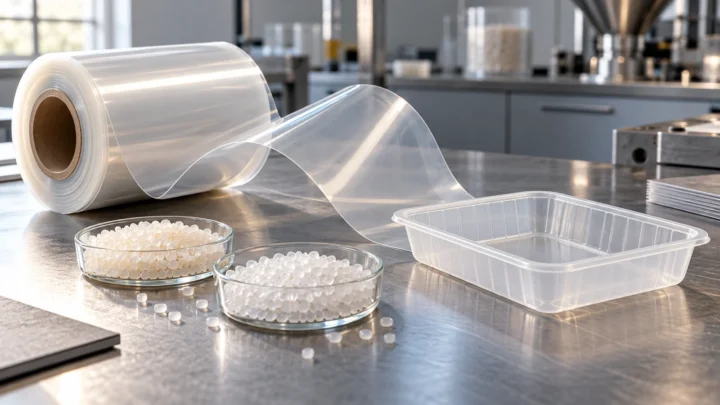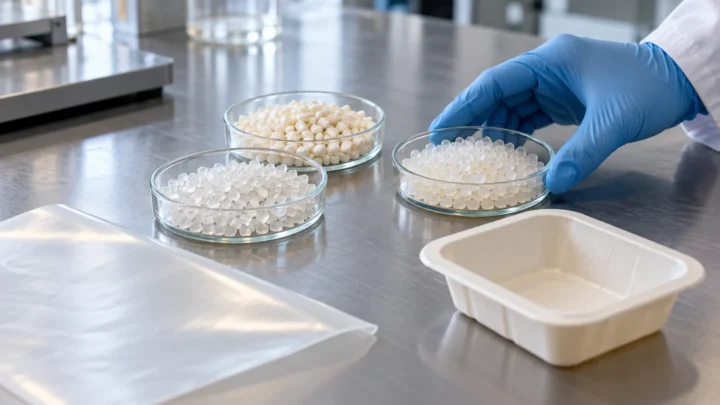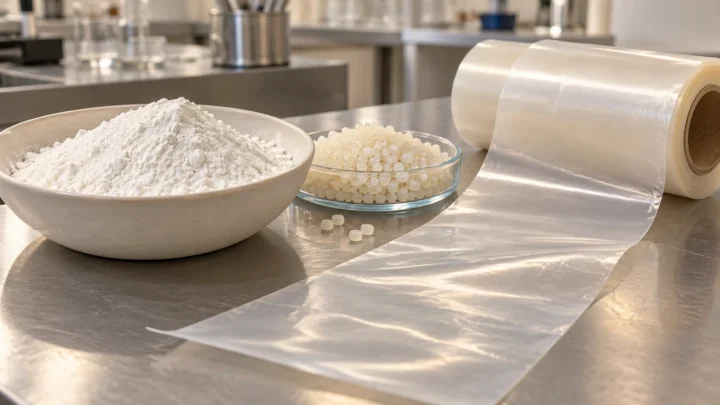
PLA, PHA and PBAT are distinct polyester systems. PLA is commonly bio-based and relatively rigid; PHA is a family of microbially produced polyesters with a wide range of properties; PBAT is a flexible biodegradable copolyester conventionally made mainly from fossil-derived feedstocks. They appear together in bioplastics discussions because feedstock origin and biodegradation overlap in that vocabulary, not because their chemistry or packaging behaviour is interchangeable. [1] [2] [3]
The useful comparison follows the connections between structure, processing, function and degradation conditions. A polymer name suggests a starting material; it does not specify a film, cup or multilayer package. This article compares qualitative tendencies, then shows where formulation and experimental evidence change that first impression.
Three different polymer systems
| Material | Full name and family | Typical production route | General character |
|---|---|---|---|
| PLA | Poly(lactic acid), or polylactide; an aliphatic polyester | Fermentation-derived lactic acid followed by polymerisation, commonly through lactide | Many unmodified packaging grades are stiff and can be transparent |
| PHA | Polyhydroxyalkanoates; a polyester family | Microbial biosynthesis followed by polymer recovery | Ranges from relatively rigid to flexible, depending on chemistry |
| PBAT | Poly(butylene adipate-co-terephthalate); an aliphatic–aromatic copolyester | Polyester synthesis using adipic acid, terephthalic acid or related precursors, and 1,4-butanediol | Flexible and ductile; relevant to films and blends |
Qualitative synthesis of [1]–[3]; these are not specifications for every grade.
PHA needs particular care: PHB, PHBV and PHBH/PHBHHx are members of the family, not synonyms for all PHA. PHB is poly(3-hydroxybutyrate); the copolymers incorporate other monomer units. Our PHA, PHB and PHBH explainer examines those distinctions in detail. Here, they explain why a single property entry for “PHA” can be misleading.
Feedstock origin and biodegradability are separate dimensions
Commercial PLA commonly starts with biological feedstock converted into lactic acid by fermentation. Polymer manufacture then builds longer polyester chains. In PHA production, microorganisms synthesise the polymer itself; the organism, carbon substrate and biosynthetic pathway influence which monomers are incorporated. These are different biological production routes. [1] [2]
Conventional commercial PBAT generally relies mainly on fossil-derived monomers. Bio-based routes to individual building blocks are possible, but the abbreviation PBAT does not establish a particular resin’s renewable-carbon content. Its biodegradable polyester structure can exist without a predominantly bio-based feedstock route. [3]
Thus bio-based describes origin, biodegradable describes biological conversion under specified conditions, and compostable adds a defined composting context and applicable criteria. Changing feedstock does not automatically change the polymer’s chemical bonds. The existing bio-based versus biodegradable comparison explains the wider distinction; neither label alone determines a finished package’s environmental impact.
Molecular structure explains much of the different behaviour
In many standard PLA grades, the amorphous material is glassy at ordinary room temperature. Restricted chain mobility helps explain stiffness and the limited deformation before fracture often seen in unmodified grades. Stereochemistry, molecular weight and crystalline organisation change the response: “PLA is brittle” is a useful warning about some formulations, not a universal mechanical specification. [1]
PHA’s monomer composition and side-chain structure affect chain packing, crystallinity and mobility. Highly crystalline PHB does not represent all copolymers or longer-side-chain PHAs. Changing comonomer content can alter flexibility, melting behaviour and processing stability; molecular weight and thermal history further affect the finished material. A family-level comparison must therefore leave room for substantially different PHA grades. [2]
PBAT combines flexible aliphatic butylene-adipate segments with aromatic butylene-terephthalate segments. The segment balance and molecular structure contribute to its ductile behaviour. Its low glass-transition behaviour relative to room temperature helps distinguish it from standard glassy PLA, while the aromatic component means it should not be treated as simply another wholly aliphatic polyester. [3]
Rigidity, toughness and flexibility describe different responses
Rigidity is resistance to deformation; elongation describes how far a specimen stretches before breaking. Toughness concerns energy absorbed before fracture. A flexible material is not automatically the strongest or toughest under every loading condition. Those distinctions matter when interpreting the tendencies below.
| Property | PLA | PHA | PBAT |
|---|---|---|---|
| Rigidity | Often relatively high in standard grades | Strongly dependent on polymer chemistry and grade | Generally lower than standard rigid PLA |
| Flexibility and elongation | Often limited without modification | Wide range; PHB cannot represent the family | Substantial flexibility and elongation are characteristic |
| Fracture behaviour | Unmodified grades can fail with limited deformation | Depends on composition, crystallinity and formulation | Ductile response is relevant to films; actual tear behaviour needs testing |
| Transparency potential | Clear amorphous packaging is possible | Varies with chemistry and morphology | Optical appearance depends on grade and formulation |
| Film formation | Possible; orientation and formulation matter | Possible for suitable grades and processing conditions | Important in flexible films and blends |
Sources: [1]–[4]. Tensile strengths or elongations from different grades, specimen thicknesses, processing histories and conditioning protocols are not placed side by side as if they came from one experiment.
Thermal behaviour and processing windows are not the same
PLA’s glass transition is distinct from melting. An amorphous PLA article can lose dimensional stiffness as molecular mobility increases without the material having melted. Crystallisation can materially change heat performance, but crystallinity develops through chemistry and processing history rather than the name alone. Heat-resistant PLA and crystallinity explains why CPLA cannot be reduced to one universal service-temperature limit. [1]
Some PHAs, notably PHB-rich materials, have a relatively narrow interval between useful melt processing and appreciable degradation. Copolymer chemistry can change that interval. Residence time, moisture control and thermal history therefore matter alongside the nominal melting point. PBAT’s flexible thermoplastic behaviour is relevant to extrusion and film processing, but a PBAT-containing blend has its own melt rheology and crystallisation behaviour. [2] [3]
Extrusion, thermoforming and injection moulding are relevant PLA routes; suitable PHAs also support melt-processing routes, while blown-film extrusion is particularly relevant to PBAT-rich formulations. A processing temperature, a thermal-analysis result and a finished article’s service temperature answer different questions. None supplies a family-wide maximum-use temperature.
Why these polymers are often blended
Material design frequently combines polymers rather than choosing one in isolation. A formulation may seek stiffness with ductility, manageable melt flow, crystallisation, barrier performance or a specified compostability target. The interface between its components becomes part of the material system.
PLA/PBAT blends commonly aim to modify PLA’s limited ductility using a flexible component. However, a 2020 experimental study of uncompatibilised blends found phase separation and morphology that changed with both ratio and processing route, including pressed panels, flat films and blown films. The ingredients did not behave as one uniformly mixed polymer. [4]
A separate 2023 melt-compounding study provides an important counterexample to automatic toughening: adding PBAT reduced stiffness, but elongation did not immediately increase across the PLA-rich formulations. The authors observed low interfacial adhesion; greater ductility appeared only in more PBAT-rich specimens. That result applies to their tested grades and preparation, not every PLA/PBAT film. It demonstrates why a formulation’s purpose cannot substitute for measured performance. [5]
PLA/PHA combinations can target changes in toughness, crystallisation, processing or degradation, depending on the PHA selected. PBAT with thermoplastic starch is relevant to flexible biodegradable structures, although starch dispersion, moisture response and compatibility affect the outcome. PBS is another blend component, rather than a fourth interchangeable answer; see what PBS adds to PLA and PBAT blends. [2] [3]
Packaging applications reflect material behaviour

A clear rigid wall and a flexible bag impose different structural demands. PLA’s combination of stiffness and potential clarity helps explain thermoformed cups, trays and other rigid transparent formats. Selected PHA chemistries support films, coatings or moulded articles, but the family name alone cannot establish their optical or forming performance. PBAT is especially relevant where deformation and film processing are central. [1]–[4]
| Function | PLA | PHA | PBAT |
|---|---|---|---|
| Clear rigid cups or trays | Established relevance for appropriate grades | Possible, grade-specific | Less typical as the primary standalone rigid resin |
| Flexible film | Possible with suitable formulation or orientation | Possible with selected chemistries and grades | Major technical relevance, including blends |
| Compostable bag structures | Blend-dependent contribution | Specific grade/construction evidence required | Frequently important in flexible blends |
| Coatings and barrier layers | Selected uses | Selected uses | Selected formulations and flexible systems |
| Moulded articles | Grade and thermal design determine suitability | Grade and processing window determine suitability | Generally less associated with standalone rigid articles |
Application relationships synthesised from [1]–[4]; these do not establish food-contact clearance or compostability for an individual package.
These relationships also explain why finished-construction descriptions are more informative than a material label alone. Bioleader’s practical PLA, PHA and PBAT material map offers manufacturer-side supplementary reading on food-packaging applications. Bioleader is a disclosed industry/commercial related party; that reference is not independent scientific evidence or validation of the comparisons here.
Biodegradation is environment-specific
Biodegradation requires biological conversion, not simply loss of visible form. Polymer chemistry, molecular weight, crystallinity, thickness, exposed surface, temperature, moisture, microorganisms, oxygen and formulation influence the observed behaviour. An end-of-life claim must identify both the material and the receiving environment. The distinction is developed further in what biodegradable packaging means.
PLA: temperature-sensitive hydrolysis and biological conversion
For many PLA systems, water first reduces chain length through hydrolysis, after which microorganisms can assimilate sufficiently small degradation products. Elevated composting temperatures can accelerate this sequence. Many compostable PLA packaging systems are consequently developed around industrial composting; this does not mean PLA can only degrade in that environment. [1] [8]
A study comparing packaging-oriented PLA- and PBS-based blends in laboratory and full-scale industrial composting found different disintegration outcomes. Its laboratory test and plant exposure differed in substrate, mixing and operating conditions. Importantly, the experiment measured retained pieces and disintegration, not complete conversion of all polymer carbon. It cannot supply a universal PLA disappearance time or certify every facility’s acceptance. [8]
PHA: chemistry and accessibility remain decisive
Microorganisms can secrete PHA depolymerases that break accessible polymer into smaller compounds. Evidence exists for particular PHAs in compost, soil and aquatic test environments, but it does not attach one degradation rate to the entire family. [2]
For example, a 2018 PHBHHx study used a specified copolymer and seawater collected from Osaka-Nanko, with oxygen-demand measurements in laboratory vessels. It compared powders with thin sheets and found that blend composition and surface morphology affected degradation. This supports an environment- and specimen-specific conclusion, not “PHA biodegrades everywhere” or a claim about complete packaging in the open ocean. [7]
PBAT: fossil-derived carbon can enter biological pathways
A 2018 soil study traced isotopically labelled PBAT carbon into carbon dioxide and microbial biomass. This is direct evidence of biological use of the tested polymer, rather than an inference from mass loss alone. It was a controlled incubation in a selected agricultural soil; it did not demonstrate complete disappearance of every PBAT package or home compostability or marine biodegradation. [6]
The seawater blend study also illustrates why these findings cannot be transferred between environments: its tested PBAT did not show the same response as PHBHHx. Soil evidence for PBAT and aquatic evidence for one PHA can both be valid without establishing a universal biodegradability league table. [6] [7]
Compostability concerns the finished construction
A resin result is not automatically a finished-package certification. Other polymers, masterbatch, pigments, inks, adhesives, coatings, labels and multilayer components can change what the final item contains and how it behaves. Thickness and geometry also affect the relationship between a tested specimen and a package.
The official catalogue records consulted for this article identify ASTM D6400-26 as active, covering plastics and products intended for aerobic municipal or industrial composting. BSI lists BS EN 13432:2000 as its current release for packaging recoverable through composting and biodegradation. These are public scope and edition checks; the paid clauses were not accessed, and this article does not assert particular test thresholds or authenticate a certificate. [9] [10]
Evidence for a resin cannot silently cover unexamined additions to the construction. Nor does certification establish collection or acceptance by a particular operator. Our industrial versus home composting explainer separates those systems. No home-compostability, marine-degradation or local-disposal instruction follows merely from PLA, PHA or PBAT appearing in a material list.
Barrier performance depends on grade and construction
Oxygen transmission, water-vapour transmission, aroma retention, grease resistance and optical clarity are distinct properties. A polymer can perform differently on each. Crystallinity, orientation, thickness, blend interfaces, coatings and multilayer construction affect the pathway through a film; temperature and humidity affect what a test measures. [1] [2]
Accordingly, “PHA barrier” is not one specification, and neither clear PLA nor flexible PBAT guarantees a complete protection system. Comparing oxygen-transmission or water-vapour figures requires compatible specimens, thickness basis, units and conditioning. This article deliberately gives no universal PLA–PHA–PBAT barrier ranking.
PLA, PHA and PBAT: a technical comparison
| Dimension | PLA | PHA | PBAT |
|---|---|---|---|
| Identity | Aliphatic polyester | Polyester family | Aliphatic–aromatic copolyester |
| Typical origin | Fermented lactic acid; commonly bio-based | Microbial biosynthesis; substrate-dependent | Conventionally mainly fossil-derived monomers |
| Mechanical character | Often stiff; modification can change fracture behaviour | Wide chemistry- and grade-dependent range | Flexible and ductile; blend interfaces matter |
| Clarity | Transparent amorphous forms possible | Variable | Formulation-dependent |
| Rigid formats | Common technical relevance | Grade-specific relevance | Less typical standalone route |
| Flexible formats | Formulation/orientation-dependent | Selected grades and blends | Strong film and blend relevance |
| Thermal behaviour | Glass transition and crystallisation affect dimensional stability | Some grades have narrow melt-processing windows | Flexible thermoplastic; blend rheology matters |
| Processing | Extrusion, thermoforming, injection moulding | Grade-specific melt processing | Extrusion and flexible-film processing |
| Biodegradation | Strong temperature dependence in many systems | Chemistry, specimen and environment dependent | Shown in specified conditions; no universal rate |
| Industrial compostability | Relevant route for suitably supported packages | Actual grade and complete item need evidence | Actual blend and complete item need evidence |
| Central technical caution | Clarity/stiffness do not establish hot-use performance | PHB does not stand for every PHA | Flexibility and biodegradability do not establish bio-based content |
Editorial synthesis of the cited science and public standards scopes. These tendencies are not product specifications, certification findings or environmental scores.
What the material name cannot tell you
PLA, PHA and PBAT do not identify exact grade, molecular weight, crystallinity, additives, blend ratio, thickness or processing history. They also do not establish a package’s food-contact status, heat resistance, compostability certificate, biodegradation rate or acceptance by a local waste system.
The useful sequence is polymer identity → feedstock → molecular and morphological structure → thermal and mechanical response → processing route → packaging function → degradation environment → finished construction → evidence for the actual claim. Following that sequence explains why the same family name can describe different outcomes without contradiction.
PLA’s association with bio-based rigid and transparent applications, PHA’s broad microbial polyester family, and PBAT’s flexible film and blend role are technically meaningful starting points. They explain why the three are grouped together and why they are not interchangeable. None, by itself, determines the environmental performance of the finished package.
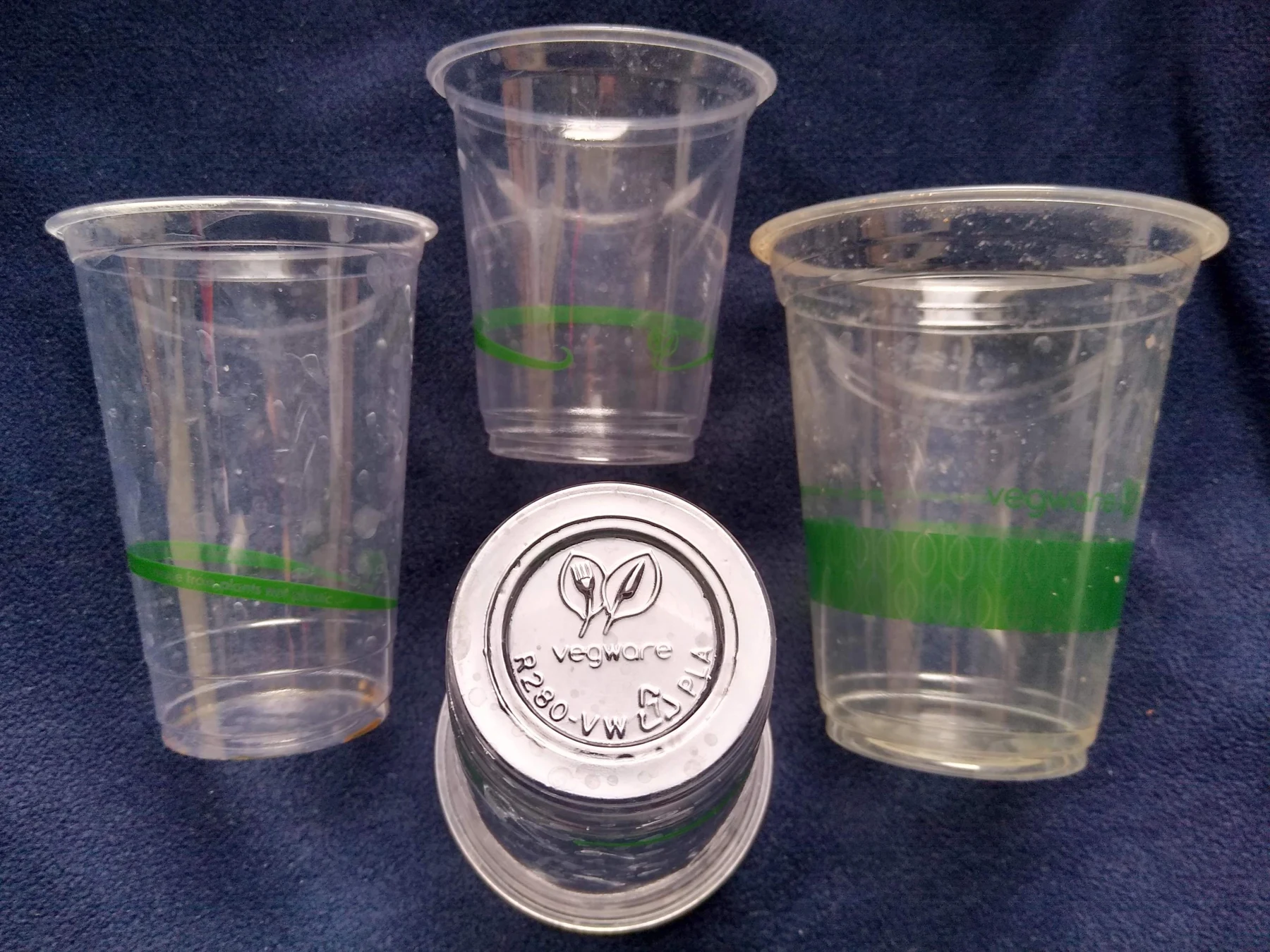
Featured photograph: Cmglee / Wikimedia Commons, CC BY-SA 4.0; resized and converted to WebP. The derivative retains that licence. Four PLA cups only; not PHA/PBAT specimens or comparative testing.
Evidence and access
This is a qualitative editorial synthesis of published research, not original testing. Relevant scientific full texts and methods were read in lawful public repositories. Cross-study mechanical, thermal and barrier numbers were not combined into a ranking. Standards use is limited to official public metadata and scope. AI-assisted source and editorial checks do not constitute human or specialist review; human editorial review remains pending after publication.
Sources
- Naser, Deiab and Darras. Poly(lactic acid) (PLA) and polyhydroxyalkanoates (PHAs), green alternatives to petroleum-based plastics: a review. RSC Advances, 2021. Full relevant text via PMC9033233; synthesis, physical/thermal/mechanical properties, permeability and applications. Review synthesis, not a common-condition performance trial.
- Materials designed to degrade: structure, properties, processing, and performance relationships in polyhydroxyalkanoate biopolymers. Polymer Chemistry; first published 2024, journal issue 2025. Full relevant text via PMC11498330, particularly structure, thermal/mechanical properties, permeability, processing and packaging sections.
- Recent advances in poly(butylene adipate-co-terephthalate) (PBAT): structure, modification strategies, degradation, and sustainable applications. Frontiers in Chemistry, 28 July 2026. Full relevant text via PMC13457383, sections2–5 and6.2. No environmental-superiority or market-adoption conclusion adopted.
- Uncompatibilized PBAT/PLA Blends: Manufacturability, Miscibility and Properties. Materials, 2020. Full text via PMC7662590; preparation/characterisation and morphology, tensile and tear results. Specific grades and forming routes, not all blends.
- Evaluation of the Physical and Shape Memory Properties of Fully Biodegradable PLA/PBAT Blends. Polymers, 2023. Full text via PMC9963890, sample preparation and sections3.2–3.4. Title terminology is not certification evidence; only the bounded morphology/mechanical results are used.
- Zumstein and colleagues. Biodegradation of synthetic polymers in soils: Tracking carbon into CO₂ and microbial biomass. Science Advances, 25 July 2018. Full methods/results via PMC6059733; labelled PBAT films in a selected agricultural soil, not universal complete degradation.
- Sashiwa and colleagues. Microbial Degradation Behavior in Seawater of Polyester Blends Containing PHBHHx. Marine Drugs, 2018. Full text via PMC5793082, sections2–3: specified copolymer, powders/thin sheets, Osaka-Nanko seawater and laboratory oxygen-demand measurements.
- Chong and colleagues. Lab-scale and full-scale industrial composting of biodegradable plastic blends for packaging. Open Research Europe, version3, 22 January 2024. Full text via PMC10899788; blend specimens, laboratory/plant methods and disintegration results, not a mineralisation or certification study.
- ASTM International. ASTM D6400-26 official catalogue record. Active edition; public scope and metadata only. Paid standard clauses not accessed.
- British Standards Institution. BS EN13432 official current-release listing. Lists BS EN13432:2000. Public title/version only; paid clauses not accessed.
- Bioleader. PLA, PHA and PBAT material map for food-packaging applications. Related-party manufacturer supplementary reading; not independent scientific, certification or performance evidence.
Found an error? Read our corrections policy and contact the editors.