A supplier writes one line on a datasheet: Material: PHA.
For a packaging buyer, that is not enough.
PHA is not one polymer. It is a family of microbially produced polyesters whose properties can range from stiff and highly crystalline to soft and elastomeric. PHB is one member of that family. PHBV and PHBH are copolymers designed, in part, to change the limitations of PHB. Their processing windows, flexibility, crystallinity, sealing behavior and degradation can differ substantially.
The first purchasing rule is therefore simple:
Do not buy “PHA” as a generic material name. Ask which PHA, which grade, which comonomer composition and which finished-package evidence.
PHA is the family name
Polyhydroxyalkanoates, or PHAs, are polyesters synthesized and accumulated by microorganisms. Different microorganisms, carbon feedstocks and fermentation conditions can produce polymers with different hydroxyalkanoate building blocks.
More than 150 PHA monomer structures have been reported in the scientific literature. That chemical diversity is why “PHA” covers such a wide property range. [S2]
At a broad level, PHA materials are often grouped by the chain length of their monomer units. Short-chain-length PHAs tend to be more crystalline and rigid. Medium-chain-length PHAs can be softer and more elastomeric. Copolymerization lets producers combine different monomer units to move the polymer between those behaviors. [S2]
For packaging, the practical names buyers most often encounter include:
- PHB — poly(3-hydroxybutyrate);
- PHBV — poly(3-hydroxybutyrate-co-3-hydroxyvalerate);
- PHBH — poly(3-hydroxybutyrate-co-3-hydroxyhexanoate).
Those names are related, but they are not interchangeable grades.
PHB is the useful but difficult baseline
PHB is the simplest and most established reference point in the PHA family.
It is semicrystalline, relatively stiff and can provide useful gas-barrier behavior. Its mechanical profile has often been compared with conventional rigid thermoplastics.
The difficulty is processability.
PHB has high crystallinity, low elongation in many unmodified grades and a relatively narrow thermal processing window. The temperatures needed for melting and forming can sit uncomfortably close to temperatures where thermal degradation becomes important.
The reviewed PHA literature identifies brittleness and a narrow thermal-processing window as important limitations of many PHB-rich grades. The limitation belongs to the actual grade and processing history, rather than every PHA formulation. [S2]
That does not make PHB a bad packaging polymer. It makes PHB a polymer that often needs formulation.
PHBV changes PHB by adding hydroxyvalerate
PHBV adds 3-hydroxyvalerate, or 3HV, units to the PHB chain.
That comonomer disrupts the highly regular PHB crystal structure. As 3HV content changes, crystallinity, melting behavior, stiffness and flexibility can change with it.
In practical terms, PHBV is often used because it can be tougher and easier to process than neat PHB.
But there is no single PHBV property set. A low-HV grade and a higher-HV grade can behave differently enough that the comonomer content belongs on the technical specification.
This is one of the recurring lessons in PHA purchasing: the copolymer name tells you the ingredients, but the monomer ratio helps tell you the behavior.
PHBH pushes the family further toward flexibility
PHBH contains 3-hydroxybutyrate and 3-hydroxyhexanoate units.
The 3-hydroxyhexanoate, or 3HH, component can reduce crystallinity and melting temperature while increasing ductility as its proportion rises. A 2022 review of PHBH describes this tunability as one reason PHBH can offer a wider processing window and better mechanical flexibility than highly crystalline PHB. [S6]
That makes PHBH relevant to applications that need more than a rigid biodegradable resin.
Depending on grade and formulation, PHBH has been investigated for:
- flexible films;
- thermoformed packaging;
- injection-molded parts;
- coatings;
- nonwovens and fibers;
- blend components;
- seal or tie-layer functions.
Again, “PHBH” is not one fixed behavior. 3HH content, molecular weight, crystallization history and blending all matter.
The family portrait
| Material | General structural tendency | Packaging advantage | Common engineering challenge |
|---|---|---|---|
| PHB | Highly crystalline homopolymer | Stiffness, gas barrier, established PHA reference material | Brittleness and narrow processing window |
| PHBV | PHB copolymer containing hydroxyvalerate | Can reduce brittleness and tune crystallinity/processability | Properties depend strongly on 3HV content |
| PHBH | PHB copolymer containing hydroxyhexanoate | Can provide greater ductility and a wider processing window | 3HH content, crystallization and grade strongly affect behavior |
| Other PHAs | Wide range of monomer and chain-length structures | Properties can span rigid to elastomeric applications | “PHA” alone provides too little information for specification |
Editorial synthesis of the cited sources. Examples are not product test results; methods, construction and conditions remain part of every claim.
This is a direction-of-travel table, not a universal ranking. Commercial grades, additives and processing history can shift the result.
Qualifying a PHA grade
Barrier performance is one reason PHAs attract packaging interest
PHA materials can provide useful oxygen, aroma and grease-barrier performance, particularly when the polymer forms a dense continuous phase.
The accessible PHA review discusses composition-dependent barrier behavior and examples of films and coatings. These are possible material functions, not a validated barrier rating for everything sold as PHA packaging. [S2]
But barrier claims need the same discipline used elsewhere in this Materials series.
A low OTR does not automatically mean low WVTR. A neat PHA film does not have the same barrier as a PHA blend. A thin coating on porous paper does not have the same performance as a freestanding film.
Always ask for the actual construction and test conditions.
See barrier-test conditions and distinct endpoints for the related evidence distinction.
PHA processing is grade-specific
“Runs on standard plastic equipment” is a useful starting statement, not a complete process specification.
PHA grades can be processed by extrusion, injection molding, thermoforming and other thermoplastic techniques, but thermal history matters. PHB-rich materials are especially sensitive because excessive residence time or temperature can reduce molecular weight and mechanical performance.
PHBV and PHBH can widen processing options, but they do not eliminate the need for:
- resin drying where required;
- controlled melt temperature;
- residence-time control;
- appropriate screw design and shear;
- cooling/crystallization control;
- grade-specific sealing or thermoforming settings.
A converter approving one PHA resin should therefore not assume that another PHA can run with the same settings.
Crystallinity follows the package out of the factory
Crystallinity is not just a resin datasheet number.
Cooling rate, annealing, film stretching and blend morphology can change the crystalline structure of the finished package. That matters because crystallinity influences stiffness, barrier performance, heat response and biodegradation.
PHB is a useful example: its high crystallinity contributes to stiffness and barrier but also contributes to brittleness. Adding HV or HH comonomers can disrupt that regular crystal structure and change the mechanical balance.
The finished package therefore carries a processing history as well as a chemical name.
PHBH is not simply “soft PHB”
The temptation is to put these materials on one straight line:
PHB = rigid → PHBV = less rigid → PHBH = flexible.
That is too simple.
Comonomer composition matters, but so do molecular weight, additives, processing, crystallization and blend partners. PHBH can be formulated into flexible structures, but some grades can still provide meaningful strength and barrier. PHBV can be highly crystalline at one composition and more ductile at another.
Think of the family as a property map, not a staircase.
Biodegradability is a major PHA advantage, but it is still condition-dependent
PHA is unusual among commercial thermoplastics because many members can be biodegraded by microorganisms across a relatively broad range of environments.
A major 2025 review in Biodegradation assessed PHA behavior in freshwater, seawater, soil, home composting, industrial composting and anaerobic environments. Its central conclusion was not that every PHA disappears at the same rate. It was that PHA biodegradation is strongly influenced by monomer composition, microstructure and environment. [S2]
That variation matters.
A buyer should never turn “PHA biodegrades in seawater” into a fixed disposal-time promise for an arbitrary PHA package.
Biodegradable does not mean “litter-safe”
Published evidence for PHA biodegradation in several environments does not by itself establish a responsible disposal instruction or a reliable disappearance time for a particular package.
Biodegradation in soil or seawater remains sensitive to temperature, microorganisms, surface area, crystallinity, specimen thickness and local conditions. A laboratory or standardized test does not mean a dropped package should be expected to disappear on demand.
For procurement and claims, separate:
- material biodegradation evidence;
- certified compostability where relevant;
- actual collection infrastructure;
- litter behavior;
- the intended disposal route.
PHA can have unusually broad biodegradation potential without making littering an end-of-life strategy.
Feedstock and sourcing evidence
PHAs are produced biologically, and commercial production commonly uses renewable or biological carbon sources. Research and industrial projects increasingly use sugar streams, plant oils, food-processing residues and other waste-derived feedstocks.
But feedstock origin still deserves documentation.
The microorganism makes the polymer, yet the upstream carbon source, fermentation process, recovery method, energy demand and purification all influence the environmental profile and economics.
A supplier should therefore distinguish:
- PHA polymer identity;
- bio-based carbon claim;
- waste/residue feedstock claim;
- mass-balance claim if used;
- finished-product biodegradation or compostability claim.
Those are related stories, not one claim.
See origin and end-of-life evidence for the related evidence distinction.
Price is still part of the technical decision
PHA packaging adoption has been limited not only by material properties but also by production cost, scale and consistency.
The PHBH author review identifies cost, availability and processing constraints at its 2022 publication date. It provides historical context, not a verified 2026 price or supply comparison; obtain current commercial evidence for an actual sourcing decision. [S6]
This affects formulation decisions. Producers may blend PHA with PLA, PBAT, starch, cellulose, mineral fillers or other components to adjust cost and performance.
That can be technically sensible, but it changes the material identity.
A package marketed prominently as “PHA packaging” may therefore not be a neat PHA resin. Ask for the formulation basis and what percentage or layer of the finished package is actually PHA.

The buyer’s document request
| Document field | Why the buyer needs it |
|---|---|
| Exact polymer | PHB, PHBV, PHBH or another PHA—not “PHA” alone |
| Comonomer content | 3HV or 3HH level can materially alter crystallinity and flexibility |
| Grade / molecular information | Different grades target film, injection, coating or other processing |
| Blend composition | PLA, PBAT, starch, fillers or additives change performance and degradation |
| Processing method | Extruded film, coating, thermoformed sheet and injection molding create different structures |
| Barrier data | OTR, WVTR, grease or other values must match the actual construction and conditions |
| Food-contact documentation | Must cover the exact resin/formulation, jurisdiction and intended use |
| End-of-life evidence | Must match the finished package, thickness and claimed environment |
| Bio-based/feedstock evidence | Should support any renewable-carbon or waste-feedstock claim separately |
Editorial synthesis of the cited sources. Examples are not product test results; methods, construction and conditions remain part of every claim.
The purchasing conclusion
Specify the polymer and comonomer content, blend and construction, processing route, and the barrier, food-contact and end-of-life evidence for the actual package. “PHA” alone cannot supply that specification.
Methodology and editorial note
This technical explainer synthesises the identified official guidance, public standard scopes and research records. Study findings remain specific to their reported materials and conditions. Sources checked 18 October 2026; no product testing, factory inspection or independent certification assessment was performed for this article.
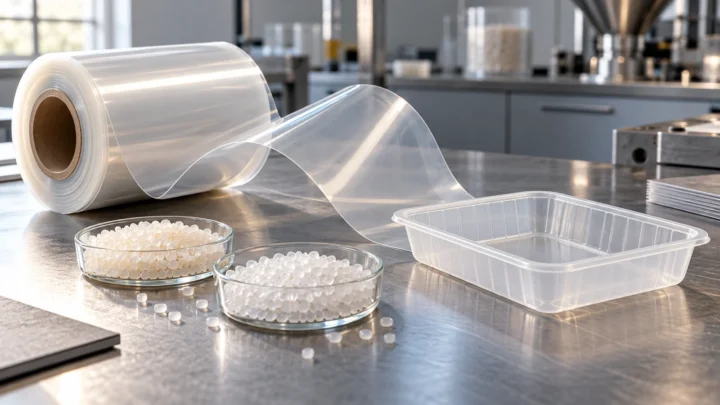
The main image is an AI-generated editorial illustration of an unnamed conceptual scene. The explanatory figure is an original editorial synthesis, not a photograph of an experiment, microscopic structure or measured result.
Official sources and reference notes
- [S2] Authors as listed in Biodegradation. Biodegradability of polyhydroxyalkanoate (PHA) biopolyesters in nature: a review. Published 2025. Identified relevant research sections and the claim-specific discussion cited above. Relevant full public sections checked; source-specific material, method and environment limits retained. Accessed 18 October 2026.
- [S6] Kerim Eraslan et al. Poly(3-hydroxybutyrate-co-3-hydroxyhexanoate) (PHBH): Synthesis, properties, and applications — A review. European Polymer Journal 167 (15 March 2022), 111044. Original-author repository abstract:3HH composition, processing window and property trade-offs. Original-author public abstract and bibliographic record checked; accepted manuscript not fully audited here. Accessed 18 October 2026.
The public corrections channel is currently inactive. Read our corrections policy.