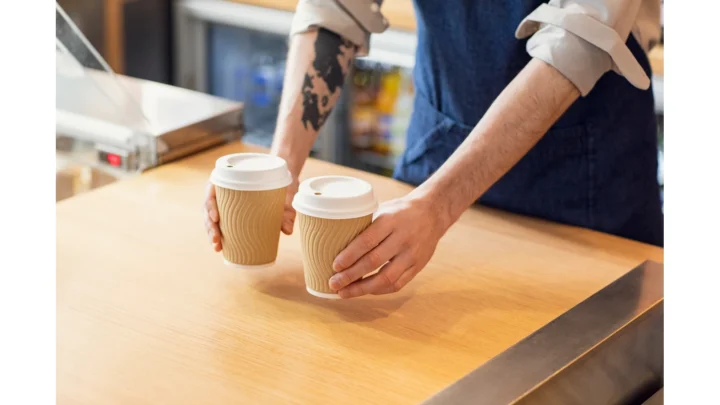
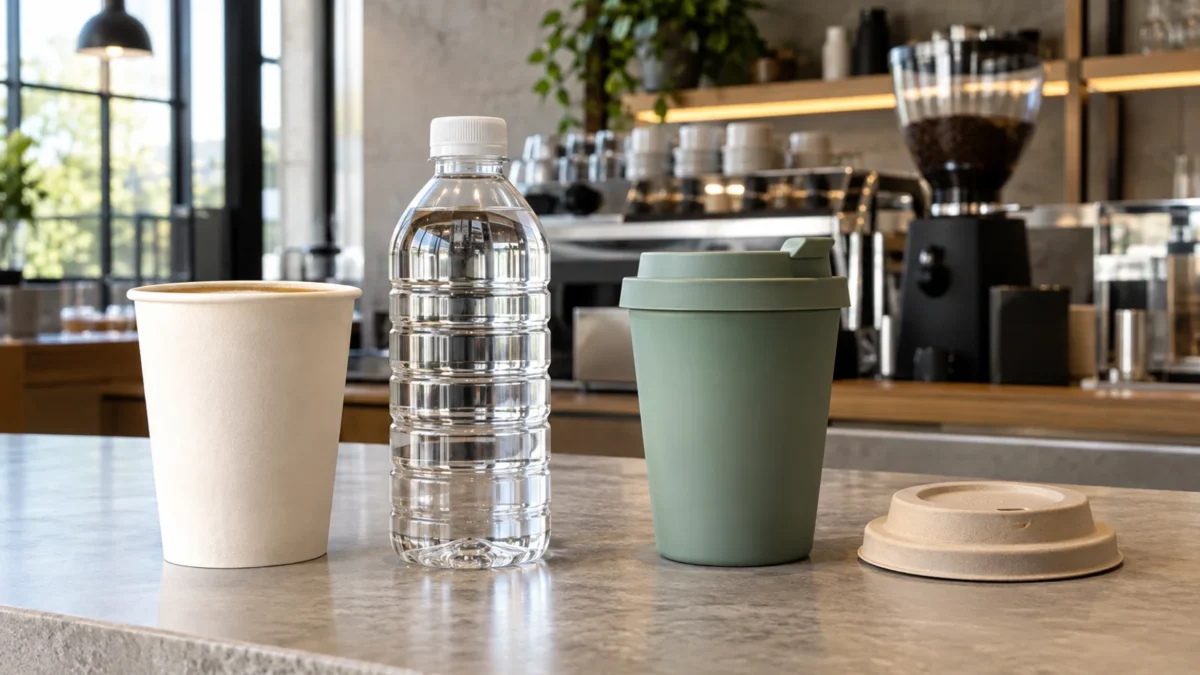
A takeaway drinks counter can serve five cups that look similar from three metres away but behave as five different packaging systems. A hot coffee may use a coated paper cup with a snap lid. An iced drink may depend on a clear PET cup and dome lid. Bubble tea may use a PP cup sealed with film. A café may offer a durable reusable cup within a return system. Another may keep the paper cup but replace the conventional plastic lid with a formed-fiber lid.
The trend is not simply “paper replacing plastic.” It is the fragmentation of one familiar object—the takeaway cup—into different cup + closure + straw or seal + carrier + recovery or return architectures. Each architecture solves a different combination of heat, clarity, stiffness, condensation, sealing, drinking access, delivery and end-of-life constraints.
One drink counter, five packaging systems
| System | Why operators consider it | What must be approved as a system |
|---|---|---|
| Coated paper cup + fitted lid | Hot-drink handling, print area, familiar café workflow | Cup wall and coating, rim, lid fit, sip opening, sleeve or double-wall need, actual fill temperature and disposal route |
| PET cold cup + lid or sealing film | High product visibility and presentation for cold drinks | Exact PET grade, rim geometry, lid or film interface, cold-use range, condensation handling and local sorting route |
| PP cup + lid or sealing film | Widely used in sealed-cup drink formats and other programs where the operating setup is built around PP | Exact cup grade, temperature range, flange/rim, film, machine tooling, seal settings, straw access and delivery handling |
| Reusable cup + return / refill system | Multiple rotations can replace repeated single-use cup consumption when the system actually recovers and reuses the cup | Durability, washing, hygiene, return method, loss rate, achieved rotations, lid compatibility and customer behavior |
| Paper cup + fiber-lid system | Reduces or removes the conventional plastic lid in selected designs while retaining a paper-cup workflow | Exact lid construction, cup-rim fit, wet/steam performance, sip geometry, coatings/additives, food-contact scope and real end-of-life route |
The same beverage can move between these systems without changing its recipe. What changes is the package’s job. That is why procurement based on “12 oz cup” or “90 mm lid” alone is increasingly inadequate. [S1] [S2]
System 1: the paper cup is not just paper
Paper remains a natural starting point for hot coffee and tea because the cup body can provide stiffness and a printable exterior without requiring a transparent wall. But the finished package must still manage liquid contact. Many paper beverage cups use a polymer lining or coating, and the lid may add another material. [S1] [S4]
That construction matters technically and legally. In the European Union, the Commission’s updated September 2026 guidance on the Single-Use Plastics Directive explicitly lists paper-based beverage cups with plastic lining or coating—including bio-based or biodegradable plastic lining or coating—as within the Directive’s scope when the other single-use cup criteria are met. A paper exterior therefore does not by itself make a single-use beverage cup “plastic-free” for EU SUP purposes. The current Commission notice is available through EUR-Lex.
For performance, the approval question is similarly construction-specific: Is the wall single- or double-wall? Is a sleeve needed? What is the actual filling temperature? Does the rim maintain the intended lid fit after filling? Does the coating continue through the critical liquid-contact area? Those are finished-package questions, not answers supplied by the word “paper.”
System 2: PET makes the drink visible—but the recovery route is not self-evident
Clear cold-drink packaging turns the beverage itself into part of the display. That is one reason PET cups appear in iced coffee, juice, smoothies and other visually merchandised drinks. But clarity is only the first design decision. Operators still have to choose between flat lids, dome lids, straw openings and heat-sealed film, then verify the complete cup-rim interface. [S7]
End-of-life needs the same caution. RecyClass’s current European tool treats plastic packaging according to the main polymer, shape, colour and the stream in which it can actually be sorted. For rigid PET packaging such as cups, pots and tubs, RecyClass specifically tells users to check whether the item is sorted into an applicable PET bottle or PET tray stream; a PET cup that ends up in mixed plastics cannot simply be assumed to have the same recyclability pathway as a PET bottle. See the current RecyClass tool.
So “PET cup” describes the main polymer. It does not establish collection, sorting, reprocessing or actual recycling in a particular market.

System 3: PP plus sealing film turns the cup into a machine interface
Bubble tea and other sealed-cup formats expose a packaging constraint that snap lids can hide: the cup has to work with a machine. The relevant unit is no longer just the cup. It is the exact cup rim, support or holder, sealing film, sealant layer, machine tooling and operating window. [S11] [S12]
Heat sealing is controlled by variables including temperature, dwell time and pressure, and the material at the seal interface has to form the intended bond. Peer-reviewed heat-seal studies demonstrate how changing these variables changes seal strength and failure behavior; they do not provide a universal setting for beverage cups. Commercial cup-sealer suppliers likewise publish different film pairings for PP, PET and other cup structures and normally require confirmation on the actual container and machine.
This has a practical consequence for sourcing: two cups with the same nominal mouth diameter can still behave differently if their rim profile, wall support, flange thickness or thermal response differs. A supplier drawing can screen candidates, but production approval should include the intended film and machine.
The same rule applies to the straw. A large-bore straw for pearls, a small straw for tea, and a sip opening in a rigid lid are three different access systems. Puncture force, seal tearing and the risk of pushing the film into the drink should be checked with the actual straw and seal—not inferred from cup material.
System 4: reuse changes the factory problem into an operating-system problem
A reusable cup can avoid repeated manufacture of single-use cups only if it completes enough real rotations. That makes washing, return convenience, loss, lid management and customer participation part of the package design. [S8] [S9] [S13]
Life-cycle studies do not produce one universal break-even number. A 2024 peer-reviewed LCA comparing several cup types found that the reusable PP and steel cups in its modeled system needed at least 54 uses to match or beat the paper-cup reference for climate-change impact, while break-even counts differed substantially for other impact categories and washing assumptions. Another reusable-cup LCA found that washing strategy and transport distance can materially change the break-even point. These are scenario results, not a rule that every reusable cup becomes preferable after a fixed number of uses.
For operators, the useful metric is therefore achieved rotations under the real washing and return system, not the manufacturer’s theoretical durability alone.
EU rules are also pushing takeaway drinks toward refill and reuse
The EU Packaging and Packaging Waste Regulation (PPWR) now adds a separate system-level driver. Article 32 states that by 12 February 2027, final distributors in the HORECA sector making hot or cold beverages available in takeaway packaging must provide a system allowing consumers to bring their own container for filling. Article 33 states that by 12 February 2028, covered final distributors must give consumers the option of receiving takeaway beverages in reusable packaging within a reuse system; Article 33(4) exempts final distributors that meet the specified micro-enterprise definition from that Article 33 obligation. [S5] [S6]
Those dates and scopes should not be collapsed into a slogan such as “the EU is banning disposable coffee cups.” It is more accurate to say that the PPWR is adding refill and reuse obligations to a market that will continue to contain several packaging formats. The operative text is in Regulation (EU) 2025/40.
System 5: the lid is becoming its own redesign project
The cup body can remain familiar while the lid changes completely. Some manufacturers market formed-fiber lids for defined hot- and cold-drink paper-cup applications. Huhtamaki, for example, lists fiber lids made from plant-based fiber and states that selected products contain no plastic coating and are designed to fit specific paper-cup ranges. Those are manufacturer statements about defined products, not evidence that every fiber lid has the same composition or end-of-life outcome. [S10]
Fiber-lid systems create their own engineering questions. A lid has to retain its shape around a warm, wet rim, engage consistently with the cup bead, survive handling, and provide the intended sip or straw opening. If a coating, additive or treatment is present, it must be evaluated as part of the finished construction. “Fiber lid” is a format description, not a certification.
It also does not make the whole drink package fiber-only if the cup has a polymer lining, a plastic window component, a separate sealing film or other polymeric elements.
The EU PLA/CPLA trap: “compostable plastic” is still plastic under SUP
This is one of the most important specification traps for European buyers. Directive (EU) 2019/904 was drafted to cover bio-based and biodegradable plastics within its plastic definition rather than exempt them because of feedstock or intended biodegradation. [S1] [S2] [S3]
But the legal consequence depends on the product category. Under the current consolidated Directive, single-use plastic straws, cutlery and beverage stirrers are among the products listed in Part B and subject to Article 5 restrictions on placing them on the market. A PLA or CPLA version does not escape that rule merely because the polymer is compostable.
Single-use beverage cups sit differently in the Directive. Cups for beverages are covered by consumption-reduction, marking, extended-producer-responsibility and awareness provisions, while the Part B market restriction specifically includes expanded-polystyrene beverage cups. Therefore, it is also inaccurate to write “all PLA cups are banned in the EU.” The correct analysis asks what the product is—cup, straw, stirrer, lid or another component—and which provision applies.
For beverage cups within the marking rules, Implementing Regulation (EU) 2020/2151 distinguishes cups made partly from plastic from those made wholly from plastic. The harmonised markings include “PLASTIC IN PRODUCT” for partly plastic cups and “MADE OF PLASTIC” for wholly plastic cups under the specified conditions.
A sealing film can replace a rigid lid without simplifying the system
A lidding film removes the need for a snap-on lid during service, but it adds a converting interface. The operator now depends on roll width, print registration where relevant, machine temperature control, tooling, sealant compatibility and a clean cup rim. It may also add another material that has to be considered in the package’s end-of-life design. [S11] [S12]
For a bubble-tea shop, this can still be the right system because sealing film controls the opening until the customer inserts a straw and can reduce accidental lid removal during handling. But the film should be specified as part of the cup system, not purchased as a generic accessory labeled only “for PP” or “for PET.”
Condensation moves the problem outside the cup
Cold drinks introduce a failure mode that hot-cup discussions often overlook: external condensation. Water on the outside of a cup can affect grip, printed sleeves, cup carriers, paper delivery bags and the base of multi-cup trays. A perfectly sealed cup can therefore still create a delivery problem. [S12]
The approval test should use the actual beverage temperature and ambient conditions expected in service. Check whether the cup becomes slippery, whether labels or printing remain stable, whether the carrier retains strength when damp and whether condensed water collects where cups contact one another. These are operational observations; they should not be replaced by a generic material claim such as “PET does not sweat” or “paper absorbs condensation.”
The carrier is part of the beverage package
For delivery and multi-drink takeaway, the four-cup carrier may be the component that determines whether the system survives the trip. Cup diameter, taper, center of gravity, lid height and drink mass all affect how the cup sits in the carrier. A dome lid can also change stacking or bag clearance. [S7]
Testing an empty carrier is not enough. Load it with the heaviest intended drinks, include the actual lids or sealed films, reproduce the delivery bag and walk the route. Wet-strength loss from condensation should be observed where paper-based carriers are used.
Choose by beverage and operating model, not by a universal material score
| Drink / operation | Likely system questions | Do not assume |
|---|---|---|
| Hot coffee | Paper or reusable cup; lid fit; sleeve/double wall; sip geometry; fill temperature; reuse option | Paper cup = plastic-free; fiber lid = automatically compostable everywhere |
| Iced coffee / juice | Clarity requirement; PET/PP/paper cold-cup option; lid or film; condensation; carrier | Clear PET = automatically recycled locally |
| Bubble tea | PP/PET/other approved cup; sealing film; machine/tooling; large-bore straw; delivery seal integrity | Same diameter = same sealer compatibility |
| Smoothie | Visibility; dome headspace or seal; viscosity; straw opening; cold condensation; delivery stability | One lid geometry works for every fill level or topping |
| Takeaway tea | Hot-fill condition; cup wall; lid/fiber-lid fit; sip opening; carrier; reusable option | Material family alone establishes safe service temperature |
End-of-life has to be checked after the system is assembled
A cup can gain a lid, sleeve, label, sealing film, straw and carrier before it reaches the customer. Those components may follow different recovery routes. Design-for-recycling guidance therefore evaluates more than the main resin, and paper-system claims similarly depend on the complete construction and the relevant collection/reprocessing route. [S8] [S9] [S7]
Compostability needs the same discipline. A PLA resin claim does not establish that a printed cup, sealing film, lid and adhesive combination is certified compostable as one finished package. Even a certified item is not evidence that a local composting facility accepts it.
For reusable cups, end-of-life is only part of the story. The system also needs actual return and washing data. For single-use PET, PP, paper or fiber systems, collection and processing infrastructure can determine whether the intended recovery route happens in practice.
The approval unit is no longer “the cup”
A useful beverage-packaging trial should record the complete configuration: beverage, fill temperature, cup SKU, lid or film SKU, straw where used, sealer and tooling where used, carrier, hold time and delivery method. The test should then look for lid lift, leakage, rim distortion, seal peel, straw puncture problems, condensation, carrier softening and customer handling issues. [S1] [S5] [S7]
That is the reason on-the-go drink packaging is splitting into multiple systems. Paper, PET, PP, reusable cups and fiber lids are not five interchangeable sustainability answers. They are different ways of allocating the same jobs—containment, drinking access, temperature handling, presentation, transport and recovery. The winning system is the one that performs those jobs under the actual beverage and operating conditions, while meeting the legal and end-of-life requirements of the market where it is used.
Methodology and editorial note
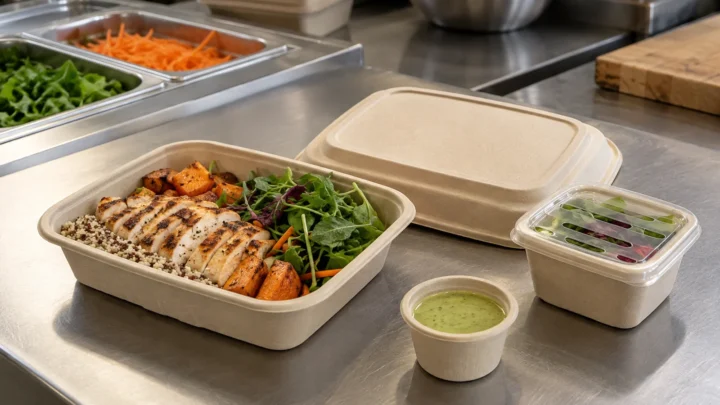
This compares complete drink-service formats rather than standalone material labels. Legal obligations are described within the cited EU product scope; environmental comparisons are bounded by the studies’ assumptions and local recovery availability. Sources checked 21 October 2026. The main image is an AI-generated generic editorial illustration, not a named company, real facility or tested product. Editorial Team human review remains pending after publication.
Sources and reference notes
- [S1] European Commission, Directorate-General for Environment. Commission Notice – Updating Commission guidelines on single-use plastic products in accordance with Directive (EU) 2019/904. Sections 2.1–2.2; Table 9 (illustrative examples of cups for beverages). Accessed 21 October 2026.
- [S2] European Union. Directive (EU) 2019/904 — consolidated text. Article 3 definitions; Articles 4, 5, 7, 8; Annex Parts A, B, D, E, G. Accessed 21 October 2026.
- [S3] European Union. Directive (EU) 2019/904 — Official Journal text. Recital 11; Article 3. Accessed 21 October 2026.
- [S4] European Commission / European Union. Commission Implementing Regulation (EU) 2020/2151. Annex IV — Harmonised marking specifications for beverage cups. Accessed 21 October 2026.
- [S5] European Union. Regulation (EU) 2025/40 on packaging and packaging waste. Article 3(3); Article 32; Article 33. Accessed 21 October 2026.
- [S6] European Commission. Commission Notice – Guidance document for Regulation (EU) 2025/40 on packaging and packaging waste. Re-use definitions; HORECA beverage reuse interpretation; national flexibility sections. Accessed 21 October 2026.
- [S7] RecyClass. RecyClass Online Tool — Plastics / Design for Recycling. Packaging type/main polymer/sorting workflow; PET rigid packaging note; Tub, Pot & Cup option. Accessed 21 October 2026.
- [S8] Peer-reviewed reusable-cup LCA. A tasty solution to packaging waste? Life cycle assessment of edible coffee cups. Abstract; reusable-cup inventory/sensitivity; Table 5 break-even analysis. Accessed 21 October 2026.
- [S9] Peer-reviewed reusable cup deposit/return LCA. Assessment of the environmental break-even point for deposit return systems through an LCA analysis of single-use and reusable cups. Abstract / break-even methodology summary. Accessed 21 October 2026.
- [S10] Huhtamaki. Fiber lids for paper cups. Composition/use claims. Accessed 21 October 2026.
- [S11] Kai Will / YODO. Which Sealing Film for PP, PET and Paper Cups?. Film/cup compatibility explanation and pairing table. Accessed 21 October 2026.
- [S12] Heat-seal engineering evidence. Development of a Biopolymer-Based Anti-Fog Coating with Sealing Properties for Applications in the Food Packaging Sector. Experimental heat-sealing section. Accessed 21 October 2026.
- [S13] S7. Combining conjoint analysis and life cycle assessment to design a business model for rental reusable cups in Taiwan. Abstract. Accessed 21 October 2026.
The public corrections channel is currently inactive. Read our corrections policy.