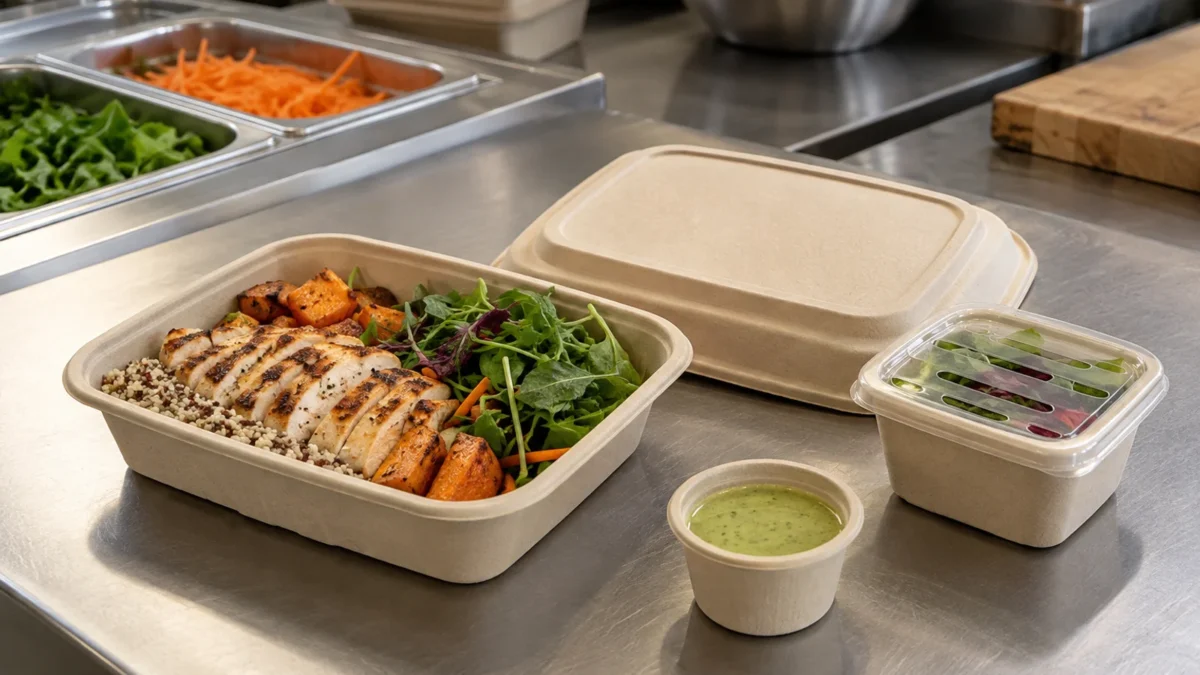
A delivery meal rarely has one packaging problem. A rice-and-curry order may contain a hot, wet main dish, a cold salad, a crisp fried side, a sauce cup, a garnish that wilts in steam, and a drink that should never share the same thermal conditions as the food. The package therefore has to do more than “hold the meal.” It has to manage several small environments while the order waits on a shelf, is stacked in a courier bag, tilts through turns and braking, and may sit another ten minutes before the customer opens it.
That is why takeaway packaging is increasingly better understood as a system of container, lid, vents, compartments, sauce packaging, secondary bag and operating instructions. Material choice matters, but it is only one variable. The more useful design question is: what happens to each part of the meal between kitchen pass and first bite?
Start with the meal journey, not the container catalogue
A package can look excellent on a counter and still fail in delivery. The failure may not be structural. It can be a wet crust, a cold main dish, dressing that migrated into a salad, sauce that reached the lid rim, a lid that lifted under stacking load, or a tamper feature that broke without making entry obvious. [S1] [S2]
Reconstructing the order by food behavior makes those risks visible before a material is selected.
| Meal zone | What changes during delivery | Packaging job | Typical failure signal |
|---|---|---|---|
| Hot wet main | Releases heat and steam; liquid moves during braking and tilt | Retain acceptable temperature, control liquid, keep closure engaged | Leaking rim, lid lift, softened wall, excessive cooling |
| Fried or crisp food | Moisture migrates from the food and vapor accumulates in the headspace | Release enough moisture without making the pack unstable or excessively cooling the food | Condensation, softened coating, wet base |
| Cold side or salad | Warms if packed beside hot food; can wilt if exposed to steam | Limit heat and moisture transfer from the hot zone | Warm salad, wilted leaves, condensation |
| Sauce or dressing | Sloshes and loads the closure during motion | Contain liquid independently and prevent migration into other foods | Wet rim, seepage into bag, soggy food |
| Garnish / topping | Texture can change quickly after contact with heat or moisture | Delay mixing until consumption where necessary | Softened herbs, soaked croutons, collapsed topping |
The point is not that every order needs five separate packages. It is that each food component has a different failure mode. A useful package system groups together foods that can tolerate the same moisture, temperature and movement conditions, and separates those that cannot.
The first ten minutes create a different package environment
Freshly packed hot food keeps releasing heat and water vapor. In a closed pack, some vapor reaches cooler surfaces and condenses. For crisp foods, that moisture matters. Research on bread crust and breaded fried foods has repeatedly shown that increasing moisture in a dry, brittle crust changes perceived crispness. That does not prove that a particular vent design will keep a specific menu item crisp, but it explains why steam management is a packaging function rather than a cosmetic feature. [S2] [S3]
Venting creates a trade-off. Too little moisture release can accelerate condensation. Too much open area can increase heat loss, allow liquid to reach a vent during motion, or expose the food to the surrounding delivery environment. The engineering target is therefore not “maximum ventilation.” It is controlled moisture release for the specific food, portion, headspace and delivery time.
Commercial formats already reflect this approach. Anchor Packaging, for example, says its Crisp Food Technologies line uses through-closure ventilation, lid vents and raised airflow channels to relieve moisture while retaining temperature. That is a company performance claim, not independent proof that the system will work for every menu. Its editorial value is the design pattern: manufacturers are treating airflow as part of the container geometry rather than adding a few holes as an afterthought.
Temperature retention cannot be predicted from the material name alone
A 2025 peer-reviewed study of simulated hot ready-to-eat meal delivery compared polypropylene trays with sugarcane-bagasse trays, both heat-sealed with film and placed in different secondary carriers. Under the tested conditions, meals in the PP trays took longer to cool to the study’s 40°C reference point than meals in the bagasse trays. The study also found effects from external temperature, the secondary carrier and the number of tray layers. [S2]
That result is useful precisely because it resists a common shortcut. A material family does not determine the thermal result by itself. Wall geometry, lid or film, headspace, secondary insulation, stack configuration, fill mass and starting temperature all contribute. The authors also reported a large imbalance in the number of PP and bagasse tray observations, so the finding should not be turned into a universal ranking. It is evidence that complete pack configuration matters, not evidence that one material is categorically superior.
The full study is available through PubMed Central.

Sauces make the lid a moving-load component
A sauce-heavy dish changes the job of the closure. On the restaurant counter, hydrostatic load may be small and the container may sit level. In a courier bag, the same food can repeatedly reach the rim during acceleration, braking, cornering and lifting. The lid must remain engaged while the base is warm, while other packs may be stacked above it, and while staff may have closed it at speed. [S3] [S4]
This is why “leak-proof” should not be treated as a material adjective. Leakage is a property of the filled container–closure system under defined conditions. Rim geometry, snap engagement, paperboard folds, coating continuity, lid stiffness, fill level, sauce viscosity and temperature can all change the outcome.
Separate sauce cups can solve more than spill control. They can protect fried coatings, salad leaves and rice from premature moisture exposure. But they also add another component, another closure and more packaging mass. A good system uses separation where it protects the meal, not by default.
Tamper evidence solves a different problem from leak control
A tight lid and a visible tamper feature are not interchangeable. A lid can resist leakage but still be opened and reclosed without obvious evidence. Conversely, a sticker, band or sealed outer bag can make entry more visible without improving liquid containment. [S1]
For U.S. online food delivery, the FDA has highlighted nonbinding best practices developed with food-safety partners that cover packaging, temperature control, contamination, allergens and other last-mile risks. The agency also distinguishes guidance from legally enforceable requirements. In other words, tamper resistance and packaging controls belong in the delivery-system discussion, but their exact legal status depends on jurisdiction and operation; this article does not treat one tamper format as a universal mandate. The FDA overview is available here.
One order can contain incompatible temperature zones
The common “one large compartmented box” solution works only when the foods tolerate similar conditions. A hot curry and warm rice may share a thermal zone. A cold slaw beside that curry does not. A crisp fried side trapped next to a steaming main can experience a completely different moisture load than it would in a vented pack. [S2]
There are several ways to create temperature or moisture zones:
- Separate primary packs: the clearest physical separation for hot, cold, wet and crisp foods, at the cost of more components.
- Rigid compartments: useful for portion control and limiting lateral food movement, but they do not necessarily stop heat or vapor transfer through the common headspace.
- Independent sauce cups: keep high-moisture components away from dry foods until eating.
- Secondary insulation: the courier bag or insulated carrier can become part of thermal performance; it should not be ignored when comparing primary containers.
- Timed assembly: in some menus, packaging the fried component last or keeping dressing separate may improve delivered quality without changing the base material.
This is a system-design decision, not simply a choice between one-compartment and three-compartment trays.
Stacking and courier motion expose failures that a desk test misses
Warm packaging behaves differently from empty packaging at room temperature. A loaded base can deform, a lid can disengage, a paper structure can soften after prolonged contact with steam or grease, and a stack can transfer load onto a hot lid. The bottom pack in a delivery bag may therefore face conditions that the top pack never experiences. [S6]
There is no single universal laboratory test that represents every restaurant-delivery route. However, established distribution-testing practice is a useful reminder that a package should be evaluated as a packaged-product system under the hazards it will actually experience. ISTA’s generalized e-commerce work, for example, identifies vibration, shock, compression, temperature and humidity as relevant direct-to-consumer distribution hazards. Restaurant meal delivery is a different distribution system, so an e-commerce protocol should not be copied blindly; the transferable principle is to validate the complete pack against the real route rather than test an empty container in isolation. See ISTA’s 3L overview for that broader packaged-product testing logic.
Material labels are poor shortcuts for delivery performance
| Format / material family | Where it may be useful | What must be verified on the finished pack |
|---|---|---|
| Molded fiber / bagasse | Rigid meal trays, clamshells and compartmented formats | Wet strength, grease/water barrier, lid fit, steam exposure, hold time, coating/additive system and food-contact scope |
| Coated paperboard | Folded boxes, bowls and cartons where printability and low pack weight are useful | Coating chemistry, edge wicking, fold integrity, grease resistance, leak path, vent design and actual use temperature |
| PP rigid containers | Applications needing robust closures and heat-tolerant rigid structures, depending on the grade and design | Finished-pack temperature range, rim and hinge behavior, stack load, lid fit, reheating instructions and food-contact scope |
| Clear plastic lids, including PET-family formats | Visibility and presentation where compatible with the base and service conditions | Actual lid grade, temperature range, deformation, seal engagement and whether it must be removed before reheating |
| Fiber lids | Fiber-forward systems where a molded or formed lid can meet the closure task | Dimensional fit, steam deformation, barrier system, vent behavior and leak performance |
| Aluminum trays | Selected high-heat or oven-related service routes where the finished format is specified for that use | Closure, food compatibility, handling temperature and explicit appliance/reheating instructions; do not assume microwave suitability |
| Hybrid systems | Applications where different components solve different functions | Component compatibility, separation, food contact, recovery route and whether added complexity is justified by performance |
The same caution applies to end-of-life claims. A fiber-looking container is not automatically plastic-free, recyclable or compostable. A PP or PET component is not automatically collected or recycled in every market. Those claims require the finished construction, local recovery system and current acceptance conditions to be checked separately from delivery performance. [S3] [S5]
Reheating is a second use condition, not an extension of delivery
A package that survives a 25-minute trip is not automatically suitable for reheating. Reheating changes temperature, pressure, steam generation and sometimes the mechanical load on the lid. If customers are expected to microwave or oven-heat the food, the complete intended configuration needs its own instructions and evidence. [S1]
That includes the base, lid, coating, print, adhesive, seal and any film. A clear lid may need to be removed before heating. A fiber pack may contain a barrier layer with a different service window from the substrate. An aluminum tray may be intended for an oven route but require specific microwave restrictions. The correct instruction comes from the finished-pack specification and the intended appliance, not from the material name alone.
A practical delivery test should reproduce the meal, not just the package
Before a chain, cloud kitchen or distributor approves a new takeaway system, a simple route simulation can reveal problems that catalogue data will not. This is an editorial test framework, not a substitute for a recognized laboratory method or food-safety validation. [S1] [S6]
- Pack the real menu at the real fill weight and dispatch temperature. Include sauces, oil, garnish and the normal headspace.
- Close it the way kitchen staff actually will. Use several operators if closure consistency matters.
- Run the expected hold and delivery time. Check at practical intervals such as dispatch, 10, 20 and 30 minutes rather than only at the end.
- Test the real stack. Put the normal number and weight of packs above the sample.
- Reproduce movement. Carry it in the normal delivery bag and include tilt, braking, turns and repeated handling without inventing a “standardized” severity that has not been validated.
- Open and score each meal zone. Record leakage, lid engagement, deformation, condensation, crispness, sauce migration, cold-side warming and presentation.
- Test reheating separately if it is part of the customer journey. Follow the finished-pack instructions and verify the entire component set.
The most useful result is not “Package A passed.” It is a failure map: which food failed, at what point in the journey, under what fill and handling conditions, and which package component caused or prevented the failure.
The design target is a stable meal, not a winning material
Takeaway packaging is becoming a system because the meal itself is a system. A vent that protects fried texture can conflict with heat retention. A tighter seal that protects sauce can increase condensation around a crisp food. A three-compartment tray can control portions while still sharing one humid headspace. A highly insulated delivery bag can change the relative importance of the primary container. [S1] [S2] [S6]
There is therefore no universal “best material for food delivery.” The better design is the one that keeps the specific meal within its required temperature, moisture, containment and handling limits for the actual delivery route, while separately meeting food-contact and end-of-life requirements. The practical unit of design is no longer the box. It is the meal journey.
Methodology and editorial note
A practical design framework drawing on food-delivery research, FDA safety advice and distribution testing. It is not an independent food-contact approval or performance test of any named container. Sources checked 21 October 2026. The main image is an AI-generated generic editorial illustration, not a named company, real facility or tested product. Editorial Team human review remains pending after publication.
Sources and reference notes
- [S1] U.S. Food and Drug Administration. FDA Highlights Best Practices on Food Safety for Online Delivery Services. Main constituent update; paragraphs describing CFP/USDA/CDC collaboration and best-practice topics. Accessed 21 October 2026.
- [S2] Hot ready-to-eat meal delivery study. Key Factors Influencing Bacillus cereus Contamination in Hot Ready-to-Eat Meal Delivery. Abstract; Materials and Methods; Table 1; Figure 2; discussion of primary wrapping and secondary carrier. Accessed 21 October 2026.
- [S3] Crispness. Water content or water activity: what rules crispy behavior in bread crust?. Abstract. Accessed 21 October 2026.
- [S4] Breaded fried food sensory crispness study. Sensory Assessment of Crispness in a Breaded Fried Food Held Under a Heat Lamp. Abstract. Accessed 21 October 2026.
- [S5] Anchor Packaging. Crisp Food Technologies® Containers. “How the Unique Design Keeps Food Hot & Crispy” and product-range sections. Accessed 21 October 2026.
- [S6] International Safe Transit Association (ISTA). ISTA 3L Generalized E-commerce Retailer Fulfillment Test. Overview; hazard description; development and validation sections. Accessed 21 October 2026.
- [S7] Packaging World. New Paper Carton with Venting Keeps Fried Chicken Crispy. Article summary and package description. Accessed 21 October 2026.
The public corrections channel is currently inactive. Read our corrections policy.