Short answer: “Eco-friendly packaging” is not a single material, certification or universally defined technical category. In practical packaging work, it should mean a package whose environmental claim is tied to a specific, evidenced improvement—such as lower material use, credible reuse, recycled content, design for recycling, verified compostability, lower toxicity or a demonstrated life-cycle benefit—without sacrificing the package’s core job of protecting the product.
That last condition matters. A package that uses less material but causes more product damage, food waste or transport failure may not deliver the environmental improvement its label implies. Likewise, a recyclable, compostable or bio-based material can still be a poor choice when the relevant collection or treatment system does not exist.
This guide focuses on turning a proposed environmental message into an evidence request. For the broader system-level decision, start with What Is Sustainable Packaging?; the material examples below are a claim-review worksheet, not a ranking.
“Eco-friendly packaging” is a claim, not a material specification
Packaging is often marketed with broad terms such as “green,” “earth-friendly,” “sustainable” or “eco-friendly.” Those words can be useful shorthand in ordinary conversation, but they are weak engineering specifications because they do not identify what environmental attribute has improved.
The U.S. Federal Trade Commission’s current Green Guides specifically caution marketers against broad, unqualified general environmental benefit claims such as “green” or “eco-friendly,” because those claims can imply wide-ranging benefits that are difficult or impossible to substantiate. The FTC recommends qualifying broad claims with clear, specific environmental benefits. [R1]
Directive(EU)2024/825 requires Member States to apply their transposing measures from 27 September 2026. It adds a prohibition on generic environmental claims without demonstrated “recognised excellent environmental performance” relevant to the claim—a defined legal condition, not merely any supporting study. This is a Directive-level account; this article does not audit each country’s transposition or decide whether a particular advertisement complies. [R2]
For packaging teams, this means “eco-friendly” should be the start of a question, not the end of one.
| Broad statement | More specific question | Evidence that may be needed |
|---|---|---|
| Eco-friendly | Which environmental attribute has improved? | Defined comparator, scope and supporting technical or life-cycle evidence. |
| Recyclable | Can the finished package enter and survive the intended recycling system? | Construction, design-for-recycling evidence, collection/sorting access and process compatibility. |
| Made with recycled content | How much recovered material is actually in the package? | Percentage, component scope and traceable recycled-material input. |
| Compostable | Industrial or home compostable, and for which finished item? | Current finished-item certification/test plus local facility acceptance where disposal advice is given. |
| Bio-based | Which fraction comes from biological feedstock? | Material composition / renewable-carbon evidence where relevant. |
| Reduced packaging | Reduced compared with what baseline? | Weight/volume comparison using the same packaging function. |
Editorial synthesis; qualitative comparisons are evidence questions, not measured product rankings. [R1] [R2] [R7]
Start with the package’s job
Environmental design begins with function. Packaging can protect against impact, moisture, oxygen, contamination, light, leakage, tampering and product loss. It can also provide dosing, handling, transport efficiency and information.
For food in particular, packaging can prevent a larger environmental burden by protecting the product. FAO notes that appropriate packaging can preserve food quality and safety, extend shelf life and reduce food loss and waste. [R3]
This creates an important design rule:
The lowest-material package is not automatically the lowest-impact package if it increases product loss or failure.
A thinner tray that cracks during distribution, a paper pack that loses barrier performance, or a reusable container that is never returned can all underperform despite appearing environmentally preferable at first glance.
Recyclable packaging depends on real infrastructure
Recyclability is one of the most common environmental attributes, but it is also one of the easiest to oversimplify.
A package can be made from a recyclable material and still fail because of:
- incompatible coatings or laminates;
- large labels or sleeves;
- problematic adhesives;
- small format or unusual geometry;
- food contamination;
- lack of local collection;
- sorting limitations;
- lack of a compatible mill or reprocessor.
EPA’s recycling guidance distinguishes recyclable material from actual local acceptance, and the FTC’s Green Guides qualify recyclable marketing claims based partly on access to appropriate facilities. [R1] [R7]
So a strong packaging specification should identify the exact recycling stream and geography, not merely use a recycling symbol or resin name.
Recycled content and recyclability solve different problems
Recycled content reduces demand for virgin material by using material recovered from an earlier production or use cycle. Recyclability describes what may happen to the finished package after use.
A package can contain high recycled content and still be difficult to recycle. Conversely, a highly recyclable package can contain no recycled content.
The FTC’s guidance keeps these claims separate, and buyers should do the same. [R1]
When comparing recycled-content packaging, check:
- post-consumer versus pre-consumer / post-industrial source;
- percentage by the relevant component or package;
- quality requirements;
- food-contact or safety constraints where applicable;
- whether the finished package remains recyclable.
Paper and paperboard: familiar recovery route, but barriers matter
Paper and paperboard can be good packaging platforms when fiber recovery is available and the package provides enough product protection. Corrugated boxes, cartons, paper trays and cups can also use high levels of recycled fiber depending on the application.
The trade-off is barrier performance. Moisture, oil and gas resistance can require PE, PLA, aqueous coatings, waxes, laminates or other functional layers. Those additions can alter repulpability and mill acceptance.
Paper should therefore not be selected because it “looks natural.” The complete construction has to be assessed.
Molded fiber and agricultural-fiber packaging
Molded fiber can use wood pulp, recycled fiber, bagasse, bamboo, straw and other cellulose sources. It is especially useful when a three-dimensional tray, food container, protective insert or cushioning component can replace a more complex plastic or foam structure.
Its environmental case depends on:
- fiber source;
- product weight;
- forming and drying energy;
- additives and coatings;
- product-protection performance;
- actual recycling or composting route.
Bagasse is a good example of why feedstock origin alone is insufficient: the fiber can come from sugarcane residue, but the finished package may still contain wet-strength chemistry, barrier treatment or polymer components that affect recovery and claims.
Plastic packaging: sometimes the better system choice
Plastic is often treated as the opposite of eco-friendly packaging, but that framing is too simple.
Plastic can deliver strong barrier performance, low mass, high impact resistance and efficient transport. In applications where those properties materially reduce product loss or total packaging weight, replacing plastic with a heavier or less protective material can create trade-offs.
The more useful question is whether the plastic package:
- uses no more material than necessary;
- can move toward mono-material design where appropriate;
- contains verified recycled content where technically and legally feasible;
- is compatible with an actual collection and recycling stream;
- avoids unnecessary additives or components that disrupt recycling.
UNEP’s report record describes lifecycle assessment across a packaging system’s value chain. This guide does not extract a universal ranking from that report or claim to have audited its underlying studies. [R8]
Glass and metal: highly recoverable, but weight matters
Glass, steel and aluminium can participate in well-established recycling systems in many markets and can be useful in refill/reuse systems. They also provide strong gas, aroma and moisture barriers.
The trade-off is mass and, in some applications, production energy. A heavy container transported long distances can shift the environmental profile even when the material itself is highly recyclable.
This does not make glass or metal “bad.” It shows why recyclability alone should not be treated as a complete sustainability score.
Compostable and bio-based packaging: use where the route is credible
Bio-based plastics, compostable plastics and fiber-based compostable formats can be useful in applications where biological treatment is genuinely integrated with the product’s use and collection system.
But the terms are not interchangeable:
- bio-based describes feedstock origin;
- biodegradable requires a defined environment and timeframe;
- compostable requires defined performance under a standard or certification route;
- accepted for composting depends on the local collection and receiving facility.
Compostable packaging is not automatically a better option when the item is sent to landfill or excluded from organics collection.
How common packaging options compare
| Option | Potential strength | Main trade-off | Recovery question |
|---|---|---|---|
| Lightweighted mono-material plastic | Low mass, efficient barrier/protection, possible recycling compatibility | Fossil feedstock and leakage/litter risk; recycling access varies | Is the exact format collected, sorted and reprocessed in the target market? |
| Recycled-content plastic | Reduces virgin-resin demand | Quality, food-contact and supply constraints can apply | Does the finished pack remain compatible with the target recycling stream? |
| Paper / paperboard | Renewable fiber options and established paper recovery in many markets | Barrier coatings and added material can affect performance/recycling | Can the complete pack be collected and repulped in the relevant paper process? |
| Molded fiber | 3D formability, plant/recovered fiber options | Drying energy, moisture/grease barriers and additive complexity | Paper recycling, industrial composting or another route for the actual construction? |
| Glass | Strong barrier, reuse potential, established recycling in many markets | High mass and breakage/transport considerations | Is refill or glass recycling genuinely available? |
| Steel / aluminium | Strong barrier and valuable recycling streams | Primary-material production can be energy intensive | Does the collection system capture the format effectively? |
| Certified compostable packaging | Can fit specific food/organics systems | Needs certified finished item and compatible organics infrastructure | Will the receiving composting program accept it? |
| Reusable packaging | Potential to displace many single-use units | Requires durable design, return logistics, washing and enough rotations | What is the measured return/rotation performance? |
Editorial synthesis; qualitative comparisons are evidence questions, not measured product rankings. [R3] [R4] [R5] [R8]
This is not a ranking. The best option changes with the product and system.
How to choose the right option
| Step | Decision | What to verify |
|---|---|---|
| 1 | Define the packaging function | Product protection, barrier, shelf life, hygiene, handling, distribution and consumer use. |
| 2 | Remove unnecessary material | Can weight, volume, layers or components be reduced without increasing product loss? |
| 3 | Check realistic reuse | Return system, washing, rotations, loss rate, logistics and end-of-life. |
| 4 | Select the material system | Required properties, food-contact/safety needs, process compatibility and sourcing. |
| 5 | Design for the actual recovery route | Collection, sorting, recycling/composting process and local operator acceptance. |
| 6 | Check environmental claims | Specific benefit, comparator, evidence, geography and limitations. |
| 7 | Compare total impact where material choices are close | Common functional unit, boundary, product protection, logistics and end-of-life assumptions. |
Editorial synthesis; qualitative comparisons are evidence questions, not measured product rankings. [R1] [R3] [R4] [R5] [R8]

What should an environmental packaging claim say?
A stronger packaging claim identifies the attribute instead of relying on a broad adjective.
For example, rather than:
“Eco-friendly food container.”
a company might be able to support a more specific statement such as:
“Made with [verified percentage] recycled paper fibre in [identified component].”
Or:
“Industrial-compostable finished item certified under the stated scheme; acceptance depends on the local organics program.”
The exact claim must match the actual evidence and jurisdiction. The point is not to replace one marketing phrase with another. It is to make the environmental benefit auditable.
Assess any separate recyclability message using collection and process evidence. For a proposed substitution, use the paper-versus-plastic comparison; for biological recovery, check compostability scope.
Methodology and editorial note
This article is an editorial synthesis of official U.S. and EU guidance, life-cycle review evidence and food-system guidance. It does not provide a universal sustainability ranking or original LCA. Environmental claims are kept separate from material identity, and no material is treated as inherently superior without a common functional unit and system boundary.
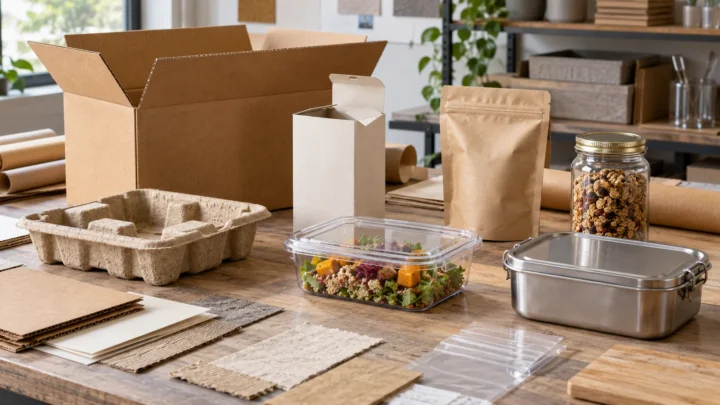
Sources checked 17 October 2026. The main image is an AI-generated editorial illustration; the explanatory figure is an original editorial diagram. Neither is a photograph of an identified product or facility, a laboratory result or an independent environmental assessment.
Official sources and reference notes
- [R1] U.S. Federal Trade Commission. 16 CFR §260.4 — General environmental benefit claims. Live public source, checked 17 October 2026. §260.4(a)–(d); FTC published summary for the other named claim types. Relevant public text checked; see the stated scope. Accessed 17 October 2026.
- [R2] European Union / European Commission. Directive (EU) 2024/825 on empowering consumers for the green transition. Live public source, checked 17 October 2026. EU action against vague environmental claims; Member State transposition deadline 27 March 2026; rules apply from 27 September 2026; broad “green/environmentally friendly” claims require substantiation under the new framework. Relevant public text checked; see the stated scope. Accessed 17 October 2026.
- [R3] FAO. Reduce, reuse, recycle: a mantra for food packaging. 29 September 2021. Packaging can protect food, extend shelf life and reduce food loss/waste; packaging reduction must not ignore product protection. Relevant public text checked; see the stated scope. Accessed 17 October 2026.
- [R4] U.S. EPA. Sustainable Materials Management: Non-Hazardous Materials and Waste Management Hierarchy. Live public source, checked 17 October 2026. Source reduction/reuse are generally preferred; recycling/composting follow; no single management approach fits all materials/circumstances. Relevant public text checked; see the stated scope. Accessed 17 October 2026.
- [R5] U.S. EPA. Sustainable Packaging. Live public source, checked 17 October 2026. Sustainable Materials Management applied to packaging; lightweighting/efficient construction and recovery can reduce impacts/waste. Relevant public text checked; see the stated scope. Accessed 17 October 2026.
- [R7] U.S. EPA. Standardized Terms for Materials Accepted by Municipal Recycling Programs. Live public source, checked 17 October 2026. Local program acceptance remains relevant even when a material belongs to a broad recyclable category. Relevant public text checked; see the stated scope. Accessed 17 October 2026.
- [R8] UNEP. Single-use Supermarket Food Packaging and its Alternatives: Recommendations from Life Cycle Assessments. December 2022. LCA should compare alternatives across the value chain; alternatives to single-use plastic do not automatically outperform in all environmental categories. Public record/abstract or identified section extracts only; no unexamined experimental details used. Accessed 17 October 2026.
The public corrections channel is currently inactive. Read our corrections policy.