Short answer: Sustainable packaging is not a single material, certification or disposal label. It is a way of designing the product-and-package system so that the package performs its job with less avoidable material and harm, uses appropriate inputs, and has a credible route for reuse, recycling or composting where the necessary system actually exists. A package can improve on one dimension and still perform poorly on another.
That distinction matters because many packaging decisions are framed too narrowly. A paper pack may use renewable fiber but still depend on coatings, adhesives or layers that affect recovery. A lightweight plastic pouch may use little material but face difficult collection and sorting. A reusable container may avoid many single-use items, but only if it is returned, cleaned and reused enough times. A compostable item may meet a technical standard yet still have no practical route into an organics program where it is sold.
The Sustainable Packaging Coalition’s 2024 framework describes sustainable packaging as an approach across design, production, distribution and the full life cycle, rather than a permanent label attached to one material or format. [R1] The U.S. Environmental Protection Agency similarly treats packaging within sustainable materials management, where efficient material use and recovery are considered together; its waste hierarchy prioritizes prevention and reuse. [R2] [R3]
This guide turns that systems view into a practical decision framework. It does not rank one packaging material as universally “best.” Instead, it asks what the package must do, what can be prevented or reduced, how material and chemistry choices affect performance, whether recovery infrastructure is real, and what evidence supports the environmental claim being made.
Sustainable packaging is a systems approach, not a material label
The easiest way to misunderstand sustainable packaging is to treat the material name as the conclusion. “Paper,” “recycled plastic,” “bio-based,” “compostable,” “reusable” and “plastic-free” each describe only part of a packaging system.
A more useful definition starts with the package’s function and follows the consequences of the design through sourcing, manufacture, distribution, use and end of life. SPC’s current framework explicitly emphasizes that sustainability depends on trade-offs in material, format and design, and that product protection belongs inside the assessment rather than outside it. [R1]
| Label or attribute | What it can tell you | What it does not establish by itself |
|---|---|---|
| Paper-based | The package uses paper, paperboard or fiber as a major material. | That the finished construction is recyclable everywhere, low-carbon, responsibly sourced or free of problematic coatings and additives. |
| Recycled content | Some defined share of the material came from recovered feedstock. | That the package itself is recyclable, has lower total impacts in every category, or is suitable for every contact application. |
| Bio-based | Some or all feedstock comes from biological rather than fossil sources. | That the material is biodegradable, compostable, recyclable or environmentally preferable overall. |
| Recyclable | The package may be technically compatible with a defined recycling route. | That it is collected, sorted and recycled at useful scale in the geography where it is sold. |
| Compostable | The item may meet defined compostability conditions or a certification scheme. | That it belongs in home compost, that a local commercial facility accepts it, or that composting is the best option for the application. |
| Reusable | The package is designed to survive multiple use cycles. | That a return, refill, washing and redistribution system will actually achieve enough cycles to deliver the intended benefit. |
| Plastic-free | The specified construction excludes plastic under the definition being used. | That the replacement has lower life-cycle impacts or better product protection, recovery or resource use. |
Editorial synthesis; use the named scheme, jurisdiction and receiving system for a specific item. Sources: [R1] [R6].
The practical implication is simple: a procurement specification should not end at the material name. It should also define performance, construction, recovery route, geography, evidence and the claim that will appear on pack.
Start with the package’s job: protecting the product is part of sustainability
Packaging exists to contain, protect, handle, deliver and present products. The EU’s Packaging and Packaging Waste Regulation uses these functions in its legal definition of packaging, while the regulation’s broader framework addresses the full packaging life cycle. [R8] The point is not that more packaging is automatically better; it is that removing or weakening packaging can create a false environmental saving if the product is then damaged, spoiled or replaced.
This is especially important when the contents carry a much larger production footprint than the package itself. SPC’s framework notes that damage or spoilage can waste the energy and materials already invested in the product, which is why optimization has to preserve the service that packaging provides. [R1]
A good first question is therefore not “Which material is greenest?” It is:
What minimum packaging system will protect this product through its real distribution, storage and use conditions?
That question changes the design process. It forces teams to identify the actual failure modes: moisture, oxygen, grease, compression, leakage, impact, tampering, temperature, shelf life, handling or return logistics. Only then does material substitution become meaningful.
Reduce and simplify before switching materials
Waste prevention usually deserves attention before end-of-life claims. EPA’s waste-management hierarchy prioritizes source reduction and reuse over recycling, and its packaging guidance highlights lightweighting and more efficient material use as practical ways to reduce discarded material. [R2] [R3]
For packaging teams, reduction can mean:
- eliminating a component that has no protective or regulatory function;
- right-sizing a shipper around the real product dimensions;
- reducing excessive headspace;
- lightweighting while maintaining required strength and barrier performance;
- removing unnecessary secondary or tertiary layers;
- standardizing components so that fewer materials and formats are needed;
- changing a distribution process so that protective packaging can be reused rather than repeatedly discarded.
Reduction is not automatically sustainable either. If lightweighting produces more breakage, leakage or food waste, the design has simply shifted impact from packaging mass to product loss. The target should be unnecessary material, not material at any cost.
There is no universally sustainable packaging material
Material choice matters, but it has to be judged against the application and system. Different materials bring different sourcing, manufacturing, performance, transport and recovery profiles. A useful material decision therefore asks which properties are required and which trade-offs are acceptable.
Paper, paperboard and molded fiber
Fiber-based packaging can use renewable feedstocks and can fit established paper-recovery systems in many markets. Recycled fiber may also reduce demand for virgin feedstock. But the finished package matters more than the headline material. Wet-strength agents, grease barriers, polymer coatings, foil layers, windows, adhesives and food contamination can change how a particular construction behaves in collection and reprocessing.
The correct question is not simply “Is paper recyclable?” It is whether the finished construction, under a defined recovery process and market, can be collected, sorted and repulped or otherwise recycled in practice.
Conventional and recycled plastics
Plastics can provide high barrier performance, durability and low package mass. Those properties can reduce material demand or product loss in some applications. Their sustainability challenges include fossil feedstock dependence for most conventional resins, persistent litter and leakage, and major differences in collection and recycling performance among formats and regions.
Recycled content can reduce virgin-material demand and create demand for recovered resin, but “contains recycled plastic” and “is recyclable” are different claims. The former concerns feedstock. The latter concerns the finished package and its recovery route.
Bio-based and compostable polymers
Bio-based polymers can reduce reliance on fossil feedstocks, but bio-based does not mean biodegradable. Likewise, a biodegradable material is not automatically suitable for industrial composting, home composting or uncontrolled disposal. The intended environment, complete construction, certification or test scope, and local collection route have to be checked separately.
Use the comparison of biodegradable, compostable and recyclable claims to separate these terms, then check the industrial and home composting guide for the compostability evidence route.
Compostable packaging can be useful where packaging and food residues are intentionally collected together and the receiving organics system accepts the specific item. Where no such collection exists, a compostability claim may describe a technical property without creating a practical recovery route.
Metals and glass
Metals and glass can fit established recycling systems and can offer strong barrier or reuse properties, but they can also carry higher package mass and transport burdens than lighter alternatives. Refillable glass, for example, is a system question involving return distance, trip count, breakage, washing and reverse logistics—not a material-only claim.
For every material family, the decision becomes stronger when the comparison is made for the same service: the same protected product, quantity, distribution conditions and required performance.
End-of-life claims are only as useful as the system behind them
One of the biggest gaps in packaging sustainability is the distance between technical design and real recovery. A package can be designed for recycling yet fail to reach a recycler because it is not collected. It can be collected but lost during sorting. It can reach a reprocessor but create poor yield or no viable end market. Each stage is different.
Recyclability: design compatibility is not the same as recycling in practice
For U.S. marketing claims, the FTC’s published Green Guides illustrate why access matters. Section 260.12 says a recyclable claim depends on an established recycling program and requires stronger qualification as access becomes limited; the Guides use a 60% “substantial majority” threshold for unqualified recyclable claims in the markets where the item is sold. [R6] That threshold is U.S. marketing guidance, not a global technical definition of recyclability.
The broader lesson is transferable: a recyclability statement should identify the construction, process and geography rather than treating a resin or fiber name as enough evidence.
Actual waste data also show why design claims cannot substitute for system performance. Eurostat reported 79.7 million tonnes of packaging waste generated in the EU in 2023, equivalent to 177.8 kg per inhabitant. Plastic packaging waste averaged 35.3 kg per person, of which 14.8 kg was recycled; Eurostat reported a 42.1% EU plastic-packaging recycling rate for that year under the applicable reporting methodology. [R9] These are system-level historical statistics, not a recyclability score for any individual package.
Compostability: certification and collection answer different questions
A compostability standard or certification can establish performance under defined conditions, but it does not prove that an organics program accepts the item. The FTC’s U.S. guidance likewise distinguishes technical compostability from facility availability and says claims should be qualified when appropriate municipal or institutional facilities are not available to a substantial majority of consumers or communities where the item is sold. [R6]
For packaging buyers, the practical checks are therefore separate:
- Does the complete package meet the relevant compostability requirement for the intended environment?
- Is that certification or test current and applicable to the actual construction, thickness and print?
- Is there a collection program for the item?
- Does the receiving facility accept that product category?
- Are consumers or staff given instructions that reduce contamination of other streams?
Reuse: durability is only the first requirement
Reusable packaging changes the question from “What happens after one use?” to “Can the system keep this package in service repeatedly?” That requires collection, return behavior, inspection, washing or cleaning where relevant, redistribution and loss control.
UNEP’s life-cycle synthesis of selected single-use products and alternatives emphasizes reducing single-use demand and promoting reuse, while also stressing geography, energy systems, recycling capability, disposal routes and other local conditions. [R4] The environmental result therefore depends on the operating system, not just the fact that a container is physically durable.
Life-cycle thinking exposes the trade-offs that labels hide
Life-cycle assessment (LCA) is useful because it forces a comparison to define boundaries: raw materials, manufacturing, logistics, use and end of life. UNEP describes LCA as a tool for assessing potential environmental impacts across the value chain and has used meta-analyses to compare single-use plastic packaging with alternatives. [R5]
For a closer reading of study boundaries and functional units, see our guide to comparing packaging life-cycle assessments.
The key value of life-cycle thinking is not that it always names one winner. It often reveals why a simple material swap can shift impacts instead of reducing them. UNEP’s broader 2021 synthesis warns that replacing one disposable product with another material can transfer burdens across the life cycle, and it recommends assessing alternatives case by case and in their geographic context. [R4]
That means a serious comparison should define at least:
- the product and quantity being delivered;
- the functional performance required;
- the package weight and complete construction;
- the production system and energy assumptions;
- transport distance and distribution model;
- expected product loss or spoilage where relevant;
- reuse cycles and return rate for reusable systems;
- collection, sorting and processing route;
- the impact categories being compared.
A carbon result alone is not an overall sustainability verdict. Nor is a waste result, a water result or a recyclability result. The broader the claim, the broader the evidence needed.
Regulation is turning packaging sustainability into an evidence problem
The EU provides one example of packaging being addressed across its life cycle. Regulation (EU) 2025/40—the Packaging and Packaging Waste Regulation (PPWR)—covers requirements across the packaging life cycle, including waste prevention, reuse or refill, collection, treatment and recycling. [R8]
The European Commission states that the PPWR began applying across the EU from 12 August 2026, with additional measures phased in on later dates. [R7] This article is not a PPWR compliance guide; the important point here is structural. Packaging teams increasingly need to connect design decisions with material use, substances, labeling, recovery and producer obligations.
Our PPWR application timeline separates the general application date from later measures. For producer responsibility and packaging records, start with the practical guide to packaging EPR.
The same shift affects environmental marketing. In the United States, the FTC’s Green Guides warn against broad, unqualified general environmental-benefit claims and require marketers to substantiate the specific claims they communicate. [R6] The Guides are administrative interpretations rather than an independently enforceable packaging code, but they illustrate a useful discipline: say what improved, define the scope, and keep the evidence close to the claim.
“Sustainable packaging” is therefore better treated as an internal design objective and evidence framework than as an unsupported label printed on the pack.

A practical eight-question test for sustainable packaging
The following framework is an editorial synthesis of the evidence above. It is not a certification scheme or legal checklist. Its purpose is to prevent a packaging team from optimizing one visible attribute while missing a larger system consequence.
| Decision area | Question to answer | Evidence that strengthens the decision | Common failure |
|---|---|---|---|
| 1. Function | What must the package protect, contain or enable? | Distribution conditions, barrier needs, damage/spoilage data, regulatory and user requirements. | Choosing a material before defining the service. |
| 2. Prevention | Can a component, layer, volume or use of packaging be avoided? | Right-sizing trials, damage data, material-use baseline. | Reducing weight until product loss or failure rises. |
| 3. Material and chemistry | Which construction provides the function with acceptable sourcing and chemical profile? | Complete bill of materials, sourcing records, relevant substance data and specifications. | Assuming one base material describes the whole package. |
| 4. Production and logistics | How do conversion, energy, transport and package mass affect the result? | Supplier/process data, logistics model, comparable life-cycle assumptions. | Ignoring upstream impact because end-of-life looks favorable. |
| 5. Reuse | Can the package realistically complete multiple cycles? | Return model, loss rate, washing, reverse logistics, measured cycle count. | Calling a durable item reusable without a functioning reuse system. |
| 6. Recovery | What happens after use in the actual market? | Collection access, sorting pathway, reprocessor/facility acceptance, end-market evidence. | Equating technical recyclability or compostability with actual recovery. |
| 7. Claims | What exactly can be said on-pack or in marketing? | Claim-specific test, certification, calculation, legal and geographic qualification. | Using “green,” “eco-friendly” or “sustainable” as an unbounded conclusion. |
| 8. Improvement | What metric will show that the redesign is actually better? | Defined baseline, functional unit, material mass, loss, reuse, recovery or life-cycle metrics. | Declaring success from one attribute without checking trade-offs. |
Editorial synthesis; use the named scheme, jurisdiction and receiving system for a specific item. Sources: [R1] [R2] [R3] [R4] [R6].
Four examples of how the framework changes the decision
These are illustrative scenarios, not product test results.
E-commerce shipper
A company wants to replace a corrugated shipping box with a “greener” fiber format. The stronger first move may be to measure empty space, damage rates and the amount of protective fill. Right-sizing the existing system could reduce both board and void fill before any material substitution is considered. If the new design then maintains product protection and fits the receiving market’s paper-recycling system, the sustainability case becomes much clearer.
Takeaway food container
A foodservice operator is choosing between coated paper, molded fiber, plastic and a compostable polymer. The decision depends on grease and moisture exposure, serving temperature, lid performance, food residue, local collection and the receiving recovery system. “Compostable” has little practical value if the item will be sent to landfill, while a theoretically recyclable format may also fail if food contamination or a composite construction prevents recovery.
Reusable beverage cup
A durable cup may avoid many single-use cups, but only when the system achieves repeated use. The useful evidence is not simply wall thickness or material type; it is the number of completed cycles, return behavior, washing process, transport and loss rate. A reusable format without a convenient return loop can underperform its design intent.
High-barrier flexible pack
A lightweight flexible package may use much less material than a rigid alternative and may protect food efficiently, yet multilayer structures can be difficult to collect and recycle. A credible assessment has to keep both sides visible: product preservation and material efficiency during use, and the practical recovery challenge after use. Calling it either “sustainable” or “unsustainable” from one of those facts alone would be incomplete.
How to write a better sustainable-packaging target
A useful sustainability target should be measurable and tied to the package’s actual job. Instead of “make the package more sustainable,” define the intended improvement and the conditions that cannot be sacrificed.
For example, a project brief might require the team to:
- reduce packaging material against a defined baseline while keeping transport damage below the existing performance level;
- increase verified recycled content in a named component while maintaining required food-contact or mechanical performance;
- design a complete package for a defined recycling or composting pathway and verify actual collection or facility acceptance in the target market;
- move from single use to reuse and measure completed cycles, return rate, loss and washing requirements;
- replace a broad “eco-friendly” claim with a specific, substantiated statement about material reduction, recycled content, reuse or recovery.
The exact metric depends on the application. What matters is that the baseline, function, geography and evidence are visible. That makes future improvement measurable and prevents a team from claiming success simply because one material was replaced by another.
Methodology and editorial note
This article is an editorial synthesis of public primary and institutional sources. It does not present an original life-cycle assessment, product test or universal material ranking. Regulatory references are used to illustrate the shift toward life-cycle packaging requirements and environmental-claim substantiation; product-specific legal compliance must be assessed separately.
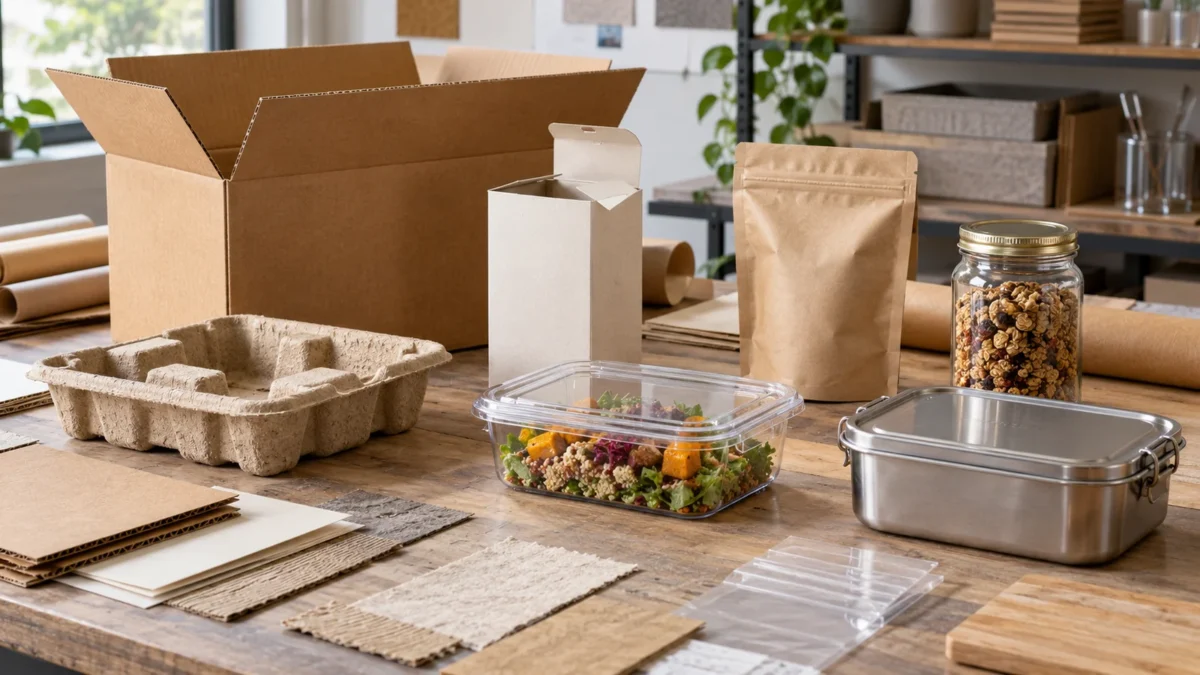
Sources checked 17 October 2026. The photographic-style main image is an AI-generated editorial illustration; the explanatory figure is an original editorial diagram. Neither is a product test, facility inspection or measured environmental result.
Direct EUR-Lex retrieval displayed browser verification, so relevant official indexed text was used for the limited EU references. The UNEP 2022 reference was used only at public record/abstract level. No product-specific compliance verdict or comprehensive check of later implementing measures is provided.
Official sources and reference notes
- R1 — Sustainable Packaging Coalition (GreenBlue). The Definition of Sustainable Packaging, January 2024, Version 1.0. Relevant sections: definition and five principles; SMART design; sourcing; recyclability/compostability; reuse/refill; infrastructure. Full relevant public PDF reviewed. Accessed 17 October 2026.
- R2 — U.S. Environmental Protection Agency. Sustainable Packaging. Used for sustainable-materials-management framing, efficient material use and recovery context. Public web page reviewed. Accessed 17 October 2026.
- R3 — U.S. Environmental Protection Agency. Sustainable Materials Management: Non-Hazardous Materials and Waste Management Hierarchy. Used for prevention/source reduction and reuse priority. Public web page reviewed. Accessed 17 October 2026.
- R4 — United Nations Environment Programme. Addressing Single-Use Plastic Products Pollution Using a Life Cycle Approach — Summary for Decision-Makers, 2021. Relevant recommendations: reuse, reduction of single-use products, geographic context, production/end-of-life effects and burden shifting. Full five-page public brief reviewed. Accessed 17 October 2026.
- R5 — United Nations Environment Programme. Single-use Supermarket Food Packaging and its Alternatives: Recommendations from Life Cycle Assessments, December 2022. Repository abstract and public record reviewed; used only for the stated scope and role of LCA meta-analysis, not for unexamined detailed comparative results. Accessed 17 October 2026.
- R6 — U.S. Federal Trade Commission. Guides for the Use of Environmental Marketing Claims, 16 CFR Part 260. Relevant sections reviewed: §260.1–.4, §260.7 and §260.12. Used as U.S. environmental-marketing guidance, not as a global recyclability or compostability standard. Accessed 17 October 2026.
- R7 — European Commission, Directorate-General for Environment. New EU packaging rules start to apply, 11 August 2026. Used for the Commission’s description of PPWR application from 12 August 2026 and phased later measures. Public official page reviewed. Accessed 17 October 2026.
- R8 — European Union. Regulation (EU) 2025/40 on packaging and packaging waste. Original Regulation (EU) 2025/40, OJ 22 January 2025. Original-act subject matter and scope, Articles 1–3. Official indexed relevant text checked; direct retrieval displayed browser verification. Original-act context only. Accessed 17 October 2026.
- R9 — Eurostat. Plastic packaging waste in the EU: 35.3 kg per person, 22 October 2025, reporting 2023 data. Used for historical EU packaging-waste and plastic-packaging recycling context only. Accessed 17 October 2026.
The public corrections channel is currently inactive. Read our corrections policy.