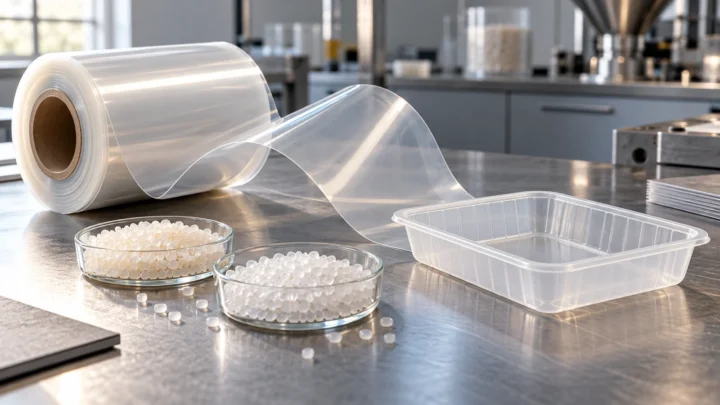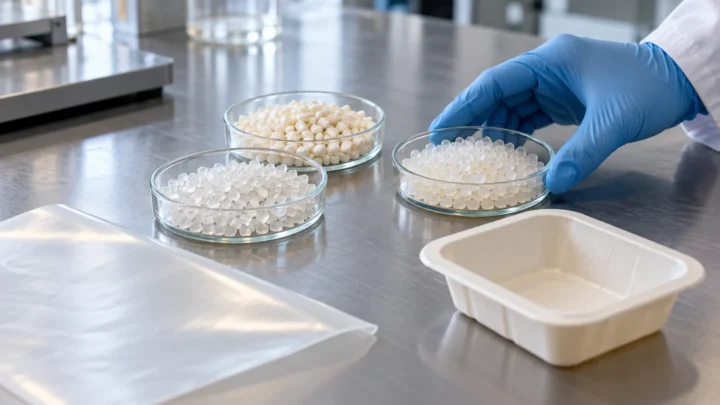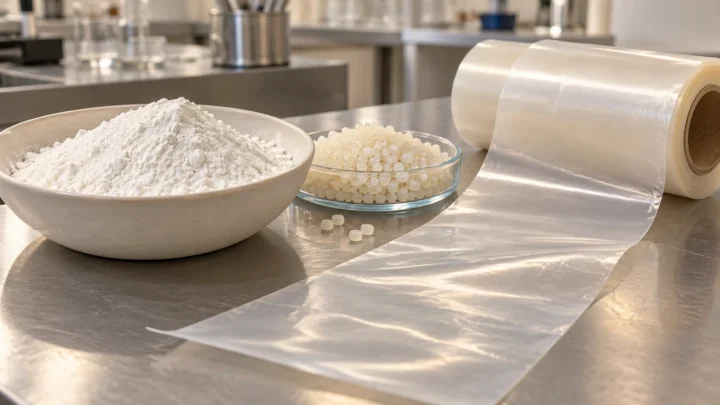
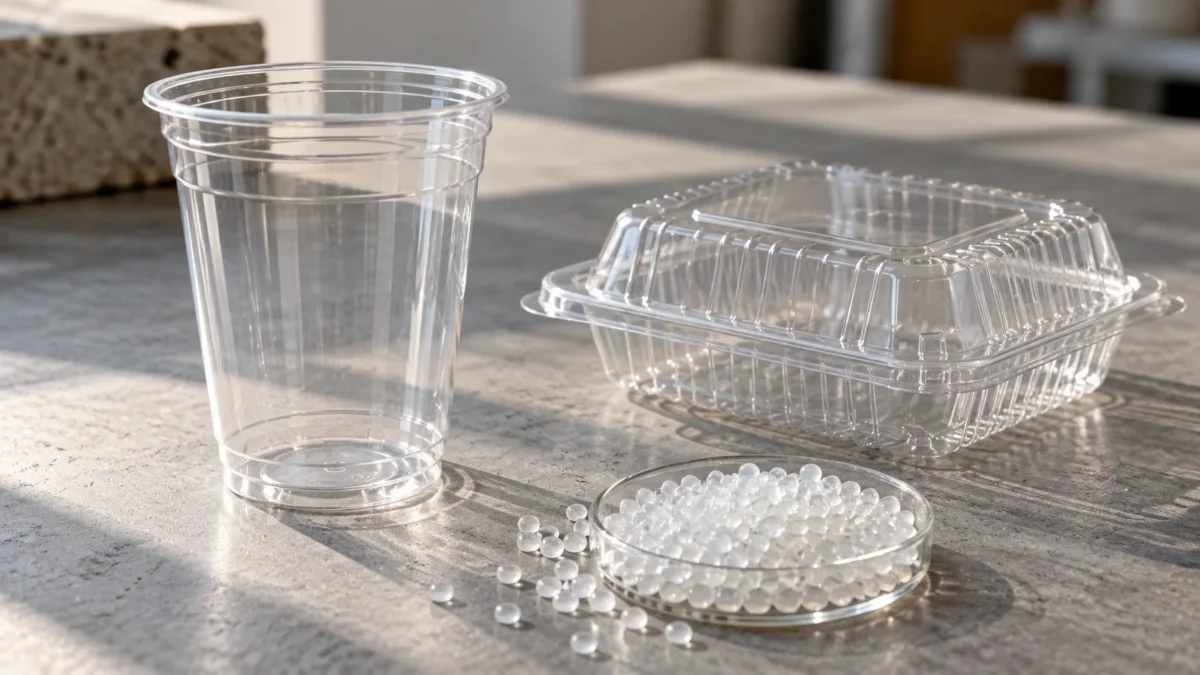
Short answer: PLA (polylactic acid or polylactide) is a thermoplastic polyester commonly made from lactic acid derived from renewable carbohydrate feedstocks. It can biodegrade under suitable conditions, and some finished PLA products are certified for industrial composting. But “PLA” alone does not prove that a package is compostable, home compostable or recyclable in a local program. PLA can also be mechanically or chemically recycled in dedicated systems, yet it should not be assumed to belong in conventional PET recycling.
PLA attracts unusually broad claims because it sits at the intersection of several packaging trends: bio-based feedstocks, compostable plastics, transparent food packaging and emerging circular-recycling technologies. That makes it useful—but also easy to describe too broadly.
A clear way to evaluate PLA is to separate four questions: what PLA is made from, how the finished package performs, under which conditions it biodegrades or composts, and whether a real recovery system accepts it. Those are different questions, and a correct answer to one does not settle the others.
What is PLA plastic?
PLA is a polymer in the polyester family. Scientific reviews describe it as a polymer made from lactic acid or lactide, with commercial production commonly linked to fermentation of carbohydrate-rich renewable feedstocks followed by polymer synthesis. [R1] That is why PLA is frequently described as a bio-based plastic.
The word plastic is still correct. “Bio-based” describes where the carbon feedstock comes from; it does not mean the material is not a plastic. PLA is processed as a thermoplastic and can be formed into films, sheets, thermoformed containers, cups, lids, fibers and other products.
For the wider material family, see our guide to bioplastics.
The European Commission makes the broader distinction explicit: bio-based plastics are made wholly or partly from biological resources, but they are not necessarily biodegradable or compostable. End-of-life behavior has to be evaluated separately from feedstock origin. [R2]
| Question | What PLA can tell you | What still needs separate evidence |
|---|---|---|
| Feedstock | PLA is commonly produced from lactic acid derived from renewable carbohydrate feedstocks. | Actual bio-based content, agricultural source, chain of custody and life-cycle impact of the specific grade. |
| Performance | PLA is a thermoplastic that can be converted into multiple packaging formats. | Heat resistance, barrier, impact strength, sealing and food-contact suitability of the actual grade and construction. |
| Compostability | PLA chemistry can support biodegradation under suitable controlled conditions. | Whether the complete finished item is certified for industrial or home composting. |
| Recycling | PLA can be reprocessed through mechanical or chemical routes in suitable dedicated systems. | Collection, sorting, reprocessing access and whether the local program accepts PLA. |
Editorial synthesis; qualitative comparisons are evidence questions, not measured product rankings. [R1] [R2] [R5] [R6] [R8]
Is PLA biodegradable?
Yes, PLA is capable of biodegradation—but that statement is incomplete without the environmental conditions.
Conventional PLA needs defined degradation conditions. A Nature Chemical Biology research highlight describes efficient degradation mainly under high-temperature industrial composting and slower breakdown in home-composting and soil conditions. Only the public preview was available to this review. [R4]
That means “biodegradable” should not be translated into “quickly disappears in nature.” A PLA cup dropped in soil, sent to landfill or released into the environment is not experiencing the same conditions as a controlled composting test.
Why conditions matter so much
PLA degradation involves more than microorganisms simply consuming an intact cup. Water, temperature and polymer structure affect the breakdown of the polymer chains before biological conversion can proceed efficiently. Crystallinity, molecular structure, thickness, additives and the geometry of the finished item can all change the rate.
This is why a useful biodegradation claim should identify:
- the receiving environment;
- the test or certification route;
- the complete material or finished-item construction;
- the conditions and relevant timeframe;
- what the evidence does—and does not—establish.
The European Commission’s policy framework similarly warns that biodegradable plastics biodegrade only under certain conditions and should not be presented as a solution to littering. [R2]
Is PLA compostable?
Some PLA products are compostable under industrial conditions, but PLA resin identity alone is not a finished-package certification.
ASTM currently lists D6400-26 as the active edition of its specification for plastics and products designed for aerobic composting in municipal or industrial facilities where thermophilic conditions are achieved. Its public scope explicitly includes end items such as packaging that use plastics or polymers as coatings or binders. [R5]
BPI provides a searchable catalogue of certified finished products. Use the exact product and listing scope rather than treating the letters “PLA” as a certificate. [R6]
Why the finished item matters
A package may contain:
- PLA resin of a particular grade;
- colourants;
- printing inks;
- labels;
- adhesives;
- other polymers or modifiers;
- paper or fiber layers;
- lids or accessories made from another material.
Those elements can change the relevant compostability evidence. A certified resin does not automatically certify every thickness, printed version or assembled package made from it.
| Evidence level | What it can support | What it cannot support by itself |
|---|---|---|
| PLA resin identification | The base polymer used in the construction. | Finished-item compostability. |
| Supplier technical data | Properties and intended applications of the named grade. | Independent certification of every converted SKU. |
| Test on a defined construction | Performance of the tested specimen under the stated conditions. | Untested thicknesses, prints, components or other product variants. |
| Current finished-item certification | Conformity with the named certification scheme within its listed scope. | Guaranteed acceptance by every local composting operator. |
Editorial synthesis; qualitative comparisons are evidence questions, not measured product rankings. [R5] [R6]
Is PLA home compostable?
Conventional PLA should not be assumed to be home compostable.
The main reason is environmental conditions. Typical home compost systems do not reliably maintain the elevated temperatures and controlled process conditions used in industrial composting. Nature’s 2024 research highlight described standard PLA as efficiently degrading only under high-temperature industrial composting conditions and reported much slower degradation under home-composting and soil conditions. [R4]
Research is actively trying to change this limitation. For example, a 2026 Scientific Reports study investigated a modified PLA composite designed for depolymerization under milder, household-compatible alkaline conditions. [R7] That is evidence of an engineered formulation under a specific study design, not evidence that ordinary commercial PLA packaging is home compostable.
The practical rule is therefore straightforward:
Do not infer home compostability from the material name. Look for home-compost-specific evidence or certification covering the finished item.
Can PLA be recycled?
Technically, yes. Operationally, it depends on whether PLA is separately collected, sorted and reprocessed.
A 2025 review discusses mechanical reprocessing, chemical depolymerisation and other recovery routes for PLA/PHA packaging waste. The visible abstract supports the existence of those routes; it does not establish local collection access or independently verified environmental superiority. [R8]
These are technical pathways, not evidence that a household collection service accepts a PLA package.
PLA should not simply be mixed with PET
PLA and PET can look similar because both can be transparent packaging materials, but they are different polymers with different recycling behavior.
The Association of Plastic Recyclers’ 2024 PET thermoform resource states that PLA thermoforms are not compatible with mechanical PET recycling. APR explains that small amounts of PLA melt-blended with PET can create undesirable haze in recycled PET. [R10]
APR’s conclusion concerns compatibility with the PET stream. It does not rule out a separately configured PLA recovery route. [R10]
This does not mean PLA can never be recycled. It means PLA requires its own compatible sorting and recovery route rather than being treated as PET.
Dedicated PLA recycling is technically emerging
In August 2026, the EU-backed Circular Bio-based Europe Joint Undertaking reported PROSPER near-infrared sorting trials at NTCP. Clean bio-based packaging samples were deliberately mixed into four tonnes of municipal packaging waste. The reported rigid-plastics results included 93% yield for biopolyester rigids and 93% purity for the PLA stream. These were pilot trials at industrial-relevant scale. [R12]
Those are separate yield and purity measures from a configured trial, not the recycling rate of PLA in Europe. The project said trials in operating facilities were planned next; routine municipal deployment was not established by this report.
PLA, PET and compostable plastic should not share one disposal rule
| Question | PLA | PET |
|---|---|---|
| Polymer family | Polyester based on lactic-acid/lactide chemistry. | Polyester based on terephthalate and ethylene-glycol chemistry. |
| Common packaging appearance | Can be clear and visually similar to PET in cups, lids and thermoformed packs. | Commonly clear in bottles and thermoformed packaging. |
| Industrial compostability | Some finished PLA products can be certified for industrial composting. | Conventional PET packaging is not marketed as industrially compostable. |
| PET recycling stream | Should not be assumed compatible; APR identifies PLA as incompatible with PET mechanical recycling. | Designed PET packaging may enter established PET recycling systems where collection exists. |
| Dedicated material recycling | Mechanical and chemical PLA recycling routes are technically available/emerging, subject to separate collection and sorting. | Mechanical PET recycling is established in many markets, with chemical routes also under development or operation. |
Editorial synthesis; qualitative comparisons are evidence questions, not measured product rankings. [R1] [R5] [R6] [R10] [R12]
The disposal instruction should therefore follow the actual package and local system. A transparent cup is not “PET recycling” merely because it looks like PET, and a PLA cup is not “compost” merely because the resin is PLA.

What should happen to a PLA cup, lid or container after use?
There is no universal disposal instruction for every PLA item. The correct route depends on product certification and local infrastructure.
The industrial and home composting guide explains why certification and operator acceptance are separate checks.
- Check the finished-item label and certification. Confirm whether the exact item is certified for commercial composting, home composting or another route.
- Check the local collection program. A certified item may still be excluded from the organics system.
- Do not place compostable PLA into conventional plastics recycling unless the program explicitly accepts it. EPA currently advises that compostable plastics are not intended for conventional recycling and can disrupt the recycling stream when mixed with non-compostable plastics. [R13]
- Do not treat PLA as PET. PET reclaimers use polymer-specific design and processing conditions.
- If a dedicated PLA recovery route exists, follow that operator’s specification. Dedicated mechanical or chemical recovery can be technically viable, but it requires collection and sorting.
Is PLA better for cold packaging than hot packaging?
Standard PLA’s heat behavior is one reason it is commonly associated with clear cold-drink cups, lids and thermoformed packaging rather than demanding high-temperature uses. But “PLA heat resistance” is not one fixed number.
Peer-reviewed literature shows that PLA’s thermal and mechanical performance changes with stereochemistry, crystallinity, blending and additives. Research on durable PLA specifically focuses on increasing toughness and heat resistance through material design. [R14]
For packaging selection, the useful conclusion is not a universal temperature limit. It is that the actual grade and finished construction must be checked against the intended fill temperature, storage conditions and use case.
What is CPLA?
CPLA is a commercial term commonly used for crystallized or crystallinity-modified PLA materials designed to improve heat performance compared with conventional amorphous PLA. Crystallinity can materially affect PLA heat resistance, but the final properties depend on formulation and processing. [R14]
CPLA also does not create a new universal end-of-life rule. A heat-resistant PLA formulation still needs finished-item evidence for any compostability or recovery claim.
Does “bio-based PLA” automatically have a lower environmental impact?
No. Bio-based feedstock is one attribute, not a complete life-cycle result.
The European Commission’s policy framework says bio-based plastics may offer benefits but also create sustainability trade-offs, including issues related to biomass sourcing and land use. It recommends evaluating the full life cycle rather than assuming that replacing fossil carbon automatically makes the finished product environmentally preferable overall. [R2]
PLA’s environmental result can depend on:
- feedstock and agricultural practices;
- energy and chemicals used in fermentation and polymer production;
- product mass;
- packaging performance and product protection;
- transport;
- reuse, if any;
- collection and sorting;
- composting, recycling, incineration or landfill route;
- whether recovered carbon/material is retained in a circular system.
For any comparison with PET, PP or fibre packaging, define the application, functional unit and study boundary before drawing an environmental conclusion.
See how to read a packaging LCA comparison before using a study as a procurement ranking.
What should a packaging buyer ask for?
| Question | Evidence to request | What not to assume |
|---|---|---|
| What is the material? | Exact PLA grade, blend, additives, coatings and other package components. | That “PLA” describes the entire finished construction. |
| What temperatures can it handle? | Grade-specific and finished-item performance data for actual fill/use conditions. | A universal PLA temperature limit. |
| Is it industrially compostable? | Current certificate or registry entry for the exact item/construction and applicable thickness/print. | That base resin identity is enough. |
| Is it home compostable? | Home-compost-specific certification/evidence for the finished item. | That industrial certification applies at home. |
| Is it recyclable? | Defined PLA recovery route, sorting process, recycler acceptance and target geography. | That it belongs in PET or general mixed-plastics recycling. |
| Is it “more sustainable”? | Application-specific life-cycle evidence with a clear baseline and functional unit. | That bio-based feedstock alone proves overall superiority. |
Editorial synthesis; qualitative comparisons are evidence questions, not measured product rankings. [R2] [R5] [R6] [R10] [R13]
Methodology and editorial note
This article is an editorial synthesis of public government, standards, technical-industry and peer-reviewed sources. It does not present an original PLA degradation test, composting trial, recycling trial or life-cycle assessment. Several scientific sources were available to this review at abstract/record level only; they are used for scoped statements visible in those records and not for unexamined experimental details. ASTM public catalogue information is used only for visible metadata and scope; paid standard clauses were not accessed.
Sources checked 17 October 2026. The main image is an AI-generated editorial illustration; the explanatory figure is an original editorial diagram. Neither is a photograph of an identified product or facility, a laboratory result or an independent environmental assessment.
Official sources and reference notes
- [R1] Bauer, Henkel, Gürer & Lieleg. Bio-Based and Degradable Food Packaging Materials: Where Are They?. Advanced Materials Interfaces 12(6), 2025, 2400645; first online 20 December 2024; DOI 10.1002/admi.202400645. Section 2.1.3, PLA chemistry and production; section 3, formulation-dependent properties. Relevant public text checked; see the stated scope. Accessed 17 October 2026.
- [R2] European Commission. Biobased, biodegradable and compostable plastics / COM(2022) 682. Live public source, checked 17 October 2026. Bio-based feedstock is separate from biodegradability/compostability; biodegradation requires conditions; full-life-cycle trade-offs; no littering inference. Relevant public text checked; see the stated scope. Accessed 17 October 2026.
- [R4] Johnson, Russell / Nature Chemical Biology. Polymers produced with depolymerase. 20 August 2024. Conventional PLA degrades efficiently mainly under high-temperature industrial composting; slower in home-composting/soil; modified approaches are being researched. Public preview only; full text not accessed. Accessed 17 October 2026.
- [R5] ASTM International. ASTM D6400-26 — Standard Specification for Labeling of Plastics Designed to be Aerobically Composted in Municipal or Industrial Facilities. D6400-26 Active; last updated 15 June 2026. Public abstract / scope §§1.1–1.3. Public catalogue and scope only; paid clauses not accessed. Accessed 17 October 2026.
- [R6] BPI. BPI Certified Products Catalog. Live public source, checked 17 October 2026. Current existence of certified PLA cups/lids/clamshells and item/SKU/thickness-specific certification records. Public catalogue explanation; no named SKU is claimed certified. Accessed 17 October 2026.
- [R7] Park & Lee. Embedded CTAB enables depolymerization of PLA composite films under mild, household-compatible alkaline conditions. 9 September 2026. A specific engineered PLA composite can be designed for milder depolymerization conditions. Public record/abstract or identified section extracts only; no unexamined experimental details used. Accessed 17 October 2026.
- [R8] Sustainable Materials and Technologies. Recycling and revalorization of PLA and PHA-based food packaging waste: A review. 2025. Mechanical and chemical recycling are recognized PLA waste-management routes. Public record/abstract or identified section extracts only; no unexamined experimental details used. Accessed 17 October 2026.
- [R10] Association of Plastic Recyclers. PET Thermoform Packaging Design. Live public source, checked 17 October 2026. PDF p. 8 (viewer lines around 387–404). Relevant public text checked; see the stated scope. Accessed 17 October 2026.
- [R12] Circular Bio-based Europe Joint Undertaking. Sorting out the future of bio-based plastics recycling. 21 August 2026. Reported industrial-scale NIR sorting trial; 93% yield for biopolyester rigids and 93% purity for the PLA stream. Relevant public text checked; see the stated scope. Accessed 17 October 2026.
- [R13] U.S. EPA. Frequently Asked Questions about Plastic Recycling and Composting. Live public source, checked 17 October 2026. Consumer guidance that compostable plastics should not be mixed into conventional plastics recycling absent a suitable program; local acceptance matters. Relevant public text checked; see the stated scope. Accessed 17 October 2026.
- [R14] Nagarajan, Mohanty & Misra. Perspective on Polylactic Acid (PLA) based Sustainable Materials for Durable Applications: Focus on Toughness and Heat Resistance. ACS Sustainable Chemistry & Engineering 4(6), 2016, 2899–2916; DOI 10.1021/acssuschemeng.6b00321. PLA toughness/heat resistance can be altered through blends, morphology and crystallinity. Public record/abstract or identified section extracts only; no unexamined experimental details used. Accessed 17 October 2026.
The public corrections channel is currently inactive. Read our corrections policy.