Short answer: “Bioplastics” is an umbrella term, not one material. It can include plastics that are bio-based, biodegradable, or both. PLA and many PHAs are commonly bio-based and can be biodegradable under defined conditions; PBAT is usually fossil-derived but biodegradable; PBS can be produced from fossil or renewable feedstocks; and starch-based plastics are often blends rather than pure starch. Bio-based PE and PET are also bioplastics in common industry usage even though they are not biodegradable.
This is why the question “Are bioplastics compostable?” has no single answer. Feedstock origin, polymer chemistry, finished-package design and end-of-life system are separate variables. A package can be bio-based but non-biodegradable, biodegradable but partly fossil-based, or compostable only when the complete finished item meets a defined certification route.
For packaging buyers, the useful task is not to choose “bioplastic” as a category. It is to identify the exact polymer or blend, the performance required during use, and the recovery route that actually exists after use.
Use the end-of-life terminology comparison to distinguish the claims before requesting finished-item compostability evidence.
What are bioplastics?
The European Commission warns that the umbrella term “bioplastics” is often used for very different materials and can blur the distinction between bio-based, biodegradable and compostable plastics. The Commission defines bio-based plastics as plastics made fully or partly from biological resources, while noting that they are not necessarily biodegradable or compostable. It also notes that biodegradable and compostable plastics can be made from biological or fossil resources. [R1]
European Bioplastics, an industry association, uses a broad materials definition: bioplastics are plastics that are bio-based, biodegradable, or both. [R2] That definition is useful for market terminology, but it also shows why “bioplastic” alone tells a buyer very little about end-of-life.
| Material type | Can be bio-based? | Can be biodegradable? | Typical examples |
|---|---|---|---|
| Bio-based and biodegradable | Yes | Yes, under defined conditions | PLA, many PHAs, some PBS grades/blends, thermoplastic starch blends |
| Bio-based but not biodegradable | Yes | No, not by virtue of feedstock origin | Bio-PE, bio-PET and other “drop-in” plastics |
| Fossil-based but biodegradable | Not necessarily | Yes, under defined conditions | PBAT and some other biodegradable polyesters |
Editorial synthesis; qualitative comparisons are evidence questions, not measured product rankings. [R1] [R2]
The table is conceptual rather than a certification matrix. Individual grades, blends and finished products can behave differently, and “biodegradable” always requires an environment and timeframe.

Bio-based does not mean biodegradable
A plastic can be made partly or entirely from renewable biological feedstock while retaining the same polymer chemistry and end-of-life behaviour as a fossil-derived version.
Bio-PE is the clearest example. Polyethylene made from bio-derived ethylene is chemically polyethylene. It does not become biodegradable because the carbon source is renewable. The same logic applies to bio-PET: a partially or more fully bio-derived PET remains PET and should be evaluated as PET for recycling and performance.
The Commission’s policy framework makes this distinction explicit and advises that the full life cycle of bio-based plastics still needs to be considered, including feedstock sourcing and land-use effects. [R1]
For packaging claims, “made from renewable feedstock” and “biodegradable” should therefore never be used as synonyms.
Biodegradable does not mean bio-based
The opposite misunderstanding is equally common. A polymer can be designed to biodegrade under defined conditions even when some or all of its feedstock is fossil-derived.
PBAT—poly(butylene adipate-co-terephthalate)—is the most familiar packaging example. Peer-reviewed reviews describe PBAT as a synthetic biodegradable polyester widely used in flexible films and blends because of its flexibility and processability. [R3]
This matters because a “compostable bioplastic” package can contain both renewable and fossil-derived polymer fractions. Compostability describes end-of-life performance under a defined standard or system; it does not prove 100% renewable carbon content.
PLA: rigid, transparent and widely used
PLA—polylactic acid or polylactide—is one of the best-known packaging bioplastics. It is commonly produced from lactic acid derived from fermentation of carbohydrate feedstocks and is used in clear cups, lids, thermoformed trays, films, coatings, fibres and other applications.
PLA can provide transparency and stiffness, but performance varies with formulation and processing. Conventional grades have limitations that motivate blending and other modifications; a material-family description does not establish a particular package’s temperature capability. [R4] [R7]
Those limitations explain why PLA is often modified by crystallisation, copolymerisation, blending, plasticisers or fillers. The commercial term CPLA is commonly used for crystallised or crystallinity-modified PLA formulations designed for greater heat resistance.
PLA end-of-life
PLA is capable of biodegradation, but conventional PLA typically degrades much more effectively under controlled, elevated-temperature industrial composting than under ambient soil or home-compost conditions. A finished PLA package should therefore not be called “home compostable” merely because the base resin is PLA.
PLA can also be mechanically or chemically recycled in dedicated systems. That does not mean it belongs in the PET stream. PET recyclers generally treat PLA as an incompatible polymer, so local disposal instructions should follow the actual collection and sorting system rather than visual similarity.
The dedicated PLA guide explains the distinction between polymer-recovery technology and a locally available stream.
PHA: a family of microbial polyesters
PHA—polyhydroxyalkanoate—is not one polymer but a family of polyesters produced biologically by microorganisms under controlled fermentation conditions.
Bauer and colleagues describe PHAs as a family of microbially produced polyesters with differing compositions and processing properties. Their review also discusses production complexity and material limitations; these are material-family observations, not a certification of a particular finished package. [R4]
PHA behaviour varies with polymer composition, crystallinity, thickness, additives and environment. A result for one PHA grade is not evidence that every PHA package rapidly biodegrades in soil, marine water or home compost.
PHA is a family, not a single specification
Common PHA variants include PHB and copolymers such as PHBV. Different monomer compositions can change stiffness, toughness, processing temperature, barrier properties and biodegradation behaviour.
For procurement, “PHA” should therefore be treated like a family name. The supplier should identify the actual grade, blend, intended application and finished-item end-of-life evidence.
PBS: biodegradable polyester with flexible feedstock routes
PBS—polybutylene succinate—is an aliphatic polyester used in films, coatings, blends and moulded applications. Its monomers can be produced from fossil or renewable routes, so PBS should not automatically be described as fully bio-based.
Bauer and colleagues distinguish fossil-derived PBS from bio-PBS and discuss blending with PLA or PHA to adjust properties. The feedstock route must be identified for the actual grade. [R4]
As with the other materials in this guide, the end-of-life claim has to follow the finished product. A PBS-containing blend may perform differently from neat PBS, and certification depends on the exact formulation and construction.
PBAT: flexible and biodegradable, but usually not bio-based
PBAT is an aliphatic-aromatic copolyester valued primarily for flexibility and toughness. It is widely used in compostable flexible bags, films and blends, especially where a brittle polymer such as PLA or a starch-rich formulation needs greater elongation.
A 2024 review describes PBAT as a synthetic biodegradable polymer used for flexible packaging, with high flexibility but lower strength and barrier performance than some other packaging polymers. [R3] A 2026 review of PLA/PBAT films similarly describes the blend strategy as a way to combine PLA’s stiffness with PBAT’s ductility. [R7]
PBAT can be biodegradable without being predominantly bio-based.
That is why renewable-carbon content and compostability need separate evidence.
Starch-based plastics are often blends
Starch is naturally bio-based, widely available and attractive as a packaging feedstock. But “starch plastic” does not necessarily mean a product made from starch alone.
Native starch is hydrophilic and has limited thermoplastic behaviour unless it is plasticised and processed into thermoplastic starch (TPS). Commercial starch-based films and moulded materials often blend TPS with PLA, PBAT, PBS or other polymers to improve flexibility, moisture resistance, processability or strength.
Bauer and colleagues describe modifying or plasticising native starch and then blending it with other materials to adjust processability and water response. “Starch-based” does not disclose the complete formulation. [R4]
For a buyer, “cornstarch packaging” is therefore not a complete material specification. The real question is the polymer blend: how much starch, what other polymer phases are present, and what certification or recovery route covers the finished item?
How PLA, PHA, PBS, PBAT and starch blends compare
| Material | Typical feedstock position | Typical packaging role | Common technical strength | Common limitation | End-of-life caution |
|---|---|---|---|---|---|
| PLA | Usually bio-based | Clear rigid packs, cups, lids, films, fibres, coatings | Transparency, stiffness, processability | Brittleness and heat limitations in conventional grades | Industrial compostability requires finished-item evidence; dedicated recycling differs from PET recycling. |
| PHA | Usually bio-based through microbial production | Films, coatings, rigid packaging, specialty applications | Broad material-design range; biodegradation potential | Cost, processing and grade-to-grade variability | Do not generalise one grade’s degradation behaviour to all PHA products. |
| PBS | Can be fossil, bio-based or mixed depending monomer route | Films, blends, coatings, moulded products | Useful toughness/processability balance in blends | Property and cost trade-offs vary by grade/blend | Certification applies to the finished formulation, not the polymer name alone. |
| PBAT | Usually fossil-based in current commercial supply | Flexible films, bags, blend modifier | Flexibility and elongation | Lower stiffness; usually needs blending for some applications | Biodegradable does not mean bio-based; compost claims still need product-specific evidence. |
| TPS / starch blends | Starch fraction is bio-based; total blend varies | Films, bags, moulded items, blend component | Renewable feedstock contribution and blendability | Moisture sensitivity and property variability | “Cornstarch” does not disclose the other polymers or guarantee compostability. |
Editorial synthesis; qualitative comparisons are evidence questions, not measured product rankings. [R2] [R3] [R4] [R7]
This is a functional comparison, not a ranking. Grade, formulation, processing, thickness, additives and package geometry can materially change performance.
Why bioplastics are blended
Few polymers provide every packaging property at once. Packaging may need stiffness, impact resistance, sealability, transparency, heat resistance, low oxygen transmission, moisture resistance and machinability—all within a specific converting process.
Blending allows manufacturers to trade one property against another. PLA/PBAT is a common example: PLA contributes stiffness while PBAT contributes flexibility. Starch/PBAT blends can increase renewable feedstock content while improving the processability of starch-rich films. PBS may be introduced to change toughness or processing behaviour.
Recent reviews emphasize that compatibilisers, plasticisers, fillers and multilayer structures can further modify blend performance. [R7] [R4]
This engineering flexibility creates a documentation problem: once several polymers and additives are combined, the finished product can no longer be described accurately by naming only the most marketable ingredient.
Are bioplastics compostable?
Some are. Many are not.
ASTM D6400-26 currently covers plastics and plastic-containing end items designed to compost under aerobic municipal or industrial conditions where thermophilic conditions are achieved. Its public scope makes clear that the standard applies to end items—including packaging—not merely to a resin family. [R10]
BPI’s current product catalogue likewise lists certified items by company, product, SKU and construction. [R11] This is the correct level of verification for a compostability claim.
Material identity alone is insufficient because:
- thickness affects disintegration;
- printing and pigments can change the finished construction;
- adhesives and labels may not share the same certification status;
- blends can change degradation behaviour;
- an industrial-composting certification does not prove home compostability;
- a certificate does not guarantee acceptance by every composting facility.
Can bioplastics be recycled?
Again, there is no single answer.
Drop-in bio-based plastics
Bio-PE and bio-PET have the same polymer chemistry as their fossil-derived counterparts. In principle they can enter the corresponding PE or PET recycling stream, subject to normal packaging-design, collection and sorting requirements.
PLA, PHA and other biodegradable polyesters
PLA and PHA can be mechanically or chemically recycled in dedicated systems. A 2025 review discusses both mechanical and chemical routes for PLA/PHA food-packaging waste. [R12]
But the existence of a recycling technology does not establish collection access. PLA should not be assumed compatible with conventional PET recycling, and dedicated PLA/PHA sorting and reprocessing remain market-dependent.
Compostable blends
Flexible PLA/PBAT, starch/PBAT or similar blends can be designed for compostability, but their conventional plastics-recycling compatibility is a separate question. A compostable film is not automatically a recyclable PE film merely because it looks and handles like one.
Do bioplastics solve plastic pollution?
No material category solves waste-system failure by itself.
The European Commission’s policy framework says biodegradable and compostable plastics should be used for specific applications where reduction, reuse or recycling is not feasible and where their end-of-life route creates a system benefit. [R1]
The same framework warns that biodegradability should not be used to justify littering. A biodegradable package released into an uncontrolled environment may not experience the conditions required for useful degradation.
Bioplastics can be valuable when they reduce fossil-resource dependence, enable a needed composting route, improve product functionality or integrate with a suitable recovery system. But those benefits are application-specific. They do not make “bioplastic” a universal synonym for “sustainable.”
Food-contact safety is a separate question
A polymer’s renewable origin or biodegradability does not establish food-contact suitability.
For food packaging, buyers should verify the applicable food-contact authorization or compliance route for the exact material, additives, colourants, coatings and intended use conditions. Time, temperature, food type and contact layer all matter.
Likewise, a compostability certificate does not prove food-contact compliance, and a food-contact declaration does not prove compostability.
How should buyers choose among bioplastics?
| Decision question | What to verify |
|---|---|
| What is the exact polymer or blend? | Grade, polymer fractions, bio-based content where relevant, additives, coating layers and thickness. |
| What must the package do? | Heat, impact, flexibility, sealability, barrier, transparency, printing and shelf-life requirements. |
| What does “bio-based” mean here? | Which feedstock or carbon fraction is renewable and how it is documented. |
| What end-of-life route is intended? | Mechanical recycling, chemical recycling, industrial composting, home composting or another route. |
| Is the finished item certified? | Exact product/SKU, thickness, print and certification scope. |
| Does the destination market accept it? | Collection, sorting, recycler or compost-facility acceptance. |
| Is it food-contact packaging? | Applicable food-contact documentation for the final construction and use conditions. |
Editorial synthesis; qualitative comparisons are evidence questions, not measured product rankings. [R1] [R4] [R10] [R11]
Six common bioplastics mistakes
- “Bioplastic means biodegradable.” Bio-PE and bio-PET are bio-based but not biodegradable.
- “Biodegradable means bio-based.” PBAT can be biodegradable while being largely fossil-derived.
- “PLA means home compostable.” Conventional PLA usually needs more demanding industrial conditions unless home-specific evidence exists.
- “Cornstarch packaging is just starch.” Commercial starch plastics are often blends containing other polymers.
- “Compostable means not recyclable.” Some biopolymers have technical recycling routes, although collection infrastructure may be limited.
- “Bioplastic means more sustainable.” Sustainability still depends on feedstock, product performance, material mass, transport and real end-of-life.
Methodology and editorial note
This article is an editorial synthesis of European Commission policy guidance, standards/certification records, industry terminology and recent peer-reviewed review literature. It does not rank polymers using incompatible laboratory studies and does not treat an industry association definition as a legal definition. Material-performance statements are kept qualitative unless a common test basis is available. Compostability and recycling claims are separated from feedstock origin.
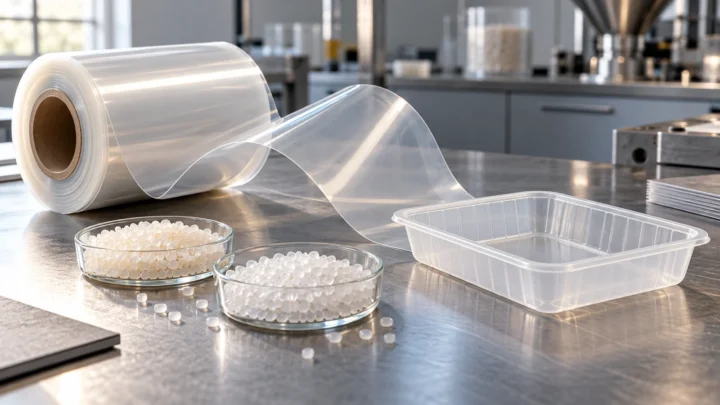
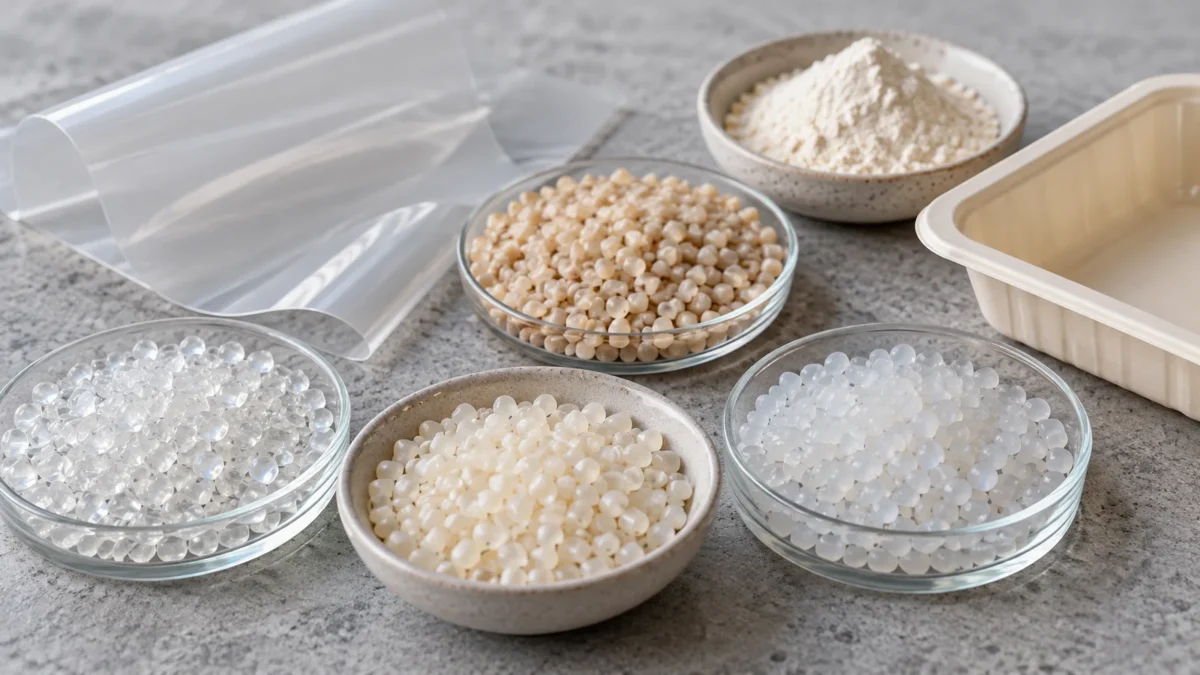
Sources checked 17 October 2026. The main image is an AI-generated editorial illustration; the explanatory figure is an original editorial diagram. Neither is a photograph of an identified product or facility, a laboratory result or an independent environmental assessment.
Official sources and reference notes
- [R1] European Commission. Biobased, biodegradable and compostable plastics / COM(2022) 682. Live public source, checked 17 October 2026. Bio-based ≠ biodegradable; biodegradable plastics may be fossil or bio-based; compostability is a subset/end-of-life route; full-life-cycle and waste-hierarchy cautions. Relevant public text checked; see the stated scope. Accessed 17 October 2026.
- [R2] European Bioplastics. Bioplastic materials / Glossary. Live public source, checked 17 October 2026. Current industry usage of “bioplastics” as bio-based, biodegradable or both; examples including PLA, PHA, PBS, PBAT and drop-in plastics. Relevant public text checked; see the stated scope. Accessed 17 October 2026.
- [R3] Roy et al. Recent progress in PBAT-based films and food packaging applications: A mini-review. 2024. PBAT chemistry, synthetic/fossil-derived positioning, flexibility, film applications and qualitative limitations. Public record/abstract or identified section extracts only; no unexamined experimental details used. Accessed 17 October 2026.
- [R4] Bauer, Henkel, Gürer & Lieleg. Bio-Based and Degradable Food Packaging Materials: Where Are They?. Advanced Materials Interfaces 12(6), 2025, 2400645; first online 20 December 2024; DOI 10.1002/admi.202400645. Sections 2.1.1–2.1.3 and 3; relevant text on lignocellulosic materials, PHA, TPS, PLA and bio-PBS. Relevant public text checked; see the stated scope. Accessed 17 October 2026.
- [R7] Food Packaging and Shelf Life. Advances in PLA/PBAT-based blend film in food packaging applications: A review. 2026. PLA stiffness/brittleness versus PBAT flexibility; rationale for blending; modifiers/fillers. Public record/abstract or identified section extracts only; no unexamined experimental details used. Accessed 17 October 2026.
- [R10] ASTM International. ASTM D6400-26. D6400-26 Active; last updated 15 June 2026. Public abstract/scope only. Public catalogue and scope only; paid clauses not accessed. Accessed 17 October 2026.
- [R11] BPI. Find BPI-Certified Products. Live public source, checked 17 October 2026. Certification is item/company/SKU-specific and distinguishes commercial/home certification. Public catalogue explanation; no named SKU is claimed certified. Accessed 17 October 2026.
- [R12] Sustainable Materials and Technologies. Recycling and revalorization of PLA and PHA-based food packaging waste: A review. 2025. Mechanical and chemical recycling routes exist technically for PLA/PHA. Public record/abstract or identified section extracts only; no unexamined experimental details used. Accessed 17 October 2026.
The public corrections channel is currently inactive. Read our corrections policy.