
Extended producer responsibility for packaging connects the businesses supplying packaging or packaged goods with responsibility for what happens after use. It can require funding and, in some systems, organizing waste management. For a brand or packaging company, the practical starting point is a market-specific question: which business is responsible for which packaging, and what information supports that decision? [S1] [S2]
EPR is a policy approach, not a single international registration or a certificate that makes a pack sustainable. This guide explains the operating logic and the records worth preparing. It uses official examples from the UK, Oregon and EU implementation resources without treating their rules as interchangeable.
The practical answer
- Identify the destination market and the scheme-defined producer before assuming the packaging factory is liable.
- Keep component specifications and supply data, then map them to the reporting categories used in that market.
- Treat registration, reporting, fees and environmental performance as distinct questions; one does not prove the others.
ScopeGeneral guide, with UK, Oregon and EU examples.
EvidenceOfficial authority guidance and OECD policy research.
Decision boundaryLocal definitions and exceptions still need a case-specific assessment.
What EPR changes—and what it does not
The OECD describes EPR as extending producer responsibility through the product lifecycle, including the post-consumer stage. For packaging, the approach can create dedicated funding for collection, sorting and treatment, while generating information about material flows. Its effectiveness depends on implementation, oversight and the waste-management system it supports. [S1]
That distinction matters in a packaging project. A design team may know exactly how a tray is manufactured while the reporting team lacks its component weights or sales-market allocation. EPR brings those records into the same business conversation. It does not, by itself, establish that the tray is collected locally, actually recycled or preferable on every environmental measure.
Who is the “producer” of packaging?
The word does not always mean the factory making the empty container. UK guidance, for example, distinguishes activities such as supplying branded filled packaging, packing or filling, importing, supplying empty packaging and operating an online marketplace. Whether a business is obligated also depends on the relevant conditions. Those UK categories should not be used as a worldwide allocation rule. [S3]
Start with the actual transaction: identify the legal entities, where the goods are supplied, who imports them, whose brand appears and whether the transaction concerns empty or filled packaging. A contract can document those facts and cooperation between businesses; a statement that “the supplier handles EPR” is not enough to explain which statutory role applies.
| Market example | Official starting point | Question the business still needs to resolve |
|---|---|---|
| United Kingdom | Defra’s producer/activity guidance and the applicable reporting route. [S3] | Which activities and producer conditions apply to the entity and packaging concerned? |
| Oregon, United States | DEQ describes PRO registration, supply reporting and fees for covered producers, while identifying a small-producer exemption. [S7] | Is the product covered, which entity is the producer, and does a specific exemption apply? |
| EU destination markets | The Commission’s implementation resources include national competent-authority information. [S8] | Which national registration, implementation and scheme arrangements govern this supply? |
For an international brand, the useful output is a market-by-market responsibility record. It should say who made the assessment, which source/version was used and what remains unresolved. It should not copy one country’s conclusion into every export market.
How the money, information and packaging move
Financial EPR and operational EPR are different arrangements. The OECD explains that public collection can be funded through producer contributions, while other systems give producers an operational role as well. Producers commonly work collectively through a producer responsibility organisation (PRO). The precise model varies. [S2]
For a business, three flows are worth keeping separate: packaging and goods move through the supply chain; information describes that supply; money helps fund the relevant system. A fee payment is not evidence that a particular package reached a recycler.
- Map and record. Define markets, entities, product scope and period. Connect component specifications with the units supplied.
- Apply the scheme rules. Resolve producer roles, reporting classifications and the appropriate reporting or compliance route.
- Reconcile and retain. Match submitted data, supporting records and charges; revisit the record when the product or market changes.
This is an editorial operating sequence. It is not a prescribed filing procedure and does not replace the instructions of the relevant authority or scheme.
Build a packaging record that can survive a handover
The most useful supplier handover is a versioned record of the actual pack. A catalogue label such as “paper bowl” or “recyclable tray” does not tell the reporting team the construction, component masses or period of supply. Keep the physical description separate from the code eventually used in a return.

| Record to retain | Why it helps | Control against misreading |
|---|---|---|
| SKU and specification revision | Connect the record to the product actually supplied. | Do not carry a previous design’s weights into a revised pack. |
| Components and construction | Identify body, lid, sleeve, label and integrated layers where relevant. | A component list is not automatically the reporting classification. |
| Mass, unit and measurement basis | Make the weight traceable to a specification or documented measurement. | Distinguish grams per component from kilograms supplied. |
| Units supplied, market and period | Connect the physical pack with the relevant sales/supply record. | Do not substitute total global orders for a defined market’s supply. |
| Source, owner and unresolved fields | Let another team reproduce the record and follow up changes. | An estimate remains an estimate until its basis is verified. |
Collect component facts; classify them under the right rules
The UK large-producer guide illustrates why this separation matters. It requests material and weight information but also gives specific treatment for separate components, certain drink containers and integrated materials. A component may therefore need to be recorded physically even when its weight is combined with another material in a particular return. Do not turn “measure the components” into “report every component separately everywhere.” [S4]
A useful calculation control: for a defined component, units supplied × verified grams per unit ÷ 1,000 gives kilograms. Keep the market, period, component version and supply basis attached. The arithmetic does not decide whether that supply is reportable, whether an adjustment applies or which material category governs it.
Understand fees before using them in a design decision
EPR costs should not be treated as one universal surcharge. In the UK, official guidance distinguishes recycling obligations and supporting recycling evidence from waste disposal fees. That distinction matters when budgeting: two documents about packaging responsibility may describe different charges or obligations. [S5]
PackUK’s notice-of-liability guidance describes disposal-fee calculations and other cost items, including administration and public-information costs. It also identifies modulation connected with environmental impact. Read the actual basis and period of a charge before comparing quotations or promising a saving. [S6]
For an internal cost model, retain the applicable category, weight basis, period and fee-schedule version. Separate a quoted rate from adjustments and other charges. If a redesign changes the material category or assessment result, document that change rather than assuming a lighter pack produces a proportionate saving. Use the official schedule for the relevant period and confirm which additional charges apply.
EPR is not the same as recyclability or compostability
Oregon’s producer guidance covers packaging, paper and food serviceware within its stated system. Its scope and exemptions have their own definitions. An environmental description should not be substituted for that scope review. “Recyclable,” “bio-based” or “compostable” is not, on its own, an EPR applicability assessment. [S7]
Equally, registration or a fee payment does not document local collection acceptance, a finished-pack test or a life-cycle comparison. Keep the questions separate: who bears responsibility under the scheme; which recovery route exists; and what evidence supports the environmental claim.
Our related guides explain how to assess recyclability of the whole packaging design and how to read a packaging life-cycle comparison. Neither type of evidence can be replaced with an EPR registration number.
What brands and packaging suppliers should do next
A productive first handover pairs two records: a market/responsibility assessment owned by the business supplying the goods, and a component/specification record maintained with the packaging supplier. Agree who updates each when the construction, importer, brand arrangement or destination changes. That turns a vague request for “EPR-compliant packaging” into questions that someone can answer and document.
For UK-specific reporting context, see our guide to keeping 2026 and 2027 recyclability reporting separate. Recheck the current official instructions before applying a reporting-year rule. The central discipline travels across markets: retain the same physical facts, but investigate each market’s legal role and reporting treatment on its own terms.
Methodology and scope
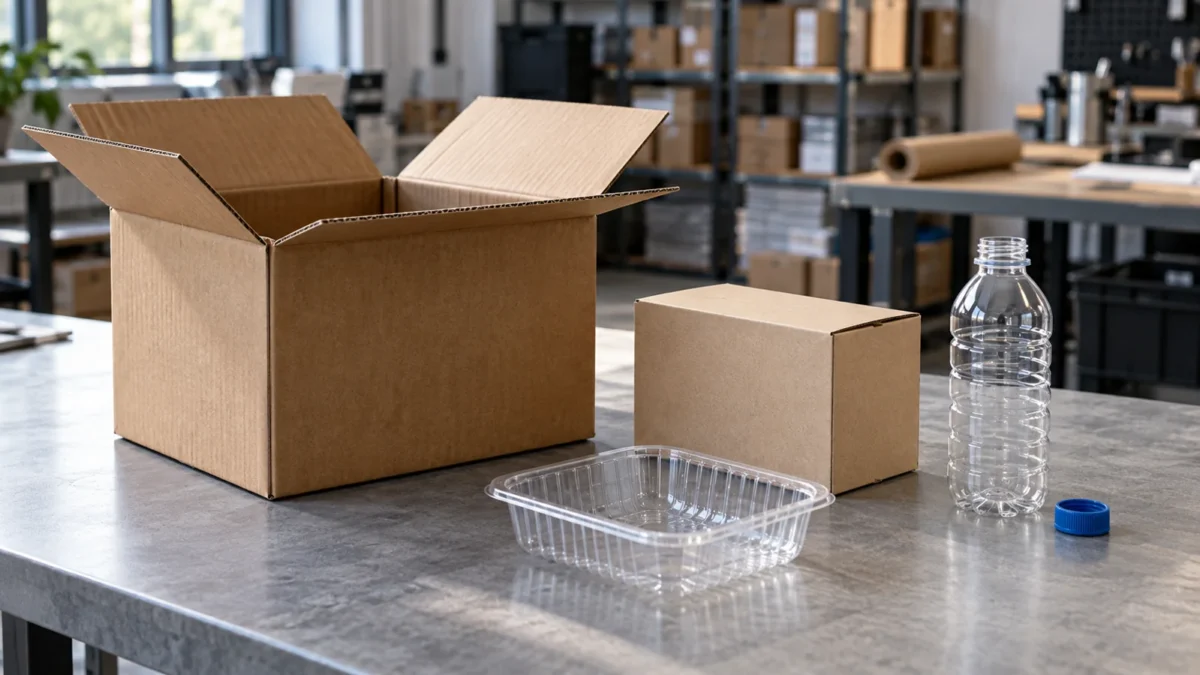
Desk-based synthesis of the official sources below, checked 17 October 2026. The tables and operating sequence are editorial tools for organising questions and records. No original experiment, company-specific liability assessment, exemption decision or complete multi-jurisdiction legal audit was performed. Fees, deadlines and thresholds are intentionally not reproduced as a worldwide checklist. Photographic-style imagery was AI-generated for context and does not document an actual company or inspection.
Official sources and reference notes
- [S1] OECD: Extended producer responsibility and economic instruments. Live topic page, accessed 17 October 2026. Key messages: funding, recycling targets and transparency.
- [S2] OECD: Extended Producer Responsibility — Basic facts and key principles. 17 April 2024; OECD Environment Policy Papers No41; DOI 10.1787/67587b0b-en. Printed pp6–8: Basic facts; pp11–12: transparency and government capacity.
- [S3] Defra / Environment Agency: Check if you must comply with EPR for packaging. Updated 19 August 2026; accessed 17 October 2026. What is a producer; obligated producer; supply-chain activity; next steps.
- [S4] Defra: Check what to report for EPR for packaging as a large producer. Live guidance, accessed 17 October 2026. Steps1–4, especially Step2 separate components, drink containers and integrated materials.
- [S5] Defra: Recycling obligations and waste disposal fees. Live guidance, accessed 17 October 2026. Recycling obligations and packaging waste disposal fees.
- [S6] PackUK / Defra: EPR for packaging — notice of liability. Published 23 March 2026; accessed 17 October 2026. What a notice includes; disposal fees, modulation and other cost items.
- [S7] Oregon DEQ: Producers of Covered Products. Live regulator page, accessed 17 October 2026. Opening producer-obligation explanation; small-producer note; Oregon PRO.
- [S8] European Commission: Packaging and Packaging Waste Regulation implementation. Live implementation page, accessed 17 October 2026. Implementation support and national competent-authority resources.
The public corrections channel is currently inactive. Read our corrections policy.