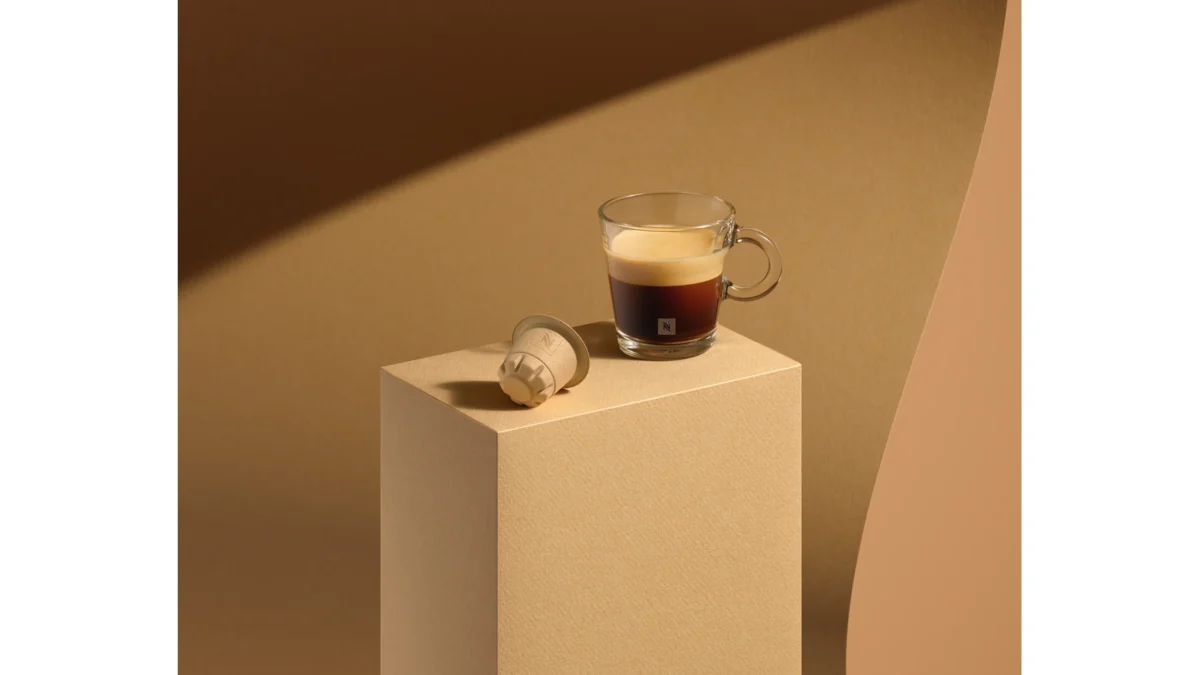
Nespresso says it has decided to discontinue its Paper-Based Collection and concentrate on aluminium capsules. Its official German-market FAQ, checked on 21 October 2026, attributes the decision to its assessment of coffee quality and customer feedback. Packaging Europe reported the development on 14 October. The FAQ does not give a dated, market-by-market withdrawal schedule.
For packaging developers, the news is a consequential example of a material substitution being reconsidered after launch. It does not demonstrate that paper-based capsules are universally unworkable. It shows that an alternative construction must deliver the complete product experience, alongside its proposed disposal route.
What the company actually says
Nespresso’s explanation centres on preserving taste and aroma. The company says its experience reinforced its preference for aluminium to protect freshly roasted coffee. It also refers to analysis of customer feedback. Those are the company’s stated reasons; this report has not reviewed the underlying feedback dataset or comparative product tests.
The official statement supports reporting a discontinuation decision. It does not support inventing a specific defect, a rate of consumer complaints or a machine-compatibility failure. It would be equally unwarranted to claim that a particular barrier layer caused the decision without a company disclosure or directly relevant test evidence.
Packaging Europe’s report provides the dated news context. Its publication date should not become the date on which Nespresso made the internal decision or stopped sales. Those are separate events, and their exact dates have not been established here.
The product involved more than a paper capsule
Nespresso’s Belgian product information describes capsules containing 82% paper pulp with a thin polymer lining, intended for Original machines. It also describes a separate freshness pouch and instructions for storage after opening. The page remained accessible at the research cutoff; its presence does not prove that every listed product remained orderable.
This construction matters to the interpretation of the withdrawal. The package was a system: capsule, protective lining, outer pouch, storage instructions, brewing equipment and disposal behaviour. Assessing only the visible capsule would omit functions carried elsewhere in that system. A paper share tells readers about composition, not whether all functions match an alternative.
The online records also need to be read at the right geographic scale. A German-market FAQ announcing the decision and a Belgian information page describing the range can coexist during a changeover. They do not establish one common final sale date. Without a country-specific notice or transactional availability check, the safest statement concerns the decision, rather than a claim that all stock has vanished worldwide.
Quality, compatibility and disposal are separate tests
Coffee packaging must protect a sensory product before use and operate within a brewing system during use. Home compostability addresses a different stage. Success at an end-of-life test cannot establish freshness, just as acceptable coffee quality cannot establish what happens after disposal.
Machine compatibility is another distinct question. A material may be designed for a particular machine family without reproducing every operating characteristic of an established capsule. The records checked here do not justify identifying compatibility as the cause of this withdrawal. It remains a relevant design dimension, not a reported failure finding.
Similarly, disposal instructions describe intended handling under a defined system. They should not be expanded into permission to place capsules in paper recycling or any municipal organic-waste collection. Our coverage of Barrier-Coated Paper, Cellulose Films and Compostable Flexibles: Where Plastic-Laminate Alternatives Actually Fit examines why barrier function and recovery need separate evidence; From Material Substitution to System Redesign: How Sustainable Packaging Innovation Is Moving Beyond “Plastic vs Paper” explains why replacing one material changes the wider packaging system.
No environmental league table follows
Nespresso also says its comparison found similar overall environmental impacts for the two capsule options. That is an attributed company position. The complete life-cycle model, assumptions and sensitivity analysis were not examined for this report, so the statement is not used to declare one format independently superior.
Several issues would determine a defensible comparison: equivalent coffee service, packaging components, product losses, the energy and materials used, and the disposal routes that actually occur. A result under one set of assumptions cannot settle every market or consumer situation. This article therefore avoids turning the withdrawal into a universal carbon or sustainability verdict.
A boundary case for substitution
The useful industry lesson is specific. Introducing an alternative material opens a new set of interactions between protection, use and recovery. Later customer experience can change a supplier’s decision even if the initial material proposition remains technically interesting. The withdrawal is evidence about this product programme, not a controlled experiment on every paper-based packaging application.
The next facts needed are exact withdrawal dates and scope, any further explanation of the quality assessment, and updated customer instructions. Until those are available, reporting should preserve the company’s stated reasons and leave unreported causes unassigned.
Sources
- Nespresso. Frequently asked questions — German-market English FAQ. Undated; accessed 21 October 2026. Top 5 FAQ; Will the compostable capsules be discontinued?; Is Nespresso scaling back its sustainability efforts?. Sources checked 21 October 2026.
- Nespresso Belgium. Discover our home compostable Original capsules. Undated; accessed 21 October 2026. Composition; Original machine; freshness pouch and storage sections. Sources checked 21 October 2026.
- Packaging Europe staff writers. Why is Nestlé discontinuing its paper-based Nespresso capsules?. 14 October 2026. Lead and quoted FAQ explanation. Sources checked 21 October 2026.
The public corrections channel is currently inactive. Read our corrections policy.