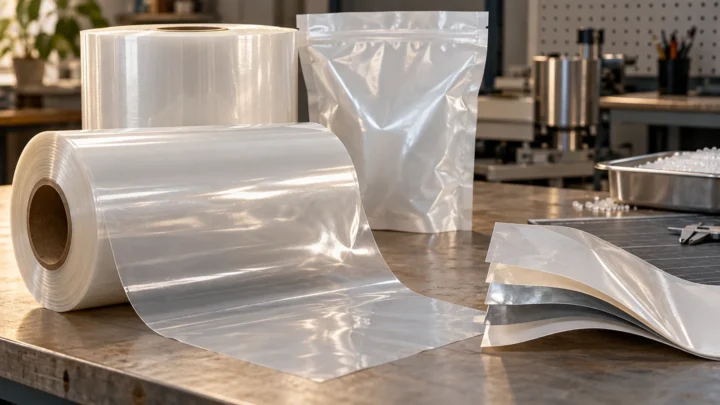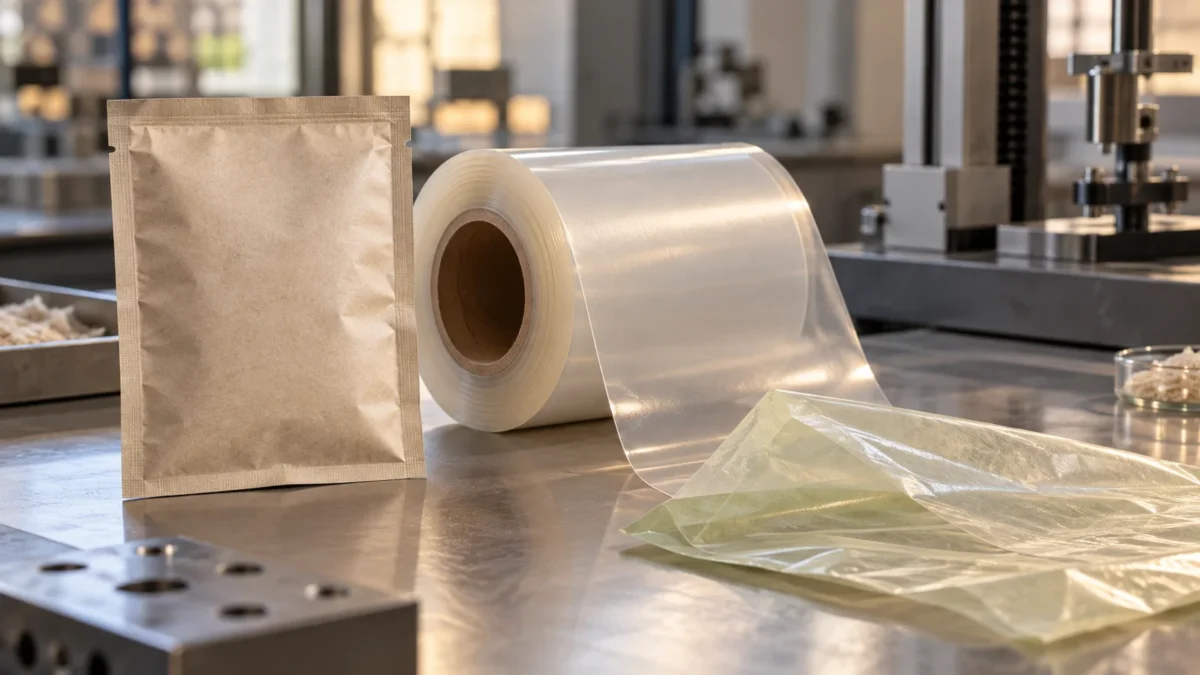
Put three “plastic-alternative” flexible packages on a table and they can look deceptively similar.
One may be paper with a thin barrier coating. Another may be a transparent regenerated-cellulose film. A third may be a compostable polymer blend based on PLA, PBAT, PBS, starch or another biodegradable resin system.
They are not interchangeable.
The paper structure may be designed to return to a paper mill. The cellulose film may provide excellent oxygen and aroma barrier in dry conditions but become more moisture-sensitive as humidity rises. The compostable film may provide better flex and heat sealing than bare paper while depending on a specific composting route after use.
So the useful question is not:
“Which one is the best alternative to plastic laminate?”
It is:
“Which construction fits the product’s barrier, sealing, mechanical and end-of-life requirements without creating a new failure somewhere else?”
Start with the package stress, not the material name
A conventional plastic laminate can be engineered for many jobs at once: moisture protection, oxygen barrier, aroma retention, heat sealing, puncture resistance, transparency, print quality and long shelf life. [S1] [S2]
Replacing it means deciding which of those jobs are actually necessary.
Four questions usually separate the realistic alternatives quickly:
- How much oxygen barrier is required?
- How much moisture barrier—or moisture transmission—is required?
- How demanding is the sealing and mechanical duty?
- Which recovery route is credible in the market where the pack will be discarded?
A dry tea overwrap, a chocolate twist wrap, a hotel soap wrapper, a face-mask sachet, a wet detergent refill and a coffee pouch may all be “flexible packaging.” They do not need the same material.
Barrier-coated paper works best when paper can remain the dominant system
Paper starts with several advantages for flexible-format redesign. [S1]
It provides stiffness, printability, opacity and a familiar recycling pathway. It can also be folded, creased and run through established paper-converting equipment.
Its weakness is that untreated paper does not provide the same grease, liquid, oxygen and water-vapor control as a high-performance plastic laminate.
That is why barrier-coated paper exists.
Coatings can add:
- grease resistance;
- water resistance;
- heat sealability;
- oxygen barrier;
- aroma protection;
- improved surface strength.
But the coating creates the central design question:
Can enough function be added without preventing the fiber from being recovered in the intended paper-recycling process?
“Paper recyclable” depends on the mill route
Europe’s current paper-packaging design work makes this more explicit than a simple paper-versus-plastic label. [S2]
The 2026 version of the 4evergreen Circularity by Design Guideline distinguishes among packaging compatible with conventional recycling mills, flotation-deinking mills and specialised recycling processes. It also warns that a structure that performs poorly in one recycling route may still be suitable for another.
That matters for coated and flexible paper formats.
A wrapper with a light functional coating is not the same recycling problem as a heavily laminated paper pouch. The fiber yield, reject fraction, stickies, coating behavior and sorting route can differ substantially.
Cepi’s current laboratory method therefore tests paper and board packaging by simulating pulping, screening and sheet formation rather than assuming recyclability from fiber percentage alone.
For designers, that means a coating should be judged on the finished pack—not on the fact that the base sheet is paper.
Where coated paper fits naturally
Coated paper tends to fit best where the package needs moderate protection and where paper stiffness or print performance is useful. [S1]
Examples can include:
- dry confectionery;
- bakery wraps;
- tea envelopes;
- powder or dry-product secondary packs;
- soap wrappers;
- hotel amenity packaging;
- selected personal-care overwraps;
- some paper sachets and pouches where barrier demand is not extreme.
The harder the application becomes—long shelf life, high humidity, free liquid, aggressive oils, very low oxygen transmission—the more the coating or laminate has to do.
At some point the structure can become less like “paper with a functional layer” and more like a composite pack that happens to contain paper.
Regenerated cellulose film solves a different problem
Cellulose film sits in an unusual position. [S4]
It can be transparent and flexible like conventional plastic film, yet it is based on regenerated cellulose rather than a thermoplastic polyolefin.
In dry conditions, regenerated cellulose can provide very strong oxygen barrier. Research on regenerated-cellulose films shows that this barrier can deteriorate significantly as the material absorbs moisture, because water changes the spacing and mobility of the cellulose chains.
That explains why commercial cellulose-film ranges are rarely one universal film.
Different grades use coatings or other treatments to adjust:
- moisture barrier;
- heat sealability;
- oxygen and aroma protection;
- grease resistance;
- controlled breathability.
For the right application, that tunability is useful.
Dry oxygen-sensitive products are one of cellulose film’s strongest territories
A dry product that needs oxygen or aroma protection but does not expose the film to severe humidity is an attractive use case. [S5]
Examples include:
- confectionery;
- tea;
- dry foods;
- some snack products;
- aroma-sensitive overwraps;
- selected cosmetics or personal-care sachets;
- premium transparent wraps.
Fresh produce creates the opposite requirement: the package may need controlled permeability so respiration and moisture do not create excessive condensation. That makes a deliberately more permeable cellulose-film grade potentially useful where an ultra-high barrier would be counterproductive.
The key point is that “high barrier” is not always the objective.
The correct permeability is the one that matches the product.
Humidity is cellulose film’s boundary condition
The weakness appears when water enters the system. [S5]
Peer-reviewed work on regenerated cellulose has shown that oxygen permeability can increase markedly as water regain rises. Cellulose is hydrophilic, and absorbed water can plasticize the structure and reduce gas-barrier performance.
This is why coatings and multilayer combinations are often used around cellulose film.
They are not necessarily evidence that the material “failed.” They are how the designer protects the useful oxygen-barrier and optical properties while adding moisture resistance or sealability.
But each added layer changes the end-of-life question.
Machineability is a separate qualification gate
A film that has good laboratory barrier data still has to run on packaging machinery. [S6] [S7]
A study available online in 2025 and published in a 2026 journal volume, using one commercial cellulose film on vertical form-fill-seal equipment found that the material could be converted successfully under the tested conditions, but sealing behavior depended strongly on tool design and operating window. The study reported an effective sealing window around 90–110°C for the tested material, and serrated jaws produced better continuous seals than flat jaws.
That result should not be treated as a universal cellulose-film setting.
It proves something more useful:
alternative films need machine-scale qualification, not only material-property testing.
A converter may have to adjust sealing temperature, pressure, dwell time, forming shoulder, friction management or jaw geometry before the material becomes commercially viable.
Compostable polymer films solve the flexibility problem—but create a different end-of-life dependency
Compostable flexible films often use polymer blends because no single compostable polymer supplies every desired property. [S8] [S9]
PLA contributes stiffness, clarity and processability but can be brittle and has limitations in heat and moisture-sensitive applications.
PBAT contributes flexibility and toughness but has its own strength, barrier and cost limitations.
PBS can alter thermal and mechanical behavior. Thermoplastic starch can increase renewable content and biodegradability potential but is moisture-sensitive and commonly needs a polymer partner.
That is why commercial and experimental compostable films frequently use blends rather than one resin.
Recent reviews of PLA/PBAT systems show the same pattern seen in conventional laminates: performance is engineered through composition, compatibilization, fillers, coatings and processing conditions.
“Compostable film” therefore describes an end-of-life target, not a single mechanical or barrier specification.
Where compostable flexibles can fit
Compostable flexible packaging becomes most interesting where three conditions line up: [S8]
- the required package performance can be achieved;
- the complete finished construction can support the claimed compostability standard;
- a realistic organics or composting route exists for the intended market.
Candidate applications can include:
- produce bags;
- some dry-food pouches;
- tea or coffee secondary components;
- compostable liners;
- single-dose cosmetics or amenity sachets;
- food-contaminated formats where accepted organics systems are specifically designed to receive them.
But compostability does not remove normal packaging requirements.
A flexible detergent sachet still needs chemical resistance. A wet cosmetic sachet still needs hermetic seals. A dry snack still needs moisture control. A coffee package may need extremely strong oxygen, aroma and light protection.
The standard applies to the end item, not the marketing adjective
ASTM D6400-26 illustrates an important evidence boundary. [S12]
The current standard covers plastics and products—including packaging—designed for aerobic municipal or industrial composting under thermophilic conditions. It explicitly addresses end items, including packages that contain polymers as coatings or binders.
That means a compostable base resin does not automatically make the final printed, laminated, adhesive-bonded pouch compostable.
The full construction matters.
The same caution applies to home composting, which is a separate condition set and should not be inferred from industrial-compostability evidence.
Paper recycling and composting are not interchangeable recovery stories
This is where alternative flexibles are often oversimplified. [S1] [S12]
A paper pouch may be designed for fiber recovery.
A coated cellulose film may be certified for composting.
A PLA/PBAT blend may be intended for industrial composting.
A laminate containing paper plus compostable film may be designed around a compostability route rather than conventional paper recycling.
Those are different systems.
They should not be presented as variations of the same “biodegradable package.”
A paper-based structure that passes a conventional-mill recyclability test may be a strong option where paper collection and mills are established. A certified compostable film may make more sense in a controlled organics system that actually accepts the product category. Neither route should be assumed from material appearance alone.

Application map: where each alternative is strongest—and where the boundary appears
| Application condition | Barrier-coated paper | Cellulose film | Compostable polymer film | Main caution |
|---|---|---|---|---|
| Dry confectionery / bakery | Often strong fit | Strong fit where transparency or twist/film behavior is useful | Potential fit | Moisture barrier and seal method still matter |
| Tea / dry aroma-sensitive goods | Possible with suitable barrier | Strong candidate, especially in dry service | Possible with engineered barrier | Long shelf-life requirements vary widely |
| Fresh produce | Limited for many flexible uses | Permeable grades can be useful | Potential bag/film application | Respiration and condensation must be controlled |
| Cosmetic / hotel amenity overwrap | Good where product contact/barrier is modest | Good candidate for clear or printed overwrap | Potential fit | Wet formulations require stronger hermetic barrier |
| Liquid / wet sachet | More difficult | Usually requires coated or laminated structure | Possible only with sufficiently robust seal/barrier system | Leak integrity and moisture exposure dominate |
| Coffee / very high barrier | Requires sophisticated barrier construction | Barrier / metallised grades or laminates may fit | Requires high-performance composite design | Oxygen, aroma, moisture and light all matter |
| Household refill pouch | Application-limited | Possible only for selected chemistries/constructions | Potential where chemical resistance and seals qualify | Drop, flex-crack, chemical and leak resistance |
| Retort / severe heat process | Difficult | Specialty systems only | Difficult and highly formulation-specific | Heat, pressure, barrier and seal retention |
High-barrier coffee is not the same redesign problem as hotel soap
This is the most useful way to read the table. [S1] [S5] [S8] [S13] [S14]
A hotel soap wrapper may need print quality, tear behavior and modest moisture protection. Barrier-coated paper or cellulose film may solve that problem with relatively little structural complexity.
A face-mask sachet contains a wet formulation and must maintain a hermetic seal for its full shelf life. The package may need a more complex compostable laminate—or the alternative may not yet be appropriate.
A coffee pack adds oxygen, aroma, moisture and often light protection simultaneously. Commercial cellulose-film systems can use barrier coatings or metallization to reach much more demanding performance, but then the exact coating, lamination and certified end item have to be evaluated.
A household refill pouch adds a different stress: chemical resistance plus repeated flexing and drop risk.
There is no meaningful “plastic-alternative winner” across those four applications.
Do not let the recovery claim outrun the package
The alternative only works when the end-of-life claim fits the full construction and the local system. [S1] [S12]
For coated paper, ask whether the finished structure is compatible with the intended paper-mill route.
For cellulose film, ask whether the exact grade and finished laminate are certified for the claimed composting environment—or whether the intended route is something else.
For compostable polymer film, ask whether the complete printed and converted pack is covered by the relevant evidence and whether the receiving organics system accepts that format.
And for all three, verify that the new structure still protects the product.
A package that fails early and causes product loss is not rescued by having a cleaner disposal label.
The application-boundary rule
Barrier-coated paper, cellulose film and compostable polymer films are not competing versions of one material. [S1] [S12]
They occupy different parts of the flexible-packaging design map.
Coated paper is strongest when fiber can remain the dominant structure and the required barrier is moderate enough to preserve a credible paper-recycling route.
Regenerated cellulose film is especially interesting when transparency, oxygen/aroma barrier, printability or controlled permeability matter, but humidity and machine-sealing behavior must be engineered carefully.
Compostable polymer blends offer film-like flexibility and sealability, but their performance depends on formulation and their end-of-life value depends on an actual composting system.
The correct design sequence is therefore:
product → barrier requirement → sealing/mechanical requirement → converting process → recovery route → material construction.
Starting with the word “paper,” “cellulose” or “compostable” reverses that logic—and is how a promising alternative becomes the wrong package.
Methodology and editorial note
This compares separate paper, cellulose-film and compostable-film applications and recovery pathways. Reported sealing conditions apply only to the tested grade and apparatus. Certification, local acceptance and actual recovery remain separate. Sources checked 20 October 2026. The main image is an AI-generated editorial illustration of a generic packaging scene; it does not depict a named product, facility, company or test.
Sources and reference notes
- [S1] 4evergreen. Circularity by Design Guideline, Version 4. 4evergreen Circularity by Design Guideline Version 4. Company statements are attributed; scientific/technical claims are limited to the stated test or review scope. Accessed 20 October 2026.
- [S2] Confederation of European Paper Industries (Cepi). Paper and Board – Recyclability Laboratory Test Method – Part I: Recycling Mill with Conventional Process. Cepi Recyclability Test Method Version 3. Company statements are attributed; scientific/technical claims are limited to the stated test or review scope. Accessed 20 October 2026.
- [S4] International Journal of Food Science / ScienceDirect listing. Cellulose-Based Films for Food Packaging Applications: Review of Preparation, Properties, and Prospects. Cellulose-based films review. Abstract/indexed record only unless retained source capture proves full text; no precise result inferred from an inaccessible paper. Accessed 20 October 2026.
- [S5] Carbohydrate Polymers. Oxygen permeability of regenerated cellulose films with different water regains. Regenerated cellulose oxygen permeability vs moisture. Abstract/indexed record only unless retained source capture proves full text; no precise result inferred from an inaccessible paper. Accessed 20 October 2026.
- [S6] Packaging Technology and Science. Heat Sealability and Convertibility of Cellulose Film in Vertical Form, Fill and Seal Machine for Food Packaging Applications. Current cellulose-film VFFS machine study. Abstract/indexed record only unless retained source capture proves full text; no precise result inferred from an inaccessible paper. Accessed 20 October 2026.
- [S7] Composites Part C. Heat sealable regenerated cellulose films enabled by zein coating for sustainable food packaging. Heat-sealable regenerated-cellulose research. Abstract/indexed record only unless retained source capture proves full text; no precise result inferred from an inaccessible paper. Accessed 20 October 2026.
- [S8] International Journal of Biological Macromolecules / ScienceDirect. Advances in PLA/PBAT-based blend film in food packaging applications: A review. PLA/PBAT flexible-film review. Abstract/indexed record only unless retained source capture proves full text; no precise result inferred from an inaccessible paper. Accessed 20 October 2026.
- [S9] Food Chemistry. Recent progress in PBAT-based films and food packaging applications: A mini-review. PBAT film review. Abstract/indexed record only unless retained source capture proves full text; no precise result inferred from an inaccessible paper. Accessed 20 October 2026.
- [S12] ASTM International. Standard Specification for Labeling of Plastics Designed to be Aerobically Composted in Municipal or Industrial Facilities. ASTM D6400-26. Company statements are attributed; scientific/technical claims are limited to the stated test or review scope. Accessed 20 October 2026.
- [S13] Futamura. NatureFlex Compostable Films. NatureFlex current product range (company example). Company statements are attributed; scientific/technical claims are limited to the stated test or review scope. Accessed 20 October 2026.
- [S14] Futamura. Groundbreaking innovation for liquid sachet packaging. NatureFlex liquid sachet application (commercial example). Company statements are attributed; scientific/technical claims are limited to the stated test or review scope. Accessed 20 October 2026.
The public corrections channel is currently inactive. Read our corrections policy.