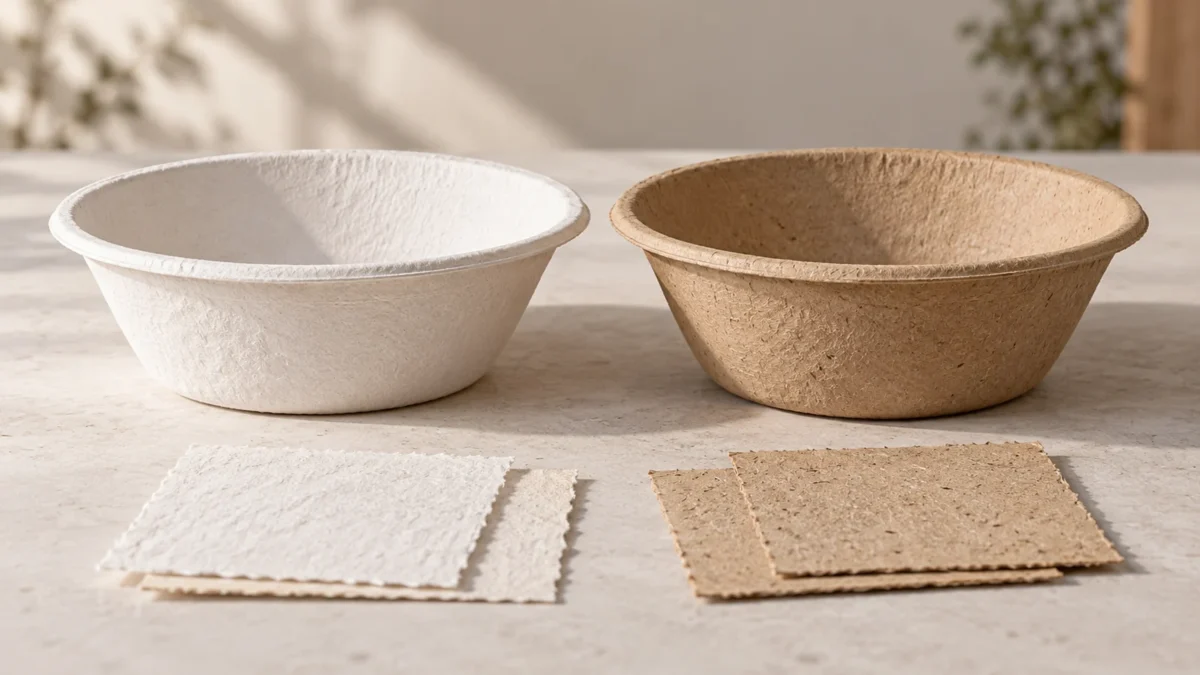
Bleaching can increase pulp brightness, but the color of a finished package is not a reliable material declaration. White or brown appearance alone does not establish whether it is virgin or recycled, stronger or weaker, safer for food, chlorine-free, recyclable, compostable or environmentally preferable.
That matters because buyers often read too much into appearance. A white molded-fiber bowl may be described as “cleaner” or “more food-grade,” while a brown tray may be marketed as “more natural” or “less processed.” Neither conclusion follows from color by itself.
Bleaching is a pulp-processing step used primarily to increase brightness and remove or alter residual colored compounds. The finished packaging properties still depend on fiber source, pulping method, bleaching sequence, refining, molding, additives, barrier treatment and intended use.
What “bleached” and “unbleached” actually mean
In chemical pulping, much of the lignin that binds wood fibers together is removed during cooking. The resulting pulp can then be used as an unbleached kraft pulp or sent through additional bleaching stages to remove residual lignin and chromophoric compounds and raise brightness.
Unbleached does not mean unprocessed. An unbleached kraft pulp has still gone through a chemical pulping process. Kraft cooking commonly uses sodium hydroxide and sodium sulfide to separate fibers and remove a large fraction of lignin. “Unbleached” means that the pulp has not undergone the subsequent bleaching sequence used to reach higher brightness.
Bleached does not automatically mean “bleached with elemental chlorine.” Modern pulp bleaching can use several chemical sequences. Elemental-chlorine-free, or ECF, bleaching replaces elemental chlorine with chlorine dioxide, typically alongside oxygen-based stages. Totally chlorine-free, or TCF, bleaching uses oxygen-based chemicals such as oxygen, hydrogen peroxide and ozone without chlorine-containing bleaching agents. [S8]
So the useful question is not “white or brown?” It is “what pulp and bleaching route produced this material?”
Why unbleached pulp is brown
Lignin and lignin-related chromophores absorb visible light and contribute to the brown or yellow appearance of many unbleached pulps. Chemical pulping removes a substantial portion of lignin, but residual lignin and colored compounds remain unless further delignification or bleaching is performed.
Mechanical and chemi-thermomechanical pulps behave differently because they retain much more of the original wood material. In these high-yield pulps, bleaching may focus more on modifying color-forming groups than removing all lignin. That is why a “bleached” mechanical pulp is not chemically identical to a highly bleached kraft pulp. [S1]
Color can also change with storage, heat, recycled-fiber content, fillers, coatings and printing. A brown surface is therefore a clue about processing, not a full material certificate.
What bleaching changes besides color
Bleaching changes pulp chemistry, and those changes can affect finished molded-fiber properties.
A controlled study of six wood-based pulps used in molded pulp products compared bleached softwood kraft pulp with unbleached softwood kraft pulp, along with other wood-pulp grades. The researchers found that the unbleached softwood kraft sample retained somewhat higher mechanical resistance than the bleached softwood kraft sample under the tested molded-pulp conditions. The bleached pulp, however, showed lower moisture uptake. [S1]
The authors connected these differences to the removal of residual non-cellulosic components during pulping and bleaching. In molded products formed under heat and pressure, retained lignin and hemicellulose can influence inter-fiber cohesion and moisture behaviour.
This does not establish a universal rule that unbleached packaging is stronger. Fiber species, fiber length, refining, density, forming pressure, wall thickness, moisture conditioning and additives can all change the result. It does show why bleaching should be treated as an engineering variable rather than a cosmetic step only.

Bleached is not automatically weaker, and unbleached is not automatically stronger
The effect of bleaching depends on the pulp and the process.
A chemical sequence that removes residual lignin or oxidizes fiber components can reduce yield or damage cellulose if it is too aggressive. At the same time, carefully controlled modern bleaching is designed to achieve brightness while preserving useful fiber strength. ECF and oxygen-based stages were developed in part to improve selectivity compared with older elemental-chlorine systems.
In molded fiber, pressing conditions can further change the picture. A pulp that performs one way in a paper sheet may behave differently when hot-pressed into a three-dimensional tray. The 2021 molded-pulp study found that non-cellulosic components retained in some pulps contributed to inter-fiber cohesion under heat and pressure, while moisture uptake also changed with pulp chemistry. [S1] [S2]
For a buyer, finished-product testing is therefore more useful than asking whether the pulp was bleached. Compression, tensile performance, rim stiffness, wet strength and dimensional stability should be tested on the actual package.
White does not mean “food safe,” and brown does not mean “safer”
Food-contact suitability is not determined by color.
In the European Union, the general food-contact framework requires materials and articles to be manufactured so that, under normal or foreseeable conditions of use, they do not transfer constituents to food in amounts that could endanger human health, unacceptably change food composition or deteriorate organoleptic properties. That requirement applies to the finished food-contact article—not to whether it looks white or brown. [S5]
A white molded-fiber container may use bleached virgin pulp, but its food-contact assessment still has to consider the full construction: fiber source, processing aids, wet-strength agents, barrier coatings, inks, adhesives and the intended food/time/temperature conditions.
A brown molded-fiber container has the same problem. “Unbleached” does not prove that no chemicals were used in pulping, that no additives are present, or that the product is automatically suitable for direct food contact.
The correct procurement question is: What evidence covers this finished construction for its intended food-contact use?
Bleached does not mean “chlorine bleached”
One of the most persistent buyer misconceptions is that a white paper or molded-fiber package must have been treated with elemental chlorine.
That is outdated as a general assumption. Modern chemical-pulp bleaching commonly uses ECF sequences in which chlorine dioxide replaces elemental chlorine, often combined with oxygen or peroxide stages. TCF sequences avoid chlorine-containing bleaching agents entirely and use oxygen-based chemicals such as oxygen, hydrogen peroxide and ozone.
| Term | What it generally means | What it does not prove |
|---|---|---|
| Unbleached | No subsequent high-brightness bleaching sequence after pulping | Chemical-free, safer, stronger or more sustainable |
| ECF | Elemental chlorine is not used; chlorine dioxide is the principal chlorine-containing bleaching agent | That no chlorine-containing chemistry is used at all |
| TCF | No chlorine-containing bleaching agents; oxygen-based chemistry is used | Automatic environmental superiority in every mill or product system |
| Bleached / white pulp | Pulp has been processed to achieve higher brightness | Food-contact compliance, purity, recyclability or compostability |
Editorial synthesis of the cited sources. Examples are not product test results; methods, construction and conditions remain part of every claim.
These terms should be used precisely. “Chlorine-free” is especially easy to misuse because ECF and TCF mean different things.
Is unbleached packaging more environmentally friendly?
Not necessarily.
Skipping or reducing bleaching stages can avoid some chemicals, energy, water use and yield loss associated with producing high-brightness pulp. But the environmental result depends on the entire mill system: wood or agricultural feedstock, pulping yield, chemical recovery, wastewater treatment, energy source, bleaching sequence, transport and finished-package mass.
Bleaching technology has also changed substantially. The pulp industry moved away from elemental chlorine because of concerns about chlorinated organic compounds in bleach-plant effluents. Modern ECF and TCF systems were developed to reduce those impacts, and current mills can have very different environmental performance from older bleaching processes.
That means “brown = greener” is not a defensible life-cycle conclusion on its own. A lower-brightness package may require less bleaching, but that single processing difference is not enough to rank two finished packaging systems.
Does white fiber mean virgin fiber?
No. Appearance does not establish fiber history.
Virgin pulp can be supplied bleached or unbleached. Recovered-fiber systems can also produce lighter or darker materials depending on the incoming paper grades, deinking, screening, fillers and subsequent processing. Conversely, a brown package can be made from virgin unbleached kraft pulp.
For molded food packaging, the distinction between virgin and recovered fiber can be important for regulatory and contamination-control reasons, but it should be established from the material specification and compliance documentation rather than inferred from color.
See molded-fiber feedstock differences for the related distinction.
Does bleaching remove everything except cellulose?
No.
Bleached chemical pulp is richer in cellulose because pulping and bleaching remove substantial amounts of lignin, extractives and other non-cellulosic components. But “bleached cellulose pulp” is still a material with a defined composition, not an abstract 100% pure substance.
EFSA’s 2022 opinion considered a specific pine/spruce bleached pulp proposed as an additive in polyethylene and polypropylene. Its composition included cellulose and hemicellulose; it was not a finding about all white fiber foodware. Crucially, the Panel could not conclude on the safety of that proposed additive use because the information was insufficient to assess potentially migrating low-molecular-mass substances. The opinion must not be presented as a general safety approval. [S7]
Surface appearance can hide the more important barrier system
For foodservice packaging, the visible fiber color is often less important than the invisible or translucent barrier system.
A white or brown molded-fiber bowl may need grease resistance, water resistance or wet strength. Those functions can come from internal additives, surface sizing, dispersion coatings, polymer layers or other treatments. The plant fiber and its color do not tell you which system is present.
This matters for claims such as PFAS-free, plastic-free, recyclable or compostable. Those claims depend on the full package construction. An unbleached brown tray with a polymer coating is not “uncoated” because it looks natural. A white molded bowl is not automatically plastic-coated because it is white.
Color is visual information. Barrier chemistry is a specification.
See plastic-free claims and hidden layers for the related distinction.
What should a buyer ask instead of “white or brown?”
| Question | Why it matters |
|---|---|
| What is the fiber source? | Wood, bagasse, bamboo and straw pulps have different morphology and processing histories. |
| What pulping route is used? | Kraft, mechanical and chemi-thermomechanical pulps retain different amounts of lignin and hemicellulose. |
| Is the pulp bleached, ECF, TCF or unbleached? | These terms describe different processing routes and should not be reduced to color alone. |
| What finished-product properties are required? | Strength, moisture response and stiffness must be tested on the actual molded article. |
| What creates the food barrier? | Oil and water resistance usually depend on coatings, additives or surface treatment rather than fiber color. |
| What food-contact evidence covers the construction? | White or brown appearance does not establish compliance. |
| What environmental claim is being made? | Lower bleaching intensity is one process variable, not a complete life-cycle comparison. |
Editorial synthesis of the cited sources. Examples are not product test results; methods, construction and conditions remain part of every claim.
What to put in the specification
For packaging decisions, treat bleaching status as one line in the material specification. The more important questions are the fiber source, pulping and bleaching route, finished-product properties, barrier chemistry, food-contact evidence and real end-of-life pathway.
Methodology and editorial note
This technical explainer synthesises the identified official guidance, public standard scopes and research records. Study findings remain specific to their reported materials and conditions. Sources checked 18 October 2026; no product testing, factory inspection or independent certification assessment was performed for this article.
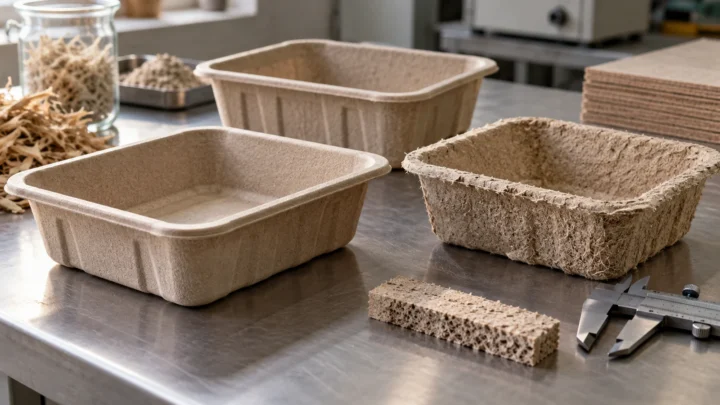
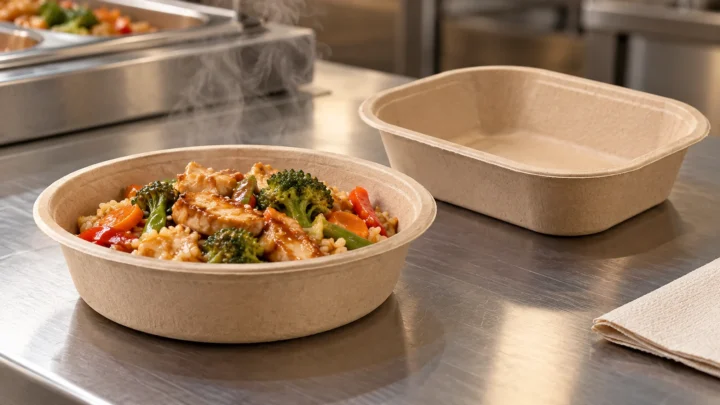
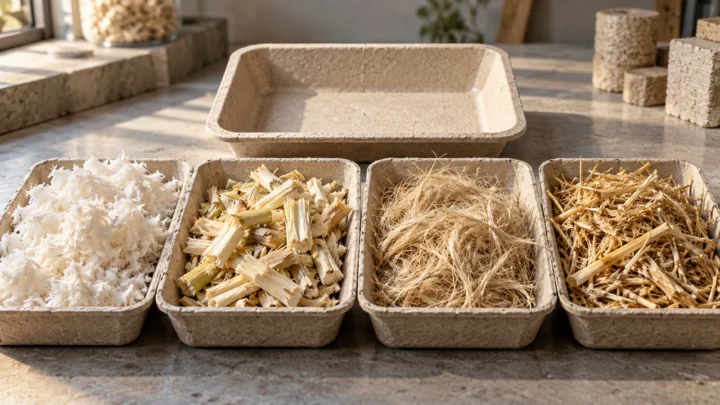
The main image is an AI-generated editorial illustration of an unnamed conceptual scene. The explanatory figure is an original editorial synthesis, not a photograph of an experiment, microscopic structure or measured result.
Official sources and reference notes
- [S1] Claire Dislaire et al. Mechanical and Hygroscopic Properties of Molded Pulp Products Using Different Wood-Based Cellulose Fibers. Polymers 2021, 13(19), 3225. Abstract; Sections 3.6, 4.1, 4.2; conclusions. Relevant public sections checked; source-specific scope retained. Accessed 18 October 2026.
- [S2] Claire Dislaire; Yves Grohens; Bastien Seantier et al. The impact of molded pulp product process on the mechanical properties of molded Bleached Chemi-Thermo-Mechanical Pulp. Published 31 March 2021. Abstract and process discussion. Relevant public sections checked; source-specific scope retained. Accessed 18 October 2026.
- [S5] European Parliament and Council. Regulation (EC) No 1935/2004 on materials and articles intended to come into contact with food. Adopted 27 October 2004; current consolidated text accessed 18 October 2026. Article 1; Article 3 general requirements. Identified public record/section access only; detailed experimental or paid-method claims require the underlying text. Accessed 18 October 2026.
- [S7] EFSA Panel on Food Contact Materials, Enzymes and Processing Aids. Safety assessment of bleached cellulose pulp for use in plastic food contact materials. Adopted 26 January 2022. Abstract / substance identity and intended use. Official public abstract/opinion conclusion checked; confidential information was redacted. Accessed 18 October 2026.
- [S8] European Commission Joint Research Centre. Best Available Techniques Reference Document for the Production of Pulp, Paper and Board. 2015; JRC95678; Chapter 3. 2015, Chapter 3, bleaching/ECF/TCF descriptions. Identified official technical-background sections checked; not a current product approval. Accessed 18 October 2026.
The public corrections channel is currently inactive. Read our corrections policy.