There is no single drop-in material that replaces every function PFAS once provided to fiber food packaging. The practical alternatives are barrier systems: aqueous polymer dispersions, starch/cellulose/chitosan coatings, nanocellulose, waxes and sizing agents, biodegradable-polymer layers, mineral or hybrid coatings, and multilayer combinations. The right system depends on whether the package must resist grease, liquid water, hot food, water vapor, oxygen, forming stress or some combination of those demands.
That is the central engineering change in PFAS replacement. Fluorinated grease-proofing chemistries could deliver very low surface energy and strong oil/water repellency with relatively small additions. Non-PFAS systems usually solve the problem by a different mechanism: filling pores, forming a continuous film, increasing surface hydrophobicity, densifying the fiber network, or combining two or more layers so that each layer handles a different barrier function.
For buyers, “PFAS-free” is therefore not enough as a performance specification. The useful question is: PFAS-free and capable of doing what, for which food, at what temperature, for how long, and with which end-of-life route?
Why PFAS were difficult to replace
PFAS-based grease-proofing agents were useful in paper and paperboard because fluorinated chemistry can repel both oil and water. The U.S. Food and Drug Administration describes historical PFAS grease-proofers as substances applied to paper food packaging to prevent leakage of grease, oil or water.
That combination is technically demanding. Cellulose fibers are naturally hydrophilic. Grease can also migrate through pores in a fiber network even when the surface initially appears dry. A successful foodservice barrier may therefore need to control several mechanisms at once:
- surface wetting;
- capillary penetration through pores;
- liquid-water uptake;
- hot-oil contact;
- water-vapor transport;
- coating cracks at folds or molded corners;
- loss of strength when the fiber becomes wet.
The replacement target should be the actual foodservice requirement rather than the maximum repellency of a historical treatment. That is an engineering specification decision, not evidence that every alternative listed below has met it.
The regulatory pressure is now concrete
In February 2024, FDA announced that PFAS-containing grease-proofing substances were no longer being sold for paper food-packaging use in the United States. In January 2025, it determined that 35 related Food Contact Notifications were no longer effective because the intended uses had been abandoned. These actions concern identified grease-proofing uses, not a universal definition of “PFAS-free.” [S1] [S2]
In the European Union, Regulation (EU) 2025/40 on packaging and packaging waste introduced PFAS concentration limits for food-contact packaging that apply from 12 August 2026. The regulation prohibits placing food-contact packaging on the market at or above specified thresholds, subject to the regulation’s wording and interaction with other Union law. [S3]
| Measurement route | Limit in Regulation (EU) 2025/40 | Important scope note |
|---|---|---|
| Any individual PFAS by targeted analysis | 25 ppb | Polymeric PFAS excluded from this targeted quantification |
| Sum of PFAS by targeted analysis | 250 ppb | Where applicable, with prior degradation of precursors; polymeric PFAS excluded from this targeted quantification |
| PFAS including polymeric PFAS | 50 ppm | Regulation includes an additional total-fluorine documentation provision when total fluorine exceeds 50 mg/kg |
Editorial synthesis of the cited sources. Examples are not product test results; methods, construction and conditions remain part of every claim.
Those limits are legal thresholds, not a universal definition of the marketing phrase “PFAS-free.” A supplier statement such as “no intentionally added PFAS,” a targeted non-detect result, a result below a laboratory reporting limit and a total-fluorine measurement are different pieces of evidence and should not be treated as interchangeable.

Start with the barrier job, not the replacement chemistry
A useful PFAS-replacement project begins by defining the package’s actual exposure.
| Application | Primary barrier problem | Additional stress |
|---|---|---|
| Burger or bakery wrap | Moderate grease resistance | Folding, printability, short contact time |
| Fried chicken / fries | Hot grease resistance | Steam, salt, mechanical handling |
| Molded-fiber bowl with sauce | Grease + liquid-water resistance | Heat, long contact, formed corners |
| Soup container | Liquid-water / wet-strength barrier | High temperature, seal or lid interface |
| Dry snack or pet-food bag | Grease + possible moisture/oxygen barrier | Longer shelf life, flex cracking, sealing |
Editorial synthesis of the cited sources. Examples are not product test results; methods, construction and conditions remain part of every claim.
The barrier architecture should follow this use case. A short-service burger wrapper may not need the same chemistry or coat weight as a high-fat pet-food bag intended to remain functional for months.
Barrier approaches and their trade-offs
Aqueous polymer dispersion coatings
Waterborne dispersion coatings are one of the most practical replacement routes because they can create a continuous film directly on paper or molded fiber. The water acts as the carrier during coating; after drying, the polymer particles coalesce into the functional layer.
Depending on chemistry, these systems can provide grease resistance, water resistance, heat sealing and—in some structures—gas or moisture-vapor barrier. They can also be applied at lower dry coat weights than some thick film laminations.
The limitation is that water-based is not a chemistry. Acrylic, styrene-acrylic, polyurethane, polyester, PHA-based and other dispersions can behave differently in food contact, recycling, composting and barrier tests. A supplier should disclose enough about the dry coating system to support the claims being made.
See aqueous coating formulation and film formation for the related distinction.
For PFAS replacement, aqueous dispersion is best viewed as a platform rather than one universal substitute.
Starch, cellulose derivatives, chitosan and alginate
Polysaccharides are attractive because many form dense films that can block grease and oxygen effectively. Research reviews identify starch, carboxymethyl cellulose, chitosan, alginate and related materials as recurring candidates for paper food-packaging barriers.
Their common weakness is moisture sensitivity. The 2021 USDA-led review of PFAS alternatives found that starches, chitosan, alginates, micro- and nanofibrillated cellulose and gelatins can provide useful oil barrier but generally need modification or combination with other chemistry to improve moisture resistance. [S6]
This is why practical systems often use:
- crosslinking to reduce water sensitivity;
- hydrophobic components such as waxes or silicones;
- multilayer structures;
- nanoparticles or nanocellulose to reduce porosity;
- blends such as starch/PVA.
Nanocellulose: closing pores rather than lowering surface energy
Cellulose nanofibrils (CNF) and cellulose nanocrystals (CNC) can improve barriers by creating a dense, tortuous path through the coating or fiber network. The mechanism is fundamentally different from fluorinated repellency.
The accessible food-packaging review discusses cellulose derivatives and nanocellulose as barrier candidates. A dense, low-porosity layer and a low-surface-energy repellent are different mechanisms; neither the ingredient name nor the mechanism alone establishes suitability for a particular food package. [S7]
The challenge is again water. Unmodified nanocellulose is hydrophilic. At high humidity or during liquid-water exposure, a nanocellulose-rich layer may require hydrophobic modification, crosslinking or a second protective layer.
Nanocellulose can therefore be a strong inner barrier component without necessarily being the entire barrier system.
PVA/PVOH and starch-PVA systems
Polyvinyl alcohol—often written PVA or PVOH in packaging literature—forms dense films with strong oxygen and grease-barrier potential because of extensive hydrogen bonding.
PVOH formulations illustrate why a polymer name is insufficient. Crosslinking or a protective layer changes water interaction and the finished coating; it also changes what needs to be assessed for recovery and food contact. Performance and recovery claims need evidence for that modified construction.
Starch/PVA blends are also widely researched because starch contributes renewable content and film formation while PVA can improve strength and barrier continuity. Crosslinking, hydrophobic layers or multilayer design are commonly needed where high moisture resistance is required.
The more detailed PVOH/PVA analysis separates water solubility, biodegradation and recycling compatibility.
Waxes, AKD, ASA and internal sizing
Hydrophobic sizing agents can improve resistance to liquid water by reducing fiber wetting.
Common papermaking approaches include alkyl ketene dimer (AKD), alkenyl succinic anhydride (ASA), rosin sizing and wax-based surface treatments. These can be useful components of a PFAS-free system, especially where the main need is water resistance.
Water repellency is not the same as grease resistance. Internal sizing and surface treatments must be evaluated against the intended liquid and food exposure; improved water resistance alone cannot establish an adequate oil barrier.
That makes them more useful as one layer of a system—for example, hydrophobic sizing combined with a grease-resistant polysaccharide or polymer coating—than as a universal replacement for fluorinated grease-proofing.
Shellac and other natural-resin coatings
Shellac is another route under investigation because it is naturally hydrophobic and can form continuous films.
Shellac-based coatings are one natural-resin research route. Whether a formulation is suitable depends on crosslinking, coat weight, forming behavior, food-contact evidence and the required service conditions; a natural-resin name is not a qualification result.
This is promising, but it should not be generalized into “shellac replaces PFAS.” Crosslinking chemistry, brittleness, heat response, coating weight, food-contact suitability and industrial application all need to be evaluated for the actual product.
Natural origin is not a substitute for a finished-package safety and performance assessment.
Biodegradable-polyester barriers: PLA, PHA, PBS and related systems
Biodegradable polyesters can also create grease and moisture barriers as films, extrusion layers or dispersions.
PLA, PHA and PBS-based systems are attractive when a project is trying to combine fiber packaging with a defined compostability route. PBAT may also appear in flexible compostable structures, although its feedstock origin and biodegradation conditions should be treated separately.
The important limitation is construction-level evidence. A compostable resin does not make a paper package automatically compostable. Thickness, additives, adhesives, inks and other layers have to be covered by the applicable assessment.
Likewise, a biodegradable polyester layer may complicate paper recycling even if it supports another end-of-life route. The package should be designed around the intended recovery system rather than collecting every environmental label at once.
Conventional polymer coatings can also be PFAS-free
Removing PFAS does not require every replacement to be bio-based.
Polyethylene, polypropylene, PET, acrylics and other conventional polymers can provide grease and moisture barriers without functioning as PFAS grease-proofers. In some applications they may be commercially mature and highly effective.
The trade-off moves to other questions: fossil feedstock, coating mass, separation, repulpability, recycling route, litter persistence and compatibility with the intended environmental claims.
This distinction is important because PFAS-free is a chemical-composition claim, not a synonym for plastic-free or compostable.
Why hybrid systems are often the realistic answer
PFAS replacement is frequently a multi-function design problem. One material rarely maximizes grease resistance, water resistance, oxygen barrier, heat sealing, recyclability and compostability simultaneously.
A practical fiber package might therefore use:
- fiber densification to reduce pore volume;
- internal sizing for water resistance;
- a starch/cellulose/PVA layer for grease or oxygen barrier;
- a thin hydrophobic topcoat for moisture;
- crosslinking for wet durability;
- a heat-seal layer where closure is required.
The goal is not to reproduce PFAS chemistry. It is to meet the package’s actual performance specification with a system whose food-contact and end-of-life consequences are understood.
Performance must be tested with the actual food problem
The transition away from PFAS also exposes a testing problem. A single grease test does not validate a finished package.
TAPPI T 559, commonly called the Kit test, was developed primarily around fluorochemical-treated paper. Its own scope warns that applicability to film-like and nonfluorochemical barriers needs evaluation. That matters when comparing PFAS-free coatings that work by pore closure or film formation rather than low-surface-energy fluorination. [S11]
A proper validation plan may include:
- standardized grease resistance;
- liquid-water absorption or penetration;
- hot-oil or real-food contact at the target temperature;
- WVTR or OTR if shelf-life protection requires them;
- fold, crease and formed-corner testing;
- wet-strength retention;
- migration / food-contact evaluation for the intended use.
The performance threshold should come from the product, not from the desire to obtain the highest possible laboratory score.
See grease, liquid-water, OTR and WVTR testing for the related distinction.
How to verify a “PFAS-free” replacement
A supplier declaration is useful, but the phrase needs a defined evidence basis.
| Statement | What it can mean | What it does not automatically prove |
|---|---|---|
| No intentionally added PFAS | PFAS were not deliberately formulated into the product under the supplier’s definition/control process | Absolute zero PFAS or non-detect by every analytical method |
| Targeted PFAS non-detect | The specified PFAS analytes were not detected above the method’s detection/reporting limits | Absence of every possible PFAS, including unmeasured compounds or polymers |
| Below a legal threshold | The tested result is below the applicable regulatory threshold under the defined method/scope | “Zero PFAS” or compliance in every jurisdiction |
| Total fluorine result | Measures fluorine more broadly, depending on method | That all detected fluorine is PFAS |
Editorial synthesis of the cited sources. Examples are not product test results; methods, construction and conditions remain part of every claim.
This distinction is particularly important under the EU PPWR because its targeted PFAS limits and broader PFAS/total-fluorine documentation route are not the same measurement question.
A procurement matrix for PFAS-free fiber packaging
| Field | Minimum question |
|---|---|
| Food/application | What food, grease level, temperature and contact time must the package survive? |
| Barrier architecture | Internal sizing, surface coating, film, dispersion, blend or multilayer? |
| Dry chemistry | What remains on the fiber after drying/curing? |
| Grease evidence | Which test, condition and finished-package result supports the claim? |
| Water evidence | Liquid-water resistance, wet strength and/or WVTR—which one is actually needed? |
| PFAS evidence | No-intentionally-added declaration, targeted analysis, broader fluorine screening or legal-threshold test? |
| Food contact | Does the evidence cover the exact coating, substrate, food type, time and temperature? |
| Recovery route | Paper recycling, industrial composting or another route—and what evidence covers the finished package? |
| Converted product | Has the coating been tested after molding, folding, printing, sealing and storage? |
Editorial synthesis of the cited sources. Examples are not product test results; methods, construction and conditions remain part of every claim.
What to put in the specification
That approach is more demanding than replacing one fluorinated additive with one new additive—but it produces a specification that can survive both regulatory scrutiny and real food-service use.
Methodology and editorial note
This technical explainer synthesises the identified official guidance, public standard scopes and research records. Study findings remain specific to their reported materials and conditions. Sources checked 18 October 2026; no product testing, factory inspection or independent certification assessment was performed for this article.
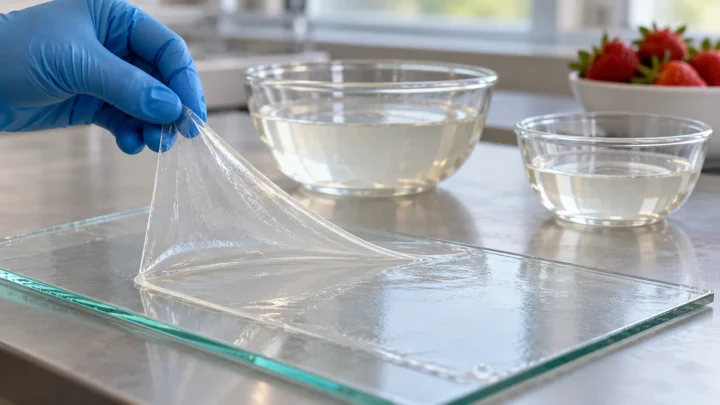
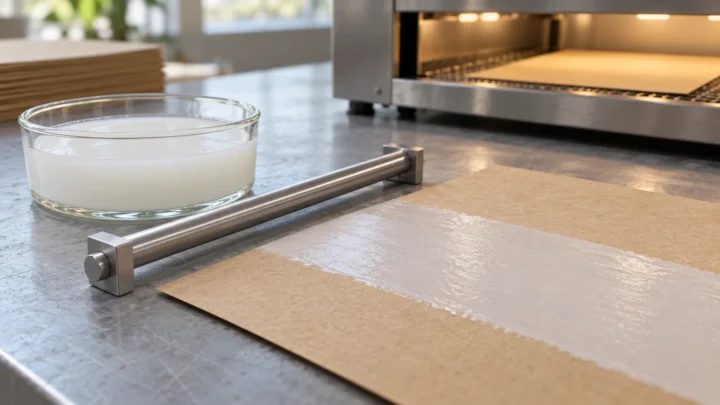
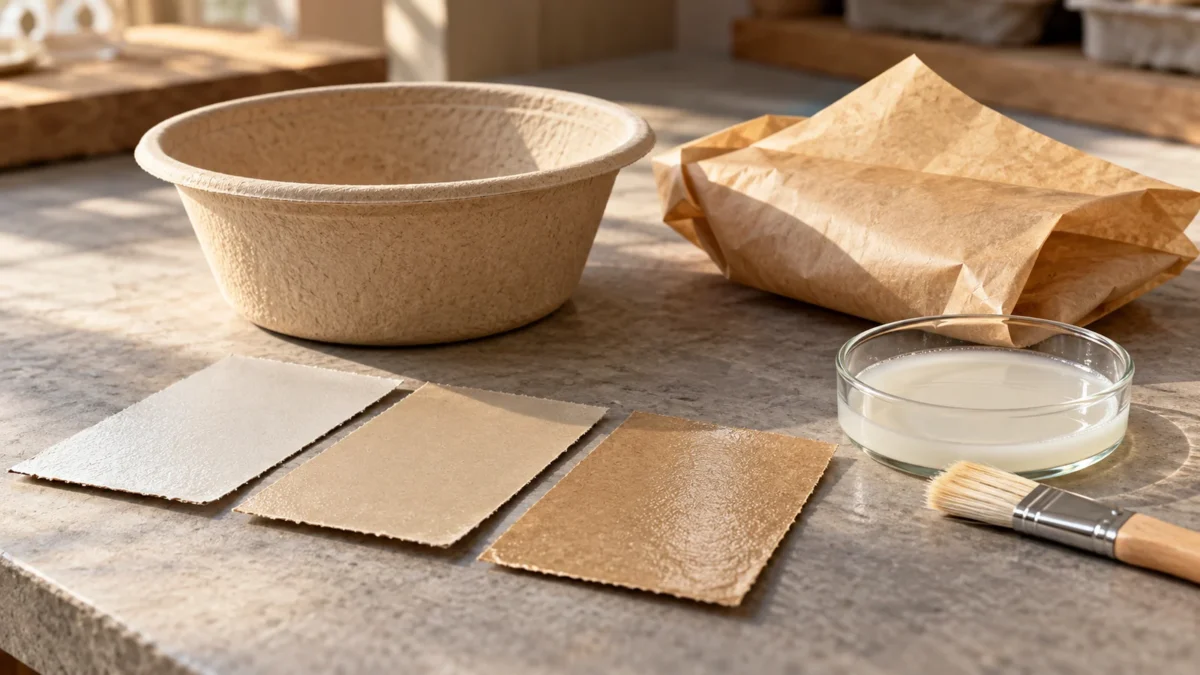
The main image is an AI-generated editorial illustration of an unnamed conceptual scene. The explanatory figure is an original editorial synthesis, not a photograph of an experiment, microscopic structure or measured result.
The legal summary is limited to the identified provisions and FDA actions. PPWR Article 5(5) uses its own PFAS definition and measurement scopes. This is not a product-specific compliance determination; the draft guidance record C(2026)2151 is not treated as binding law or a verified final amendment.
Official sources and reference notes
- [S1] U.S. Food and Drug Administration. FDA Announces PFAS Used in Grease-Proofing Agents for Food Packaging No Longer Being Sold in the U.S.. 28 February 2024. Announcement of 28 February 2024: identified grease-proofing uses and voluntary market phase-out. Relevant public sections checked; source-specific scope retained. Accessed 18 October 2026.
- [S2] U.S. Food and Drug Administration. Market Phase-Out of Grease-Proofing Substances Containing PFAS. Current page accessed 18 October 2026. January 2025 determination: 35 Food Contact Notifications no longer effective after abandonment. Relevant public sections checked; source-specific scope retained. Accessed 18 October 2026.
- [S3] European Parliament and Council. Regulation (EU) 2025/40 on packaging and packaging waste. Official Journal text; applicable PFAS provision from 12 August 2026. Article 5(5)(a)–(c), Article 5(6): PFAS thresholds, measurement scopes and documentation. Identified public record/section access only; detailed experimental or paid-method claims require the underlying text. Accessed 18 October 2026.
- [S6] Gregory Glenn et al. / USDA-ARS and collaborators. Per- and polyfluoroalkyl substances and their alternatives in paper food packaging. 2021; DOI 10.1111/1541-4337.12726. Original-author abstract: hydrophilic film formers, moisture sensitivity and alternative barrier architectures. USDA original-author publication summary checked; underlying full review not audited here. Accessed 18 October 2026.
- [S7] Authors as listed in Comprehensive Reviews in Food Science and Food Safety. Food packaging solutions in the post-PFAS and microplastics era: A review of functions, materials, and bio-based alternatives. Published online 16 December 2024; 2025 issue. Barrier functions and material-system discussions; review evidence, not package approval. Identified public record/section access only; detailed experimental or paid-method claims require the underlying text. Accessed 18 October 2026.
- [S11] TAPPI. Grease resistance test for paper and paperboard, T 559 cm-22. Identified public edition. Public scope1.2–1.5. Official public scope checked; paid complete method not accessed. Accessed 18 October 2026.
The public corrections channel is currently inactive. Read our corrections policy.