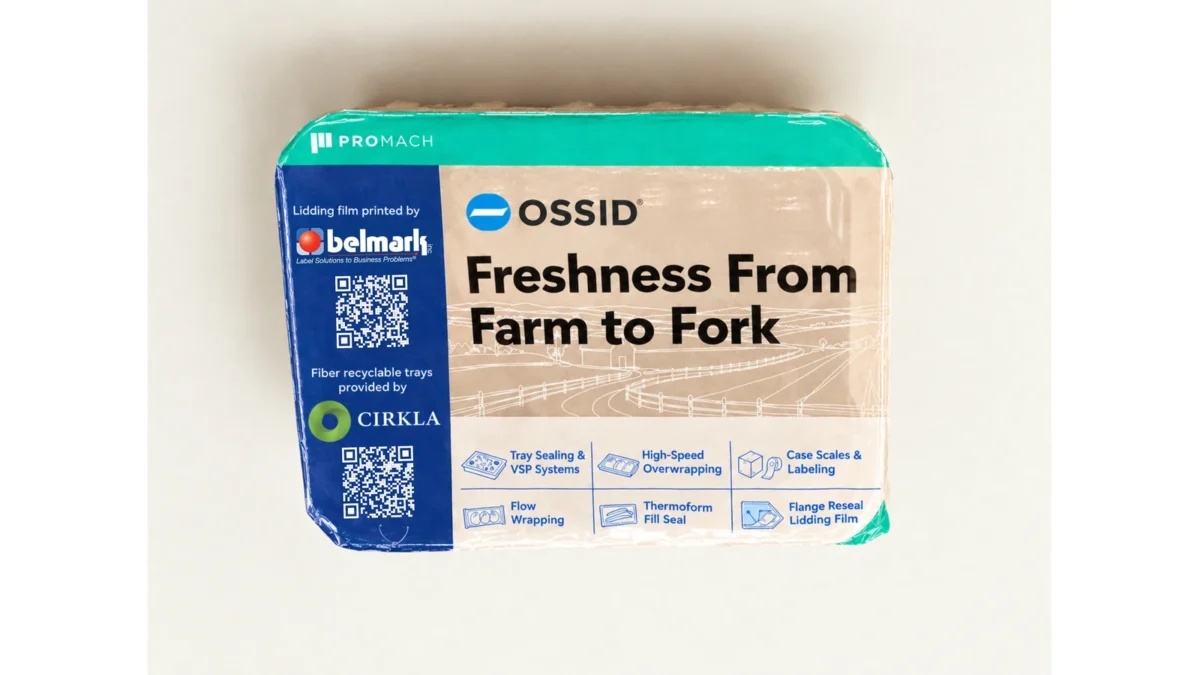
Cirkla, Belmark and Ossid announced on 12 October 2026 an integrated food packaging system combining moulded fibre trays, resealable lidding film and automated tray sealing. Their Cirkla-issued release presents it as a commercially validated combination for proteins, produce, ready meals and other food applications. The system claim remains company-reported; the announcement is not independent evidence of full-scale customer adoption.
The packaging significance is the interface between the three components. A fibre base alone does not create a resealable food pack. The film must open and close against that tray, while the machine must deliver an appropriate initial seal without damaging the construction.
What each partner contributes
The release assigns the tray to Cirkla, the resealable lidding film to Belmark and the automated sealing technology to Ossid. It identifies Ossid’s ReeMaster NextGen platform and describes the challenge as achieving peel-and-reseal functionality without damaging the tray liner. It also announces planned exhibition appearances in October.
Research went beyond that distributed release. Cirkla’s official news page lists the collaboration and its October trade-show presence. Belmark’s official lidding information explains the need to match film to the container and filling line. Ossid’s official equipment information separately establishes the referenced sealing platform. These records support the partners’ roles; they do not independently verify every combined-system performance claim.
A reseal is different from the original seal
The first seal must protect the product through its intended distribution and storage conditions. A reseal serves the consumer after the initial opening. Those stages can have different performance requirements. Calling a pack resealable does not establish that every subsequent closure recreates the original barrier or shelf life.
That distinction is especially important when a fibre tray includes a functional liner. The opening action must be considered at the film-to-tray interface, rather than evaluated as an isolated film property. A successful peel that damages another layer could change what subsequent closure means. This is an engineering question raised by the design, not a finding that the announced system suffers from that problem.
Belmark’s own information treats the container and line as part of selecting a film construction. The collaboration’s value proposition follows the same system logic: joining expertise across the base, lid and equipment rather than presenting a material swap as sufficient by itself.
Machine capability does not validate every food application
Ossid describes the NextGen ReeMaster as offering conventional sealing, modified-atmosphere and vacuum-skin packaging options. That equipment portfolio does not establish that this particular tray-and-film construction has been validated in all those formats or for every food category.
Different products introduce different requirements for liquid containment, gas exchange, contamination at the seal and handling. Produce, raw protein and a prepared meal cannot be assumed to share one validation result. A machine demonstration is useful evidence of a demonstrated configuration; it is not a substitute for a defined product application and its tests.
Our article on Takeaway Packaging Is Becoming a System: Containers, Lids, Vents, Sauces and Temperature Zones explores the same interface problem across containers, lids and operating conditions. The relevant comparison is the completed pack delivering the required food service, not a tray material considered separately from everything attached to it.
Launch, exhibition and adoption remain distinct
The companies announced public appearances at the Global Produce & Floral Show on 14–16 October and PACK EXPO on 18–21 October. Cirkla’s official page also lists its PACK EXPO presence. This report does not claim that DP attended, observed a demonstration or verified customer orders at either event.
The release describes validation and broad equipment compatibility. Without named customer cases, disclosed test conditions or independently examined operating records, those remain supplier claims. The story can accurately report a launch while leaving the extent of current commercial uptake unresolved.
The same boundary applies to environmental language. A fibre tray with a liner and lidding film is a complete construction whose recovery route needs its own evidence. This report does not repeat unverified universal recyclability, compostability, chemical-absence or food-safety claims. Barrier-Coated Paper, Cellulose Films and Compostable Flexibles: Where Plastic-Laminate Alternatives Actually Fit explains why composition and recovery cannot be inferred from the word fibre.
The next consequential evidence would connect a named food application, the actual pack construction and a repeatable production result. Until then, the news is an integrated system launch with company-reported validation, rather than proof that the format has displaced plastic trays at scale.
Sources
- Cirkla, distributed by Cision/CNW. Cirkla, Belmark, and Ossid Unite to Launch … Resealable Fiber Tray Packaging Solution Across Food Categories. 12 October 2026, 10:30 ET. Lead; partner contributions; planned exhibition appearances. Sources checked 21 October 2026.
- Cirkla. News & Events. Undated page; dated entries 13 October 2026. Cirkla in the news; Upcoming Events. Sources checked 21 October 2026.
- Belmark. Resealable Lidding Film Solutions for Modern Packaging. Undated commercial page; accessed 21 October 2026. Film That Works With Your Equipment. Sources checked 21 October 2026.
- Ossid. NextGen ReeMaster Series Tray Sealers. Undated; accessed 21 October 2026. Product overview; packaging styles. Sources checked 21 October 2026.
The public corrections channel is currently inactive. Read our corrections policy.