Cut open a high-performance pouch and the recycling problem becomes visible.
The outside layer may provide stiffness, print quality and heat resistance. A second layer may stop oxygen. Another may resist puncture. Aluminium or metallization may block light. The inside layer has to seal reliably against itself while touching the packed product. Adhesives or tie layers hold the system together.
That architecture is why multilayer flexible packaging became so effective.
It is also why redesigning it for recycling is difficult.
The redesign work toward mono-material flexible packaging is therefore not a simple move from “many layers” to “one layer.” In most commercial cases, it means trying to keep multiple functions while making the structure predominantly compatible with one recycling stream—usually polyethylene or polypropylene.
The engineering problem is not removing layers. It is removing incompatible functions without losing the package.
Autopsy of a conventional laminate
Flexible packaging often looks materially simple because the finished structure may be only tens or hundreds of micrometres thick. [S1] [S11]
Functionally, it can be complex.
| Layer or component | Typical job | Why replacing it can be difficult |
|---|---|---|
| PE seal layer | Heat sealing, flexibility, moisture resistance | Needs a wide and reliable sealing window on filling equipment |
| BOPP / PP | Stiffness, moisture resistance, print surface, heat performance | Grades and orientation affect sealing, stiffness and converting behavior |
| BOPET / PET | Stiffness, dimensional stability, print protection, thermal resistance | Allows aggressive sealing conditions while protecting the outer web |
| PA / nylon | Puncture resistance, toughness, oxygen and aroma barrier | Important in demanding bags, vacuum packs and abuse-resistant structures |
| EVOH | High oxygen barrier | Performance is sensitive to moisture and it normally needs surrounding layers |
| Foil / metallization / oxide coating | Light and gas barrier | Very high barrier can be difficult to reproduce with a simple polyolefin film |
| Adhesive / tie layer | Bonds chemically different layers | Must survive converting and use without harming recycling compatibility |
| Ink / varnish | Branding, information, protection | Coverage and chemistry can affect recyclate quality |
The multilayer package is therefore not complicated by accident.
It is a compact way to combine properties that one polymer rarely provides at the same level.
“Mono-material” usually does not mean one film layer
This is the first terminology problem. [S1] [S2]
A recyclable-design mono-material pouch can still contain several layers.
An all-PE structure, for example, may combine different PE grades for stiffness, sealing and toughness. An all-PP structure may use oriented PP with a separate PP sealant web. Minor barrier layers, coatings, adhesives and inks may still be present if the relevant recycling-design system considers them compatible within defined limits.
CEFLEX’s flexible-packaging design guidance expresses a preference for mono-PE and mono-PP structures and has historically described a targeted mono-material flexible pack as having more than 90% of the main polymer type, with the remainder used for necessary functional components. Its current Phase 2 guidance goes further by applying tested compatibility thresholds to barriers, coatings, adhesives, inks, metallisation and tie layers.
RecyClass follows the same basic engineering logic from a different methodology: packaging composition matters, but so do barriers, printing, adhesives, size, attachments and sorting behavior. Its design-for-recycling guidance for PE and PP flexibles was updated again in March 2026 based on laboratory findings.
So “mono-material” is better understood as:
a structure designed to remain compatible with a predominant material recycling stream.
Why the redesign pressure is real
Three forces are pushing flexible packaging in this direction. [S15] [S16]
First, mechanical recycling works more easily when the incoming material is dominated by one compatible polymer family. Mixed PET/PE, PA/PE or foil-containing laminates create more difficult separation and recyclate-quality problems.
Second, design-for-recycling systems now assess details that were previously treated as secondary: barrier percentage, adhesive chemistry, print coverage, metallisation, closures and small attachments.
Third, regulation is making the distinction commercially important.
Under the EU Packaging and Packaging Waste Regulation, packaging recyclability is moving toward harmonised design-for-recycling criteria and performance grades. The Regulation applies from 2026, while detailed design-for-recycling assessment requirements are scheduled to apply from 2030 or later depending on the timing of the delegated acts. The Commission is expected to establish those detailed criteria by 2028.
This does not mean EU law currently says “use mono-PE.”
It means packaging designers increasingly have to prove that the finished structure can enter a material-recycling route rather than relying on a broad material label.

The first failure point: oxygen barrier
Polyethylene and polypropylene are useful moisture barriers, but they are relatively poor oxygen barriers compared with polymers such as EVOH, PA and PET or with foil and high-barrier coatings. [S12] [S13]
That matters for products such as:
- coffee;
- oxygen-sensitive snacks;
- nuts;
- processed foods;
- pet food;
- some pharmaceuticals and specialty products.
For these applications, replacing a PET/PE or PET/foil/PE structure with “just PE” can destroy the package’s original shelf-life function.
The usual engineering response is not to abandon mono-material design. It is to add a small compatible barrier component.
EVOH is one example.
RecyClass laboratory work on PE films found that EVOH content can materially change recycling behavior: lower concentrations had a much smaller effect than higher concentrations, while excess EVOH created extrusion problems and poorer recycled-film appearance. CEFLEX’s current design guidance similarly treats functional barriers through defined compatibility thresholds rather than assuming that any non-PE component makes the package unrecyclable.
The lesson is important:
a high-barrier mono-material redesign is often a compatibility exercise, not a purity exercise.
The second failure point: the sealing window
High-speed packaging equipment does not care whether the redesign looks elegant on a recycling diagram. [S11]
It needs to seal.
Traditional laminates often use a thermally stable outer layer such as PET and a lower-temperature PE seal layer. That difference gives the converter or packer room to apply heat through the outside web while melting the sealant without distorting the whole package.
All-PE and all-PP structures can narrow or change that process window.
Film producers can compensate through:
- different polymer grades;
- orientation;
- sealant formulations;
- coextrusion;
- surface treatment;
- equipment adjustment.
But the redesigned package still has to run at commercial speed.
A pouch that seals perfectly at laboratory speed but forces a filling line to run substantially slower may fail commercially even if its recycling assessment improves.
The third failure point: puncture and mechanical abuse
PA and PET layers are not used only for barrier. [S10]
They can contribute toughness, dimensional stability and puncture resistance.
That becomes important in:
- vacuum packaging;
- large refill pouches;
- pet-food bags;
- products with sharp edges;
- industrial or heavy dry goods;
- packages exposed to repeated flexing.
Removing the high-strength layer may force the designer to increase total film thickness, change geometry or use more sophisticated PE or PP grades.
This creates a trade-off that is easy to miss.
A redesign can be more compatible with mechanical recycling while using more material to reproduce the original mechanical performance.
That does not automatically make the redesign worse.
It means recyclability and material efficiency are separate variables.
The fourth failure point: retort, hot-fill and severe thermal processing
Some flexible packages are exposed to conditions far beyond ambient shelf storage. [S10]
Retort and sterilisation structures may need to withstand heat, pressure, moisture and long processing cycles while preserving seals and extremely low oxygen transmission.
These applications are among the hardest to simplify.
Barrier research continues to improve coated polyolefins and mono-material multilayer structures, but evidence from high-barrier packaging research shows why demanding thermal processes still require careful combinations of barrier layers, moisture protection and mechanical support.
For a dry snack pouch, a mono-PP redesign may already be commercially practical.
For a retorted wet-food pouch, the same design logic cannot simply be copied.
Metallisation solves one problem and creates another design question
Metallised films can provide stronger light and oxygen barrier than clear polyolefin films without using a full aluminium-foil layer. [S1] [S5]
This makes metallisation attractive in redesigns for snacks, coffee and other sensitive dry products.
But recyclability depends on the exact structure and the recycling-design protocol being used.
CEFLEX and RecyClass both distinguish between different barrier technologies, coatings and metallised structures rather than treating the word “metallised” as a single category.
The practical rule is:
test the finished structure against the relevant recycling protocol; do not infer compatibility from the base polymer.
Adhesives and inks can undo a good polymer choice
A package can be more than 90% PE and still perform poorly in a recycling assessment if the remaining components are badly chosen. [S1] [S3]
Laminating adhesives can alter melt filtration, odor, color or mechanical properties of recyclate. Heavy ink coverage can affect recyclate quality. Closures, valves or spouts made from an incompatible polymer can disrupt the intended stream.
That is why current flexible-packaging design guidelines have become much more detailed.
The question is no longer:
“Is the pouch PE?”
It is:
“What is every significant component, how much of it is present, how does it sort, and what happens when the complete package is reprocessed?”
Downgauging can conflict with recyclability—and sometimes support it
Flexible packaging has historically achieved material efficiency by becoming thinner. [S14]
Multilayer structures help because each layer can be optimized for a specific function.
Moving to a less complex polymer system may require more thickness to recover stiffness, puncture resistance or barrier.
On the other hand, new orientation technologies, higher-performance resins and coatings can allow mono-material structures to remain thin.
The correct comparison is therefore not:
old package = 80 micrometres; new package = 90 micrometres; therefore new package is worse.
It is:
does the redesigned package deliver the same product protection, filling performance and shelf life while improving its realistic end-of-life route?
That requires a functional comparison, not a material slogan.
Where mono-material redesign is easiest
The most straightforward applications tend to be those that do not require an extreme oxygen, light or thermal barrier. [S1]
Examples can include:
- some dry-food pouches;
- selected frozen-food bags;
- detergent and household refill pouches;
- personal-care refills;
- dry consumer goods;
- secondary flexible packaging.
Even here, product chemistry matters. A detergent refill pouch may not need food shelf-life protection, but it still needs chemical resistance, leak resistance and reliable seals.
The easier end-of-life story does not remove the application engineering.
Where it remains hardest
The hardest conversions tend to combine several extreme requirements at once: [S11] [S12]
- very low oxygen transmission;
- very low moisture transmission;
- light barrier;
- high puncture resistance;
- retort or sterilisation;
- long shelf life;
- aggressive chemicals or aromas;
- high-speed filling with a wide sealing window.
Typical difficult examples include high-barrier coffee, retort pouches, some wet pet-food formats and specialty industrial or healthcare packages.
In these cases, a multi-material structure may still deliver more function with less material than an immature mono-material alternative.
That is not an argument to stop redesigning.
It is an argument to measure the whole function before declaring the redesign complete.
A recyclable design still needs a recycling system
This is the final boundary. [S6] [S7]
Even a well-designed mono-PE or mono-PP pouch is not automatically recycled in practice.
Flexible packaging has to be:
- collected;
- captured by sorting equipment;
- separated into an appropriate film stream;
- reprocessed at sufficient scale;
- sold into a viable end market.
CEFLEX’s European work explicitly treats collection, sorting, recycling and end markets as separate parts of the system. Its 2026 implementation projects continue to test whether flexible packaging can move through those steps at national scale.
The same caution applies outside Europe.
Access to film collection and recycling differs by geography. A package that is compatible with one technical recycling protocol should not be marketed as universally recyclable without checking the actual collection and processing route where it is sold.
The package-autopsy rule
Mono-material flexible packaging is replacing some traditional laminates because it can make mechanical recycling simpler and produce a cleaner predominant material stream. [S1] [S4]
But the strongest redesigns are not the ones that remove the largest number of layers.
They are the ones that preserve the package’s original job while eliminating components that the intended recycling system cannot tolerate.
Before approving a redesign, the useful questions are:
- What function did each original layer provide?
- Which functions can the main PE or PP structure now perform?
- Which barrier, coating, adhesive or ink still has to remain?
- Does the finished structure run at commercial line speed and seal reliably?
- Does it protect the product for the required shelf life and distribution conditions?
- Is the complete package compatible with the relevant recycling-design protocol?
- Is that flexible-packaging stream actually collected, sorted and recycled in the target market?
If any of those questions is unanswered, “mono-material” is a design direction—not yet proof of circularity.
Methodology and editorial note
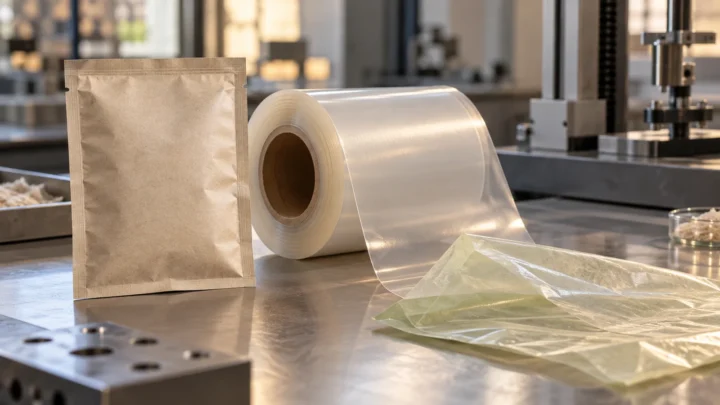
This is a construction-level synthesis of CEFLEX and RecyClass design guidance plus selected technical reviews, not a recycling-rate audit. A compatible design does not prove collection, sorting or actual recycling in any market. Sources checked 20 October 2026. The main image is an AI-generated editorial illustration of a generic packaging scene; it does not depict a named product, facility, company or test.
Sources and reference notes
- [S1] CEFLEX. Designing for a Circular Economy Guidelines. CEFLEX D4ACE current guidelines. Company statements are attributed; scientific/technical claims are limited to the stated test or review scope. Accessed 20 October 2026.
- [S2] CEFLEX. CEFLEX definition / >90% mono-material direction. CEFLEX definition / >90% mono-material direction. Company statements are attributed; scientific/technical claims are limited to the stated test or review scope. Accessed 20 October 2026.
- [S3] CEFLEX. Design Choices. CEFLEX design choices. Company statements are attributed; scientific/technical claims are limited to the stated test or review scope. Accessed 20 October 2026.
- [S4] RecyClass. Design for Recycling Guidelines / Online Tool changelog. RecyClass current 2026 guideline status. Company statements are attributed; scientific/technical claims are limited to the stated test or review scope. Accessed 20 October 2026.
- [S5] RecyClass. PE flexible films recycling: new findings for functional barriers. RecyClass EVOH compatibility testing. Company statements are attributed; scientific/technical claims are limited to the stated test or review scope. Accessed 20 October 2026.
- [S6] CEFLEX. Collection Systems for Flexible Packaging in a Circular Economy. CEFLEX collection-system boundary. Company statements are attributed; scientific/technical claims are limited to the stated test or review scope. Accessed 20 October 2026.
- [S7] CEFLEX. Can flexible packaging be sorted, recycled and achieve EU targets in Romania?. CEFLEX 2026 national implementation evidence. Company statements are attributed; scientific/technical claims are limited to the stated test or review scope. Accessed 20 October 2026.
- [S10] Foods. Recyclability and Redesign Challenges in Multilayer Flexible Food Packaging—A Review. Review: flexible multilayer redesign. Company statements are attributed; scientific/technical claims are limited to the stated test or review scope. Accessed 20 October 2026.
- [S11] Packaging Technology and Science. Seal materials in flexible plastic food packaging: A review. Seal-layer review. Abstract/indexed record only unless retained source capture proves full text; no precise result inferred from an inaccessible paper. Accessed 20 October 2026.
- [S12] Progress in Polymer Science. Promising strategies and new opportunities for high barrier polymer packaging films. High-barrier polymer film review. Company statements are attributed; scientific/technical claims are limited to the stated test or review scope. Accessed 20 October 2026.
- [S13] Journal of Food Science / PubMed. Ethylene vinyl alcohol: a review of barrier properties for packaging shelf stable foods. EVOH barrier review. Company statements are attributed; scientific/technical claims are limited to the stated test or review scope. Accessed 20 October 2026.
- [S14] Journal of Environmental Chemical Engineering / ScienceDirect. Life cycle assessment of flexible plastic food packaging designed for recycling: Shift from multi-material to mono-material multilayer structure. 2026 flexible multilayer LCA / design-for-recycling study. Abstract/indexed record only unless retained source capture proves full text; no precise result inferred from an inaccessible paper. Accessed 20 October 2026.
- [S15] European Parliament and Council / EUR-Lex. EU PPWR legal framework. EU PPWR legal framework. Company statements are attributed; scientific/technical claims are limited to the stated test or review scope. Accessed 20 October 2026.
- [S16] European Commission / EUR-Lex. Commission 2026 PPWR Guidance. Commission 2026 PPWR Guidance. Company statements are attributed; scientific/technical claims are limited to the stated test or review scope. Accessed 20 October 2026.
The public corrections channel is currently inactive. Read our corrections policy.