A new packaging material can look exceptional in the laboratory and still never become a commercial package.
The failure may have nothing to do with whether the chemistry “works.”
A film can show excellent oxygen barrier on a flat coupon and crack when it is folded. A coating can resist grease but run too slowly on a converter’s line. A molded-fiber formulation can survive a hot-food test but drift in weight and dimensions at production scale. A resin can process well yet lack the food-contact evidence required for the intended use. A pilot can impress customers and still be too expensive to make at the volume they need.
This is the commercialization gap.
The useful question is not:
“Has the material been demonstrated?”
It is:
“Has the material survived the sequence of technical, manufacturing, regulatory and commercial gates required to become a repeatable package?”
The first trap: treating technical readiness as market readiness
Technology-readiness frameworks are useful because they force a distinction between an idea, a prototype and an operational system.
NASA’s framework has nine levels, from early research to a technology proven in a successful mission. DOE’s published definitions distinguish relevant-environment demonstration, integrated pilot operation and pre-commercial demonstration. These are useful analogies, not packaging certifications or formal scores assigned by this article. [S1] [S2]
But DOE also makes a second point that is more important for packaging commercialization:
technical readiness is necessary, but it is not sufficient for adoption.
Its Adoption Readiness Level framework evaluates nontechnical risks such as customer value, market acceptance, supply-chain maturity and the ability to operate within regulatory and social constraints. [S3]
Packaging materials face exactly that problem.
A coating may be technically ready before the supply chain, converter, customer or end-of-life system is ready to use it.
A laboratory sample proves less than people think
Early material development usually asks a narrow question:
Can we make the material perform?
That may involve:
- tensile strength;
- heat resistance;
- grease resistance;
- oxygen transmission;
- water-vapor transmission;
- clarity;
- seal strength;
- biodegradation or disintegration under defined conditions.
These measurements matter.
But a laboratory specimen is often cleaner, flatter, more uniform and more carefully prepared than a mass-produced package.
Commercialization begins when the question changes from:
“Can the material reach this property?”
to:
“Can the manufacturing process hit this property repeatedly, at the required speed, on the finished geometry, at acceptable yield?”
Gate one: can the material be made consistently?
Scale creates variation.
A laboratory batch may be mixed slowly, dried carefully and cast under controlled conditions. Industrial production introduces larger vessels, faster throughput, wider webs, more cavities, longer drying paths and more opportunities for variation.
The variables that matter can include:
- raw-material moisture;
- particle or fiber distribution;
- viscosity;
- coating weight;
- temperature profile;
- line speed;
- forming pressure;
- drying time;
- tool temperature;
- scrap and rework.
This is why manufacturing readiness needs different evidence from laboratory readiness.
For packaging scale-up, we would ask for throughput, first-pass yield, defect or scrap rate, material utilization, cost per accepted unit and qualification time. These are editorial engineering questions, not mandatory packaging thresholds extracted from an unexamined DOE solicitation. [S3]
Those metrics translate well to packaging.
A commercial process does not need only to make good packages. It needs to make enough good packages.
Gate two: can existing converting equipment handle it?
Most new packaging materials do not enter an empty factory.
They enter a factory designed around existing substrates.
A new film may need to run through:
- extrusion or coating;
- printing;
- lamination;
- slitting;
- thermoforming;
- cup forming;
- die cutting;
- heat sealing;
- filling;
- case packing.
If the material needs half the normal line speed, a wider sealing window, new tooling and extra drying, its theoretical material cost is no longer the whole cost.
Commercial adoption therefore depends heavily on switching cost.
A material that is slightly more expensive but drops into existing equipment may commercialize faster than a cheaper material that requires a new production line.
Gate three: does the finished package still perform?
Material properties can change after conversion.
A barrier coating may crack at a score line. A thermoformed corner may become thinner than the original sheet. A heat-sealed area may behave differently from the unsealed film. Printing, adhesives and labels can change the final construction.
The finished package also has to survive the actual application:
- hot fill;
- cold storage;
- freezing;
- oil and sauce;
- steam;
- stacking;
- vibration;
- delivery time;
- microwave or reheating conditions where relevant.
This is the point where “material qualification” has to become “package qualification.”
The buyer does not use a resin pellet, a coating formulation or a lab coupon.
The buyer uses the finished package.
Gate four: can the compliance file survive the intended use?
Food packaging adds another adoption filter.
In the United States, FDA evaluates food-contact substances against defined food types and conditions of use. High-temperature sterilization, hot filling, room-temperature storage, refrigerated use, frozen use and reheating are not treated as one generic “food-grade” condition. [S6]
FDA’s Food Contact Notification inventory also shows why supplier identity and intended use matter: an effective notification is tied to the manufacturer or supplier identified in the notification and to the stated use and limitations. [S7]
An effective FCN is one possible U.S. regulatory route, not the route for every substance or use. This explanation does not verify a particular supplier, notification or finished package.
In the European Union, food-contact materials must comply with the general framework under Regulation (EC) No 1935/2004 and must be manufactured according to good manufacturing practice under Regulation (EC) No 2023/2006, with additional material-specific or national rules applying where relevant. [S9]
A new material therefore does not become commercially adoptable merely because one raw ingredient has a favorable safety document.
The company needs an evidence path for the actual construction, intended use and market.
Gate five: can customers qualify it without disrupting operations?
Customer qualification is where many promising materials meet reality.
A packaging buyer may require:
- technical data;
- food-contact documentation;
- migration or chemistry information;
- finished-package performance tests;
- line trials;
- approved samples;
- dimension and tolerance data;
- change-control commitments;
- traceability;
- commercial supply assurance.
Then the buyer has to decide whether the benefit is worth the qualification effort.
A new material that forces a food manufacturer to stop a filling line, rewrite specifications, validate shelf life, retrain operators and redesign labels carries a switching cost even before the supplier quotes the first commercial order.
This is why DOE’s adoption framework includes ease of use, customer value, downstream value-chain readiness and market acceptance rather than treating technical performance as the whole commercialization problem. [S3]
Gate six: can the supplier make enough of it?
Commercial interest can arrive before capacity.
A pilot plant may produce enough material for samples and several customer trials while being unable to support a national retail rollout.
The capacity question has several layers:
- Is the raw material available at scale?
- Is the process batch or continuous?
- What is the demonstrated throughput?
- What is the first-pass yield?
- How much off-spec material is generated?
- Can more lines be added without changing quality?
- Is there a second source?
- How long does qualification take at a new site?
This is where a technology can be commercially interesting but operationally unavailable.
An announced plant is not the same as qualified output, as our capacity-announcement analysis distinguishes nameplate capacity from commissioned and effective capacity.
Gate seven: does the economics survive scale?
Scale can lower cost.
It can also reveal costs that laboratory work hid.
Commercial economics have to include:
- raw materials;
- energy;
- labor;
- yield loss;
- tooling;
- line-speed penalty;
- quality inspection;
- capital depreciation;
- packaging conversion;
- transport;
- inventory;
- customer qualification;
- scrap or disposal.
A laboratory recipe may use an expensive specialty additive because only grams are needed.
A commercial factory has to buy tonnes.
In a hypothetical development trial, a team might tolerate a 15% scrap rate because the goal is to demonstrate feasibility.
A commercial operation may not.
That is why “cost at full scale” is a separate commercialization claim from “estimated raw-material cost.”
The commercialization funnel is narrower than the innovation pipeline
| Stage | What is being proved | Typical evidence | Common failure |
|---|---|---|---|
| Lab material | Basic material function | Property tests, formulation data | Property works only under ideal preparation |
| Prototype | Material can become a package-like article | Small-run film, sheet, coating, tray or cup | Geometry changes performance |
| Pilot converting | Process can run beyond laboratory scale | Throughput, yield, defect data | Slow line speed or unstable quality |
| Finished-package validation | Actual SKU survives use conditions | Hot/oil/barrier/seal/transport tests | Lab property does not survive conversion |
| Compliance | Use is supportable in target market | Food-contact / chemistry / claim evidence | Evidence covers ingredient, not finished construction |
| Customer qualification | Buyer can integrate package into operation | Line trial, approved specification, QA records | Switching cost or operational failure |
| Commercial supply | Supplier can produce repeatably at volume | Capacity, yield, lead time, second-source evidence | Pilot supply cannot support rollout |
| Repeat orders | Value proposition survives real use and price | Reorders, stable specifications, acceptable claims/cost | One launch never becomes recurring demand |
Editorial framework adapted from readiness concepts, not a mandatory linear sequence or certification system. Several workstreams may proceed together; no universal yield or qualification threshold is implied. [S1] [S2] [S3] [S6] [S7] [S9]
Repeat orders are a stronger commercialization signal than a press release
A new material often passes through several public milestones:
research paper → prototype → pilot → brand collaboration → launch announcement → first commercial shipment.
None of those is the same as sustained adoption.
The strongest commercial evidence comes later:
- repeat orders;
- additional SKUs;
- second customer qualification;
- another production line;
- another manufacturing site;
- stable commercial pricing;
- measurable delivered volume.
One customer pilot proves that a customer was willing to test.
A repeat order establishes another purchase. It is stronger adoption evidence than a trial, but does not by itself prove profitability, retained performance or market-wide scale.
The end-of-life claim can become a commercialization bottleneck
A material can perform well and still struggle if its disposal route is unclear.
A compostable polymer needs a credible composting claim and a market where that claim can be used responsibly. A recyclable coating needs to work with the relevant recycling stream. A new fiber composite can create confusion if mills, sorters or consumers do not know where it belongs.
This is another form of adoption readiness.
The package must fit not only the manufacturing system and customer line, but also the claims and infrastructure available after use.
A technically novel material with no credible end-of-life route can face a market barrier even when its production performance is strong.
Why some “inferior” materials commercialize faster
The best laboratory property does not always win.
An incumbent material may have:
- many approved suppliers;
- known processing windows;
- existing tooling;
- stable food-contact documentation;
- known printing and sealing behavior;
- predictable freight;
- established recycling or disposal instructions;
- years of buyer operating data.
A new material has to compete against that installed knowledge, not only against the incumbent’s tensile strength or carbon footprint.
This is why commercialization often rewards “good enough and easy to integrate” over “technically outstanding but operationally difficult.”

A better way to describe packaging readiness
Instead of asking whether a material is “commercial” or “not commercial,” a buyer or analyst should ask six separate questions:
- Technical readiness: does the material meet required properties?
- Manufacturing readiness: can it be produced repeatedly at required throughput and yield?
- Package readiness: does the finished SKU perform after forming, printing, sealing and transport?
- Compliance readiness: does the evidence support the intended use and market?
- Supply readiness: is qualified volume available at the required scale?
- Adoption readiness: does the value proposition justify switching, qualification and operating change?
A technology can be high on one scale and low on another. The 2026 technology readiness tracker shows how these distinctions apply to named projects.
That is not failure.
It is a more accurate description of where commercialization work remains.
The commercial threshold
Packaging innovation is often described as a race from laboratory discovery to launch.
The more useful model is a funnel.
At the top are many promising chemistries, coatings, fibers and formats.
Each gate removes technologies that cannot meet the next requirement: process stability, finished-package performance, compliance, line integration, capacity, cost, customer qualification or end-of-life fit.
Reaching a pilot is evidence.
Reaching a commercial shipment is stronger evidence.
But the clearest adoption signal is still the least glamorous one:
the customer orders it again, at commercial scale, without the supplier having to explain why the first order was special.
Methodology and editorial note
NASA and DOE framework definitions, FDA intended-use and notification explanations and the Commission food-contact overview were read. The manufacturing questions and readiness matrix are editorial adaptations, not formal scores, mandatory process thresholds or a new qualification standard. No factory trial, supplier audit, individual authorization or full consolidated-law review was performed. Sources checked 20 October 2026. No supplier audit, factory inspection or independent market census was performed for this article.
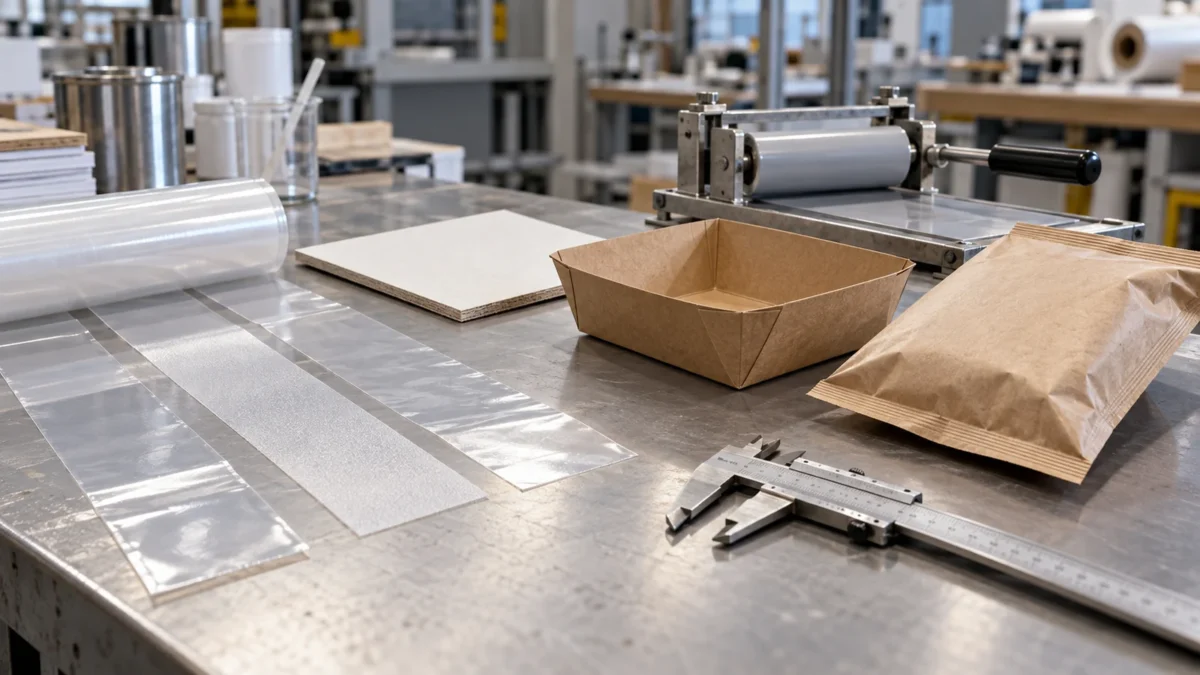
The main image is a visibly disclosed AI-generated editorial illustration of a generic scene, not a real named company, product, shipment, experiment or facility. The body figure is an original source-grounded explanation.
Official sources and reference notes
- [S1] NASA. Technology Readiness Levels. 27 September 2023. Nine levels; TRL1 research and TRL9 flight-proven mission. Framework analogy only. No formal packaging score or certification assigned. Accessed 20 October 2026.
- [S2] U.S. Department of Energy. Technology Readiness Levels (TRLs). Live framework. Levels 6–8: relevant environment, integrated pilot and pre-commercial demonstration. Full relevant definitions read; this page lists through TRL8, not a packaging commercialization guarantee. Accessed 20 October 2026.
- [S3] U.S. Department of Energy. Adoption Readiness Levels (ARL) Framework. Live framework. Technical readiness necessary but insufficient;17 dimensions in four risk buckets. Full relevant framework text read; packaging questions are our adaptation, not mandatory DOE packaging thresholds. Accessed 20 October 2026.
- [S6] U.S. FDA. Food Types & Conditions of Use for Food Contact Substances. Live reference. Table 1 food types and Table 2 conditions of use. Relevant official web-reader tables read; no formulation or package authorized by this article. Accessed 20 October 2026.
- [S7] U.S. FDA. Inventory of Effective Food Contact Substance Notifications. Live inventory introduction. Manufacturer/supplier specificity and intended-use/limitation paragraphs. Official explanatory text read via web reader. An FCN is one route, not the route for every food-contact use. Accessed 20 October 2026.
- [S9] European Commission. Food Contact Materials. Live official overview. Framework 1935/2004, GMP 2023/2006 and specific Union/national rules. Full relevant official overview read; no unseen consolidated GMP provision or product verdict claimed. Accessed 20 October 2026.
The public corrections channel is currently inactive. Read our corrections policy.