A supplier describes a film as “starch-based biodegradable packaging.”
That description may be true and still tell a buyer very little.
Native starch is abundant, renewable and biologically degradable, but it is not a drop-in replacement for polyethylene film. Its granular structure, extensive hydrogen bonding, moisture sensitivity and aging behavior make direct thermoplastic processing difficult. To turn starch into a melt-processable packaging material, manufacturers typically use heat, shear, water and one or more plasticizers to disrupt the native structure. The resulting material is commonly called thermoplastic starch, or TPS.
Even then, starch usually does not solve every packaging requirement by itself.
Commercially relevant starch-based films and thermoformed structures are therefore often blends: TPS with PBAT, PLA, PHA, PBS, PVOH or another polymer. The partner polymer is not merely a filler. It is commonly the component that helps supply toughness, moisture resistance, melt strength, dimensional stability or processability that plasticized starch alone struggles to maintain.
This article treats TPS as a material system rather than an environmental label.
From starch granules to a processable material
What actually turns starch into TPS?
Native starch consists mainly of amylose and amylopectin organized inside semicrystalline granules. Strong intra- and intermolecular hydrogen bonding helps maintain that structure.
Conventional polymer melt processing requires those interactions to be disrupted. Heat and mechanical shear help, but plasticizers are central to the transformation.
A 2021 review focused specifically on extrusion-produced TPS describes plasticizers as essential to reducing the strong interactions between starch chains during processing. Common systems include water, glycerol, sorbitol and combinations of polyols or other small molecules. [S2]
Heat, shear and plasticizer can disrupt native granular order and permit thermoplastic processing. The separate 2025 hydroxypropylated-cassava study is a chemical-modification example; its reaction should not be treated as the general process definition for every TPS formulation.
The exact final structure depends on starch source, amylose/amylopectin ratio, water content, plasticizer chemistry, shear and temperature. [S1]
Evidence boundary: there is no single universal TPS recipe.
The term “TPS” is not used perfectly consistently
Technical literature does not always draw the same boundary around the term thermoplastic starch.
Many papers use TPS to mean starch that has been plasticized under heat and shear so that it can be processed in thermoplastic equipment. A 2022 Green Chemistry review notes a terminology problem: some authors distinguish plasticized starch itself from tougher TPS blend systems containing another polymer. [S1]
For packaging procurement, the naming debate is less important than the composition.
If a supplier says “TPS,” ask:
- Which starch source?
- Which plasticizer?
- How much plasticizer and water remain?
- Is another polymer present?
- What percentage of the final compound is starch?
- Is the starch chemically modified?
- Which compatibilizer or reactive additive is used?
A material called TPS can therefore range from a starch-rich plasticized matrix to a multiphase blend in which another polyester carries much of the mechanical load.
Plasticizer improves processability—but creates trade-offs
Plasticizers work by increasing molecular mobility and reducing the effective interactions that make starch rigid and difficult to process.
Glycerol is widely used because it is effective and readily mixes with starch. But more flexibility is not free.
Reviews of extrusion-produced TPS consistently identify a balance among:
- flexibility;
- tensile modulus;
- thermal behavior;
- water uptake;
- plasticizer migration;
- aging and retrogradation.
Glycerol-rich systems can become more flexible but also more moisture-sensitive. Sorbitol can produce different thermal and aging behavior because of its molecular size and lower volatility. Co-plasticizer systems can be used to balance properties.
Plasticizer choice changes starch-chain interactions and can change flexibility, moisture response and storage stability. The result should be qualified for the particular plasticizer and starch system, rather than inferred from a bio-based label.
Evidence boundary: “plasticized” does not mean “better” in every property. It means the material has been moved toward a different balance of mobility, flexibility and stability.
Why conditioning changes performance
TPS continues to change after production
One of the most important TPS properties is not visible when the film leaves the extruder.
Starch can undergo retrogradation during storage. After gelatinization or plasticization has disrupted its original ordered structure, amylose and amylopectin chains can gradually reassociate into more ordered regions.
The 2022 Green Chemistry review describes this as recrystallization during cooling and aging. Plasticized starch can therefore become stiffer or more brittle over time even if its initial tensile test looked acceptable. [S1]
Storage humidity complicates the picture further because water itself acts as a plasticizer for starch. Changes in environmental moisture can shift mechanical and barrier performance without any change in nominal formulation.
This means a TPS film should not be qualified only immediately after manufacture.
For packaging, aging data matter.
Starch is hydrophilic, and that is the central packaging limitation
The hydroxyl-rich chemistry that makes starch biologically accessible also makes it strongly interact with water.
The starch review identifies hydrophilicity and retrogradation as continuing design constraints. Those mechanisms explain why humidity and storage history belong in a packaging specification. [S1]
Water can:
- plasticize the starch phase;
- lower stiffness;
- change tensile behavior;
- increase dimensional instability;
- increase water-vapor transmission;
- promote swelling or dissolution in highly water-sensitive structures.
This does not mean starch has poor barrier performance against everything. Dense starch-rich films can provide useful oxygen barrier under suitable humidity. But strong oxygen barrier and strong moisture barrier are not the same property.
As with PVOH and nanocellulose, relative humidity belongs beside the barrier number.
See humidity-sensitive coating and recovery evidence for the related evidence distinction.
What TPS is good at—and where the evidence becomes conditional
| Property | Evidence-supported tendency | Main qualification |
|---|---|---|
| Renewable content | Starch itself is derived from biological feedstocks | The complete blend may contain fossil-derived polymers or additives |
| Melt processing | Plasticized starch can be processed using extrusion and related thermoplastic routes | Water, plasticizer, temperature and shear strongly affect behavior |
| Oxygen barrier | Can be useful under controlled/drier conditions | Humidity can substantially alter performance |
| Moisture barrier | Generally a weakness of starch-rich structures | Blend partners, coatings or chemical modification may improve it |
| Mechanical behavior | Can be tuned from brittle to flexible through plasticization and blending | Aging, humidity and phase compatibility matter |
| Biodegradation | Starch is readily biologically utilized in suitable systems | The finished blend follows the behavior of all components and the actual environment |
Editorial synthesis of the cited sources. Examples are not product test results; methods, construction and conditions remain part of every claim.
What the partner polymer changes
Why PBAT is such a common TPS partner
PBAT addresses several weaknesses of starch-rich thermoplastics.
PBAT is flexible, ductile and processable as a thermoplastic film resin. TPS is comparatively stiff, hydrophilic and difficult to stabilize as a standalone flexible packaging material. Combining them can create a material with higher starch content while retaining useful film-processing and mechanical behavior.
But the two phases are not automatically compatible.
A 2020 Industrial Crops and Products study examined PBAT/TPS blends with different compatibilization strategies. The authors reported that maleated PBAT improved interfacial adhesion and changed tensile, rheological and morphological behavior. The same study also found that compatibilization changed biodegradation kinetics. [S6]
That last point is important.
A compatibilizer can improve the package during use while also changing the way the blend breaks down later.
Performance and end-of-life cannot be optimized as two unrelated topics.
See PBAT identity, blending and biodegradation for the related evidence distinction.
The interface is often the real material
In a polymer blend, the weakest point can be the boundary between phases.
Starch is strongly polar and hydrophilic. Many polyester partners are less hydrophilic. Without sufficient adhesion, dispersed starch domains can behave like poorly bonded inclusions rather than a reinforcing or load-sharing phase.
Compatibility can be improved through:
- reactive extrusion;
- maleic-anhydride chemistry;
- epoxy-functional chain extenders;
- chemical modification of starch;
- plasticizer selection;
- controlled phase morphology.
PLA can add stiffness, but TPS/PLA is also a multiphase problem
PLA provides stiffness and bio-based content, which can make it an attractive partner for starch. Yet PLA and plasticized starch do not automatically form a homogeneous material.
Reviews of PLA/TPS systems describe phase compatibility as a recurring challenge. Plasticizer choice, reactive chemistry and processing sequence can affect whether starch forms large domains, finely dispersed regions or more continuous structures.
This means adding PLA does not simply “strengthen starch.”
It changes the blend morphology, crystallization and stress-transfer mechanism.
Too much poorly bonded starch can reduce strength. Better interfacial adhesion can improve performance. Processing sequence can change the answer again.
The finished morphology has to be measured rather than inferred from the ingredient list.
A ternary PLA/PBAT/TPS blend can solve more than one problem
Combining PLA, PBAT and TPS gives formulators three distinct property levers:
- PLA for stiffness and structure;
- PBAT for ductility and film toughness;
- TPS for renewable starch content and biological accessibility.
A 2022 study by Barletta and Aversa examined reactive extrusion of PLA/PBAT/TPS compounds, followed by cast extrusion and thermoforming. The original-author abstract describes rheological, mechanical, thermal and permeability characterization together with preliminary inertness and biodegradation tests. [S7]
The study is useful because it demonstrates that TPS can be incorporated into a more industrially relevant melt-processing route rather than only a laboratory casting experiment.
The reported processing example does not establish a universal formulation, home-compostability claim or hot-food specification.
The paper’s formulation, reactive chemistry, geometry and test conditions belong to that system.
Laboratory casting is not industrial film production
This evidence boundary deserves its own section because starch-packaging literature contains a large number of solvent-cast films.
Solution casting is valuable for studying:
- polymer compatibility;
- plasticizer effects;
- antimicrobial or antioxidant additives;
- film formation;
- basic barrier mechanisms.
But a cast film forms slowly from a liquid layer. Blown-film extrusion creates a melt under heat, shear, pressure, draw and rapid cooling.
A casting result does not reproduce the melt rheology, draw, cooling and residence-time history of a blown-film process. Qualification must follow the intended route and finished construction, rather than treating casting and extrusion as equivalent.
That caution applies beyond starch-gelatin systems.
If a supplier proposes a blown TPS/PBAT bag, evidence from a cast pure-starch film is supporting background—not proof of the commercial film’s performance.
Chemical modification can improve one weakness and create a new material
Starch can be chemically modified through approaches such as crosslinking, esterification, etherification and hydroxypropylation.
The 2025 ACS Omega study on hydroxypropylated cassava starch is a useful example. The treatment disrupted the native starch structure and altered thermal and structural behavior, with the aim of reducing some of the limitations associated with native starch processing. [S3]
But once starch is chemically modified, a claim such as “made from starch” no longer describes the entire technical situation.
The modification route affects:
- hydrophilicity;
- plasticizer demand;
- retrogradation;
- thermal response;
- food-contact assessment;
- biodegradation behavior.
The modifier itself and residual reaction products may also become relevant.
Natural origin does not remove the need for chemical characterization.
“starch-based” does not tell you the biodegradation of the package
Starch is biodegradable. A starch-containing package is a more complicated statement.
If the package contains PBAT, PLA, PHA, PVOH, compatibilizers, fillers, pigments or coatings, the finished construction has its own degradation behavior.
The Dammak PBAT/TPS study is particularly instructive because changing compatibilization changed biodegradation kinetics even though the major polymers were still PBAT and TPS. [S6]
This means formulation engineering can change both use-phase performance and end-of-life behavior.
The European Commission’s policy framework also separates bio-based origin from biodegradability and compostability. A high renewable content does not by itself establish a specific end-of-life claim. [S9]
For packaging claims, a buyer should request evidence for the finished formulation, thickness and claimed environment.

What should be on a TPS technical data request?
| Field | Why it matters |
|---|---|
| Starch source and type | Amylose/amylopectin structure and source influence processing and film behavior |
| Starch percentage | “Starch-based” does not state how much starch is present |
| Plasticizer system | Controls flexibility, water sensitivity, aging and processability |
| Partner polymer(s) | PBAT, PLA, PHA, PBS, PVOH or others can dominate key properties |
| Compatibilizer / reactive chemistry | Interfacial chemistry can change mechanics, rheology and degradation |
| Processing route | Casting, blown film, cast extrusion, injection and thermoforming create different structures |
| Conditioning and test RH | Water acts as a plasticizer and can strongly change TPS properties |
| Aging data | Retrogradation and plasticizer redistribution can alter performance over time |
| Finished-product barrier/mechanical tests | Blend ingredients do not predict final package performance by themselves |
| End-of-life evidence | Must cover the complete formulation and claimed disposal environment |
Editorial synthesis of the cited sources. Examples are not product test results; methods, construction and conditions remain part of every claim.
TPS is a platform, not a complete packaging answer
What exact starch-based formulation was processed into this exact package, how was it conditioned and tested, and what evidence supports its use-phase and end-of-life claims?
Methodology and editorial note
This technical explainer synthesises the identified official guidance, public standard scopes and research records. Study findings remain specific to their reported materials and conditions. Sources checked 18 October 2026; no product testing, factory inspection or independent certification assessment was performed for this article.
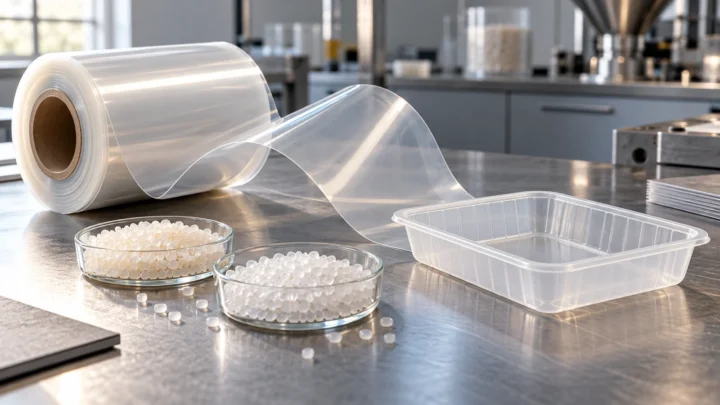
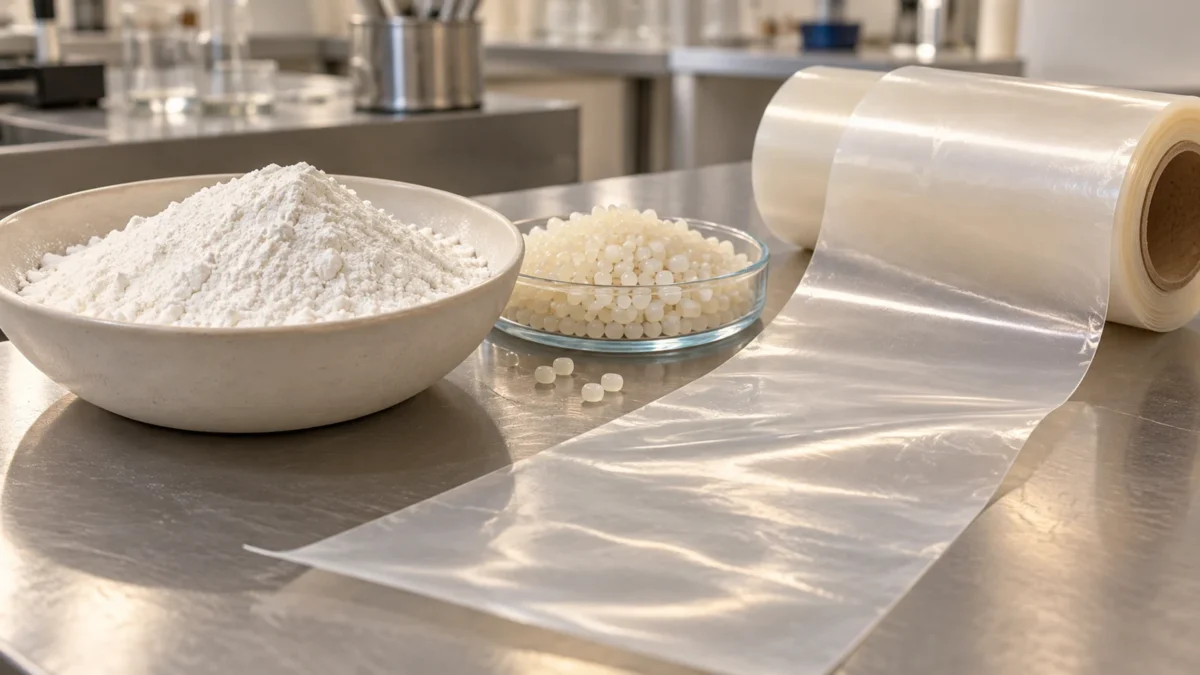
The main image is an AI-generated editorial illustration of an unnamed conceptual scene. The explanatory figure is an original editorial synthesis, not a photograph of an experiment, microscopic structure or measured result.
Official sources and reference notes
- [S1] Review authors as listed by Green Chemistry / Royal Society of Chemistry. A review of biodegradable thermoplastic starches, their blends and composites: recent developments and opportunities for single-use plastic packaging alternatives. Green Chemistry 24 (2022), 8606–8636. Identified publisher-indexed plasticization, terminology, retrogradation and blend sections. Official indexed review sections checked; complete direct rendition not retrieved. Not a consensus terminology standard. Accessed 18 October 2026.
- [S2] Camilo E. Montilla-Buitrago et al. Effect of Plasticizers on Properties, Retrogradation, and Processing of Extrusion-Obtained Thermoplastic Starch: A Review. Starch/Stärke 73 (2021), 2100060. Public review abstract: extrusion-produced TPS plasticizers, processing and retrogradation. Original authors’ abstract checked in a public abstract redistribution; original publisher DOI linked. Full publisher text not retrieved; no precise formulation reproduced. Accessed 18 October 2026.
- [S3] Henrique Solowej Medeiros Lopes et al. Gelatinized Cassava Starch Obtained via Low Molar Ratio Hydroxypropylation Reaction. ACS Omega 10(12), 2025, 12543–12552. Abstract and Conclusions: hydroxypropylated cassava, PPO formation and altered granular structure. Full public original study checked; chemical-modification example, not a universal TPS extrusion recipe. Accessed 18 October 2026.
- [S6] Mohamed Dammak et al. Blends of PBAT with plasticized starch for packaging applications: Mechanical properties, rheological behaviour and biodegradability. Industrial Crops and Products 144 (2020), 112061. Original-author abstract: PBATg-MA interfacial adhesion, mechanics and reduced degradation rate. Full original-author public abstract checked; exact test protocol not independently audited. Accessed 18 October 2026.
- [S7] Massimiliano Barletta and Clizia Aversa. Addition of Thermoplastic Starch (TPS) to Binary Blends of Poly(lactic acid) (PLA) with Poly(butylene adipate-co-terephthalate) (PBAT): Extrusion Compounding, Cast Extrusion and Thermoforming of Home Compostable Materials. Chinese Journal of Polymer Science 40(10), 2022, 1269–1286. Original-author abstract: reactive extrusion, cast extrusion, thermoforming and preliminary tests. Original-author record checked; unverified25wt% detail removed. Article title is not a universal compostability certificate. Accessed 18 October 2026.
- [S9] European Commission, Directorate-General for Environment. Bio-based, biodegradable and compostable plastics. Current public page accessed 18 October 2026; framework adopted 30 November 2022. Definitions / policy-framework overview. Relevant full public sections checked; source-specific material, method and environment limits retained. Accessed 18 October 2026.
The public corrections channel is currently inactive. Read our corrections policy.