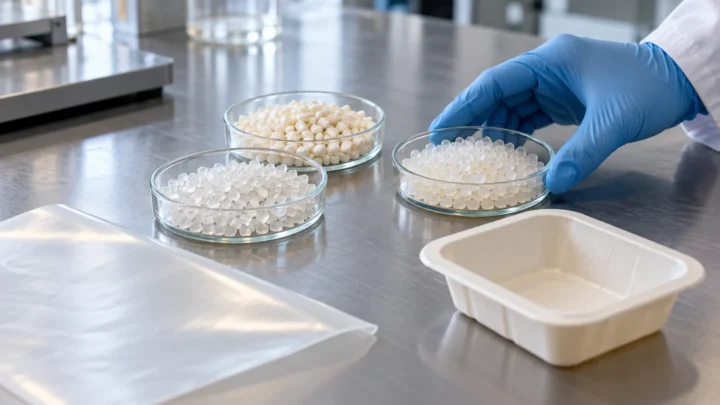
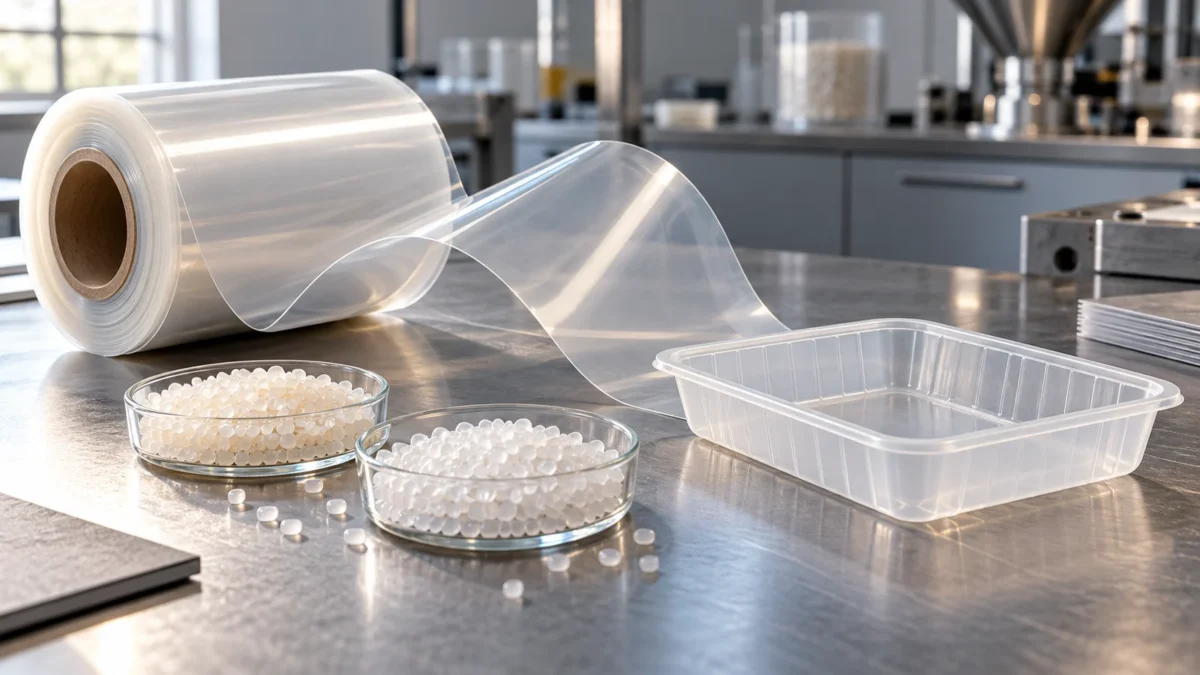
Put three pellets on a compounding bench: PLA, PBAT and PBS.
PLA brings stiffness and strength but can be brittle. PBAT brings ductility and flexibility but can be too soft for some packaging structures. PBS sits between those extremes—not as a perfect midpoint, but as another polyester that can change crystallization, stiffness, toughness, heat response, sealing and blend morphology.
That is why formulators sometimes add PBS to a system that already contains PLA and PBAT.
The question is not whether PBS is “better” than either polymer. The question is: what job is PBS being asked to do inside the blend?
What PBS can change in a formulation
Binary PLA/PBAT blends are attractive because the polymers have complementary mechanical behavior. PLA is relatively stiff; PBAT is highly ductile. But a binary blend can still present problems with phase morphology, stiffness-flexibility balance, thermal response, film processing and sealing.
PBS gives the formulator another control lever.
In different formulations, PBS can be used to:
- increase ductility relative to neat PLA;
- increase stiffness or strength relative to PBAT-rich blends;
- change crystallization behavior;
- change melt rheology and processing;
- modify moisture-barrier performance;
- alter heat resistance and sealing behavior;
- change the morphology of a PLA/PBAT blend.
None of those effects is guaranteed by the name “PBS.” Blend ratio, molecular weight, processing history, compatibilization and crystallinity determine the result.
PBS is an aliphatic polyester, not a synonym for “bio-based”
Poly(butylene succinate), or PBS, is an aliphatic polyester made from succinic acid and 1,4-butanediol. [S1]
Those building blocks can come from fossil or biological feedstock routes. Bio-based succinic acid can be produced through fermentation, but polymer identity alone does not establish the renewable-carbon share of a particular PBS grade.
Commercial bio-based 1,4-butanediol routes already exist: Novamont and Genomatica announced a commercial-scale sugar-to-BDO plant in 2016. That historical announcement establishes a route, not the current feedstock or renewable content of an arbitrary PBS grade. Document the actual monomers and carbon-content claim separately. [S9]
So “PBS” describes the polymer chemistry. It does not tell a buyer the renewable carbon content of the actual grade.
PBS is not simply “flexible PLA”
PLA and PBS are both aliphatic polyesters, but their mechanical behavior is different.
PLA is commonly used where stiffness and strength are useful, yet many grades have limited elongation and can fracture in a relatively brittle manner. PBS has a glass-transition temperature well below room temperature and generally behaves as a more ductile material.
That is why PLA/PBS blending has been studied for years as a route to reduce PLA brittleness.
A review of PLA/PBS blends found that when PBS is the minor phase in PLA-rich blends, elongation at break often increases while tensile strength and modulus can decrease. That is not a defect; it is the usual trade-off when a formulator exchanges some stiffness for ductility. [S1]
The exact change depends heavily on blend morphology and compatibility.
PBS and PLA do not automatically mix into one uniform phase
Two biodegradable polymers are not necessarily thermodynamically compatible.
PLA/PBS blends commonly form multiphase structures. The size, distribution and adhesion of the dispersed phase influence whether the material toughens successfully or develops weak interfaces. [S1]
This is why many PLA/PBS studies use:
- reactive compatibilizers;
- chain extenders;
- copolymers;
- plasticizers;
- controlled processing conditions.
A good blend therefore depends on more than the ingredient percentages. The interface between the polymers is part of the material.
Which problem is the blend solving?
The first formulation question: what is wrong with the PLA?
If the starting problem is a brittle PLA film or thermoformed part, adding PBS can make sense because PBS can introduce a softer, more deformable phase.
But “add PBS for toughness” is too vague for production.
The formulator still has to decide:
| PLA problem | What PBS may change | Trade-off to monitor |
|---|---|---|
| Low elongation / brittle fracture | Increase ductility and energy absorption | Lower modulus or tensile strength |
| Slow crystallization | Alter crystallization kinetics in some blend systems | Processing history becomes more important |
| Low heat resistance in amorphous part | Change blend crystallinity and thermal response | No automatic high-heat rating |
| Poor flexible-film behavior | Introduce a more ductile polyester phase | Compatibility and film rheology must be controlled |
Editorial synthesis of the cited sources. Examples are not product test results; methods, construction and conditions remain part of every claim.
PBS is therefore a formulation tool, not a universal PLA modifier.
The second formulation question: what is wrong with the PBAT-rich blend?
PBAT is extremely useful where flexibility is needed, but PBAT-rich films can lack the stiffness, strength or moisture-barrier profile required by some packages.
A 2026 open-access study examined PBS/PBAT films across a wide composition range. Under the study’s solution-casting conditions, PBS-rich compositions showed higher strength and stiffness, while increasing PBAT shifted the films toward greater ductility. [S4]
The same study found that adding PBS to PBAT reduced water-vapor transmission under its test conditions and changed surface wettability, thermal behavior and optical properties. [S4]
Those results should not be converted into a universal formula: the study used solution-cast laboratory films, not commercial blown film. But it illustrates the real formulation principle. PBS can move a PBAT system toward more structure and barrier, while PBAT moves PBS toward more flexibility.
Now put all three together: PLA / PBAT / PBS
The most interesting role for PBS appears in ternary systems.
A 2024 Polymer Testing study started with a fixed PLA/PBAT ratio and then added different amounts of PBS. In the non-reactive blends, PBS was observed near the PLA/PBAT interface and refined the phase morphology. [S2]
But the blend still did not have adequate rheological behavior for blown-film processing.
The researchers then used reactive extrusion with peroxide and carbodiimide chemistry. That changed the morphology and rheology enough to process thin blown films. The resulting reactive blends showed ductile behavior, useful seal strength and thermal resistance for the packaging application tested. [S2]
The interesting lesson is not the exact recipe. It is this:
PBS did not “fix” the blend by itself. PBS content, interfacial morphology and reactive processing worked together.
PBS can behave like a morphology tool—not just a third bulk polymer
In a ternary blend, location matters.
If PBS distributes mainly inside one phase, the result can differ from a system where PBS accumulates near the PLA/PBAT interface. The 2024 study reported micro-spherulitic PBS located at that interface, where it reduced interfacial tension and refined morphology in the tested blend. [S2]
This is a useful reminder that weight percentage is only one part of a formulation.
Two compounds with the same 20% PBS can behave differently if:
- PBS molecular weight differs;
- the PLA/PBAT phase ratio differs;
- mixing sequence differs;
- shear history differs;
- reactive additives differ;
- moisture before extrusion differs;
- cooling and crystallization differ.
Formulators are designing a microstructure, not merely weighing pellets.
The processing window belongs in the recipe
PBS is melt-processable through extrusion and molding, but biodegradable polyesters are sensitive to processing history.
A 2025 critical review of PBS melt processing emphasizes the effect of melt temperature, screw speed, moisture, residence time and additives on molecular weight and rheology. [S1]
Moisture is particularly important because hydrolysis can reduce polyester molecular weight during melt processing. Drying and process control therefore influence whether the final compound has the same viscosity and mechanical performance as the nominal formulation suggests.
The same review also notes that PBS grades are tailored for different processes. A high-flow injection grade and a film/extrusion grade should not be treated as interchangeable simply because both are labeled PBS.
Crystallinity changes the blend after the extruder
Polymer blends keep developing structure during cooling.
PBS is semicrystalline. PLA can also crystallize depending on stereochemistry, additives and cooling history. In PLA/PBS systems, one polymer can influence the crystallization behavior of the other.
This matters because crystallinity affects:
- stiffness;
- heat response;
- barrier properties;
- dimensional stability;
- biodegradation rate.
A film cooled rapidly on one production line may therefore not behave like a sheet annealed or cooled slowly, even if both started with the same PLA/PBS percentages.
This is another reason “blend ratio” should never be the entire specification.
Performance claims to qualify
Does PBS improve heat resistance?
It can change thermal performance, but the phrase needs boundaries.
PBS can change blend crystallization and thermal response, but melting behavior or thermal-degradation stability is not a finished-package service-temperature rating. Heat performance also depends on morphology, wall thickness, load and test method.
A PLA/PBAT/PBS film showing improved thermal resistance in one reactive-extrusion study does not establish that every PBS-containing cup or lid is suitable for hot filling.
Heat resistance remains a finished-article property.
Does PBS improve barrier performance?
Again: sometimes, in a defined construction.
The 2026 PBS/PBAT film study found lower WVTR as PBS content increased in the tested films. Other reviews describe PBS as having useful packaging barrier properties but also identify gas and vapor performance as an area where blends and additives are frequently used for improvement.
This means PBS can participate in a moisture-barrier strategy, but it should not be marketed as a universal “high-barrier biodegradable polymer.”
OTR, WVTR, grease and liquid-water performance remain separate measurements.
See the separate barrier measurements for the related evidence distinction.
Biodegradation is not blend arithmetic
PLA, PBAT and PBS are all discussed as biodegradable polyesters, but a blend does not biodegrade according to a simple weighted average.
The 2025 RSC critical review of PBS and PBSA reports large differences between degradation environments. PBS generally degrades faster under warm composting conditions than in cooler soil environments, and morphology, crystallinity, specimen dimensions and fillers all affect the rate. [S3]
Blending can change all of those variables.
For example, adding another polymer can:
- change crystallinity;
- change water uptake;
- change surface area after fragmentation;
- change microbial access;
- change disintegration behavior.
Therefore a formulation made only from polymers that each have biodegradation evidence is not automatically certified compostable as a finished film or package.
PBS can be biodegradable without being fully bio-based
This is the same conceptual distinction established earlier in the Materials series.
The European Commission explicitly separates feedstock origin from end-of-life behavior: biodegradable and compostable plastics can be made from fossil or biological raw materials. [S7]
PBS fits that framework well.
A PBS grade may be fossil-derived, partly bio-derived or potentially produced from more renewable building blocks, depending on the monomer supply route. Its biodegradation behavior comes primarily from polymer chemistry and environmental conditions—not from whether the carbon originally came from biomass.
Buyers should therefore request bio-based content and compostability evidence separately.
See bio-based origin versus biodegradation for the related evidence distinction.

A formulator’s decision map
| Starting system | Why consider PBS? | What must still be verified? |
|---|---|---|
| PLA-rich | Increase ductility; modify crystallization and thermal response | Loss of stiffness, phase compatibility, final heat performance |
| PBAT-rich | Add structure/strength and potentially improve moisture barrier | Ductility, morphology, processing method, film conditions |
| PLA/PBAT | Modify interfacial morphology and tune mechanical/thermal balance | Rheology, reactive compatibilization, blown-film processability |
| Compostable finished package | Provide a biodegradable polyester component with useful processing properties | Finished-product compostability, thickness, additives and real disposal route |
Editorial synthesis of the cited sources. Examples are not product test results; methods, construction and conditions remain part of every claim.
What should be on the formulation sheet?
A useful PBS packaging specification needs more than “contains PBS.”
It should record:
- PBS grade and intended processing method;
- feedstock / certified bio-based content if claimed;
- PLA, PBAT and PBS weight fractions;
- compatibilizer, chain extender or reactive additive;
- drying conditions before extrusion;
- melt-processing history;
- crystallization / cooling history;
- film or article thickness;
- mechanical, seal and barrier test conditions;
- finished-product compostability or other end-of-life evidence.
Without that information, two “PLA/PBAT/PBS” compounds can be materially different products.
The formulator’s takeaway
And in compostable packaging, the successful formulation is not the one with the most biodegradable polymer names on the datasheet. It is the one whose morphology, processing, mechanical performance, barrier behavior and finished-product end-of-life evidence all match the application.
Methodology and editorial note
This technical explainer synthesises the identified official guidance, public standard scopes and research records. Study findings remain specific to their reported materials and conditions. Sources checked 18 October 2026; no product testing, factory inspection or independent certification assessment was performed for this article.
The main image is an AI-generated editorial illustration of an unnamed conceptual scene. The explanatory figure is an original editorial synthesis, not a photograph of an experiment, microscopic structure or measured result.
Official sources and reference notes
- [S1] Massimiliano Barletta; Annalisa Genovesi; Maria Pia Desole et al. Melt processing of biodegradable poly(butylene succinate) (PBS)—a critical review. Published 18 September 2024; Clean Technologies and Environmental Policy 27 (2025), 683–725. Identified relevant research sections and the claim-specific discussion cited above. Relevant full public sections checked; source-specific material, method and environment limits retained. Accessed 18 October 2026.
- [S2] Sarocha Chuakhao; Juan Torres Rodríguez; Somjit Lapnonkawow; Gokul Kannan; Alejandro J. Müller; Supakij Suttiruengwong. Formulating PBS/PLA/PBAT blends for biodegradable, compostable packaging: The crucial roles of PBS content and reactive extrusion. Polymer Testing 132 (March 2024), 108383. Public publisher-indexed abstract/highlights: interfacial PBS and reactive blown-film processability. Identified official publisher-indexed sections checked; no numerical formulation or commercial recipe inferred. Accessed 18 October 2026.
- [S3] D. Nath; M. Misra; F. Al-Daoud; A. K. Mohanty. Studies on poly(butylene succinate) and poly(butylene succinate-co-adipate)-based biodegradable plastics for sustainable flexible packaging and agricultural applications: a comprehensive review. RSC Sustainability 3 (2025), 1267–1302. Identified publisher-indexed PBS/PBSA environmental-degradation discussion. Official indexed review sections only; full direct rendition not retrieved. No universal rate or product certificate claimed. Accessed 18 October 2026.
- [S4] A. Adeebpasha; A. B. Hemavathi; H. Umesh Hebbar et al. Development and characterization of PBS and PBAT blend based sustainable films for food packaging applications. Published 18 August 2026; Discover Polymers 3, Article 21. Sections2.2.1–2.2.2; composition-dependent results; Conclusion limitations. Full public study sections checked. Solution-cast laboratory films; oxygen, migration, food safety and practical biodegradation not validated. Accessed 18 October 2026.
- [S7] European Commission, Directorate-General for Environment. Bio-based, biodegradable and compostable plastics. Current page accessed 18 October 2026; policy framework adopted 30 November 2022. Identified relevant research sections and the claim-specific discussion cited above. Relevant full public sections checked; source-specific material, method and environment limits retained. Accessed 18 October 2026.
- [S9] Novamont and Genomatica. Novamont opens commercial plant for bio-based1,4-butanediol. 29 September 2016 company announcement. Opening announcement: commercial-scale bio-BDO production route. Original joint announcement checked; company statement, not current capacity verification. Accessed 18 October 2026.
The public corrections channel is currently inactive. Read our corrections policy.