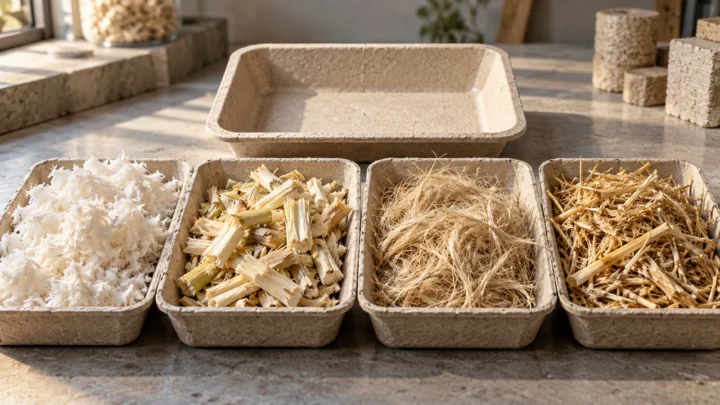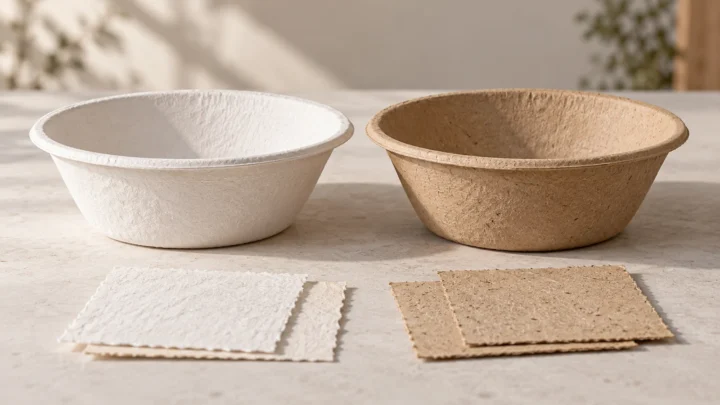
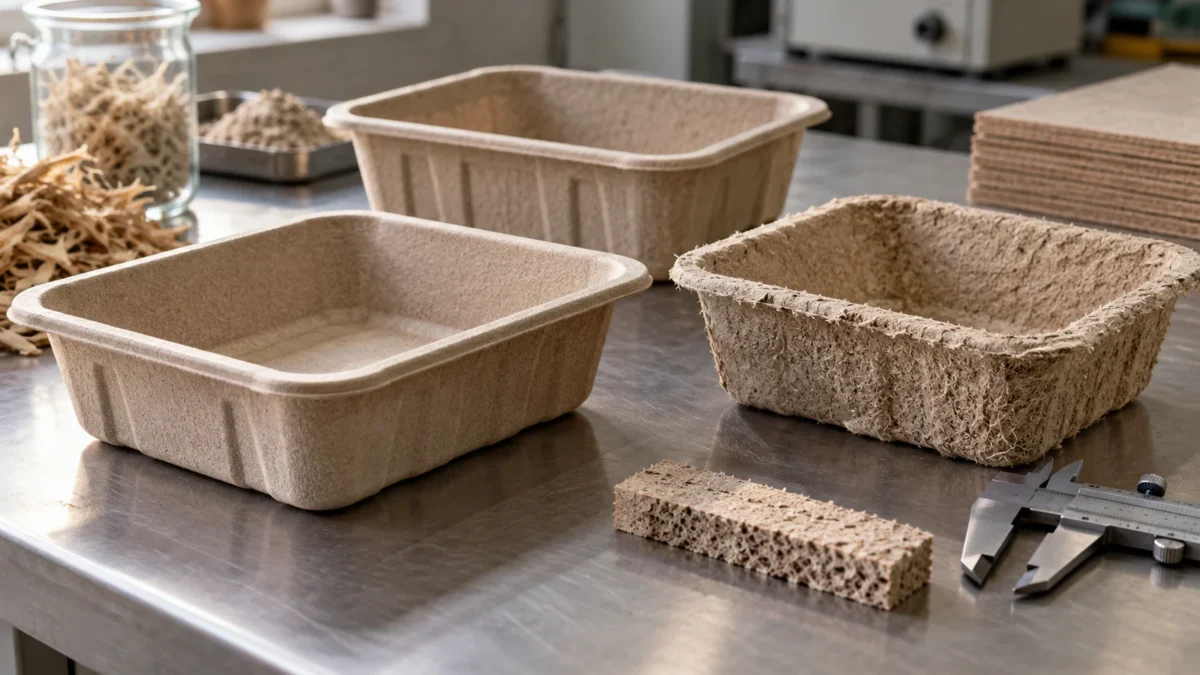
Consider an illustrative manufacturing comparison: two trays start with the same pulp specification. This is a hypothetical diagnostic case, not a report of a factory trial.
One leaves the line with crisp edges, a dense surface and enough stiffness to carry a hot meal without sagging. The other looks rougher, absorbs liquid faster and loses shape sooner. The raw-material certificate is identical. The fiber source is identical. Even the nominal basis weight may be close.
So what changed?
Almost everything that happened after the pulp arrived.
Molded fiber is not a resin that simply fills a cavity and freezes into a shape. It is a three-dimensional network created through suspension preparation, refining, vacuum forming, dewatering, pressing, drying, heat, pressure and sometimes additives or coatings. Small changes at any of those stages can alter fiber orientation, density, porosity, bonding area, wall thickness and surface quality. [S1]
This is why “same pulp” does not mean “same package.”
Case file: identical furnish, different tray
Imagine that one furnish tank feeds two production lines. Both use the same nominal pulp blend. After forming, however, Line A produces a tray with a dense rim and strong bottom panel, while Line B produces a more porous tray with uneven walls.
A useful investigation does not start by blaming the fiber supplier. It asks where the structure diverged.
The main suspects are:
- refining and fiber preparation;
- stock consistency and fines distribution;
- vacuum and dewatering;
- fiber orientation during forming;
- pre-press moisture;
- hot-press temperature, pressure and dwell time;
- local wall thickness and mold geometry;
- additive retention and cure;
- coating coverage and post-forming treatment.
Each changes the network in a different way.
Where the process histories diverge
The pulp may be “the same” but the fibers are no longer in the same condition
Refining changes fiber morphology before molding begins.
Mechanical treatment can increase fibrillation and fiber flexibility, creating more surface area for bonding. It can also shorten fibers and generate fines if pushed too far. The result is a different balance between drainage, formation and strength.
A 2025 review of form-molded pulp manufacturing identifies pulp beating/refining as one of the variables that influences product density and strength alongside fiber type, wall geometry and manufacturing technique. The important point is that a pulp specification at delivery does not describe its state after a converter has refined it. [S6]
Two lines can therefore receive the same pulp and create two different furnishes before the stock ever reaches a forming mold.
Fines do not always follow the long fibers
Fines can fill spaces between larger fibers and increase bonded area, but they also change drainage.
During forming, the distribution of long fibers and fines is not guaranteed to stay uniform. A 2024 study of dry-formed CTMP showed that fiber fractionation and fines retention occurred during the forming process itself. That means the formed web can have a different local composition from the starting pulp mixture. [S3]
Wet forming has its own fractionation mechanisms. Vacuum flow, screen geometry, slurry movement and local drainage resistance can influence which fibers deposit first and where fines accumulate.
If one part of a tray receives a higher fraction of fines while another receives a more open long-fiber network, the finished part can develop local differences in density and liquid penetration even though the total furnish is unchanged.
Vacuum does not only remove water—it builds the preform
In wet molded fiber, vacuum draws the fiber suspension onto a porous mold. This step determines far more than cycle time.
Vacuum level, duration, stock consistency and mold drainage influence:
- how rapidly fibers accumulate;
- how uniformly the wall builds;
- how much water remains in the preform;
- local fiber orientation;
- fines retention;
- thickness at corners, ribs and deep features.
If suction is uneven across the tool, the part may enter the press with nonuniform wall thickness. Hot pressing can densify those regions, but it cannot always erase a badly formed preform.
This is one reason a molded-fiber package should be evaluated as a three-dimensional structure rather than as a flat paper sheet.
Fiber orientation creates hidden directional strength
Paper engineers are used to machine direction and cross direction. Molded fiber is more complicated because pulp flows over and into three-dimensional geometry.
A 2026 Cellulose study introduced a method for characterizing fiber orientation through the X, Y and Z directions of molded fiber. The researchers used high-resolution layer analysis to map alignment and connect it to pulp-flow patterns during forming. [S5]
The practical consequence is important: fibers do not necessarily align the same way in the base, sidewall and corner of a tray.
Two packages with the same average thickness can therefore carry loads differently because their fibers are arranged differently. A rib can reinforce one direction while leaving another direction weaker. Pulp flow around a deep cavity can also create local orientation that changes crack or tear behavior.
“Same pulp, same gsm” does not capture any of that.
Moisture before hot pressing changes what heat and pressure can do
Pre-press moisture is one of the least visible variables and one of the most consequential.
Water helps fibers remain flexible before final drying. It can support closer contact as the network is compressed. Too much moisture, however, increases the amount of water that has to escape during pressing and can contribute to uneven drying or dimensional defects. Too little moisture can reduce conformability and change bonding development.
A 2025 study of kraft-lignin-containing molded pulp reported that moisture during pressing strongly affected dry and wet strength in its tested system. That supports treating moisture as a controlled process variable; it does not establish one moisture window for every furnish. [S7]
The mechanism and useful moisture window can differ between kraft, CTMP, bagasse and additive-containing furnishes. Moisture entering the press is a process variable, rather than merely leftover water.
Hot-press pressure changes density—and density changes almost everything
As pressure rises, fibers are forced into closer contact. Void volume falls. Bonded area generally increases.
A 2024 thermoforming study of CTMP fibers found that increasing temperature and pressure produced greater densification and higher tensile strength in the dry-formed substrates tested. The study also showed that dry forming and wet forming did not produce identical structures even when pulp type was comparable. [S3]
That difference matters because wet-formed fibers already develop cohesion during suspension forming and dewatering. Dry-formed airlaid mats rely much more heavily on thermoforming to create fiber bonds.
Pressure therefore cannot be discussed independently of the forming route.
Higher density can improve:
- stiffness;
- surface smoothness;
- fiber-to-fiber contact;
- resistance to local collapse;
- barrier-coating coverage by reducing large surface voids.
Material stiffness and whole-tray bending stiffness must also be separated. At a fixed mass, greater density can mean a thinner wall; geometry and thickness can offset a gain in material modulus. Compare finished parts under equivalent loads rather than assuming densification always makes a tray stiffer.
But maximum density is not automatically the optimum. Excessive consolidation can reduce extensibility, increase brittleness or add unnecessary energy demand.
Temperature changes more than drying speed
Hot-press temperature affects the rate of water removal, but it can also change fiber and non-cellulosic components.
The accessible molded-pulp manufacturing review discusses how thermoforming conditions interact with pulp chemistry and bonding. A setting used for a lignin-rich CTMP furnish should not be transferred automatically to a different kraft or non-wood furnish. [S6]
Densification and the ability to deform without breaking are separate outcomes. A process comparison should report both strength and extensibility, rather than selecting a press setting from density alone.
This is why copying one factory’s hot-press temperature into another line is not necessarily useful. Pulp chemistry, moisture, dwell time, tool temperature distribution and pressure all interact.
The mold itself changes the material
A flat coupon does not have ribs, corners, draw depth or sidewall angles. A molded tray does.
A manufacturing review of form-molded pulp identifies product geometry—including ribs, cells, wall thickness, inclination angle and connection areas—as variables that influence strength. Structural design and material properties cannot be separated cleanly. [S6]
Consider two trays molded from the same pulp:
| Feature | Tray A | Tray B | Likely consequence |
|---|---|---|---|
| Bottom panel | Shallow ribs | Large flat panel | Tray A may resist panel flex better |
| Corner radius | Generous radius | Sharp/deep corner | Tray B may have more difficult fiber deposition and local thinning |
| Sidewall | Moderate slope | Steep wall | Fiber flow/orientation and wall build can differ |
| Rim | Reinforced rolled geometry | Thin flat rim | Tray A may retain lid fit and edge stiffness better |
Editorial synthesis of the cited sources. Examples are not product test results; methods, construction and conditions remain part of every claim.
Material optimization cannot compensate indefinitely for poor structural design.
Additives only work if they are retained and cured
Wet-strength resins, starch, sizing agents and barrier additives are often discussed as formulation percentages. In production, the real question is how much ends up in the right place and whether it develops the intended chemistry.
Retention depends on charge balance, fines, pH, mixing sequence and furnish chemistry. Cure depends on temperature, moisture and residence time.
A wet-strength additive that is poorly retained can raise chemical usage without delivering proportional performance. A starch system that is not properly cooked, distributed or cured can also behave differently from the same nominal recipe on another line.
That is why “same recipe” is not necessarily “same fiber network.”
Coating turns small surface differences into large barrier differences
Barrier coatings are especially sensitive to the surface underneath them.
A dense, smooth molded surface can often be covered with a thinner and more continuous coating than a rough, porous surface. On the rougher part, liquid coating can penetrate into pores, leaving less material at the surface. Peaks can remain thin while valleys accumulate more coating.
This means two trays receiving the same nominal wet coat weight can finish with different effective barrier layers.
Three-dimensional geometry adds another complication. Corners and rims may receive uneven coating or be damaged after forming. The hot-food molded-fiber analysis explains why these local regions matter alongside flat-panel results.

What the factory should measure when performance drifts
If two molded-fiber runs behave differently, checking the incoming pulp certificate alone is usually not enough.
| Stage | Useful checks | Why it matters |
|---|---|---|
| Pulp preparation | Freeness, refining energy, fiber length/fines, consistency | Changes drainage and bonding potential |
| Forming | Vacuum level, forming time, slurry flow, tool drainage | Controls wall build and local fiber distribution |
| Pre-press | Moisture content and uniformity | Affects conformability, vapor removal and bonding |
| Hot press | Tool temperature map, pressure, dwell time | Controls densification and cure |
| Part structure | Wall thickness map, density, basis mass, geometry | Average values can hide local weak zones |
| Additives | Dosage, retention, pH, mixing order, cure | Nominal recipe does not equal effective chemistry |
| Barrier | Dry coat weight, coverage, corner/rim condition | Local defects can dominate liquid failure |
| Finished test | Compression, wet strength, real-food holdout, lid fit | Confirms whether process differences matter in use |
Editorial synthesis of the cited sources. Examples are not product test results; methods, construction and conditions remain part of every claim.
Average numbers can hide the real defect
One of the most common quality-control mistakes is relying only on whole-part averages.
A tray can meet average wall weight while one corner is thin. It can meet average moisture while the rim remains wetter. It can meet average coating weight while the bottom radius has incomplete coverage.
For three-dimensional molded fiber, location-specific measurements are often more diagnostic than one number for the entire part.
A repeated leak at the same location is a reason to examine local wall formation, damage and coating coverage before attributing the failure to a change in cellulose chemistry. The location is a diagnostic clue, not a causal finding by itself.
“Same pulp” is only the beginning of a specification
A useful molded-fiber specification should separate the incoming material from the manufacturing outcome.
The incoming-pulp section can define fiber source, pulp type, brightness or bleaching state, freeness range and other material properties. The process section can then define forming consistency, moisture window, pressing conditions and coating architecture. Finally, finished-product testing verifies the performance that buyers actually need.
See how molded-fiber feedstocks differ for the related evidence distinction.
This avoids a common procurement trap: approving a sample based on “100% bagasse” or “same pulp as last order” and assuming the production line cannot change the result.
It can.
The engineering conclusion
For troubleshooting and procurement, compare the process path—not just the raw-material label.
Methodology and editorial note
This technical explainer synthesises the identified official guidance, public standard scopes and research records. Study findings remain specific to their reported materials and conditions. Sources checked 18 October 2026; no product testing, factory inspection or independent certification assessment was performed for this article.
The main image is an AI-generated editorial illustration of an unnamed conceptual scene. The explanatory figure is an original editorial synthesis, not a photograph of an experiment, microscopic structure or measured result.
Official sources and reference notes
- [S1] Yifan Liu; Shufeng Ma; Feijie Wang; Liqiang Wang. Advances in Research of Molded Pulp for Food Packaging. Journal of Renewable Materials 11(11), 2023. Identified relevant research sections and the claim-specific discussion cited above. Relevant full public sections checked; source-specific material, method and environment limits retained. Accessed 18 October 2026.
- [S3] Authors as listed in Journal of Natural Fibers. Effect of Raw Material and Process Conditions During the Dry Forming of CTMP Fibers for Molded Pulp Products. Published online 2024. Abstract: fractionation/fines retention; temperature/pressure-dependent dry-forming bonding. Public abstract/indexed study record checked; author-deposited PDF download was incomplete. Exact operating values not reproduced. Accessed 18 October 2026.
- [S5] Emma E. Gobes et al. Characterising fibre alignment in moulded fibre materials across X, Y, and Z axes. Cellulose33,6479–6496;14 August 2026. Abstract; sheet-splitting and X/Y alignment across Z layers; methods and interpretation. Relevant full public sections checked; source-specific material, method and environment limits retained. Accessed 18 October 2026.
- [S6] Dariusz Danielewicz. Manufacturing of form-molded pulp products (FMPPs) in the papermaking industry – A review. 2025. Manufacturing, refining, geometry and mechanical-property sections. Relevant full public review sections checked via BioResources; not a factory audit. Accessed 18 October 2026.
- [S7] Eva Pasquier and Jost Ruwoldt. Kraft lignin as wet-strength and wet-stiffness additives for molded pulp materials. 2025. Public indexed abstract: moisture effect in the tested lignin-containing system. Publisher-indexed public summary checked; no complete experimental-method audit claimed. Accessed 18 October 2026.
The public corrections channel is currently inactive. Read our corrections policy.