“Bio-based” tells you where some or all of a plastic’s carbon comes from. “Biodegradable” tells you what can happen to the material under specified biological conditions. Those are different questions. A plastic can be bio-based and durable, biodegradable and fossil-derived, both, or neither. For packaging buyers, treating the two terms as synonyms can lead to the wrong material specification and the wrong end-of-life claim.
The distinction matters because the word bioplastic is often used for materials with very different chemistry and waste routes. The European Commission’s policy framework on bio-based, biodegradable and compostable plastics explicitly separates feedstock origin from end-of-life behaviour and warns that the terms are widely confused. A renewable feedstock does not, by itself, make a polymer compostable; a biodegradable polymer does not, by itself, prove that a finished package will break down in a particular collection or treatment system. [S1]
This article uses five packaging-relevant polymer families—PLA, PHA, bio-PE, bio-PET and PEF—to show why material origin, polymer structure, product construction and disposal route have to be evaluated separately.
Two different questions: where did the carbon come from, and what happens after use?
Bio-based describes origin. A bio-based plastic is made wholly or partly from biomass-derived resources rather than relying only on fossil feedstocks. The claim can be expressed in different ways, such as bio-based carbon content or bio-based mass content, so a percentage is meaningful only when the measurement basis is stated. [S3]
Biodegradable describes a process. Microorganisms convert susceptible material into simpler substances under conditions that support that process. Temperature, moisture, oxygen, microbial community, time, polymer structure, crystallinity, thickness and formulation can all affect the result. A useful biodegradability claim therefore needs an environment and a timeframe; “biodegradable” on its own is incomplete.
Compostable is narrower still. Compostability is normally evaluated against defined conditions and performance criteria for a finished material or product. It should not be inferred merely because a resin is described as biodegradable. Collection rules also matter: certification does not automatically mean every local composting operator accepts every certified package.
This creates a simple two-axis framework. One axis is feedstock origin. The other is end-of-life behaviour under specified conditions. Keeping those axes separate is the fastest way to avoid most bioplastics terminology errors.
PLA, PHA, bio-PE, bio-PET and PEF at a glance
| Material | Bio-based status | Biodegradation / composting position | Practical packaging interpretation |
|---|---|---|---|
| PLA | Commonly bio-based | Can biodegrade under suitable conditions; many compostable applications depend on controlled industrial-composting conditions and product-level evidence | Do not translate “made from plants” into “will disappear in nature” |
| PHA | Often bio-based; biological production does not itself identify the carbon feedstock | PHA is a family of biodegradable polyesters, but rate and extent vary with polymer type, formulation and environment | Ask which PHA, which product construction and which disposal environment |
| Bio-PE | Wholly or partly bio-based depending on feedstock route | Not made biodegradable merely by switching the carbon source | It remains polyethylene chemistry; the main change is feedstock origin |
| Bio-PET | Can be partly or more extensively bio-based depending on how its monomers are sourced | Not made biodegradable merely by using bio-derived monomers | It remains PET chemistry and should be evaluated primarily through PET-compatible recovery routes where available |
| PEF | Can be fully bio-based | Current evidence does not support a simple blanket classification as generally compostable or biodegradable across real environments | Treat bio-based origin, recycling potential and biodegradation evidence as separate claims |
Editorial synthesis of the cited sources. Examples are not product test results; methods, construction and conditions remain part of every claim.
The table is intentionally cautious. Polymer names are not disposal instructions. A cup, film or tray may contain pigments, coatings, adhesives, fillers or blended polymers that change the behaviour of the finished package. Likewise, a resin property does not establish what a municipal collection system, recycler or composting facility will accept.
How the polymer families differ

PLA: bio-based origin does not mean rapid breakdown everywhere
Polylactic acid, or PLA, is commonly produced from fermentation-derived lactic acid using renewable carbohydrate feedstocks. That makes feedstock origin one of PLA’s defining commercial features. It does not mean a PLA package will rapidly biodegrade in soil, seawater, a roadside environment or a typical backyard compost pile.
PLA degradation is strongly temperature-dependent. Reviews of composting research show that hydrolysis and subsequent biological breakdown accelerate under thermophilic industrial-composting conditions, while degradation is far slower at lower temperatures. This is why statements such as “PLA is biodegradable” need a condition attached to them. A technically useful statement is closer to: a specified PLA product may meet a defined industrial-compostability route when the complete construction has been evaluated for that route. [S5]
See PLA disposal and composting conditions for the related distinction.
That qualification is especially important for packaging because the finished article is not always neat PLA. Heat-resistant grades, mineral-filled structures, coatings, labels, inks and multilayer combinations may have different disintegration or processing behaviour. Buyers should therefore ask for evidence covering the finished construction they intend to place on the market, not only a generic resin brochure.
PHA: a biologically produced polymer family, with specific evidence needs
Polyhydroxyalkanoates, or PHAs, are a family of polyesters produced by microorganisms. That makes them fundamentally different from simply replacing fossil feedstock with renewable feedstock in an otherwise conventional polymer. Recent scientific reviews describe a large PHA family with many monomer combinations and material properties rather than a single universal resin.
PHA materials are notable because biodegradation has been observed across multiple managed and natural environments. But that does not justify writing one universal degradation time on every PHA package. A 2025 review of PHA biodegradability found that polymer microstructure and environmental conditions both influence degradation. Soil type, temperature, humidity, microbial population, crystallinity, exposed surface area and product geometry can change the rate substantially. [S4]
For procurement, “PHA” is therefore only the start of the specification. The next questions are which PHA or copolymer is used, whether it is blended, how thick the article is, what additives are present, what disposal environment is claimed and what evidence supports the complete product.
Bio-PE: renewable feedstock, conventional polyethylene behaviour
Bio-based polyethylene is one of the clearest examples of why bio-based and biodegradable should not be merged. Bio-PE is a drop-in polymer: renewable feedstock can be used to produce the chemical building blocks, but the resulting polyethylene polymer is designed to be chemically equivalent to conventional PE.
Changing the carbon source does not introduce an automatic biodegradation pathway. In practical packaging terms, bio-PE should be evaluated as polyethylene for performance and end-of-life management. Where a suitable PE collection, sorting and recycling route exists and accepts the finished construction, that route is normally more relevant than a compostability claim.
See the broader bioplastics material guide for the related distinction.
This also shows why the phrase “plant-based plastic” can be misleading when used without explanation. It may describe renewable origin while saying nothing about whether the package is biodegradable. For a buyer comparing two PE films, bio-based content and recyclability are separate specification fields.
Bio-PET: a familiar polyester with a different possible feedstock route
Bio-PET follows the same logic. PET is made from two principal monomer building blocks. Depending on the manufacturing route, one or both can potentially be sourced from biomass-derived feedstocks, so the amount of bio-based content is not necessarily the same from one bio-PET product to another.
What does not change simply because a monomer is bio-derived is the identity of the PET polymer. Bio-PET is not automatically biodegradable or compostable. Its main circularity question is generally whether the finished package can enter an appropriate PET collection, sorting and recycling system in the relevant market.
For environmental claims, the percentage matters. A buyer should not accept “bio-PET” as a complete material declaration. The useful specification is the actual bio-based content, the method or certification used to substantiate it, the finished-package construction and the intended recovery route.
PEF: fully bio-based does not justify an easy biodegradability label
Poly(ethylene furanoate), or PEF, makes the two-axis framework even more useful. PEF can be produced as a fully bio-based polyester, commonly using a bio-derived furan dicarboxylic acid route together with ethylene glycol. It has attracted packaging interest because of its polyester processing potential and strong gas-barrier properties.
PEF illustrates why renewable origin must be separated from a disposal claim. The identified 2026 ACS Polymers Au review discusses organic recycling and limited biodegradation evidence; it does not establish a universally accepted composting route for every PEF package. This review accessed identified publisher-indexed sections, not an independent examination of every underlying experiment. A finished-package claim still needs its own evidence. [S6]
That is a useful editorial lesson. A material can be fully bio-based while its practical biodegradation route remains unresolved. For PEF packaging, renewable origin, barrier performance, recyclability and biodegradation should therefore be treated as four separate evidence questions rather than compressed into one “green material” label.
Why the finished package matters more than the resin name
Material discussions often stop at the polymer acronym, but converters and waste operators receive finished articles. A package can include several components that change its performance and recovery pathway:
- polymer blends used to modify flexibility, toughness or heat resistance;
- mineral or bio-based fillers;
- printing inks and pigments;
- barrier coatings;
- adhesives and labels;
- multilayer structures;
- lids, seals or windows made from another material.
For biodegradation and compostability claims, thickness and geometry also matter. A thin film and a thick injection-moulded article made from related polymer chemistry should not be assumed to break down at the same rate. For recycling, compatibility with sorting and reprocessing systems matters just as much as the polymer name.
This is why procurement decisions should move from “Is this material biodegradable?” to “What is the exact finished construction, and what happens to that construction in the intended system?”
Four fields every packaging specification should separate
| Field | What to request | Why it matters |
|---|---|---|
| 1. Material identity | Polymer or blend, layers, coating, fillers and major components | Prevents a resin name from standing in for the full package |
| 2. Bio-based claim | Bio-based percentage, whether it refers to carbon or mass, and the substantiation method | “Plant-based” and “bio-based” can otherwise hide very different renewable shares |
| 3. Biodegradation / compostability claim | Exact environment, timeframe, applicable test or certification, and whether evidence covers the finished product | Biodegradation is condition-dependent and compostability is not inferred from feedstock origin |
| 4. Real end-of-life route | Collection, sorting, recycler or composting-facility acceptance in the target market | A technical material property does not guarantee an available local recovery route |
Editorial synthesis of the cited sources. Examples are not product test results; methods, construction and conditions remain part of every claim.
These four fields also prevent a common comparison error: asking whether a bio-based material is “more sustainable” than a fossil-based one without defining the application, functional unit, product protection, material mass, transport, reuse, collection and end-of-life system. Renewable carbon can reduce dependence on fossil feedstock, but that fact alone is not a complete life-cycle assessment.
What the term “bioplastics” should—and should not—tell a buyer
Industry groups commonly use bioplastics as an umbrella term for plastics that are bio-based, biodegradable, or both. That can be useful for describing a sector, but it is not precise enough for a packaging specification. [S2]
PLA and many PHA materials can sit in the bio-based-and-biodegradable part of the map, although their actual degradation conditions differ. Bio-PE and bio-PET demonstrate the bio-based-but-durable part of the map. PEF demonstrates why emerging polymers may resist a simple binary label: its bio-based origin can be clear while its end-of-life evidence continues to develop.
The safest approach is therefore not to ask, “Is this a bioplastic?” Ask two separate questions first:
- How much of this material is bio-based, and how was that measured?
- What end-of-life behaviour is actually demonstrated for this finished package, under what conditions?
Only after those answers are clear should a buyer move to application performance, local recovery infrastructure and comparative environmental assessment.
What to put in the specification
For packaging decisions, specify the feedstock claim, the exact material construction, the demonstrated end-of-life route and the real local system separately. That is more useful than any single “bio” label.
Methodology and editorial note
This technical explainer synthesises the identified official guidance, public standard scopes and research records. Study findings remain specific to their reported materials and conditions. Sources checked 18 October 2026; no product testing, factory inspection or independent certification assessment was performed for this article.
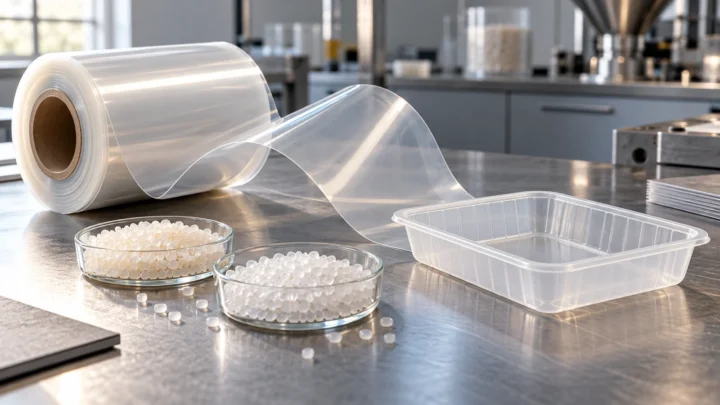
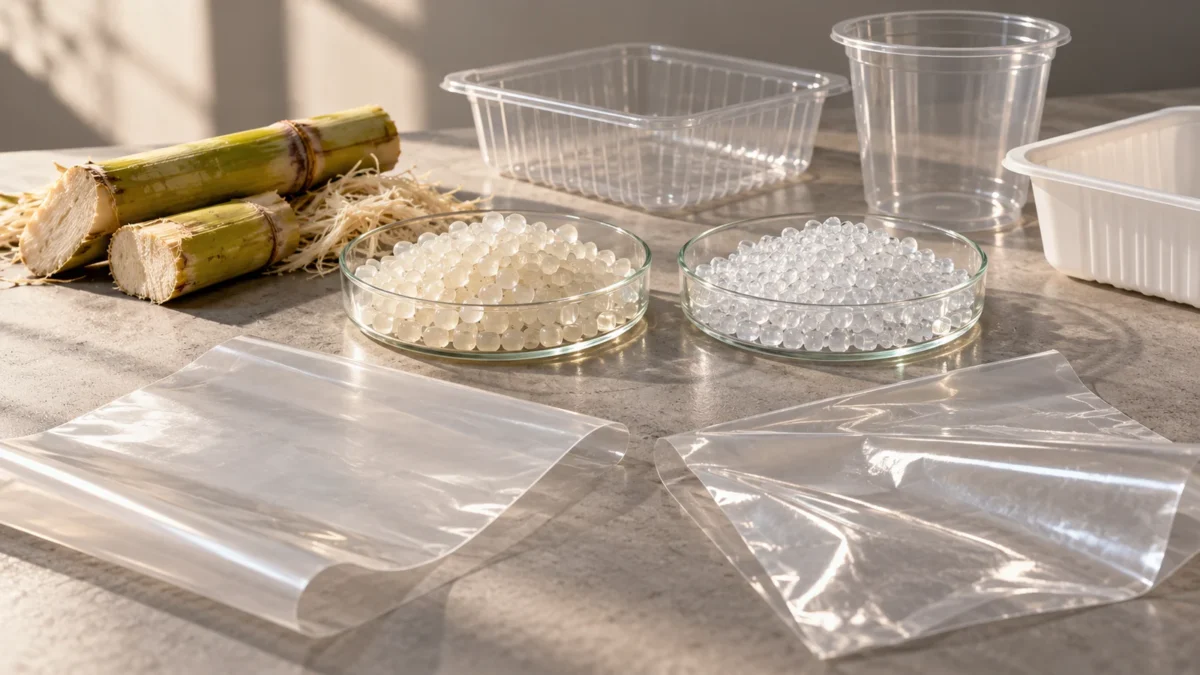
The main image is an AI-generated editorial illustration of an unnamed conceptual scene. The explanatory figure is an original editorial synthesis, not a photograph of an experiment, microscopic structure or measured result.
Official sources and reference notes
- [S1] European Commission — Directorate-General for Environment. Bio-based, biodegradable and compostable plastics. Current webpage accessed 18 October 2026; framework status states adopted 30 November 2022. “What are these plastics?”; “Why do we have this framework?”; “Implementation — Standards”. Relevant public sections checked; source-specific scope retained. Accessed 18 October 2026.
- [S2] European Bioplastics e.V. FAQ — How does EUBP define bioplastics? / What types of bioplastics do exist and what properties do they have?. FAQ entries updated 23 March 2026. Definition and material-type FAQ entries. Relevant public sections checked; source-specific scope retained. Accessed 18 October 2026.
- [S3] European Bioplastics e.V. Bioplastics Glossary. Current webpage accessed 18 October 2026. “Biobased”; “Biobased carbon content”; “Biodegradable”; “Bioplastics”. Relevant public sections checked; source-specific scope retained. Accessed 18 October 2026.
- [S4] Martin Koller et al. Biodegradability of polyhydroxyalkanoate (PHA) biopolyesters in nature: a review. 2025. Abstract; “Biodegradability in nature”; environment-specific biodegradation sections. Identified public record/section access only; detailed experimental or paid-method claims require the underlying text. Accessed 18 October 2026.
- [S5] Peer-reviewed review article available through PubMed Central. Biodegradability of Bioplastics in Managed and Unmanaged Environments: A Comprehensive Review. 2025. Managed environments; PLA degradation discussion. Identified public record/section access only; detailed experimental or paid-method claims require the underlying text. Accessed 18 October 2026.
- [S6] Purabi Bhagabati et al., ACS Polymers Au. Poly(ethylene furanoate) (PEF): Advances in Synthesis, Properties, Recycling, Applications, and Future Challenges. Published online 24 March 2026; issue 8 April 2026. Abstract; Section 4.4 Organic Recycling; Conclusions. Publisher-indexed identified sections accessed; complete direct rendition not retrieved. No experimental numerical result reproduced. Accessed 18 October 2026.
The public corrections channel is currently inactive. Read our corrections policy.