Short answer: Plastic-free packaging is packaging whose finished construction does not contain plastic under the definition relevant to the claim or jurisdiction. That sounds simple, but it is not the same as “paper-based,” “bio-based,” “compostable,” “water-based coated” or “made from natural materials.” A paper pack with a plastic lining is not plastic-free under the EU Single-Use Plastics framework, while some regenerated-cellulose materials can fall outside that Directive’s plastic definition. The exact construction matters.
Plastic-free can be a useful sourcing goal where plastic reduction is technically realistic, but it is not automatically a sustainability score. Replacing a thin plastic barrier with a much heavier structure, shortening food shelf life, adding a difficult-to-recycle coating or moving to a material with poor local recovery can shift the environmental burden rather than remove it.
The practical task is therefore to define what “plastic-free” means for the finished package, verify every component, and then check whether the alternative still performs and has a credible end-of-life route.
“Plastic-free” is not one universal technical category
There is no single global packaging definition that makes every “plastic-free” claim mean exactly the same thing. Different laws and schemes define plastic for specific regulatory purposes, while marketing rules focus on whether a claim is truthful and adequately substantiated.
The EU Single-Use Plastics Directive provides one of the clearest current examples. It defines plastic as a material consisting of a polymer, with possible additives, that can function as a main structural component of final products, while excluding natural polymers that have not been chemically modified. [R1]
The Commission’s 8 September 2026 notice republishes its Single-Use Plastics guidance. Its introduction says the only changes from the previous version concern cap, lid and cover examples in Table 4-6. The material-definition explanations discussed below are retained guidance, not newly introduced September 2026 rules. [R2]
That EU definition is useful, but it is not a universal worldwide “plastic-free certification.” A buyer still needs to identify the destination market and the basis on which the claim is being made.
See the environmental-claims guide for the broader distinction between a specific attribute and an overall benefit.
Paper packaging can still contain plastic
One of the most common sourcing errors is to treat “paper” and “plastic-free” as synonyms.
Under the Commission’s current Single-Use Plastics guidance, a paper- or board-based single-use product made only from paper or board and without a plastic lining or coating is not considered a single-use plastic product under that Directive. But where a plastic coating or lining is applied to provide water or grease protection, the finished item is considered partly made of plastic for the Directive’s purposes. [R2]
The same guidance says the Directive does not create a de minimis plastic-content threshold for listed single-use products: a product can fall within scope when it is only partly made of plastic. [R2]
| Package description | What must be checked | Why the label can mislead |
|---|---|---|
| Paper cup | Lining or barrier chemistry, lid and any separate components | A paper body may contain a PE, PLA or other polymer barrier. |
| Molded-fiber tray | Surface treatment, internal sizing, coating, lid and seal layer | Fiber appearance does not reveal polymer additives or coatings. |
| “Water-based coated” paper | Polymer type in the aqueous dispersion and the dried film | Water can be the carrier while the final barrier is still polymeric. |
| Bio-based film | Actual polymer chemistry | Bio-based plastics remain plastics under many regulatory definitions. |
| Cellulose film | Exact cellulose chemistry and jurisdiction | Regenerated cellulose and chemically modified cellulose derivatives can be treated differently. |
Editorial synthesis of the identified source provisions and evidence boundaries; illustrative examples are not product test results or compliance determinations.
Bio-based plastic is still plastic
“Made from plants” is not the same as plastic-free.
The European Commission’s policy framework on bio-based, biodegradable and compostable plastics states that bio-based plastics are made fully or partly from biological resources but remain plastics; they are not necessarily biodegradable or compostable. [R3]
PLA is the obvious packaging example. It can be produced from renewable feedstocks, but it is still a thermoplastic polymer. Replacing a PE lining with PLA may change fossil-feedstock use and compostability options, but it does not automatically create a plastic-free package.
The Commission’s updated 2026 Single-Use Plastics guidance goes further. It states that polymers produced through industrial fermentation, such as PHA, are not considered “natural polymers” for the Directive’s natural-polymer exception because the polymerisation took place in an industrial process rather than in nature. [R2]
So “plant-based,” “bio-based” and “plastic-free” should be kept as separate claims.
Regenerated cellulose shows why chemistry matters
Not every polymeric-looking film is treated the same way.
The Commission’s 2026 guidance says regenerated cellulose—such as viscose, lyocell and cellulosic film—is not considered chemically modified for the purpose of the Single-Use Plastics Directive because the resulting cellulose polymer is not chemically modified compared with the incoming polymer. By contrast, cellulose acetate is considered chemically modified because the chemical modification remains in the final polymer. [R2]
This does not mean every regenerated-cellulose package is automatically “plastic-free” in every country or under every private scheme. It means that under this specific EU definition, the chemistry of the polymer matters, not merely whether the film is transparent, flexible or plant-derived.
For procurement, the lesson is simple: ask for the actual material identity instead of relying on a marketing family such as “cellulose film” or “plant-based film.”
Water-based coating does not automatically mean plastic-free
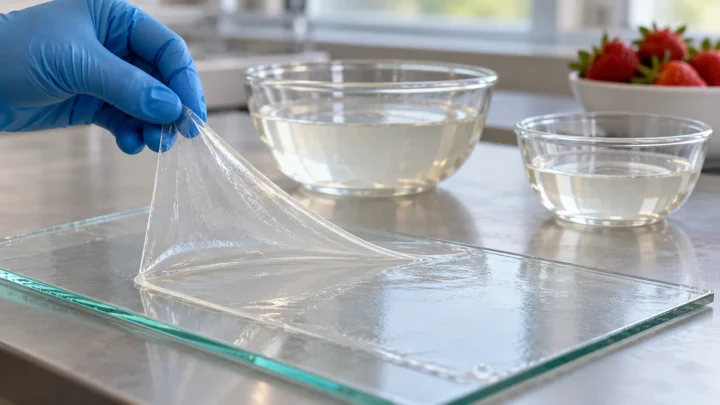
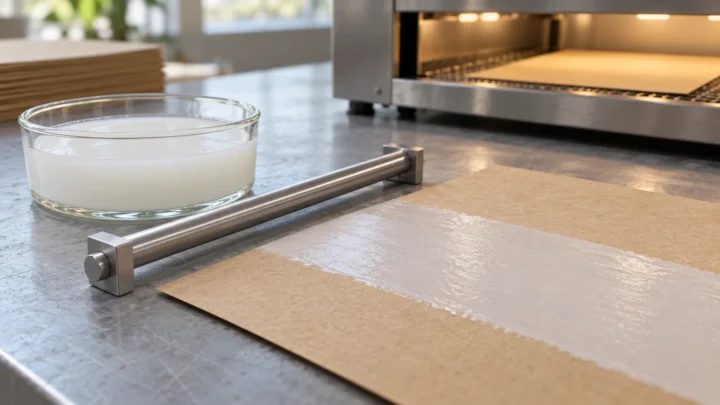
“Water-based” usually describes how a coating is dispersed or applied, not what remains on the paper after drying.
Umeileka and Hubbe’s 2026 review defines water-borne barrier formulations as containing water-soluble or water-dispersible polymer components. It discusses starch and chitosan as well as other film-forming materials. The carrier water and the dried coating composition are different parts of the specification. [R6]
That does not mean every aqueous coating contains plastic. Some systems use natural or mineral components and may fall outside a given plastic definition. The point is narrower:
“Water-based” is not sufficient evidence for a “plastic-free” claim.
The coating formulation and the dried barrier layer need to be identified.
See paper-barrier performance and recycling evidence.
Why paper often needs a barrier at all
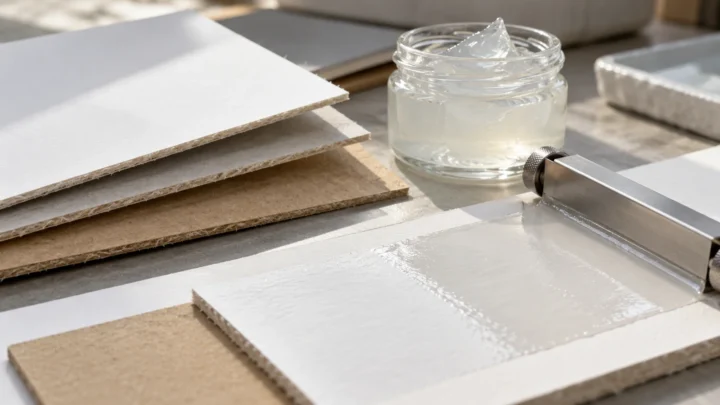
Plain cellulose fiber is porous and hydrophilic. For dry secondary packaging, that may be acceptable. For food, beverage and other moisture-sensitive applications, the package may need resistance to water, grease, oxygen, aroma or water vapor.
The same review explains that barrier layers control water, oxygen, grease and other transfers. Their formulation and dispersibility also affect subsequent repulping. Removing a layer therefore requires checking both the use function and the recovery process. [R6]
This creates one of the central plastic-free trade-offs: eliminating a plastic layer may require another material or treatment to reproduce the same function.
The best question is not “Can the plastic layer be removed?” but:
What is the minimum barrier needed to protect this product, and which non-plastic construction can deliver it without creating a larger recovery or product-waste problem?

What are the main plastic-free packaging options?
| Option | Where it can work well | Main hidden trade-off | What to verify |
|---|---|---|---|
| Uncoated paper / paperboard | Dry foods, cartons, sleeves, wraps, secondary packaging | Limited moisture, grease and gas barrier | Fiber source, strength, printing, local paper recycling |
| Molded fiber | Trays, clamshells, protective inserts, foodservice formats | Wet strength, barrier treatment, drying energy and surface finish | Fiber furnish, additives, coating, fit, food/contact performance, recovery route |
| Regenerated-cellulose film | Selected wraps, windows and flexible applications | Barrier and seal performance varies by grade and coating | Exact cellulose chemistry, coatings, jurisdiction and end-of-life evidence |
| Glass | Jars, bottles and refill systems | High mass, breakage and transport burden | Reuse rotations, return distance and glass-recycling access |
| Steel / aluminium | Cans, tins, closures and durable containers | Primary-metal production can be energy intensive | Package mass, recycled content, collection and metal recovery |
| Wood / bamboo / natural-fiber structures | Some trays, baskets, secondary packs and specialty formats | Moisture, hygiene, consistency and geometry limitations | Surface treatment, food-contact suitability and recovery route |
| Reuse / refill with non-plastic containers | Local closed-loop systems using glass, metal or durable fiber-based formats | Return logistics, washing, breakage and low return rates | Actual rotations, return rate, cleaning and end-of-life |
Editorial synthesis of the identified source provisions and evidence boundaries; illustrative examples are not product test results or compliance determinations.
The table is not a ranking. A material that is excellent for a dry carton can be a poor replacement for a high-barrier pouch.
Paper and molded fiber are often the first alternatives—but not always the lightest
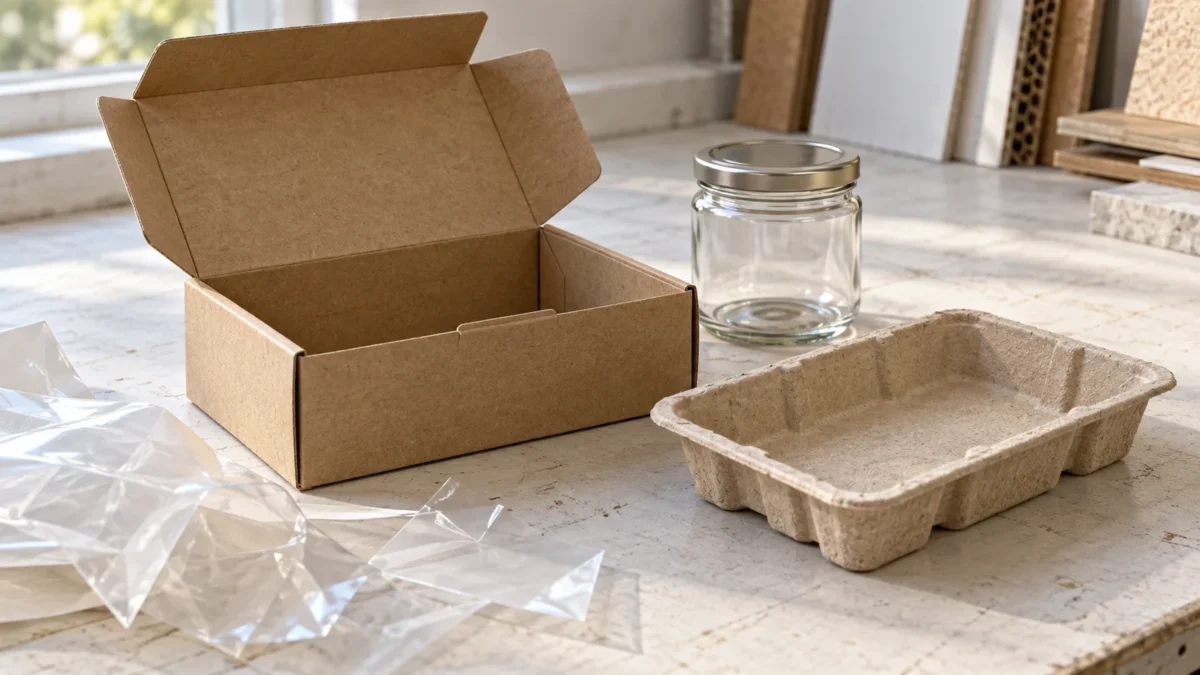
Paperboard and molded fiber can replace plastic in many rigid and semi-rigid applications. Their advantages can include renewable or recovered fiber content, printability, stiffness and established paper-recovery systems in many markets.
The trade-off is that an equivalent fiber structure can require more material mass than a thin plastic film or thin-wall plastic container. Additional barrier layers, lids or structural ribs may also be necessary.
UNEP’s report compares supermarket food-packaging alternatives using life-cycle assessment. Its public record establishes that whole-value-chain scope; this article does not extract a universal material ranking from an unread underlying study. [R7]
So “plastic eliminated” is an input metric, not a complete environmental result.
Glass and metal change the construction and logistics
Glass, steel and aluminium container bodies are non-plastic substrates and can provide strong barriers. But a finished jar, can or closure may also contain a polymer liner, gasket, seal or coating. A non-plastic body is not proof that the complete pack is plastic-free.
But they are materially different substitutes. Glass in particular can add substantial package mass, while metals have significant upstream production burdens. The environmental outcome depends on recycled content, package weight, logistics, reuse cycles and recovery.
A plastic-free material switch should therefore compare the filled package and distribution system, not only the empty container.
See the equivalent-function paper-versus-plastic comparison.
Reuse can reduce plastic without requiring a single-use substitute
One of the most important plastic-reduction strategies is not material substitution at all.
EPA’s packaging guidance describes source reduction through lighter materials, better production processes and reduced shipping packaging. Those are distinct options from replacing one substrate with another. [R8]
For some food and beverage systems, a refillable glass or stainless-steel container can reduce single-use plastic. But reuse only works environmentally when enough containers are actually returned, washed and used again.
FAO similarly notes that refillable food containers can reduce disposable packaging, while emphasizing the need for hygienic designs that prevent contamination during filling and reuse. [R9]
Product protection is the hidden limit to plastic elimination
Plastic became common in packaging partly because thin polymer layers can provide moisture resistance, sealability, toughness and barrier performance with little material.
Removing that functionality without replacing it can shorten shelf life or increase damage. For food, that can be a larger environmental problem than the packaging reduction itself.
FAO notes that suitable packaging helps keep food safe, extend shelf life and reduce food loss and waste. [R9]
A plastic-free redesign should therefore validate:
- shelf life;
- moisture and grease resistance;
- oxygen/aroma barrier where relevant;
- heat and cold performance;
- seal integrity;
- drop/compression performance;
- leakage;
- distribution damage;
- food-contact suitability.
Plastic-free does not mean chemical-free
A package can contain no plastic and still use inks, adhesives, wet-strength agents, fluorinated or non-fluorinated grease barriers, mineral treatments and other functional chemistry.
The environmental and food-contact questions do not disappear when plastic is removed. They change.
For example, replacing a polymer lining with a different coating still requires the buyer to check food-contact status, PFAS or other restricted-substance requirements where relevant, compostability/recyclability compatibility and real use performance.
“Plastic-free” should therefore never be used as shorthand for “non-toxic,” “chemical-free,” “compostable” or “safe for all foods.”
Plastic-free does not automatically mean recyclable
A non-plastic package can still fail in recycling.
Examples include:
- wet-strength paper that does not repulp well in the intended process;
- fiber packaging with non-dispersible barriers or high reject levels;
- food-soiled paper excluded by local programs;
- composite glass/metal/fiber designs that are difficult to separate;
- small-format components lost during sorting.
Likewise, replacing a recyclable mono-material plastic package with a non-plastic composite can reduce plastic use while making material recovery more difficult.
This is why plastic reduction and recyclability should be tracked as separate design objectives.
Plastic-free does not automatically mean compostable
Cellulose, wood and other natural materials can biodegrade under appropriate conditions, but a finished package may include coatings, additives, labels, adhesives or treatments that change compostability.
Industrial compostability and home compostability are also different claims. Even a certified item may not be accepted by the local composting program.
So a package should not be marketed as compostable simply because the primary structure is paper, bagasse, bamboo or regenerated cellulose.
What does “plastic-free” mean in marketing?
The U.S. FTC’s§260.9 addresses free-of claims generally; it does not set a worldwide plastic-free threshold. Its trace/background exception requires all three stated conditions: no more than trace or background presence, no material harm of the kind associated with the substance, and no intentional addition. The section also addresses misleading substitutes and irrelevant free-of claims. These are administrative guides, not a plastic-specific certification. [R10]
That guidance should not be mechanically converted into a global plastic-free threshold. Its value here is narrower: a “free-of” claim needs a documented basis, not just a visual impression.
For packaging, a defensible plastic-free file should identify the complete construction and the definition used for the claim.
A practical plastic-free verification checklist
| Check | What to verify | Why it matters |
|---|---|---|
| Claim definition | Which legal, scheme or internal definition of plastic is being used? | “Plastic” is not defined identically in every context. |
| Complete bill of materials | Body, lining, coating, film, lid, window, label, adhesive and seal layer | The main substrate may hide plastic components. |
| Coating chemistry | What remains after drying, not only whether the coating is water-based | Aqueous polymer dispersions can form plastic/polymer films. |
| Bio-based polymer identity | PLA, PHA, cellulose derivatives and other polymer chemistry | Bio-based does not automatically mean non-plastic. |
| Performance validation | Barrier, seal, heat, leakage, drop and shelf-life requirements | Material substitution must not increase product loss. |
| Food-contact / chemical review | Applicable migration, restricted-substance and use-condition evidence | Plastic-free is not a safety claim. |
| Recovery route | Paper recycling, glass/metal recycling, reuse or composting access | Plastic elimination does not establish circularity. |
| Environmental comparison | Material mass, logistics, product protection and end-of-life | A heavier substitute can shift impacts rather than reduce them. |
Editorial synthesis of the identified source provisions and evidence boundaries; illustrative examples are not product test results or compliance determinations.
Methodology and editorial note
This article is an editorial synthesis of current EU regulatory guidance, U.S. environmental-marketing guidance, official sustainability/food-system sources and peer-reviewed packaging research. It does not create a universal legal definition of “plastic-free.” The EU Single-Use Plastics definition is used as a jurisdiction-specific example, and material substitutions are not ranked without a common functional unit and system boundary.
Sources checked 18 October 2026. The main image is an AI-generated editorial illustration; the explanatory figure is an original editorial diagram. Neither is a photograph of an identified product or facility, a laboratory result or an independent environmental assessment.
Legal discussion is limited to the identified provisions and dated source explanations. No product-specific compliance determination, comprehensive audit of subsequent measures or universal laboratory procedure is provided.
Official sources and reference notes
- [R1] European Union. Directive (EU) 2019/904 on the reduction of the impact of certain plastic products on the environment. Live source. Article 3 definition; Article 5 oxo-degradable scope; Article 6(5) beverage-bottle targets as relevant. Relevant original official Directive text read; national implementation and product-specific conclusions not audited. Accessed 18 October 2026.
- [R2] European Commission. Commission Notice — Updating Commission guidelines on single-use plastic products in accordance with Directive (EU) 2019/904. C/2026/4813,8 September 2026. Introduction; sections2.1–2.2; applicable Annex-listed single-use product context. Relevant full official guidance text read. Introduction limits the 2026 change to cap/lid examples; guidance is nonbinding. Accessed 18 October 2026.
- [R3] European Commission. Bio-based, biodegradable and compostable plastics. Live source. Bio-based plastics remain plastics and are not necessarily biodegradable/compostable. Relevant public text checked 18 October 2026; source scope retained. Accessed 18 October 2026.
- [R6] Umeileka, C. C. & Hubbe, M. A. Repulpability and biodegradability of paper-based packaging products with water-borne barrier coatings: A review. BioResources 21(4), 2026; DOI 10.15376/biores.21.4.Umeileka. Definitions: Barrier coatings; Waterborne; relevant barrier/repulpability discussion. Relevant full public review sections read. No new experiment or commercial-product performance is inferred. Accessed 18 October 2026.
- [R7] UNEP. Single-use Supermarket Food Packaging and its Alternatives: Recommendations from Life Cycle Assessments. December 2022; ISBN978-92-807-3998-5. UNEP repository abstract and report scope. Official public record/abstract read; full report and its underlying comparative studies not audited. Accessed 18 October 2026.
- [R8] U.S. EPA. Sustainable Packaging / Sustainable Materials Management hierarchy. Live source. Source reduction, lightweighting and reuse as relevant packaging strategies. Relevant public text checked 18 October 2026; source scope retained. Accessed 18 October 2026.
- [R9] FAO. Reduce, reuse, recycle: a mantra for food packaging. 29 September 2021. Packaging’s role in food safety/shelf life/loss reduction; refill/reuse hygiene context. Relevant public text checked 18 October 2026; source scope retained. Accessed 18 October 2026.
- [R10] U.S. FTC. 16CFR§260.9—Free-of claims. Current eCFR text checked 18 October 2026. §260.9(a)–(c), including all three trace/background conditions. Relevant public text checked 18 October 2026; source scope retained. Accessed 18 October 2026.
The public corrections channel is currently inactive. Read our corrections policy.