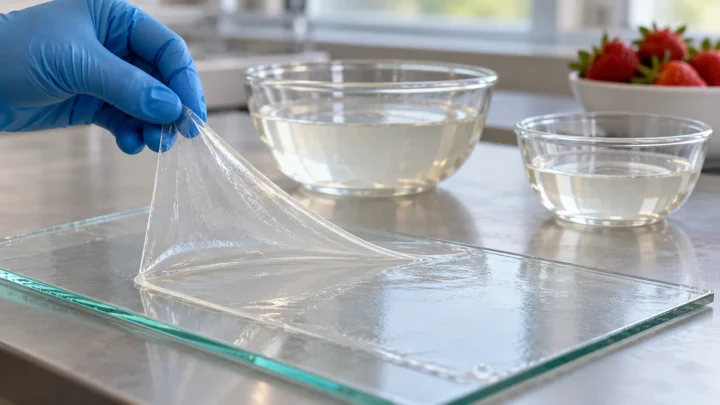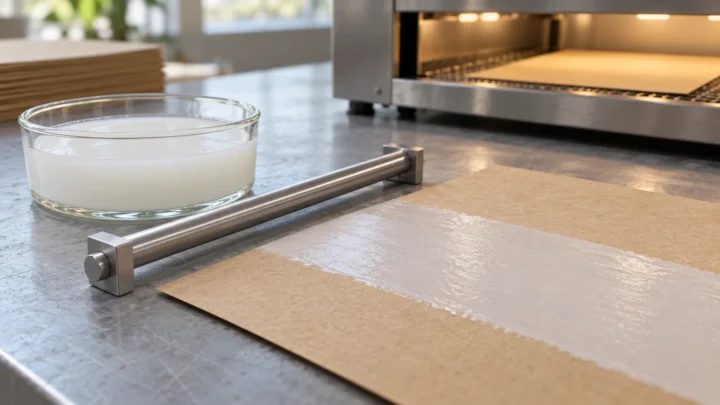
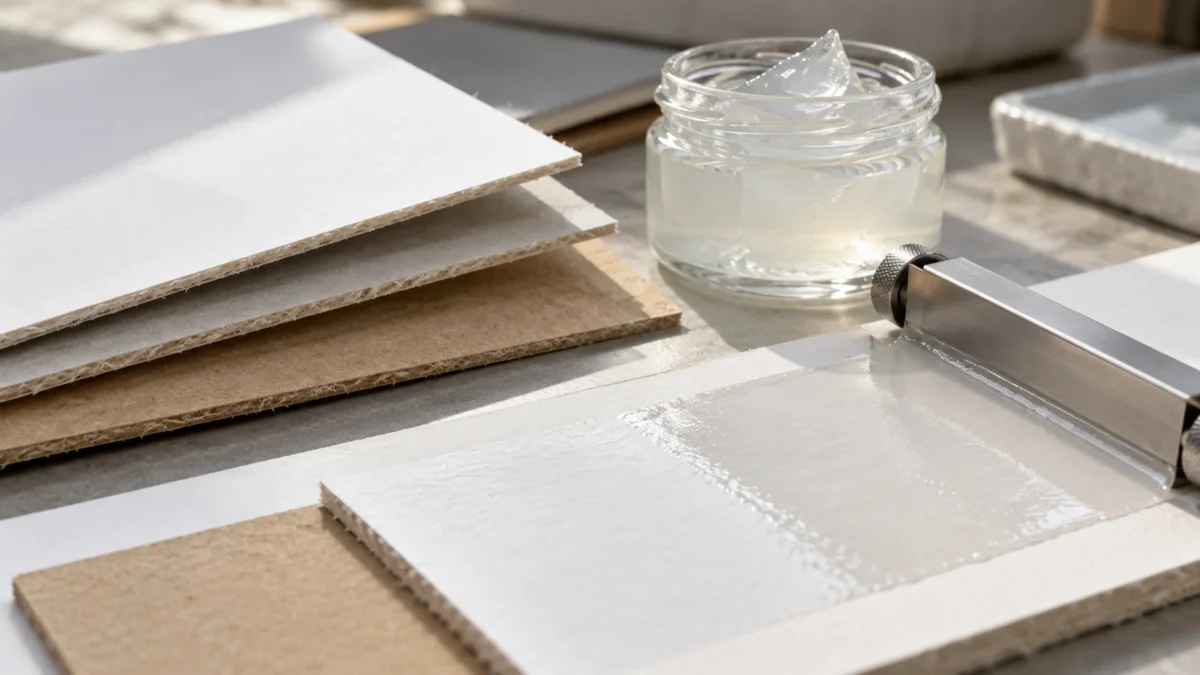
Nanocellulose can be an excellent grease and oxygen barrier because very small cellulose fibrils or crystals can form dense, low-porosity layers with long diffusion paths. Its main weakness is moisture. Cellulose is hydrophilic, so high relative humidity and direct water exposure can plasticize or swell the network and reduce barrier performance. In practice, nanocellulose often works best as one layer inside a multilayer or hybrid barrier system rather than as a universal standalone coating.
This makes nanocellulose a good example of why “bio-based barrier” should not be treated as one performance category. A coating can be strong against oil and oxygen while remaining comparatively weak against water vapor. The correct question is therefore not “Does nanocellulose have barrier properties?” It is: which nanocellulose, applied how, at what coat weight, under what humidity, and combined with which other layers?
See the separate barrier measurement questions for the related distinction.
What counts as nanocellulose?
Nanocellulose is an umbrella term for several cellulose materials with nanoscale dimensions. The most relevant types for packaging are:
- Cellulose nanofibrils (CNF/NFC): long, flexible fibrils that can entangle into continuous networks.
- Cellulose nanocrystals (CNC): shorter, rigid, highly crystalline rod-like particles.
- Bacterial nanocellulose (BNC): nanoscale cellulose produced by microorganisms rather than mechanically or chemically separated from plant fibers.
Those materials are not interchangeable. CNF tends to form continuous, flexible networks more readily. CNC can contribute high crystallinity and dense particle packing but can be more brittle in films. Surface chemistry also varies according to production route, such as TEMPO oxidation, enzymatic treatment or acid hydrolysis.
That is why a datasheet that says only “nanocellulose coating” is incomplete.
Why nanocellulose can create a strong barrier
Ordinary paper contains pores between much larger fibers. Those pores provide pathways for air, oil and gas transport. Nanocellulose can fill or bridge those openings and form a much denser surface layer.
The barrier mechanism is largely physical:
- nanocellulose particles or fibrils fill surface voids;
- hydrogen bonding creates a cohesive cellulose network;
- the dried coating reduces connected porosity;
- gas or liquid molecules have to follow a longer, more tortuous path through the layer.
The relevant distinction is a dense layer with controlled defects, not the mere presence of a nanoscale ingredient. The identified cellulose-coating studies examine particular substrates and formulations; they do not establish a universal performance class.
Grease resistance can be very strong
Oil and grease resistance is one of nanocellulose’s clearest packaging strengths.
The identified cellulose-based paperboard study compared MeNC, MFC and hydrophobically modified cellulose layers. Its results illustrate that surface coverage, chemistry and layer sequence matter alongside the cellulose origin. [S7]
Oxygen barrier is often excellent—when humidity is controlled
Nanocellulose can form dense hydrogen-bonded films with very low oxygen transmission under dry or moderate-humidity conditions.
The identified cellulose-coated-paper and multilayer-paperboard studies support a bounded conclusion: coating composition and architecture can improve oxygen barrier, but performance needs to be reported with the actual humidity and substrate. [S5] [S7]
The qualification matters: oxygen barrier is strongly humidity-dependent.
Water absorbed into a hydrophilic nanocellulose network acts as a plasticizer. It increases molecular mobility, disrupts hydrogen bonding and can open diffusion pathways. That means an OTR measured under dry laboratory conditions may not represent performance around moist food or at high relative humidity.

Moisture is the central weakness
Pure cellulose nanofibril films are generally poor water-vapor barriers compared with hydrophobic polyolefins.
The accessible research does not justify treating an untreated hydrophilic cellulose layer as equivalent to a polyolefin moisture barrier. Its water-vapor performance must be measured under the relevant humidity and temperature, separately from oxygen or grease resistance.
This does not mean nanocellulose has no moisture-barrier value. Surface modification, crosslinking, multilayer design and hydrophobic topcoats can improve performance. But the improvement comes from changing or protecting the hydrophilic cellulose network—not from pretending the underlying chemistry is moisture-insensitive.
| Barrier function | Typical nanocellulose tendency | Main limitation to check |
|---|---|---|
| Grease / oil | Often strong when a dense, low-porosity coating is formed | Pinholes, cracks, formed corners, coating continuity |
| Oxygen | Can be excellent at low/moderate humidity | High RH can sharply increase gas transmission |
| Liquid water | Untreated nanocellulose is intrinsically hydrophilic | Swelling, wetting, loss of cohesion |
| Water vapor | Usually weaker than hydrophobic polymers when used alone | Humidity-driven plasticization and vapor transport |
Editorial synthesis of the cited sources. Examples are not product test results; methods, construction and conditions remain part of every claim.
CNF and CNC solve different parts of the problem
CNF and CNC are frequently grouped together, but their morphology gives them different strengths.
CNF forms long, entangled fibril networks. That can help film continuity, flexibility and crack resistance. CNC consists of shorter, more rigid crystalline particles that can create a dense layer but may be more brittle.
Combining layers can place different chemistries where they are useful, rather than requiring a CNF or CNC layer to provide every function. This is a design option, not proof that one morphology always outperforms the other.
That is a recurring design principle in modern barrier research: nanocellulose is often more useful as part of an architecture than as a single-material replacement.
Surface chemistry matters as much as particle size
Nanocellulose production methods change the surface.
TEMPO-mediated oxidation introduces charged carboxyl groups and can support highly individualized fibrils. Acid hydrolysis can leave sulfate groups on CNC. Enzymatic or mechanical routes create different fibril sizes, charge densities and rheology.
Production and pretreatment change surface chemistry, fibril dimensions and dispersion behavior. These fields belong in the material specification; the production route alone does not specify the finished barrier.
Relevant fields include:
- CNF vs CNC vs BNC;
- production / pretreatment route;
- surface charge or functionalization;
- solids content and rheology;
- fibril dimensions;
- coat weight;
- drying and calendaring conditions.
Coat weight and coverage determine whether the network is continuous
A nanoscale material does not guarantee a defect-free coating.
Paper is rough and porous. If coat weight is too low, nanocellulose may disappear into surface pores or leave uncovered pathways. Higher coat weight can improve continuity but increases drying demand and may affect stiffness, cost and converting.
Substrate dependence must be checked on the actual grade of paper or paperboard. Surface roughness and porosity can change coverage even when the coating formulation is unchanged.
Substrate roughness, porosity and sizing therefore belong in the same specification as the nanocellulose itself.
Why hydrophobic modification is so common
Researchers use several strategies to reduce nanocellulose’s moisture sensitivity:
- esterification or other chemical hydrophobization;
- silane treatment;
- fatty-acid or wax modification;
- crosslinking;
- incorporation of lignin, tannins or hydrophobic particles;
- multilayer structures with an outer moisture barrier;
- polymer/nanocellulose nanocomposites.
These modifications can improve moisture resistance, but they also create new questions. A chemically modified nanocellulose coating may no longer have the same biodegradation, repulpability, food-contact or compostability profile as unmodified cellulose.
“Made from cellulose” should therefore not be used as a shortcut for the finished coating’s end-of-life behavior.
Multilayer systems are the practical path to balanced performance
Recent work increasingly treats nanocellulose as the oxygen/grease layer inside a multilayer structure.
A 2025 open-access paper on multilayer cellulose-based coatings combined methyl nanocellulose, microfibrillated cellulose and hydrophobically modified ethyl(hydroxyethyl) cellulose on paperboard. The study varied layer number, coat weight, temperature and relative humidity to understand how different cellulose-derived layers contributed to oxygen, water-vapor and grease performance. [S7]
A 2026 review of nanocellulose/plastic multilayers reached a similar conclusion from a different direction. It described nanocellulose as a strong oxygen-barrier core while hydrophobic outer plastic layers protect against moisture. Laboratory separation by water soaking has been demonstrated in some multilayer systems, but the review also identifies moisture management, adhesion, scalability and recycling as unresolved design issues. [S8]
The key point is not that one particular multilayer is the answer. It is that oxygen and water-vapor barrier often require opposite material tendencies: a dense hydrophilic layer can be excellent for oxygen, while a hydrophobic outer layer is better for moisture.
Does nanocellulose make paper recyclable?
Not automatically.
Nanocellulose itself is cellulose, but the finished package may include crosslinkers, hydrophobic modifiers, latexes, waxes, plastic films, adhesives or other layers. Those components determine what happens during pulping and screening.
A thin nanocellulose coating may be more compatible with fiber recovery than some thick laminations, but that should be tested rather than assumed. Laboratory separation of a multilayer structure is useful evidence for that structure; it is not proof that every mill will accept it.
The usual recyclability chain still applies:
- collection;
- sorting;
- repulping / process compatibility;
- rejects and stickies control;
- recovered-fiber quality;
- actual mill acceptance.
The coating should therefore be evaluated as part of the complete paper package.
See whole-design paper recyclability for the related distinction.
Does nanocellulose make paper compostable?
Again, not automatically.
Unmodified cellulose is biodegradable, but a package may include surface modifications, crosslinkers, synthetic polymer layers, mineral nanoparticles, inks, adhesives or heat-seal layers. Compostability applies to the finished construction under the relevant conditions.
A nanocellulose coating can be a useful component of a compostable design, but the cellulose origin alone cannot establish the claim.
What should a buyer ask for?
| Question | Why it matters |
|---|---|
| CNF, CNC, BNC or a blend? | Different morphology and film behavior produce different barrier results. |
| How was it produced or modified? | Surface chemistry, fibrillation and charge affect coating quality and moisture response. |
| What is the dry coat weight? | Coverage and continuity depend on enough material reaching the surface. |
| What substrate was tested? | Recycled paper, food-contact paper and paperboard can respond differently. |
| What OTR condition was used? | Nanocellulose oxygen barrier is strongly humidity-dependent. |
| What WVTR / liquid-water data exist? | Good oxygen or grease barrier does not prove moisture resistance. |
| Is there a hydrophobic or polymer top layer? | The final package may be a multilayer, not a cellulose-only construction. |
| What happens after creasing or forming? | Cracks or pinholes can defeat flat-sheet barrier values. |
| What recycling or composting evidence covers the finished construction? | Cellulose origin does not establish system-level end-of-life. |
Editorial synthesis of the cited sources. Examples are not product test results; methods, construction and conditions remain part of every claim.
What to put in the specification
For procurement, require the exact nanocellulose type, modification route, coat weight, substrate, humidity-specific OTR/WVTR data and finished-package end-of-life evidence. “Nanocellulose-coated” is a useful material description; it is not a complete performance specification.
Methodology and editorial note
This technical explainer synthesises the identified official guidance, public standard scopes and research records. Study findings remain specific to their reported materials and conditions. Sources checked 18 October 2026; no product testing, factory inspection or independent certification assessment was performed for this article.
The main image is an AI-generated editorial illustration of an unnamed conceptual scene. The explanatory figure is an original editorial synthesis, not a photograph of an experiment, microscopic structure or measured result.
Official sources and reference notes
- [S5] Ronald Sabo et al. Grease, Oxygen, and Air Barrier Properties of Cellulose-Coated Copy Paper. Polysaccharides 5(4),783–806; 4 December 2024; DOI 10.3390/polysaccharides5040049. Cellulose-coated copy-paper specimens; methods, grease/oxygen/air results and creasing limitations. Original-author USDA-hosted paper and publisher-indexed methods/results; copy-paper specimens, not a universal packaging validation. Accessed 18 October 2026.
- [S7] Johanna Lyytikäinen, Krista Koljonen and Ville Leminen. Effects of multilayered cellulose-based coatings on the barrier properties of paperboard. Published 15 February 2025. Multilayer MeNC/MFC/HM-EHEC paperboard specimens; coverage, architecture and humidity discussion. Relevant public sections checked; source-specific scope retained. Accessed 18 October 2026.
- [S8] Yufei Nan; Daniel J. Franke; Cody A. Schilling; Ronald C. Sabo; Nicole M. Stark; Laurent M. Matuana. Functional multilayer films with nanocellulose core and plastic outer layers for high-performance oxygen and water vapor barrier food packaging. Trends in Food Science & Technology 173 (2026), 105750. Original-author public abstract: CNM-core/plastic-outer-layer architecture and lab-scale separation. Identified public record/section access only; detailed experimental or paid-method claims require the underlying text. Accessed 18 October 2026.
The public corrections channel is currently inactive. Read our corrections policy.