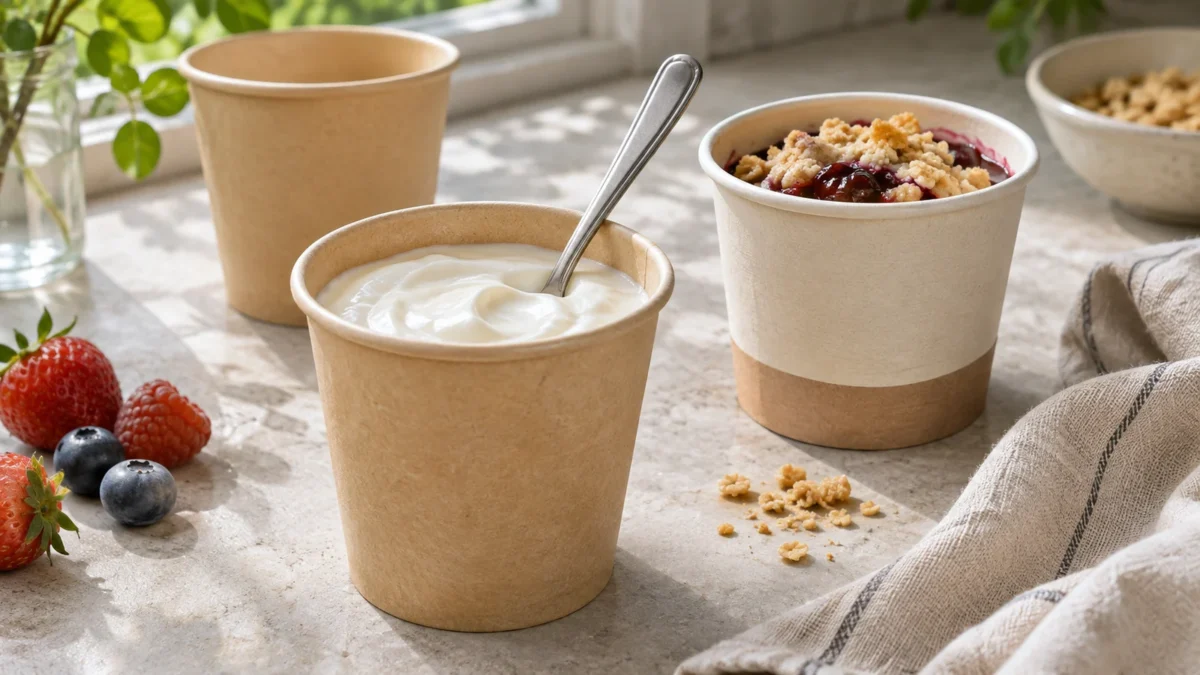
Tetra Pak introduced Tetra Reva on 24 November 2026 as a paper-based carton for foods eaten with a spoon. The company lists yoghurt, desserts, plant-based alternatives and soft cheeses among the intended applications. [S1]
For a brand considering a switch from a pot and lid, the engineering brief starts with how the customer grips and opens the pack, reaches the contents and handles any remaining food. The recipe and the way the product is sold and served determine which opening design to test.
A spoonable product changes the geometry of a carton
Liquid packs can be designed around pouring through a relatively small opening. A thick yoghurt, a dessert with inclusions or cottage cheese presents different demands. The consumer may need to reach the bottom and corners with a spoon, move larger pieces through the opening and remove the last portion without crushing the container or transferring the food to another vessel.
Tetra Pak describes full-top options with a tethered or untethered lid, plus curved and customisable untethered options for single-serve use. Those configurations establish what to ask a supplier to quote. Compare opening force, residual food and usability with the brand’s current pot using the same recipe and serving size. [S2]
A repositionable lid may suit a multi-serve soft cheese. A tear-off format may suit a single-serve dessert. Include repeat handling and storage in the test plan where shoppers will keep part of the product for later.
The filling process deserves equal attention
Tetra Pak describes the filling system as supporting chilled or high-acid ambient production. Thick foods and inclusions can change flow at the nozzle and leave residue near the closing surface, so qualification needs the actual product and intended operating conditions. [S1]
Specify the viscosity range, inclusion size where relevant, intended fill temperature and handling process. Include the most demanding realistic recipe and operating conditions in the line trial.
Establish the shelf life of the candidate filled pack with the actual recipe, complete construction, production process and storage conditions.
Compare a spoonable carton with the existing pack
| Qualification area | Question for the brand or converter |
|---|---|
| Filling and sealing | Can the real recipe be filled consistently without compromising the closure area? |
| Opening | Can intended users open the pack reliably, with suitable opening force and without problematic tearing? |
| Spoon access | Can the user reach corners and the bottom, including when the pack is nearly empty? |
| Multi-occasion use | Does the selected lid and handling instruction fit the actual storage pattern? |
| Distribution | Does the filled pack retain its geometry, seal integrity and stacking performance through the intended route? |
| Recovery | What is the complete construction, including layers and lid, and which local systems accept it? |
Editorial trial questions for comparing a spoonable carton with an existing pack.
Test the complete use sequence, including cold handling or condensation for chilled foods and repeat opening for multi-serve packs. Evaluate the filled pack in its intended shipping case and distribution route.
What to check about construction and recovery
Obtain the construction of the finished pack, including the barrier and the lid, before evaluating local collection, sorting and reprocessing. These details determine the evidence needed for a recovery claim.
Our earlier analysis of paper barriers in a one-litre aseptic carton covered a different pack and use. Compare the spoonable format on its own construction and verify any recycling instruction for the market where the pack will be sold.
For some brands, the retail shape and decoration space may be part of the attraction. For others, the decision will be determined by whether a new format can run reliably without expensive disruption to an established filling system. A comparison of material mass alone cannot measure that trade-off. The relevant cost includes the package, filling process, rejected output, handling and any product lost before sale or left in the container.
What evidence to ask for before switching
Start with one use case and compare the complete carton against the current pot on the same line and distribution route. Separate what consumers can do with each opening from the production cost, shelf life and recovery evidence for that pack.
Customer deployments, documented filling trials, shelf-life data and local recycling acceptance would give packaging teams a firmer basis for comparing the carton with an existing pack.
Sources
- Tetra Pak, Tetra Reva launch announcement, 24 November 2026.
- Tetra Pak, Tetra Reva carton packages, ‘Choose the lid that fits the moment’.
Found an error? Read our corrections policy and contact the editors.