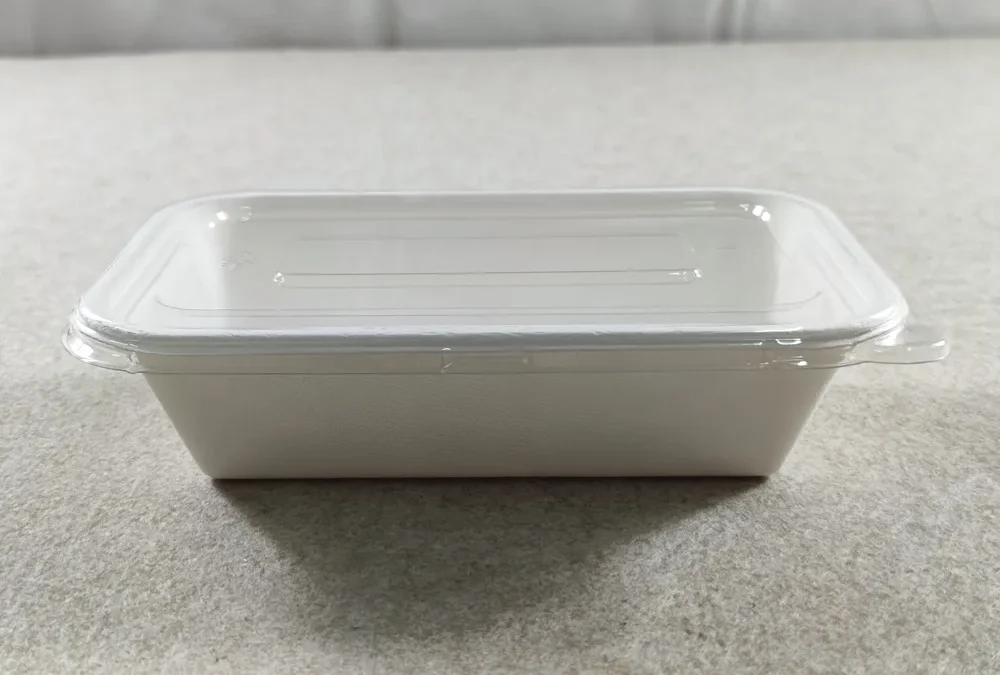
A takeaway tray can resist oil while the fitted lid still leaks at the rim. The tray and lid can also have different disposal routes. A documented example from China is Bioleader’s T056, a moulded sugarcane-bagasse tray. The manufacturer lists it as 32 oz and 215 × 140 × 52 mm, with flat and dome PET lid options in the product documentation. Those details identify what to order for a trial. The trial still has to establish how the chosen combination works with the meal. [1]
Bioleader T056 bagasse tray with the clear flat PET lid option. Photo: Bioleader official product gallery.
Test the tray with the actual meal
Use the menu item that places the greatest demand on the tray. Record fill temperature, holding time and any reheating step, then check for oil transfer, softening and loss of rigidity at the base and corners. A pilot study by the USDA Forest Products Laboratory examined how fibre type, refining and additives affect moulded pulp tray properties. That research supports testing the specified tray under its intended conditions. [2] [3]
Treat the fitted lid as a separate specification
Record the lid material and exact lid code on the trial order. Check rim engagement on filled trays, then look for leaks and lid movement after stacking, transport and the intended holding period. Confirm whether the lid stays on during reheating and obtain the supplier’s instructions for that exact component. If the application needs a heat-sealed film, qualify the tray, film and sealing equipment as a separate configuration. The T056 example here uses a fitted lid. [1] [3]
Confirm where each component can go after use
Separate the used tray and lid in the condition in which customers will discard them. Ask the collector or receiving facility whether it accepts a food-soiled fibre tray and whether it accepts the particular PET lid format. Use those answers to write the disposal instructions. A material description on the order form identifies the components. Local acceptance determines the disposal route available to the customer.
Make the purchasing decision in stages. A successful tray test supports a material shortlist. A successful filled-pack test supports a pilot order for the exact tray-and-lid pair. Confirmed collection routes support the disposal instructions. Keep the three records together so a change in meal, lid or collection service can be reviewed on its own.
Sources
Found an error? Read our corrections policy and contact the editors.