Paper food-packaging barriers are facing a more demanding engineering question: can the same construction protect its contents, seal on the intended equipment and retain a credible fibre-recovery route? Recent supplier developments place these requirements within a single design brief. They do not establish a market-wide replacement of polyethylene.
The contrast is useful. UPM, Ingredion and Paramelt are developing a starch-barrier paper structure with an initial recyclability test behind it. Michelman offers commercially available cup coatings whose technical discussion extends to beverage composition, forming equipment and short sealing dwell times. These are different stages of maturity, addressing different applications. Their shared significance lies in the need to qualify the package as an integrated system.
Development samples and commercial coatings answer different questions
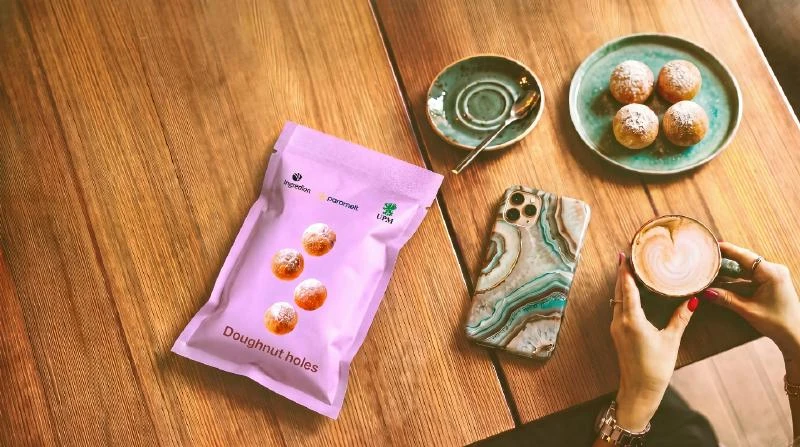
In its 20 October 2026 announcement, UPM described combining paper substrates, Ingredion’s plant-based starch grease-barrier technology and Paramelt’s bio-based heat-seal and barrier coatings. The programme considers UPM Solide Lucent 78 gsm and UPM Asendo 65 gsm papers. The reported Western Michigan University Part 1 result applies to a structure based on Solide Lucent 78 gsm; it should not be extended to both substrates or every coating combination. [1]
A companion UPM technical account identifies the test as SBS-E Part 1, describes compatibility with existing equipment and says development continues. Those are supplier statements about a developing system. They are not a disclosed production record showing sustained commercial output, scrap rates or customer adoption. [2]
Michelman’s PACK EXPO announcement identifies Michem Coat 9100 and the Michem Coat 9250 series as commercially available. The chronology matters: the release is dated 15 September 2026 and concerns the October exhibition. The products should therefore be discussed as established commercial offerings in the October conversation, rather than presented as October launches. Its longer-term coating roadmap is also separate from products already offered for sale. [3]
Different evidence stages, not a performance ranking
| Route | What the public record establishes | What remains application-specific |
|---|---|---|
| UPM / Ingredion / Paramelt | Development structure; reported SBS-E Part 1 result for the identified Solide Lucent construction. [1–2] | Complete assessment, finished-pack performance and sustained production qualification |
| Michelman cup coatings | Commercial availability; supplier-described beverage, sealing and equipment capabilities. [3–5] | Performance and recovery of the converter’s actual cup construction |
Commercial availability reduces uncertainty about whether a coating can be sourced. It does not remove the need to qualify a particular substrate, coating application and package format. Conversely, an encouraging prototype test is useful development evidence without becoming a claim of commercial readiness.
Grease protection is not a hot-beverage qualification
The two examples should not be forced into a single barrier league table. The starch collaboration’s stated focus is grease resistance in food packaging. The cup route addresses a liquid-containing format with its own sealing and use conditions. A bakery wrapper and a hot-coffee cup cannot share an acceptance criterion merely because both contain paper.
For development teams, the practical starting point is an exposure brief: the actual food or beverage, contact temperature, required holding time and finished geometry. The grease-barrier finding answers one part of that brief. It does not supply missing liquid-resistance, shelf-life or seal-integrity results. Our guide to different barrier measurements explains why their endpoints need to remain separate.
Michelman’s technical discussion makes the beverage distinction concrete: coffee formulations and additions such as creamers create different challenges. It also identifies sealing, taste and odour, coating application and equipment compatibility as relevant to hot-cup development. These remain supplier-described requirements and capabilities, rather than an independent comparison against the UPM structure. [4]
The consequence is a change in the evidence request. Instead of asking whether a coating is simply grease-resistant, a converter needs to ask whether the finished package meets the defined exposure and seal requirements after the intended manufacturing sequence.
A sealable sample is only the beginning of a production window
Heat-seal capability and production throughput deserve separate entries in a qualification plan. One asks whether the intended surfaces can form a suitable bond. The other asks whether that bond, along with the rest of the package, remains acceptable at the required production rate. Treating the first as proof of the second skips the scale-up question.
Michelman’s Michem Coat 9250 series sheet discusses compatibility with ultrasonic, servo and high-speed cup formers, and sealing performance at short dwell times. It also distinguishes grades for different production environments and describes coating and drying arrangements. This is more operationally specific than a broad claim that a coating is heat-sealable. Nevertheless, the sheet does not provide a common, independently measured line-speed benchmark against the starch collaboration. [5]
The engineering implication is to treat coating, drying and forming as a connected trial. A successful seal observation should be accompanied by the tested structure, equipment, settings and acceptance criteria. A production trial should then show whether the agreed seal and barrier outcomes persist at the intended operating rate, including the resulting rejects. This is an editorial qualification framework, not a report that either supplier has published those comparative results.
For a converter, that framework changes the commercial conversation. A material can be available and technically promising while the intended production window remains unqualified. The next decision is whether to proceed to an application trial, rather than to infer that every advertised function has already been demonstrated together on the buyer’s line.
Part 1 is a defined result, not a complete recycling outcome
The UPM structure’s reported SBS-E Part 1 pass is a useful milestone with a specific boundary. How2Recycle’s current public Guidelines for Use, covering August 2026–January 2027, requires both Repulpability (Part 1) and Recyclability (Part 2) for fibre packaging requiring technical testing. Packaging must be tested as it would enter the recycling stream, including print and decoration. The guidance notes that the accepted OCC-E and SBS-E protocols were updated in early 2025. A Part 1 result does not establish a complete technical assessment, an assigned recycling label or collection acceptance. [6]
WMU’s public recycling overview likewise describes a two-stage approach for a related packaging protocol, with initial benchtop work followed by pilot-plant testing. It does not provide the complete SBS-E protocol or the test report for this UPM sample. [7] The Sustainable Packaging Coalition’s paper-packaging testing report also notes that the SBS-E protocol was not publicly available in that report. No unpublished test conditions or thresholds are reconstructed here. [8]
Three questions therefore remain distinct: what happened to the tested sample; whether the final package passes the applicable complete technical assessment; and whether that package will be collected, sorted and recycled in its destination market. A favourable answer to the first does not settle the other two. [8]
Michelman also says customers need to test their final structures. Its discussion of results for representative cups and coated-paper samples should not become blanket certification of every cup using the coating. Commercial maturity changes the starting point for qualification, rather than eliminating the finished-construction boundary. [4]
Sustainability attributes belong inside the specification
Bio-based content describes a material-origin attribute. It does not supply a recycling result. Plastic reduction describes a change against an identified baseline; it does not establish that the finished construction contains no plastic. A listed cup construction using plant-based PE illustrates why renewable feedstock and polymer absence are different questions. Likewise, the description “water-based” does not, on its own, disclose the composition of the dried coating. These questions need their own evidence rather than being answered by another attribute’s name.
This is why the October discussion matters beyond the companies involved. It brings the sustainability claim into the same decision as product protection and manufacturability. A promising material-origin story cannot compensate for an unsuitable package, while a production-compatible coating still needs a defensible account of its recovery route.
An editorial framework for the next qualification decision
| Question | Evidence to keep attached to the answer |
|---|---|
| Does it protect the intended contents? | Defined exposure, finished specimen and relevant barrier or containment result |
| Does it seal at the required production rate? | Equipment and settings, operating rate, seal acceptance and rejects from the same trial |
| What was assessed for fibre recovery? | Exact construction, protocol, completed test parts and report limitations |
| What sustainability attribute is being claimed? | Composition or origin basis, comparison baseline where relevant, and the separate recovery evidence |
These examples support a direction of technical development, not a quantified adoption trend. They do not show starch coatings displacing PE across the market, a universal plastic-free construction, or improved recycling rates in practice. Evidence of that broader transition would require adoption or market data and documented recovery outcomes beyond these announcements.
The strongest conclusion is narrower and more useful: current development signals point toward multifunctional, production-compatible paper barrier systems. The next meaningful advance will be evidence that the required functions coexist in the same converted package at the intended operating conditions, with a recovery assessment that matches that construction.
Method and evidence limits
Desk-based analysis of primary supplier releases, technical material and published testing guidance, checked 29 October 2026. Supplier statements are attributed; no independent package trials, unpublished reports, measured market adoption or product-certification verdict are claimed. The How2Recycle source is the current public August 2026–January 2027 edition; no unpublished SBS-E conditions or thresholds are inferred.
Sources
- UPM. UPM, Ingredion and Paramelt explore the potential of starch-based barriers in recyclable paper packaging, 20 October 2026. Construction, substrates and the structure-specific Part 1 result.
- UPM Specialty Materials. UPM × Ingredion × Paramelt: Grease-resistant, heat-sealable paper packaging developed to help replace fossil-based materials, 20 October 2026. Technical summary identifies SBS-E Part 1 and continuing development; supplier account, not the test report.
- Michelman. Paper Packaging and Next-Gen Cup Coatings at PACK EXPO 2026, 15 September 2026. Commercial availability, October exhibition context and distinction from the future roadmap.
- Michelman. Paper Cup Solutions Providing Sustainability AND Performance, undated active technical article, checked 29 October 2026. Beverage composition, converting variables and final-structure testing responsibility.
- Michelman. Michem Coat 9250 Series for Paper Cups, global English sheet dated 21 April 2026, two pages, supplied through the official interpack exhibitor portal. Pages 1–2: short-dwell sealing, equipment, grades, coating methods and limitations. Supplier technical sheet, not independent line trials.
- How2Recycle. Guidelines for Use — Abbreviated, August 2026–January 2027, printed/PDF page 32, Testing for Fiber Packaging; current public download checked 29 October 2026. Parts 1 and 2, print and decoration, and the early-2025 OCC-E/SBS-E protocol updates. Does not establish a label assignment or recycling in practice.
- Western Michigan University. Paper Pilot Plant: Recycling, checked 29 October 2026. General facility and two-stage related-protocol description; not the full SBS-E method or this sample’s report.
- Sustainable Packaging Coalition. Introduction to Paper Packaging Recyclability: Test Methods and Specifications, January 2023, version 1.0, pages 5 and 17. Technical testing within the recycling system and the access boundary for SBS-E; no proprietary clauses inferred.
Found an error? Read our corrections policy and contact the editors.