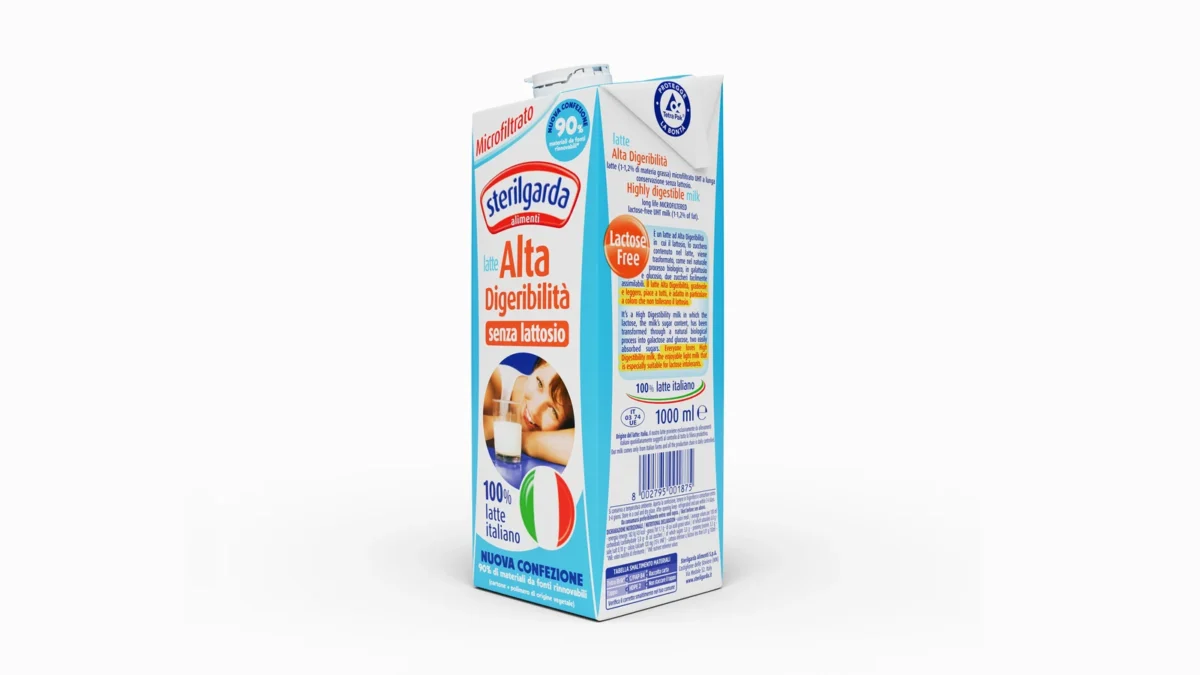
In April 2026, Tetra Pak and Italian dairy producer Sterilgarda Alimenti announced a one-litre aseptic beverage carton using a paper-based barrier in place of the conventional aluminum-foil barrier layer. For the specified Tetra Brik Aseptic 1000 Edge construction with plant-based polymers, Tetra Pak reports renewable content of 90% and a carbon-footprint reduction of up to 50% relative to a defined foil-and-fossil-polymer comparator, using a company calculator model verified by the Carbon Trust. Those figures describe a particular package, comparison and model—not an environmental result for every aseptic carton. [S1]
Related analysis: barrier performance and recycling evidence.
The engineering importance of the announcement is broader than replacing one layer. Aseptic cartons need to preserve product quality during ambient storage while surviving filling, sealing, transport and distribution. The barrier is part of a system of layers, not a decorative coating. A material change is commercially relevant only if it maintains the food-protection function and can operate within a qualified production process.
Why aseptic cartons have used multiple material layers
A beverage carton is designed to do several jobs at once. Paperboard provides stiffness and form. Polymer layers provide sealing and moisture protection. A barrier layer limits the transfer of oxygen or light where the product requires it. The closure, creases and sealed edges are also part of the protection system. A high-fibre percentage does not mean the packaging is simply untreated paper.
Traditional aseptic carton structures often include aluminum foil for barrier performance. Tetra Pak says its paper-based barrier approach simplifies the main material grouping from paper, polymers and aluminum foil to paper and polymers. That statement should not be interpreted as the elimination of all polymers or a guarantee that a carton can be recycled in a conventional paper mill everywhere. [S1] [S2]
The company’s product description explains that its paper-based barrier is intended to support similar performance to existing foil-barrier packages in the targeted application. It also says that some carton configurations using the technology have been evaluated in recycling systems. These are manufacturer-supported performance statements, not proof of universal mill acceptance.
The commercial example and the scope of the headline claim
Tetra Pak’s 22 April 2026 release identifies Sterilgarda as the commercial partner and the one-litre package as a new format for the barrier technology. The company notes an earlier portion-pack deployment in 2023, followed by development toward high-speed lines. The April event is therefore a format expansion, not the invention of paper-based carton barriers from nothing. [S1]
| Reported feature | Source-specific meaning | What remains outside the claim |
|---|---|---|
| One-litre aseptic carton | Specific Tetra Brik Aseptic 1000 Edge format | All carton formats and brands |
| 90% renewable content | Selected pack with paper barrier and plant-based polymers | Percentage for every closure or material configuration |
| Up to 50% lower carbon footprint | Defined model-based comparison verified by Carbon Trust | Independent universal result for all packages |
| Two main material groups | Paper and polymers rather than paper, polymers and foil | Zero plastic, standard paper-only recyclability |
| Comparable ambient performance | Manufacturer-described application capability | Every beverage or shelf-life condition |
The source’s footnote is crucial. The carbon comparison uses Tetra Pak’s Carton CO2 Calculator, model version 12 valid from 1 January 2026, for a specific 1000 Edge LightWing carton with plant-based polymer coating and cap compared with a counterpart using an aluminum foil layer and fossil-based polymers. The declared geographical basis is Europe and the measurement is cradle to grave. The comparison changes more than only the barrier layer, so the entire percentage should not be attributed to the barrier substitution by itself. [S1]
A material percentage is not a performance certificate
A 90% renewable-content figure is potentially useful, but it says little on its own about shelf-life performance, leakage risk or local recovery. Those are separate questions. A carton can contain a high percentage of renewable material and still require specialist recycling infrastructure. It can also be technically recyclable yet be discarded in a location without a suitable collection route.
For dairy and other oxygen-sensitive products, migration, oxygen transmission, sealing integrity and product quality after ambient storage are central design factors. Performance must be tested under actual filling and distribution conditions. A manufacturer announcement can establish that a commercial configuration was introduced; it does not publish every validation result for every beverage type.
Manufacturers considering a foil-free structure should ask for the relevant qualification basis: the exact carton configuration, oxygen and light-barrier performance, tested fill conditions, processing-line compatibility and shelf-life results. Those are engineering questions. Simply copying the renewable-content percentage into a product specification would create a false sense of equivalence.
Recycling: two materials are simpler, but collection still matters
Reducing the number of principal material groups may simplify some recycling processes. Tetra Pak says the paper-based barrier cartons can enter existing beverage-carton recovery routes where adequate collection, sorting and recycling infrastructure is present. The caveat is important. A claim about process compatibility is not evidence that every municipality collects the format or that every paper mill has the necessary equipment. [S2]
Aseptic cartons are composite packages. The recovered fibre can be valuable, but non-fibre fractions require management. Higher fibre yield may be attractive to a specialist carton recycler, while collection availability remains a limiting factor in other markets. The relevant destination and actual accepted construction should be documented before making a public recyclability promise.
Recycling also does not automatically follow from aluminum removal. The residual polymer fraction, caps, adhesives and the performance of local sorting systems still need to be considered. A supplier should distinguish laboratory repulpability, industrial process compatibility and real-world recycling volumes.
Why beverage filling lines make material transitions harder
An aseptic packaging format is not simply a blank container waiting for a new recipe. The material must tolerate converting, sterilisation, filling and sealing under the line’s operating conditions. A barrier that performs well as a flat laboratory sheet can fail at a crease, sealed corner or high-stress interface. The finished carton is the correct unit of validation.
Production teams also need to consider line speed and yield. A new structure that cuts modeled packaging emissions but causes more defective cartons or product losses could change the overall impact. The appropriate assessment therefore includes accepted cartons per production hour, losses at startup, rejects after sealing, and product spoilage across shelf life.
This is where commercial cooperation matters. Sterilgarda’s Plant Director Giampaolo Rossi presents the development as a response to evolving consumer and product expectations; Tetra Pak’s Packaging Solutions executive Tatiana Liceti positions it as a material innovation made possible through customer collaboration. Both are involved parties, not independent scientific reviewers. Their remarks help explain the deployment context, not the universal technical performance of the technology. [S1]
What another beverage producer should request
| Qualification question | Evidence to request |
|---|---|
| Is the same barrier construction available? | Exact material and carton specification, including cap and coating |
| Will the current filling line work? | Equipment compatibility and validation plan |
| Will it protect this drink? | Product-specific shelf-life, oxygen/light and seal performance |
| Is the environmental comparison relevant? | Functional unit, baseline, geography, model version and polymer assumptions |
| Is the carton locally recyclable? | Collection, sorting and recycler acceptance for the construction |
| What could go wrong at scale? | Reject rates, changeovers, maintenance and material variability |
These are not evidence that the supplier has failed to answer them; they identify the records another manufacturer would need before transferring the claim to a different product.
Editorial assessment: barrier redesign succeeds only at the system level
The 2026 one-litre rollout is a meaningful commercial example of barrier redesign. It suggests that material simplification can progress beyond a laboratory demonstration into a named beverage application. Its lesson should not be reduced to ‘paper is better than foil’. The useful standard is whether a specific carton preserves the required food protection, works on the intended production line and has a credible recovery route at an acceptable total system cost.
A successful transition may produce benefits in renewable content and modeled carbon footprint. The evidence needs to retain the comparator and product boundary. For packaging engineers and sustainability teams, that precision is not bureaucratic detail; it is what makes a claim transferable or non-transferable to the next product. [S1] [S2]
Sources / References
- [S1] Tetra Pak — Tetra Pak and Sterilgarda Alimenti launch 1-litre aseptic carton with paper-based barrier, 22 April 2026; full release and model-footnote scope reviewed. Company-supported claims are attributed; no independent LCA reproduced.
- [S2] Tetra Pak — Paper-based barrier FAQ, product FAQ; Manufacturer FAQ, checked against the retained accessible page snapshot. Manufacturer-reported recycling compatibility, conditional on infrastructure.
Found an error? Read our corrections policy and contact the editors.