A paper food bowl can look sound on the production line and still leak during delivery. The board and barrier have to withstand converting, the sidewall and base have to form continuous seals, and the rim has to retain a shape that fits the selected lid under the intended filling conditions.
A round, two-piece paperboard bowl starts as a wall blank and a separate base. The converter prints the board if needed, cuts and wraps the wall blank, seals the side seam, joins the bottom piece, and finishes the rim before inspection and packing. The order and equipment vary. Qualify the finished bowl on the intended line, then test it with its matching lid and intended fill.
This guide covers converted paperboard food bowls used for soup, salad and takeaway meals. For bowls formed directly from pulp, see our guide to molded fiber packaging. The research discussed below examines paper cups. It helps identify variables worth testing on bowls, including friction, seal formation and bottom curling.
Specify how the bowl will be used
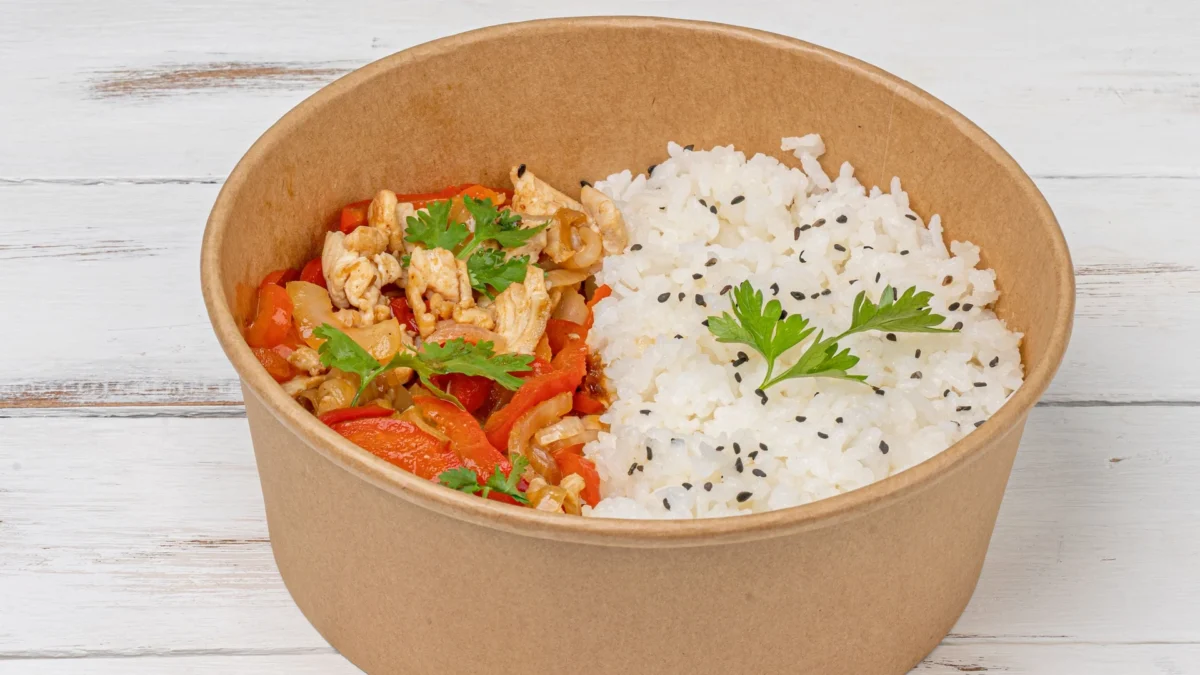
A specification reading “1,000 mL kraft paper bowl” gives nominal volume and a board description. The buyer also needs a working fill level with the lid fitted, the likely food temperature and oil exposure, the holding time, and how the closed bowl will be carried.
The design brief should give the converter five sets of inputs.
- Food and filling profile. Name the food, from soup and oily noodles to cold salad, and give the expected filling temperature and contact duration.
- Container geometry. Specify nominal and working volume, wall taper, bottom footprint, height, rim shape and allowable dimensional variation.
- Board construction. Specify paperboard type, basis weight, thickness, stiffness and the barrier or lining on each relevant surface.
- Closure system. Identify the lid part number and material, the rim interface, any venting need, and the required retention and removal behavior.
- Market and disposal pathway. Identify the destination market for food-contact documentation and the evidence needed for any recycling or composting claim.
These are connected variables. Changing the barrier coating may alter seal formation; changing stiffness may change rim rolling; and changing the rim tool can affect compatibility with a lid that fit the previous production lot.
How a converted paper bowl is formed
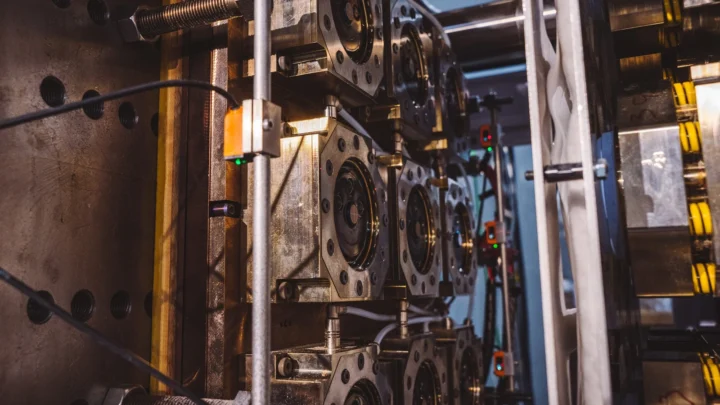
Equipment maker HQ Machinery describes a bowl-forming machine that takes pre-cut wall blanks, punches bottoms from a roll, seals the side and bottom, and has adjustable rim-rolling stations. This is one documented equipment layout. Confirm the sequence, tools and controls on the line that will make the specified bowl. [P7]
Bioleader, a manufacturer with a commercial relationship with Degradable Packaging, describes a paper bowl manufacturing workflow that starts with specifying the paperboard and barrier before forming the sidewall, sealing the base and curling the rim. The company says it pairs the finished bowl with a lid suited to the intended use.
1. Qualify the board and barrier construction
Paperboard provides shape and stiffness. A barrier layer can resist water or grease and can act as the joining layer in heat-sealable constructions. Two boards with the same printed color and basis weight may behave differently during converting.
Juho Bonifer, Panu Tanninen and Ville Leminen formed four coated boards into 250 mL paper cups in a 2024 study. They identified friction as the property most indicative of the defects seen in their trials. The boards also differed in mechanical properties and coating construction. For bowl qualification, check runnability on the proposed stock and tool combination before setting a coating specification. [P1]
2. Print and die-cut the wall blank
The converting line requires an accurately shaped sidewall blank. Printing and die-cutting may take place upstream of forming, depending on the plant arrangement. Poor registration, inconsistent blank dimensions, fiber dust or damaged coated edges can introduce later problems that final visual inspection alone may not fully identify.
Approve the blank against a controlled drawing. Check the intended seam overlap, where the print ends relative to the seam, and board orientation where it affects forming. If a drawing revision changes the rim or wall geometry, recheck the tooling and lid fit.
3. Form the wall and seal the side seam
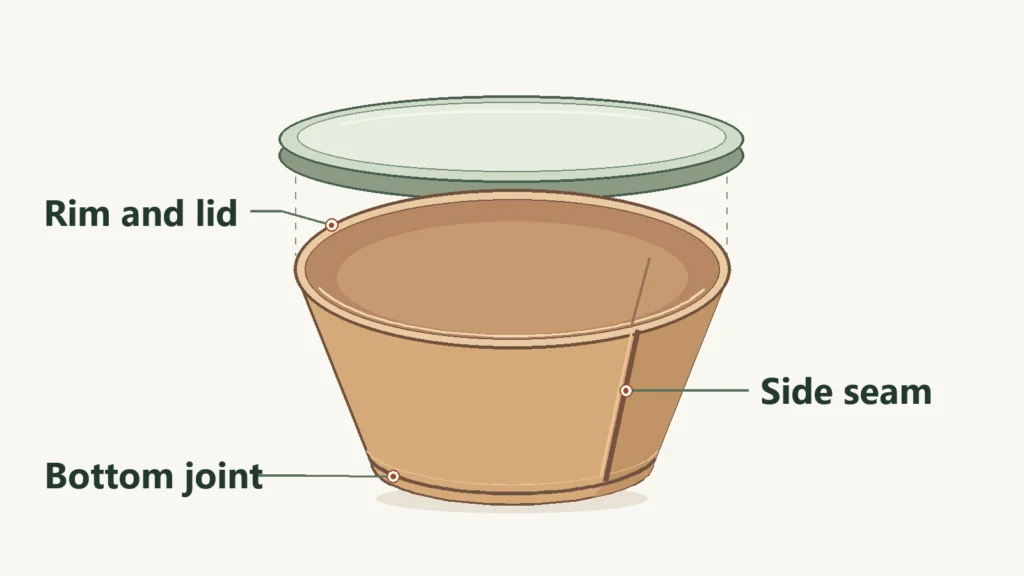
The blank wraps around a forming tool and the overlapping edges are joined. Heat and pressure or ultrasonic equipment may be used, depending on the board, coating and machine. Inspect how the joint holds up through bottom forming, rim finishing and use.
A side seam can open or buckle during later operations. In the 2024 cup trials, Bonifer and colleagues observed different defects after adjusting the side-seam position on the mandrel. In a separate study, Bonifer and colleagues compared hot-air and ultrasonic side sealing and measured seam strength on finished cups. Use the proposed bowl and coating to establish a suitable joining process and acceptance limits. [P1] [P3]
4. Insert, fold and secure the bottom
The bottom disc and sidewall have to form a continuous joint. In a common heat-sealed design, tooling folds the lower wall around the base edge and presses the layers together. Converters may call the pressing step knurling. Confirm the fold and sealing sequence for the selected bowl and machine.
Where the wall seam crosses the bottom fold, the tool has to close the joint through the overlapping layers. In the 2024 cup trials, Bonifer and colleagues documented a failure mode in which the wall seam opened during curling or knurling. Inspect the overlap where it passes through the base tooling and record heat, fold depth and pressure when testing the bowl on its own line. [P1]
Look for incomplete folds, gaps, wrinkles and uneven base seating. Follow the visual inspection with a filled-bowl test under the stated use conditions.
5. Finish the rim and verify lid engagement
The top edge is rolled, curled or otherwise finished to suit the bowl design. Its profile adds stiffness and gives a fitted lid a contact surface. In addition to nominal diameter, measure the curl profile and ovality, and check how variation across lots affects fit.
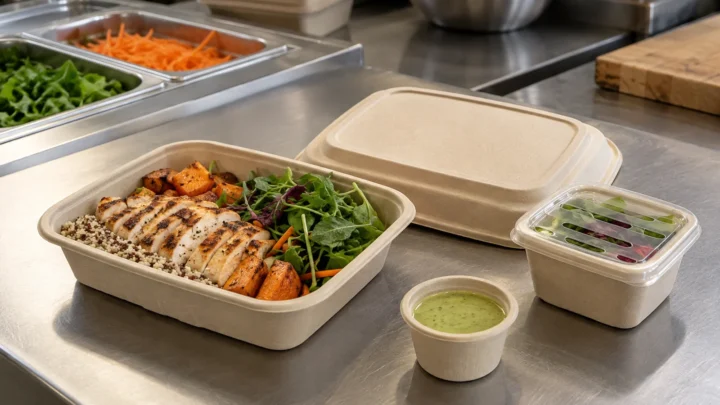
Test a production bowl with the exact lid part number intended for sale. A cold-salad trial might assess visibility and condensation. A hot-soup trial may also need to assess any designed vent, fit during cooling, and retention during handling. Confirm the lid’s documented use conditions before specifying it for a hot fill.
If the lid lifts during a tilt or transport test, measure both parts and check the fill level and handling conditions. Distinguish a leak through the lid interface from discharge through an intentional vent when setting acceptance criteria.
6. Inspect, separate defects and pack by traceable lot
Visual inspection can catch obvious cracks, printing defects, severe deformation and missing components. Record findings for appearance, dimensions, seal integrity and lid fit. Link the results to the material lot, line setup and disposition of rejected bowls.
Where to investigate forming defects
Use the location and timing of a defect to choose the first checks. Verify a suspected cause against the actual board and line.
| Observed problem | Possible starting points | Confirmation method |
|---|---|---|
| Leakage at the wall seam | Incomplete bonding, inconsistent overlap or damaged coating | Examine the overlap and confirm the leak location under the specified fill conditions. |
| Leakage at the bottom | Incomplete fold, uneven pressure, side-seam interference or a damaged base blank | Inspect the base section and run a controlled liquid-hold test. |
| Rim splitting or delamination | High forming strain, board conditioning or a rim profile unsuitable for the board | Inspect cross-sections and compare board condition and tooling setup across lots. |
| Lid lifts during handling | Rim ovality, mismatched lid, fill level or handling conditions | Measure the mating parts and repeat the retention test under the stated use conditions. |
| Bowl loses shape when filled | Low wall stiffness, poor support geometry, heat or moisture exposure | Measure deformation in the filled system after the specified hold time. |
| Surface stains or softens | Barrier construction, exposed edge or contact conditions | Locate the affected surface and repeat the exposure with the specified food and contact time. |
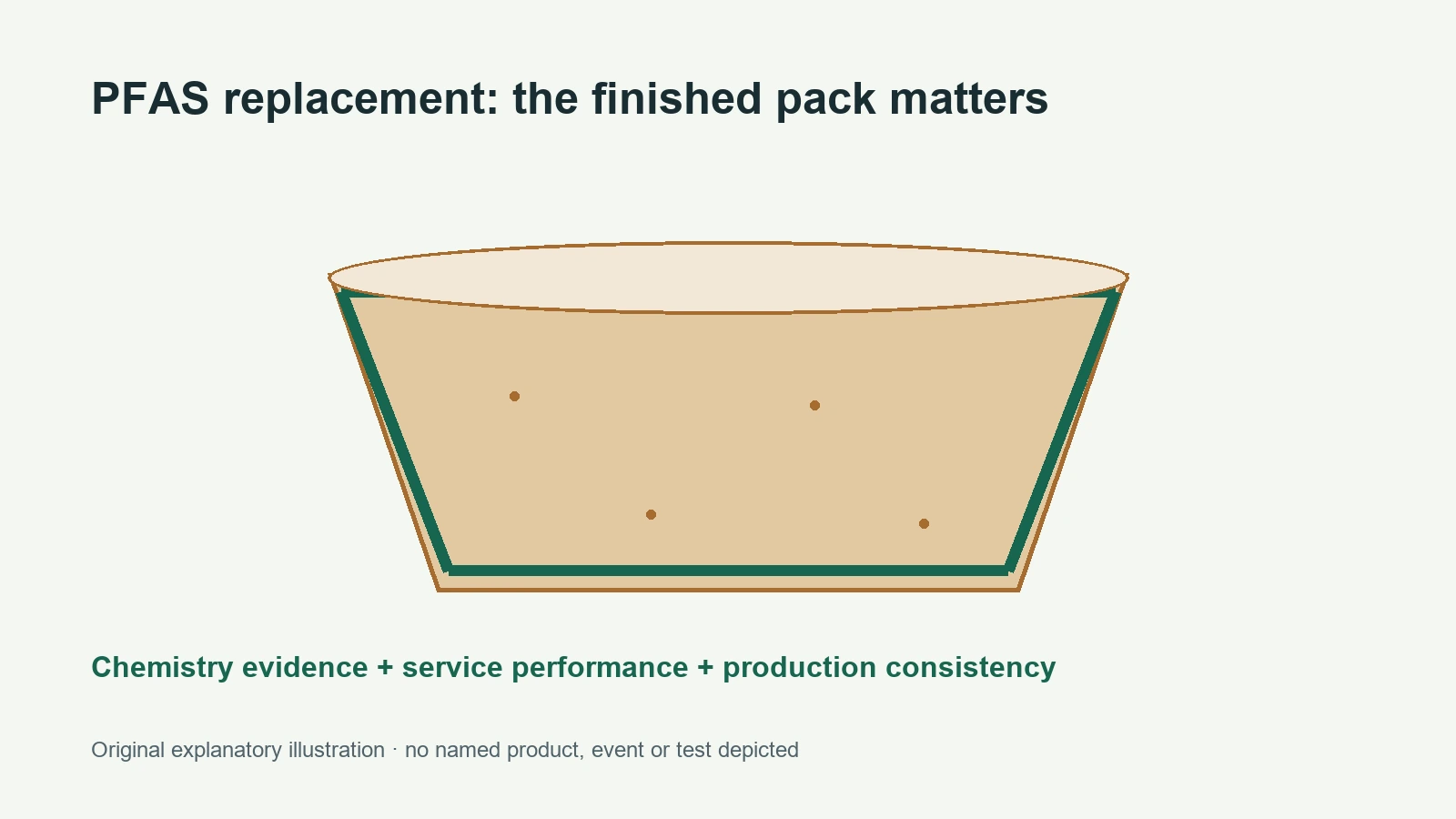
If a leak repeatedly starts where the wall seam crosses the base fold, compare a section through that point with a section from the opposite side of the bowl. The comparison helps distinguish a local fold or contact problem from weak sealing around the whole base. Retest the full bowl after any adjustment, since a setting change can alter another joint.
A qualification plan that tests the complete bowl-and-lid system
Agree on test conditions and pass limits before the converter makes production samples. Choose the fill, hold time and handling sequence from how the bowl will actually be used.
- Freeze the construction. Record the board, coating, thickness, print, bowl drawing, lid variant and any relevant additives.
- Define intended use. Specify food type, temperature, fill level, hold time and handling or delivery conditions.
- Agree on measurements. Set methods, sampling rules and pass limits for rim dimensions, sealing defects, deformation and leakage.
- Sample across the run. Include startup, stable-running and later-run samples and relevant material lots where feasible. Record how many bowls were tested at each point.
- Test the complete assembly. Fit the specified lid to the production bowl and include realistic closure, lifting, tilt and transport steps where they affect use.
- Record the decision. Keep the versioned drawing, test results, deviations, corrective actions and approved use conditions.
For a hot-soup order, use a room-temperature water hold to screen for obvious leaks. Confirm the final assembly using the intended temperature, fill level, hold time and handling profile before approving it for that service.
Why changing the coating can require new tooling settings
A barrier can limit liquid or grease penetration, slide against forming surfaces and provide the bond at a seam. Changing the board or coating can therefore change both forming behavior and service performance.
The cup trials identified friction-related defects during actual converting. When comparing a new barrier with an incumbent, record the line settings and check the finished seam, base and rim as well as the flat sheet’s barrier performance. [P1]
A cold-food bowl may be a practical first application for evaluating an alternative barrier, with its own grease, moisture, seam and lid tests. Keep geometry and service conditions comparable with those of the incumbent. Track any changes in line speed, tooling, board weight or inks as part of the trial. Qualify a hot-liquid application separately.
Food-contact documentation and recovery
Check food-contact documentation for the finished bowl, its matching lid and the intended market and use. The EU framework includes Regulation (EC) No 1935/2004 and the good manufacturing practice rules in Regulation (EC) No 2023/2006. Check the applicable EU and national measures for paper and board and any measures relevant to the other materials. In the United States, 21 CFR § 176.170 sets out conditions for certain components of paper and paperboard in contact with aqueous and fatty foods. Ask which provisions apply to the actual construction and what food types, times and temperatures the documentation covers. [P4] [P5]
Assess recovery using separate evidence for the finished construction and local collection and treatment routes. For a change of lining or coating, check what supports the proposed claim with the coating, inks, adhesives and lid in view. See how barrier performance and recycling evidence apply to different questions.
What procurement should request before approving production
Ask for the released bowl drawing and matched lid part number, the board and barrier specification, the intended-use conditions, the agreed defect and test plan, the applicable food-contact documentation and a production-lot identifier. If the supplier proposes a new lining or lighter board, repeat the checks affected by the change.
Approve the specified bowl-and-lid assembly when samples from the intended production process meet the agreed limits for that food and service. Retain the drawing and trial record so later lots can be checked on the same basis.
Sources
- [P1] Bonifer, Tanninen and Leminen (2024), Effect of material properties on the paper cup manufacturing process. DOI 10.15376/biores.19.4.8493-8511.
- [P3] Bonifer et al. (2026), Comparative evaluation of hot air and ultrasonic sealing in paper cup manufacturing. DOI 10.15376/biores.21.2.2796-2814.
- [P4] European Commission, Food Contact Materials legislation.
- [P5] Electronic Code of Federal Regulations, 21 CFR § 176.170.
- [P7] HQ Machinery, CM200 paper bowl forming machine documentation.
Found an error? Read our corrections policy and contact the editors.