
GSM in paper packaging means grams per square metre (g/m²). It describes the mass of a square metre of paper or paperboard, not its thickness. A 250 GSM board has a nominal grammage of 250 grams per square metre. That number helps packaging teams compare material specifications and estimate the paper used in a blank, but it does not establish whether the finished package is stiff enough, liquid-resistant, food-contact compliant or recyclable.
For a paper cup, folding carton or takeaway box, the most useful question is not simply “What GSM should I buy?” It is “Which sheet or layer does this GSM describe, and what other properties must the finished construction meet?” The distinction matters when comparing suppliers, coatings and manufacturing methods.
What does GSM mean in paper and paperboard?
GSM is the everyday abbreviation for grammage, or mass per unit area. The unit is g/m²: grams divided by square metres. Consider three hypothetical, uniformly made sheets, each measuring exactly one square metre:
| Stated grammage | Mass of 1 m² | What it tells you |
|---|---|---|
| 100 GSM | 100 g | Mass per unit area only |
| 250 GSM | 250 g | Mass per unit area only |
| 350 GSM | 350 g | Mass per unit area only |
The third sheet contains more mass per square metre than the first, but the numbers alone do not reveal fibre composition, caliper, moisture response, bending stiffness or coating performance. Two boards with identical GSM values can behave differently in creasing, folding and use.
In the United States, paper specifications may instead use basis weight in pounds per ream. That figure depends on the reference sheet size and the number of sheets defining the ream; it is not a universal pounds-to-GSM conversion. TAPPI’s description of T 410 explains this distinction. Ask for the exact basis-weight convention before comparing an American quotation with a specification in g/m².
How is GSM calculated?
The arithmetic is straightforward:
Grammage (g/m²) = sample mass (g) ÷ sample area (m²).
For a simple demonstration, imagine a flat rectangular specimen that measures 10 cm by 10 cm and weighs 2.50 g:
- Convert the dimensions to metres: 0.10 m × 0.10 m.
- Calculate the area: 0.0100 m².
- Divide the mass by the area: 2.50 g ÷ 0.0100 m² = 250 g/m².
This is a teaching example, not a report from a laboratory test. Actual grammage determination requires suitable sampling, cutting, weighing and conditioning practices. Small errors in specimen dimensions or mass can create significant errors when a small test piece is scaled to one square metre.
ISO 536:2019 is the published international standard for determining the grammage of paper and board; ISO confirmed this edition in 2025. The public ISO record establishes the standard’s title, scope and status, not every procedural detail in its full text. ISO 187:2022 addresses conditioning and testing atmospheres. Paper absorbs and releases moisture, so results obtained after different storage or conditioning histories may not be directly comparable.
For a purchase dispute or a formal quality-control result, use the agreed standard and edition, an appropriate sampling plan and a documented laboratory procedure rather than a kitchen-scale demonstration. A nominal GSM value on a quotation is not itself a certificate of test results.
GSM vs thickness: why 300 GSM does not mean 300 microns
Grammage answers “How much mass is spread over this area?” Thickness, also called caliper, answers “How far apart are the two surfaces under a defined measurement?” Thickness is commonly expressed in micrometres (µm) or millimetres (mm). For reference, 1 mm equals 1,000 µm.
The properties are connected through density and bulk, but they are not interchangeable. Fibre selection, refining, fillers, coating and compression during manufacture can affect how much thickness a board achieves at a given grammage.
| Property | Common unit | Question answered | What it does not prove |
|---|---|---|---|
| Grammage (GSM) | g/m² | How much sheet mass is present per unit area? | Exact thickness or strength |
| Caliper | µm or mm | How thick is the sheet under the stated method? | Strength, foldability or barrier quality |
| Apparent bulk | cm³/g | How much apparent sheet volume corresponds to a unit mass? | Finished-pack performance |
| Bending stiffness | Method-dependent | How strongly does a specimen resist bending in the tested direction? | Liquid barrier or product safety |
ISO 534:2011 covers measurement of paper and board thickness and calculations of apparent density and specific volume. Its public scope expressly excludes corrugated fibreboard; its stacked-sheet thickness method is also not suitable for board. Do not apply that standard to a completed corrugated box simply because its liners are made of paper.
What is paperboard bulk?
For a single sheet, a useful numerical relationship is apparent bulk (cm³/g) = thickness (µm) ÷ grammage (g/m²), provided both measurements describe the same material and are made on a consistent basis. This works because of the unit conversions involved.
Take an illustrative uncoated board with a grammage of 250 g/m² and measured thickness of 350 µm. Its calculated apparent bulk is 350 ÷ 250 = 1.40 cm³/g. If a different 250 GSM board measures 400 µm, its calculated bulk is 1.60 cm³/g. Both carry the same mass per unit area; the second is thicker in this hypothetical comparison.
That does not mean the thicker board will necessarily perform better in every carton. Crease design, fibre orientation, grade construction and actual stiffness testing still matter. A fixed GSM cannot be converted into a universal thickness in mm without an additional material property such as measured bulk or density.
Does a paper coating change the GSM?
Yes, a retained coating adds mass to the sheet. But a supplier’s single GSM number may refer to the base paper or to the finished coated structure. You cannot tell which without the specification.
For a development-stage example, see our report on starch grease barriers and heat-seal paper structures.
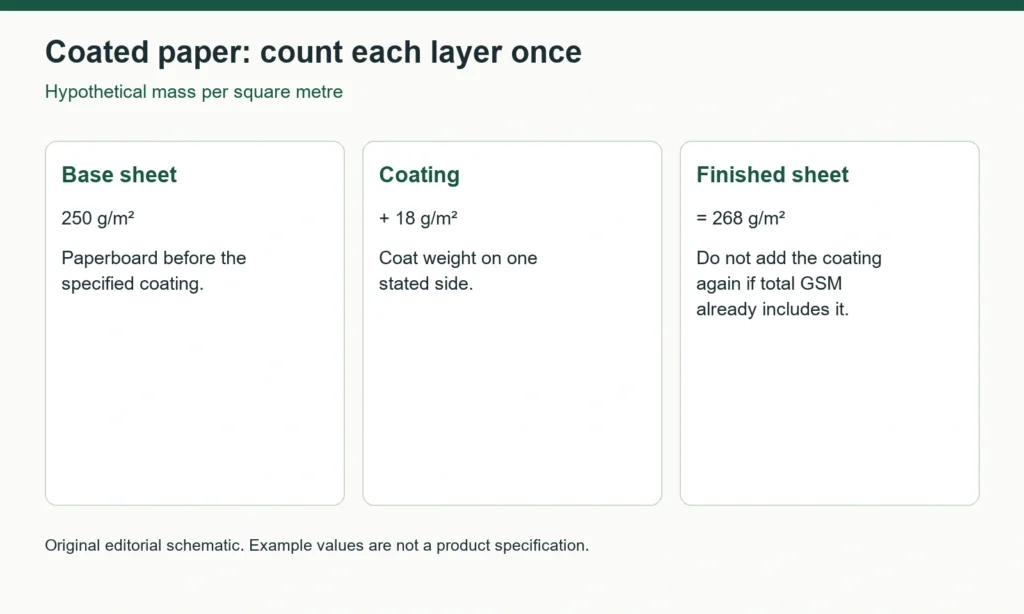
Consider the following entirely hypothetical one-sided barrier-coated paperboard:
| Component | Mass per area | Interpretation |
|---|---|---|
| Base paperboard | 250 g/m² | Substrate grammage before the specified barrier |
| Retained dry barrier layer | 18 g/m² | Additional dry coating on one side |
| Combined nominal structure | 268 g/m² | 250 + 18, assuming no other changes or added layers |
If another retained layer of 8 g/m² were added to the opposite side, the simplified total would be 276 g/m². Do not add it twice if a supplier already quotes the finished structure at 276 GSM. Conversely, if the original base-board figure already includes a mineral coating, the buyer must not count that layer again as a separate addition.
The distinction is particularly important with aqueous dispersions. The wet application weight includes liquid that may subsequently evaporate; the retained dry coat weight is the relevant added dry mass per area in this simplified calculation. Ask which value the supplier is reporting, along with its measurement basis and tolerances.
Grammage also does not reveal coating chemistry. PE extrusion coating, PLA coating, water-based barrier systems and other constructions may differ in sealing, moisture resistance and end-of-life compatibility even at the same total GSM. For any environmental claim, examine the complete structure and its relevant evidence rather than relying on a weight figure.
How to estimate the weight of a packaging blank from GSM
Grammage becomes useful for budgeting and material comparisons when you know the actual area being cut. The basic calculation is:
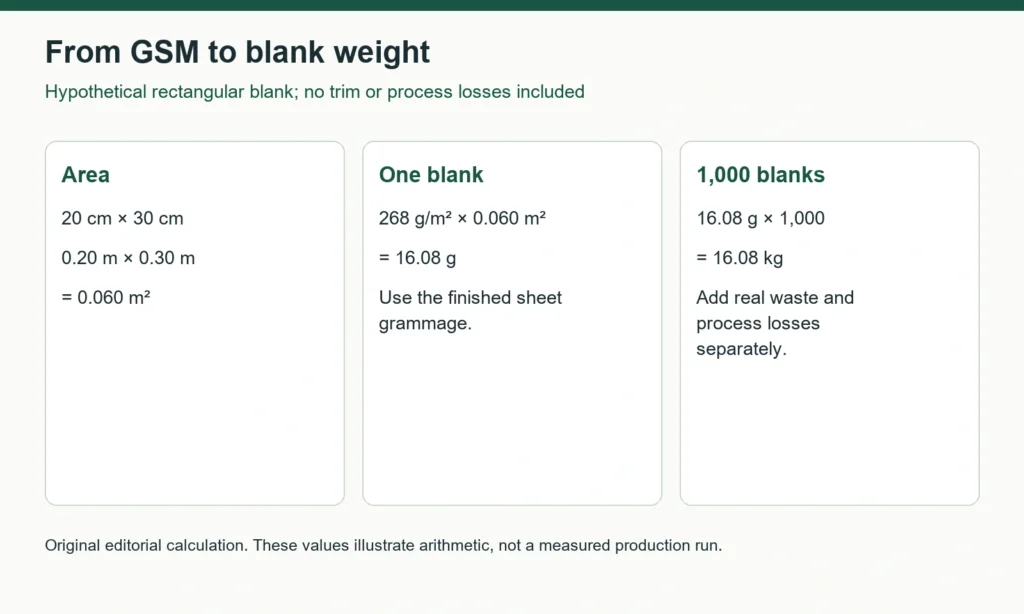
Blank mass (g) = grammage (g/m²) × blank area (m²).
Suppose a rectangular paperboard blank measures 20 cm × 30 cm. Its area is 0.20 m × 0.30 m = 0.060 m². At 250 GSM, its nominal sheet mass is 250 × 0.060 = 15.00 g.
If the same geometry is cut from the illustrative 268 GSM coated structure above, the nominal material mass becomes 268 × 0.060 = 16.08 g. For 1,000 such blanks, that is 16.08 kg of material contained in the blanks before adhesives, additional components or conversion losses.
| Sheet specification | Area per blank | Mass per blank | Mass in 1,000 blanks |
|---|---|---|---|
| 250 GSM base board | 0.060 m² | 15.00 g | 15.00 kg |
| 268 GSM finished coated sheet | 0.060 m² | 16.08 g | 16.08 kg |
Real blanks are not always simple rectangles. A cup sidewall may be shaped, a carton blank may include flaps and cut-outs, and a converter’s nesting layout may leave unused material between parts. Use the net dieline area to estimate material retained in the blank, then calculate input sheet demand separately using actual layout utilization and scrap records. Dividing by a utilization assumption may be useful for planning, but it does not replace production data.
Most importantly, blank mass is not finished-package mass. A completed paper cup can include a separate bottom disc, seam overlap and a lid; a folding carton can include glue, windows, labels or inserts. None is captured simply by multiplying sidewall GSM by its nominal external dimensions.
What does GSM tell you for different packaging formats?
The same metric appears throughout paper packaging, but the decisions it supports depend on how the package is built.
Paper cups and paper food containers
In cup specifications, distinguish the cup sidewall board, bottom board where applicable, and coatings. For a hot-drink or soup application, cup integrity depends on material construction, seams, rim forming, barrier integrity and conditions of use. A higher GSM figure alone does not establish leak resistance, a suitable temperature range or food-contact compliance.
Folding cartons and paperboard sleeves
GSM helps compare material mass, but caliper, grain direction, bending stiffness, scoring and print surface govern whether a particular carton converts and performs as designed. A change to another “equivalent GSM” grade can alter fold behaviour or panel rigidity. Confirm the new board on the actual dieline and equipment before substitution.
Kraft paper bags
For a bag, the relevant decisions include carrying load, tear resistance, bottom construction, handles, adhesives and moisture exposure. GSM should be read alongside the paper grade and relevant strength results, not used as a stand-alone load rating.
Corrugated shipping boxes
A corrugated board is a construction with liner and fluting components. Individual paper layers may have specified grammage, but the assembled board also depends on flute geometry, combination, bonding and test performance. A single “box GSM” number, without a clear definition, is inadequate for a stacking or transport decision. Also, ISO 534 does not cover the thickness of corrugated fibreboard.
| Format | Useful additional specifications | Performance to verify |
|---|---|---|
| Paper cup or soup container | Base board, layer construction, dry coat weight, bottom specification, dimensions | Sealing, leak resistance, intended food-contact use |
| Folding carton | Caliper, grade, machine/cross direction, crease design, print finish | Conversion, stiffness, closing and transit performance |
| Paper bag | Paper grade, ply count, handle and bottom construction | Tear and carrying performance in the intended conditions |
| Corrugated box | Liner/fluting specifications, flute profile, board combination | Compression and distribution performance |
How to read a GSM specification before ordering
An effective technical specification identifies the actual construction, the measurement basis and the performance requirements. For a coated paperboard component, a buyer might request the following records:
Our guide to reading a paper-cup barrier specification separates layer composition from finished-pack requirements.
- Exact sheet identity: material grade, producer and intended converting process; specify whether the GSM describes base board or the finished coated sheet.
- Grammage and tolerance: target g/m², agreed acceptance range, test method and edition, and how lots are sampled.
- Caliper and related characteristics: measured thickness, direction-dependent properties where relevant, and suitable tolerance.
- Coating breakdown: composition and side of application, retained dry coat weight or layer masses, and whether other coatings are already included in the stated GSM.
- Operating requirements: converting, sealing, barrier, print, use-temperature and transport tests matched to the finished package and its application.
- Evidence of environmental or food-contact claims: records for the exact finished construction and intended market, not assumptions derived from GSM.
If samples are weighed after different humidity exposures, first establish whether they were conditioned and tested on a comparable basis. If two suppliers quote 250 GSM and 250 g/m², the units are the same; if they quote “250 GSM paper” and “250 GSM coated board,” the included layers may not be.
Common GSM conversion and specification questions
Can I convert GSM directly into millimetres or points?
No. GSM is mass per area and millimetres measure thickness. If the specific board’s bulk or density is known, a calculated thickness can be estimated, but there is no universal GSM-to-mm conversion. Thickness in “points” or “mils” is normally a length convention, not a paper-weight conversion.
Does 300 GSM paper weigh 300 grams per sheet?
Only if the sheet covers exactly one square metre. A smaller 300 GSM sheet weighs proportionally less; calculate its area in square metres and multiply by 300. Actual weighed mass can vary with moisture, coatings and measurement conditions.
Is higher GSM always stronger or more environmentally preferable?
No. Greater grammage means more mass per unit area, but packaging strength depends on structure and the relevant test. Environmental performance also depends on the amount of material, protection of the packed product, manufacturing, distribution and actual recovery route. GSM alone does not establish recyclability, compostability or lower life-cycle impact.
For the end-of-life question, see how paper-cup recycling depends on the complete construction and collection route.
The practical decision
Use GSM to describe and calculate sheet mass. Use caliper and appropriate performance tests to assess what the package will do. For coated structures, confirm whether the stated grammage includes each retained layer. For a finished pack, validate the complete construction rather than treating one paper-weight number as a guarantee of quality, safety or environmental performance.
Sources / References
Found an error? Read our corrections policy and contact the editors.