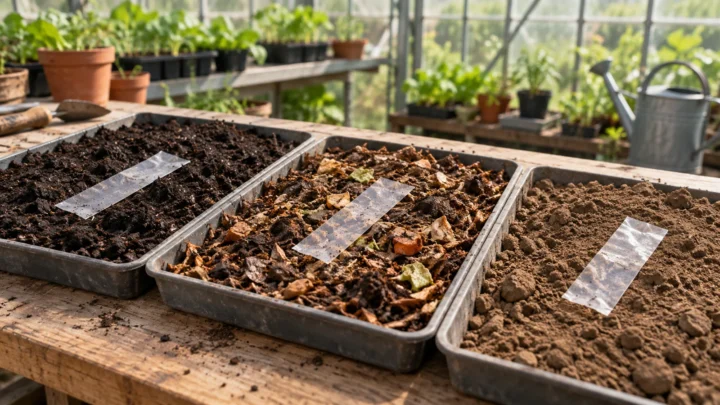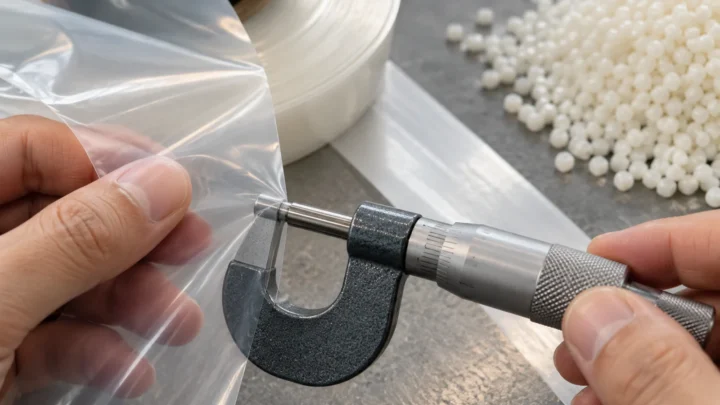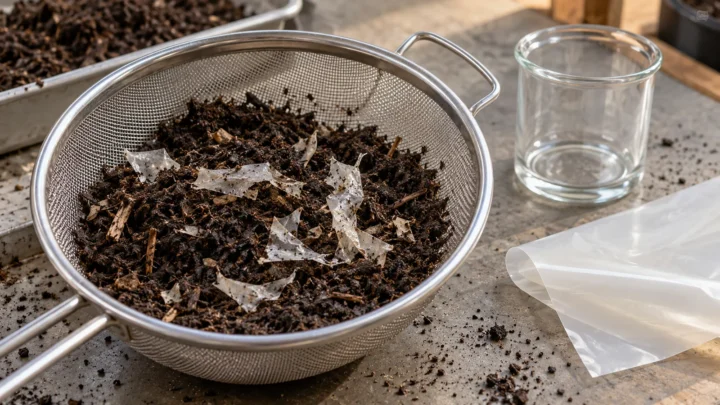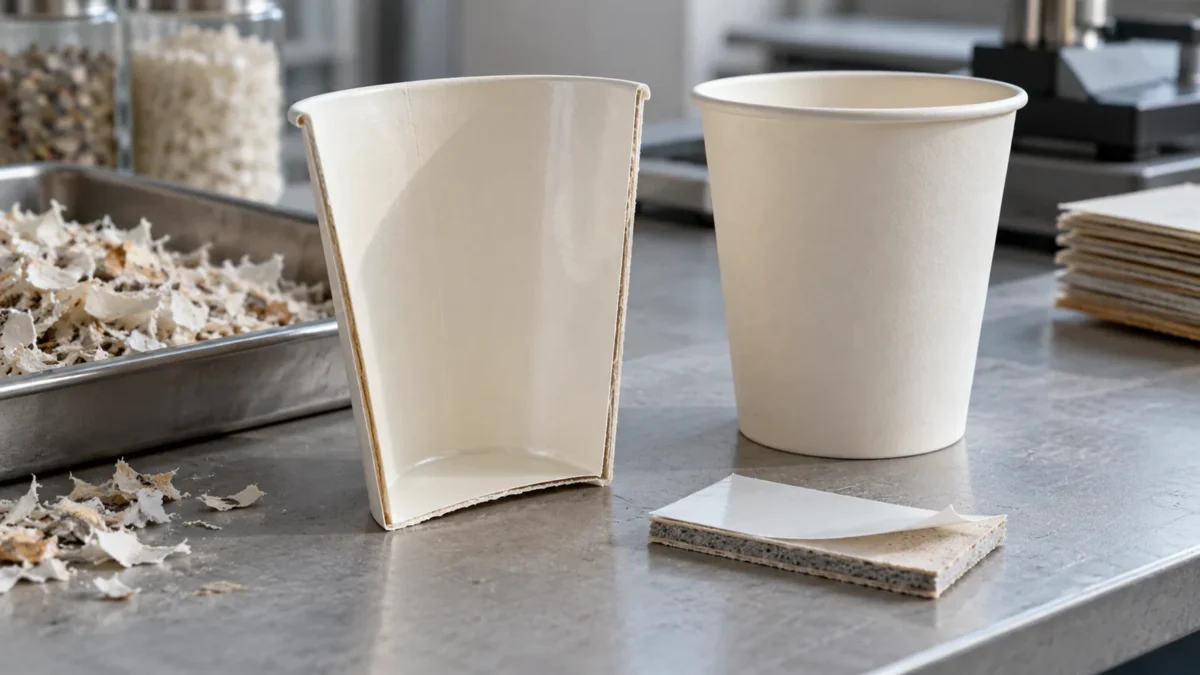
Short answer: Some paper cups can be recycled, but not every paper cup belongs in ordinary paper recycling. The cup’s coating, complete construction, collection route and receiving mill all matter. PE-lined cups can be processed in suitable paper-recycling systems that separate non-fibre material; PLA-lined cups need equally specific recovery instructions and should not be assumed to follow either standard paper recycling or composting. Water-based or aqueous coatings can improve repulpability in some formulations, but “water-based” by itself is not proof that a cup is recyclable or plastic-free.
The reason paper cups cause so much confusion is that the visible material and the functional material are different. Most of the cup may be paper fibre, while a much thinner barrier layer prevents liquid from soaking through. That layer is essential during use, but it changes what happens in a repulper and how the cup should be collected.
The useful question is therefore not simply “Is paper recyclable?” It is: Can this finished cup be collected, sorted and processed in the paper-recycling system available in the market where it is used?
This is the cup-specific application of the paper-packaging recycling evidence guide; barrier-specification coverage examines performance documentation.
Why a paper cup is not the same as an ordinary sheet of paper
A disposable paper cup has to hold hot or cold liquid without losing strength or leaking. The fibre board therefore needs a barrier. Common constructions use a thermoplastic layer such as polyethylene (PE), a biopolymer such as PLA, or a coating applied from an aqueous or “water-based” formulation.
That barrier can represent a relatively small share of the package by mass, but it can have a large effect on recycling. During paper recycling, the objective is to disperse and recover usable cellulose fibres while removing or managing non-fibre components such as films, adhesives, coatings, inks and other rejects.
Cepi’s current European laboratory method, Version 3 published in 2025, was designed to emulate key stages of a conventional paper mill: pulping, screening and sheet formation. Cepi states that the method can be used together with the 4evergreen Recyclability Evaluation Protocol to assess the technical recyclability of fibre-based packaging. [R1]
That distinction—technical recyclability—is important. A lab or mill can show that fibres are recoverable, but the cup still will not be recycled if it is not collected or sorted into a compatible stream.
Our recyclability evidence framework separates design tests from collection, sorting and operating recovery.
| Cup barrier | What it does during use | What matters in paper recycling | Do not assume |
|---|---|---|---|
| PE lining | Provides a continuous moisture barrier and heat-sealable layer. | The fibre must separate during pulping; PE film and other non-fibre material must be screened or otherwise removed and managed. | That “plastic-lined” means impossible to recycle—or that every kerbside system accepts it. |
| PLA lining | Can provide a polymer barrier while using a bio-based polyester. | The complete cup still needs a defined paper-recycling, composting or other recovery route; PLA remains a non-fibre component in a paper mill. | That bio-based or compostable resin makes the whole cup automatically compostable or recyclable. |
| Water-based / aqueous coating | Barrier chemistry is applied from a water-based formulation; compositions vary widely. | Repulpability, fibre yield, rejects, stickies and recycled-pulp quality depend on the actual formulation, coat weight and construction. | That “water-based” means plastic-free, fully dispersible or recyclable without testing. |
Editorial synthesis; qualitative comparisons are evidence questions, not measured product rankings. [R1] [R4] [R5]
How paper-cup recycling works
The recycling route is easier to understand when it is broken into stages.
1. Collection
The cup has to enter a recycling program that actually accepts it. This is a major constraint because paper-cup access differs by city, country and collection model.
In the United States, the Foodservice Packaging Institute reported in May 2026 that recycling access for both single-sided hot-drink and double-sided cold-drink paper cups had reached about 20% of the U.S. population. FPI says the estimate was compiled by Resource Recycling Systems from community program guidance and industry announcements. [R2] This is an industry-reported access estimate, not an official national recycling rate, and it does not mean that 20% of cups are actually recycled.
2. Sorting
Collected cups need to remain in or be directed to a suitable fibre stream. Dedicated collection can make this easier because cups are more consistent than mixed household paper and can be sent to mills that are prepared to process them.
The UK National Cup Recycling Scheme asks users to separate cups, lids and liquids. Its live page says it can support PE-lined, compostable, biodegradable and aqueous-lined cups by routing them to an appropriate recycling or composting facility. That is a scheme-specific service description, not proof that every lining enters the same paper mill. [R3]
3. Repulping
At the mill, the paper component is mixed with water and mechanically agitated so the fibre structure can disperse. A technically recyclable cup needs to release a useful amount of fibre under the process being assessed.
A 2026 review of paper-based food packaging with water-borne barrier coatings describes two fundamental repulpability questions: whether fibres can be dispersed and whether a sufficiently high material yield can be recovered. [R4]
4. Screening and cleaning
Films, flakes, stickies and other non-fibre materials may then need to be removed. The mill can use screens, cleaners, flotation or other process steps depending on the furnish and equipment.
This is where the coating design matters. A barrier that performs well in a cup but remains as difficult sticky material in the paper process can reduce runnability or fibre quality. A coating that releases cleanly or can be efficiently screened may be more compatible with the recycling process.
5. Recycled-fibre use
Recovered fibre has to be suitable for another paper or board product. A high fibre-release result alone does not establish that the recycled pulp has the required quality, nor that the non-fibre fraction has a useful destination.
The 4evergreen protocol makes a similar boundary explicit: its laboratory framework assesses technical recyclability in different paper-mill processes, while collection and sorting are outside the protocol itself. [R5]
Can PE-lined paper cups be recycled?
Yes, PE-lined paper cups can be recycled in suitable systems, but the PE layer changes the processing requirement.
PE is used because it forms an effective moisture barrier and is compatible with conventional cup-converting operations. During paper recycling, however, PE does not turn back into paper fibre. The objective is to recover the cellulose while separating the plastic fraction.
The 2026 BioResources review describes polyethylene-laminated paper as a conventional reference case in which the plastic layer can remain intact or form agglomerates during repulping, requiring physical separation from recovered fibre. [R4] This should not be read as “PE-lined cups cannot be recycled.” It means the recycling system has to be able to release the fibre and manage the plastic reject.
That is why dedicated cup systems can handle constructions that ordinary mixed-paper systems may exclude. The UK National Cup Recycling Scheme specifically lists PE-lined cups among the cup types it supports through dedicated collection and specialist processing. [R3]
The practical question is therefore mill compatibility and collection access, not the mere presence of PE.
Can PLA-lined paper cups be recycled?
PLA makes the answer more complicated because it can be associated with two different end-of-life narratives: paper recycling and industrial composting.
PLA is a polyester, not paper fibre. A cup intended for paper recycling needs a test and receiving process that can manage the exact non-fibre construction; the coating name alone does not establish fibre yield or reject behaviour.
At the same time, some finished PLA-containing cups can be certified for industrial composting. That does not mean every PLA-lined cup is compostable, and certification does not guarantee that the user has access to an accepting organics program.
The correct route should be established at finished-item level:
- Is the cup certified for industrial or home composting?
- Is the complete printed and converted cup covered by that certification?
- Does the local organics program accept it?
- If the intended route is paper recycling instead, has the cup been assessed for the relevant paper-mill process?
- Does the collection program accept that cup construction?
A PLA label is therefore not a disposal instruction.

Are water-based coated paper cups recyclable?
Potentially—but “water-based” is a formulation description, not a recycling certificate.
The term usually means the coating ingredients are applied in a water-borne formulation. That formulation can contain starch, polyvinyl alcohol, latex particles, rosin emulsions, modified bioplastics, minerals and other components. [R4] In other words, “water-based” does not necessarily mean “contains no polymer” or “plastic-free.”
A 2026 peer-reviewed review found that numerous water-borne coating formulations reported promising repulpability and fibre-recovery results. It also emphasized that chemistry has to be evaluated case by case and that fibre yield alone is not enough; stickies, rejects, recovered-fibre quality and process conditions matter. [R4]
Why some aqueous coatings can help
Some water-borne coatings are designed to redisperse, dissolve, fragment or release from fibre during repulping. That can reduce the amount of large film material that has to be screened out. Cellulose-derived coatings can be particularly compatible when they redisperse with the fibre network.
But the same review also notes that hydrophobic coatings, crosslinking and polymer components can create very different outcomes. Some systems require chemical assistance; others can generate stickies or reject material. Successful coating removal also does not automatically prove that the recovered fibres retain the same quality as uncoated paper. [R4]
Coat weight matters
The barrier layer has to be heavy enough to prevent leakage but light and compatible enough to avoid unnecessary loss in recycling. The 2026 review identifies coating thickness or mass per area as one factor affecting recovered-material yield: non-fibre coating that is removed from the pulp reduces the fraction recovered as usable paper material. [R4]
This creates a real engineering trade-off. A thinner coating is not automatically better if the cup leaks; a more robust barrier is not automatically better if it sharply reduces fibre recovery. Performance during use and performance during recycling have to be assessed together.
Water-based, PE and PLA are not three recycling grades
One of the easiest mistakes is to turn coating names into a simple ranking:
water-based = recyclable, PE = difficult, PLA = compostable.
That is too crude.
| What to verify | Why it matters |
|---|---|
| Complete construction | Base paper, barrier, coat weight, inks, adhesives and other components affect repulping and rejects. |
| Relevant mill process | A construction may work in a conventional mill, a deinking mill or a specialist fibre process differently. |
| Fibre yield | Shows how much useful fibre can be recovered rather than lost with rejects. |
| Rejects and stickies | Non-fibre material can affect equipment, process water and recycled-paper quality. |
| Collection and sorting | Technical repulpability has no practical value if the cup never reaches the compatible mill. |
| Alternative recovery route | A certified compostable construction may have a different intended route, but only where organics collection and facility acceptance exist. |
Editorial synthesis; qualitative comparisons are evidence questions, not measured product rankings. [R1] [R4] [R5]
The 4evergreen framework reflects this process-specific approach by evaluating fibre-based packaging against different recycling-mill scenarios rather than assigning recyclability from a material name alone. [R5]
What does “repulpable” actually prove?
Repulpability is an important piece of evidence, but it is not the same as full recyclability in the marketplace.
Cepi’s Version 3 laboratory method tests relevant parts of the paper-recycling process, and 4evergreen uses those outputs in a broader technical recyclability evaluation. [R1] A good assessment can show how the finished paper-based package behaves during pulping, screening and sheet formation.
But a technically strong lab result does not establish:
- that the local authority collects the cup;
- that a sorting facility sends it to a compatible mill;
- that every mill accepts the same construction;
- that the item is recycled at a high national rate;
- that the package may carry an unqualified recyclable marketing claim in every jurisdiction.
For U.S. marketing, the FTC Green Guides add a separate access question. The current Guides say recyclable claims should be qualified when appropriate facilities are not available to at least 60% of consumers or communities where the item is sold. [R6] That is a U.S. marketing-guidance threshold, not a technical paper-recycling standard.
Why paper-cup recycling varies so much by location
Paper cups sit between high-value fibre and a foodservice waste stream. Their collection environment can include liquid residue, lids, sleeves, straws and mixed waste. The economics also depend on having enough cup material to justify separate collection or specialist processing.
This explains why two statements can both be true:
- paper cups are technically recyclable in suitable paper-recycling processes; and
- your local kerbside program may tell you not to put them in the paper bin.
In the U.S., FPI’s 2026 access estimate of 20% illustrates that acceptance is growing but remains far from universal. [R2] In the UK, the existence of a national dedicated cup scheme similarly shows that specialist collection can solve a problem that ordinary mixed-paper collection does not always address. [R3]
For the end user, the local program’s current instruction should take priority over a generic material claim.
Should lids, sleeves and liquids stay with the cup?
Usually, a dedicated cup-recycling program wants the cup separated from obvious contaminants and other materials. The UK National Cup Recycling Scheme instructs users to separate cups, lids and liquids before collection. [R3]
That does not create a universal rule for every recycling system. Some collection programs may specify different preparation. The broader point is that a paper cup is a multi-component package, and the collection specification should say what happens to each component.
| Component | Question for recovery |
|---|---|
| Cup body | What paper grade, coating and coat weight are used, and is the finished construction repulpable in the relevant process? |
| Lid | Is it fibre, PP, PET, PLA or another material, and does the collection program want it attached or separated? |
| Sleeve | Can it remain with the fibre stream, or should it be separated for a different paper grade? |
| Ink and print | Do they affect deinking, stickies, food-contact or compostability requirements? |
| Residue | Does liquid or food contamination exceed what the receiving program can handle? |
Editorial synthesis; qualitative comparisons are evidence questions, not measured product rankings. [R3] [R4]
How should buyers compare PE, PLA and water-based cups?
A useful procurement comparison should ask for evidence, not a coating slogan.
- Identify the complete structure. Ask for base-paper grammage, barrier chemistry, coat weight, print and accessory materials.
- Define the intended recovery route. Paper recycling, industrial composting or another route should be chosen for the actual market—not after the cup is already designed.
- Request relevant recyclability evidence. For paper recycling, look for a current test or assessment matched to the relevant mill process.
- Check collection access. Confirm whether the target customer or venue can actually place the cup into that stream.
- Check receiving-operator acceptance. A technical test and an operator’s acceptance policy answer different questions.
- Keep marketing claims within the evidence. “Recyclable,” “compostable,” “plastic-free” and similar claims each require their own support.
For a water-based coating, request the actual formulation category and test result rather than relying on the phrase “aqueous barrier.” For PLA, verify the finished-item route rather than assuming the resin’s industrial-composting potential applies to the cup. For PE, verify fibre recovery and the mill’s ability to separate and manage the polymer fraction.
Five common paper-cup recycling mistakes
- “Paper cups are just paper.” The barrier and other components change how the finished cup behaves in recycling.
- “Plastic-lined cups cannot be recycled.” Suitable mills and dedicated collection systems can recover fibre from many lined cups, but access is not universal.
- “Water-based means plastic-free and recyclable.” Water describes the coating application medium; the chemistry and repulping result still need to be checked.
- “PLA-lined means compost bin.” The complete item needs the relevant certification and a local accepting organics route.
- “A repulpability test proves the cup is recycled in practice.” Collection, sorting, mill acceptance and market access remain separate stages.
What evidence should support a recyclable paper-cup claim?
| Evidence | What it should identify | What it still may not prove |
|---|---|---|
| Construction specification | Paper grade, coating chemistry, coat weight, printing, adhesives and components. | Actual recycling performance. |
| Laboratory recyclability test | Method/version, specimen, pulping, screening, fibre yield, rejects/stickies and relevant output quality. | Local collection or sorting access. |
| Mill or recycler acceptance | Named process, geography and accepted construction. | Consumer access outside that service area. |
| Collection-program acceptance | Current instructions for the target market and whether dedicated collection is required. | That every collected cup becomes a new product. |
| Marketing-claim review | Applicable jurisdiction, consumer access and required qualification. | A universal global claim. |
Editorial synthesis; qualitative comparisons are evidence questions, not measured product rankings. [R1] [R3] [R5] [R6]
Methodology and editorial note
This article is an editorial synthesis of current paper-industry methods, recycling-program information, U.S. marketing guidance and peer-reviewed technical literature. It does not present an original repulpability test, mill trial or municipal-acceptance survey. Technical recyclability is kept separate from collection, sorting and actual recycling. Industry-association access figures are attributed as such rather than treated as official national recycling rates.
Sources checked 17 October 2026. The main image is an AI-generated editorial illustration; the explanatory figure is an original editorial diagram. Neither is a photograph of an identified product or facility, a laboratory result or an independent environmental assessment.
Official sources and reference notes
- [R1] Cepi. Cepi Recyclability Test Method Version 3. February 2025 / Version 3. Public method overview: conventional process, pulping, screening, sheet formation, use with 4evergreen protocol. Relevant public text checked; see the stated scope. Accessed 17 October 2026.
- [R2] Foodservice Packaging Institute. Recycling Access Reaches 20% of U.S. Population for Paper Cups, Marking Major Progress. 8 May 2026. FPI/RRS-reported 20% U.S. population access for recycling both single-sided hot and double-sided cold paper cups. Relevant public text checked; see the stated scope. Accessed 17 October 2026.
- [R3] National Cup Recycling Scheme (UK). How to recycle paper cups. Live public source, checked 17 October 2026. Current scheme page: separate cups, lids and liquids; PE-lined, compostable, biodegradable and aqueous-lined cups routed to the appropriate recycling or composting facility. Relevant public text checked; see the stated scope. Accessed 17 October 2026.
- [R4] Umeileka, C. C. & Hubbe, M. A. Repulpability and biodegradability of paper-based packaging products with water-borne barrier coatings: A review. BioResources 21(4), 2026; DOI 10.15376/biores.21.4.Umeileka. Water-borne coating definitions; PE reference construction; repulpability, dispersibility, yield and coating-related process limitations. Relevant public text checked; see the stated scope. Accessed 17 October 2026.
- [R5] 4evergreen. Recyclability Evaluation Protocol. Version 1, January 2025 framework / current published protocol page. Technical recyclability assessment across conventional, flotation-deinking and specialised paper-mill processes; collection/sorting are separate from technical protocol. Relevant public text checked; see the stated scope. Accessed 17 October 2026.
- [R6] U.S. FTC. Environmental Claims: Summary of the Green Guides. Live public source, checked 17 October 2026. U.S. recyclable-claim access qualification; 60% substantial-majority threshold in current Guides. Relevant public text checked; see the stated scope. Accessed 17 October 2026.
The public corrections channel is currently inactive. Read our corrections policy.