“Food grade” usually means a material or product is represented as suitable for an intended food-related use. It is a common commercial expression, but it is not one universal approval, one test or one worldwide certification. To judge a container, coating or utensil properly, ask what it will contact, for how long, at what temperature and under which country’s requirements.
A bottle suitable for room-temperature water may not be suitable for microwave reheating. A packaging component allowed for one kind of food may have restrictions for another. The phrase “food grade” is therefore a starting point—not the evidence file. For a material-specific example, see polypropylene food-contact suitability.
Food grade, food safe and food-contact compliant: what is the difference?
| Term | What people commonly mean | What it does not prove |
|---|---|---|
| Food grade | Marketed or specified for a particular food-related application | Universal suitability or a single international certification |
| Food safe | Considered suitable for specified contact with food | Safety under every temperature, food type or duration |
| Food-contact compliant | Conformity with identified jurisdictional rules for a defined intended use | Automatic compliance in other countries or uses |
| Microwave safe | Intended for specified microwave heating conditions | That every food-contact article made from the same polymer is microwave-safe |
| BPA-free / PFAS-free / compostable | A claim about a named chemical attribute or end-of-life property | Complete food-contact suitability by itself |
These expressions appear on packaging, sales pages and specification sheets, but their precision varies. For a technical or procurement decision, a claim should identify the finished construction, the intended use and the supporting documentation.
What makes a material suitable for contact with food?
Food-contact evaluation is not limited to the visible surface. A finished article can include base resin or fiber, additives, colorants, coatings, inks, adhesives and processing aids. What matters is whether substances that may migrate into food are permitted or otherwise meet the applicable safety and compliance requirements for their actual use.
The U.S. FDA consumer explanation includes packaging components and substances used on packaging surfaces within the food-contact system. Its separate regulatory-status guidance explains that the compliance of an article depends on the status of the relevant constituent substances and their authorized conditions.
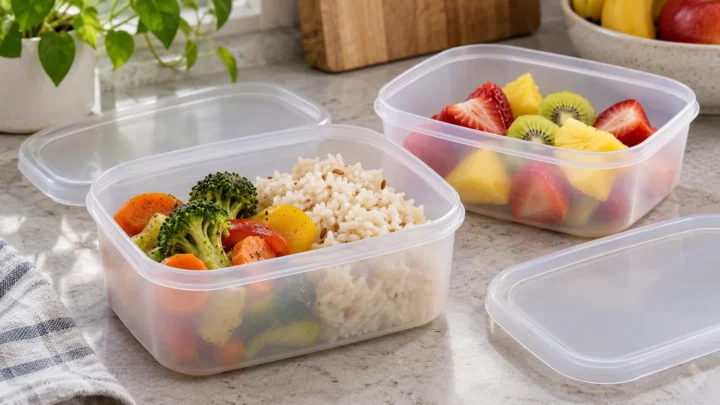
This is why the word “food-grade plastic” on a sales page is too broad to tell you whether a specific finished tub is suitable for hot soup or prolonged contact with fatty food.
What does “FDA food grade” mean in the United States?
“FDA food grade” is widespread shorthand, but FDA food-contact rules are more specific. Depending on the material, substance and intended use, the relevant regulatory route may involve an applicable rule in Title 21 of the Code of Federal Regulations, an effective Food Contact Substance Notification (FCN), qualifying generally recognized as safe (GRAS) status, a prior sanction, a threshold-of-regulation exemption or another legally recognized basis.
These routes do not mean that every finished container goes through an individual FDA product approval. The FDA’s “Is It Really FDA Approved?” guidance distinguishes products and substances that require premarket review from those that do not. A seller should describe the actual basis for its claim, not imply that the agency endorsed a particular brand of cup or plate.
An FCN also has a specific scope. As the FDA explains, an effective notification is tied to the identified manufacturer, substance and conditions of use; it is not automatically transferable to every other manufacturer’s nominally identical substance. Our guide to FDA notification scope and supplier identity explains that distinction further.
What does food-contact compliance mean in the European Union?
The EU has a separate regulatory system. The European Commission’s food-contact legislation overview identifies Regulation (EC) No 1935/2004 as the general framework for food contact materials, supported by good manufacturing practice requirements in Regulation (EC) No 2023/2006. Article 3 of the framework addresses migration that could endanger health or cause unacceptable changes to food composition or deterioration of taste or odor.
Some groups, notably plastics, have more detailed harmonized measures. The European Commission lists Regulation (EU) No 10/2011 and its subsequent amendments for plastic food-contact articles, including composition restrictions, migration assessment and applicable compliance documentation. Article 15 and Annex IV of the plastics regulation govern the written declaration at marketing stages other than retail; Article 16 addresses supporting documents for competent authorities. Other materials can also be subject to national measures where harmonized EU rules do not cover every detail.
As a result, a U.S. statement does not establish EU compliance, and an EU declaration does not automatically demonstrate conformity with U.S. requirements. The finished article and the specific market both matter. Read the EU plastics declaration and intended-use evidence together.
Can a product be food grade but not microwave safe?
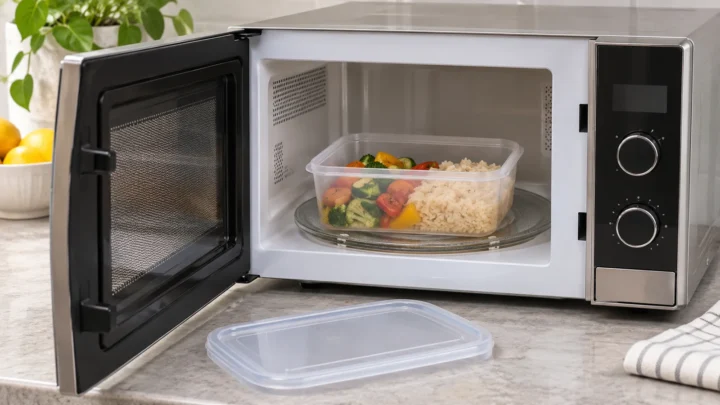
Yes. A container can be suitable for cold food or room-temperature storage while being unsuitable for microwave use. Heating changes the conditions of contact and can affect material integrity or chemical migration.
The FDA groups food-contact applications by types of food and conditions of use, including refrigerated storage, hot filling and reheating food in the container. Those conditions are not interchangeable. Always check the specific container’s microwave instructions rather than relying on a “food grade” claim. For paper plates, see our microwave-use guide.
Is food-grade plastic safe for all foods?
No single plastic type offers a blanket answer. PP, PET, PE and other polymers occur in different formulations and finished products. Temperature, contact duration, food composition and additive packages can change the appropriate conditions. A plastic container suitable for cold beverages does not automatically qualify for hot oil or repeated microwave heating.
The same principle applies to food-contact paper, coated fiber products, glass, metal and silicone. Each may be appropriate for some uses, while restrictions apply to others. Use a product-specific statement supported by the relevant legal and technical record.
Is recycled or biodegradable packaging automatically food grade?
No. “Recycled” describes the origin of material feedstock. “Biodegradable” describes potential behavior at the end of life. Neither states whether the finished item complies with food-contact requirements for an intended use. As discussed in our PCR, PIR and recycled-content guide, recycled feedstocks may require additional control of input quality and processing, while biodegradable packaging may need assessment of all additives and coatings.
These are independent questions: a material’s environmental profile cannot replace a food-contact assessment, and compliance for food contact does not demonstrate recyclability or compostability.
How can you check a food-grade claim?
For personal use, begin with the label or manufacturer’s published instructions. If the item is unlabeled or its intended use is unclear, choose one designed explicitly for your task. For sourcing and technical review, request documentation specific to the finished article and market.
- Name the jurisdiction. U.S., EU and other markets use different regulatory frameworks.
- Specify the food. Dry, aqueous, acidic and fatty foods may present different contact conditions.
- Specify time and temperature. Cold storage, hot filling, reheating and long-term storage are not the same use.
- Identify the whole construction. Review the contact layer, coatings, adhesives, printing and other relevant components.
- Request the appropriate evidence. Depending on the market and material, this could include a declaration, relevant test report, authorization references and supporting formulation or migration information.
- Confirm that the evidence covers your version. Test reports for a different coating, thickness or production configuration may not support the finished article being purchased.
A certificate or supplier declaration is useful only to the extent that its issuer, product scope, validity and actual supporting evidence match the claim. There is no single piece of paperwork that universally authorizes every food-contact product worldwide.
Questions people frequently ask
Does “food grade” mean the item is edible?
No. It refers to suitability for a food-related function, not to whether the container itself is intended to be eaten.
Does “food grade” mean BPA-free?
No. A food-contact claim and a “BPA-free” claim describe different attributes. Neither can be inferred from the other without product-specific information.
What is a food-contact declaration?
It is a document making defined compliance statements about an article under a specified regulatory framework. The required form and availability depend on the jurisdiction and material. In the EU, plastic food-contact materials have specific documentation requirements described by the European Commission; those requirements should not be assumed identical for every material group.
The takeaway
Food grade is not a permission slip for every kind of food contact. The useful question is whether the finished product is appropriate—and compliant where required—for a specific food, temperature, duration and market. That is what turns a broad label into a meaningful food-contact decision.
Sources
Sources checked 7 November 2026. This is an editorial explanation, not a product test or certification.
- FDA — Food Packaging and Other Substances: Information for Consumers. Food contact substances and packaging components; authorization for intended use.
- FDA — Determining the Regulatory Status of Components of a Food Contact Material. Regulatory routes including GRAS; manufacturer/substance/use scope of an FCN.
- FDA — Food Types & Conditions of Use. Tables 1 and 2; food types, storage and reheating.
- European Commission — Food Contact Materials: Legislation. General legislation, plastics, amendments and national measures.
- FDA — Is It Really FDA Approved?. Food additives and packaging: authorization versus general product endorsement.
- Regulation (EC) No 1935/2004 — consolidated 27 March 2021. Articles 1, 3, 6, 16–17; finished articles, general requirements and national measures.
- Regulation (EC) No 2023/2006 — consolidated 16 March 2025. Articles 1–7; scope, quality assurance, quality control and documentation.
- Regulation (EU) No 10/2011 — consolidated 14 July 2026. Articles 2, 15–16 and Annex IV; plastics scope and documentation. Read with later applicable amendments; consolidation is a documentation aid.
- Commission Regulation (EU) 2026/2412. Later Annex I amendment checked separately, including Article 2 entry-into-force wording. No SKU/substance authorization verdict is made here.
Found an error? Read our corrections policy and contact the editors.