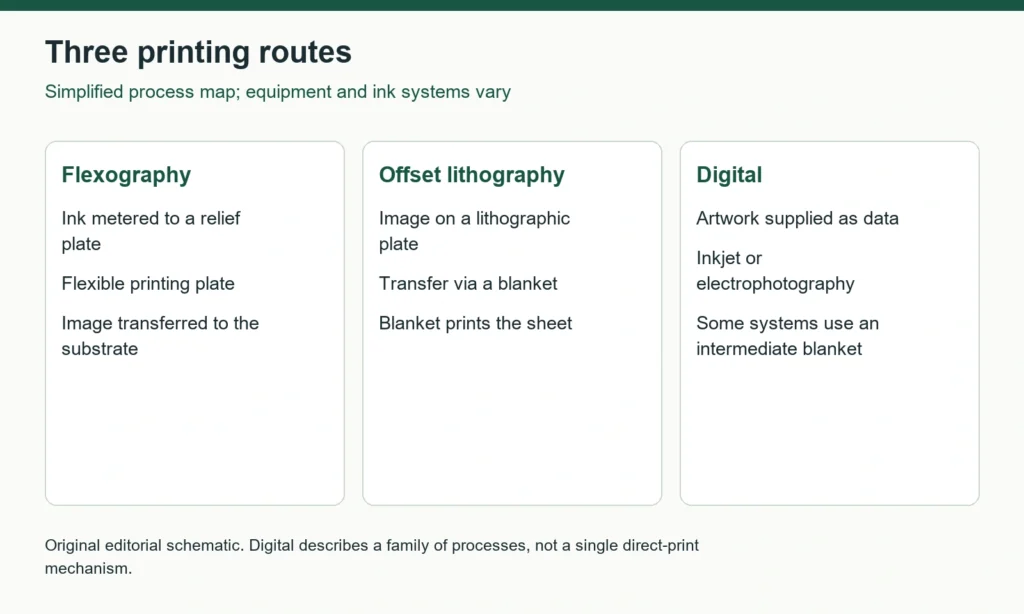
Flexographic, offset lithographic and digital printing can all produce retail-ready packaging, but they solve different production problems. Flexography uses raised, flexible printing plates and is widely used for continuous production on films, labels, bags and corrugated board. Offset lithography transfers an image from a plate through a blanket and is a well-established route for detailed graphics on suitable paper and folding cartonboard. Digital printing makes each image from electronic data without a conventional, job-specific press plate, which can be useful for short runs, rapid artwork changes and multiple package versions.
For a packaging buyer, the choice is not simply “which produces the best print?” It is which process can reproduce the approved artwork on the actual substrate, at the required volume and change frequency, with acceptable food-contact and end-of-life evidence? A process comparison made without the package construction, finishing route and quotation assumptions can be misleading.
Flexo vs offset vs digital printing: the practical differences
| Decision factor | Flexographic (flexo) | Offset lithographic | Digital |
|---|---|---|---|
| How the image is formed | Raised image on a flexible plate; ink commonly metered by an anilox roller | Planographic plate; image transferred via a rubber blanket | Variable image made electronically, such as by inkjet or electrophotography |
| Conventional job-specific plates | Yes | Yes | No |
| Common packaging applications | Roll-fed labels, flexible film, paper bags, corrugated and some cartonboard | Folding cartons, printed paperboard sheets, some labels and litho-laminated graphics | Short-run labels, cartons, certain films and corrugated applications, often with many versions |
| Artwork changes | May require new plates and prepress work | May require new plates and prepress work | Usually a new approved digital file and workflow setup, without new conventional plates |
| Economics to investigate | Plate, mounting and make-ready costs spread over repeat production | Plate and press make-ready costs spread over saleable sheets | Lower conventional plate burden; click, ink, substrate and finishing charges still apply |
| Critical qualification | Screening, dot gain, substrate handling, inks and registration | Board suitability, sheet handling, colour control and finishing | Approved substrate, press format, colour gamut, durability and downstream converting |
These distinctions follow the process descriptions and practical considerations published by packaging-prepress supplier Esko and equipment manufacturer HEIDELBERG. They do not establish which press will win a particular tender. A modern flexo line can reproduce complex images; a digital press can run production jobs; and offset is not automatically too expensive for every short order. Test the actual job instead of treating these as fixed rules.
How each printing process works
Flexographic printing: flexible plates and controlled ink transfer
In flexography, the printable parts of a flexible plate stand above the non-printing areas. The plate is mounted on a cylinder. An anilox roller meters ink, which is transferred to the raised image and then to the moving packaging material. The press can be configured for web-fed film or labels, among other formats, while sheet-fed flexo systems are also used in corrugated converting.
The plate, ink, drying or curing system and substrate work as a unit. Water-based, solvent-based and energy-curable inks may be found in different applications; no one ink chemistry describes all flexography. On an uncoated paper bag, ink holdout and absorption matter. On a plastic film, surface energy, primer requirements, adhesion, drying and any later lamination matter. A promising print sample is not enough if the printed web will fail during sealing or conversion.
Flexo prepress also has process-specific challenges. Plate deformation on the cylinder, highlight-dot reproduction, tonal gain and fine reversed text can affect the result. Modern screening, plates and press control can address many of these limitations, but they do not remove the need to approve a real production proof. The correct artwork limits should come from the selected converter and press rather than a universal minimum-font-size rule.
Offset lithography: plate to blanket to paperboard
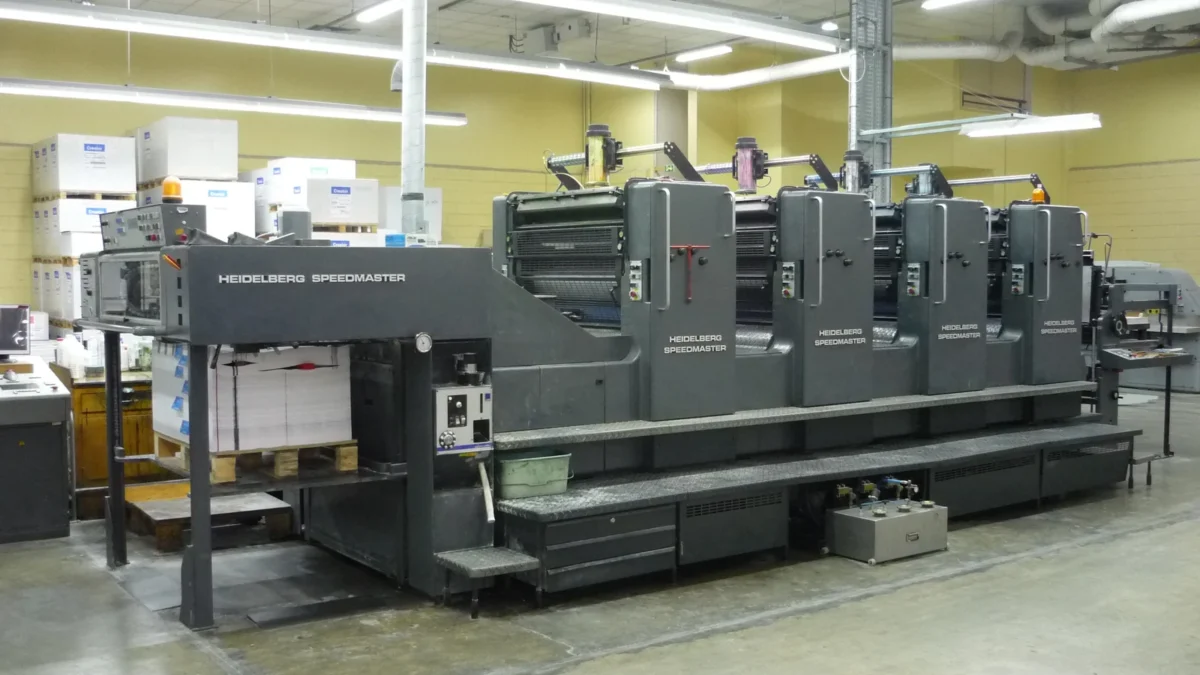
Conventional offset lithography uses a printing plate whose image and non-image areas behave differently toward ink and, in typical dampened lithography, a fountain solution. The inked image transfers first to a rubber blanket and then to the sheet. Sheet-fed offset is an established choice for printed folding cartons, sleeves, labels and other suitable paperboard work.
Its strengths can include fine artwork, detailed images and repeatable printing on appropriately prepared smooth stock. But coated and uncoated boards behave differently; a stiff or thick substrate must fit the press’s sheet-handling and delivery specifications. Carton quality also depends on coatings, drying or curing, die-cutting, creasing and folding-gluing. The printing press does not independently determine the finished pack’s performance.
Do not confuse offset lithography with dry offset used for decoration of formed containers. The latter is a distinct application family often used to print onto plastic cups, tubs and lids. A converter may use offset lithography on paperboard sheets before forming, while a different supplier prints a formed cup using dry offset. An inquiry that merely says “offset printed cups” is incomplete: ask what substrate is printed and at what manufacturing stage. Container maker PFF Group gives a documented example of dry-offset decoration on thermoformed or injection-moulded containers.
Digital printing: variable images without conventional job plates
Digital printing is an umbrella term, not one ink or transfer method. Industrial inkjet deposits an image from digitally controlled printheads. Electrophotographic systems form images electrically; some use toner and others use liquid inks. For example, HP describes its Indigo liquid electrophotographic process as using a photo-imaging surface and heated blanket to transfer ink to the media. The presence of a blanket in that digital process does not make it conventional offset lithography.
Because there are no conventional job-specific printing plates to replace for every design, digital is attractive when a brand needs a test market, regional language variants, changing promotional artwork or serialized content. It is not automatically ready for any film, paperboard or cup. Available sheet or web widths, primers, image durability, ink or toner compatibility, colour capabilities, registration to die-cutting and converting constraints vary substantially by press.
Which process fits the packaging format?
The package’s physical form can rule out options before quantity is considered. The table below gives practical starting points for a quotation—not a substitute for press trials and material qualification.
For paper and board specifications, use our GSM, thickness and sheet-weight guide alongside the printing brief.
| Packaging job | Processes worth evaluating | First technical question |
|---|---|---|
| Repeated artwork on flexible film or pouch web | Flexo; digital where film, ink and lamination route are qualified | Can the printed construction pass seal, rub, barrier and conversion requirements? |
| Premium folding carton on smooth paperboard | Offset; digital for shorter or highly versioned production; flexo where the line and design suit it | What colour, registration, board and finishing tolerances are achievable? |
| Corrugated shipper with repeat markings | Flexo, often directly on corrugated; digital for short or changing artwork | Is the substrate printed before or after corrugation, and how does flute/liner variation affect the image? |
| Shelf-ready corrugated with detailed retail graphics | Direct-print flexo; high-graphics digital; offset-printed liner later laminated to corrugated | Are the offers comparing equivalent constructions and conversion steps? |
| Paper bag with a limited-colour repeat logo | Flexo; digital or offset where substrate and manufacturing route allow | Will the chosen paper and ink reproduce the logo consistently? |
| Short-run labels with many SKUs | Digital; flexo or hybrid for repeat volumes and finishing needs | How many designs, versions and changeovers are in the order? |
| Logo printed directly on a formed plastic cup | Dry offset or other container-decoration processes; specialist digital solutions where qualified | Is the print on the formed container rather than a flat sheet or label? |
The phrase digital packaging printing also covers different products: a single-pass corrugated inkjet line and a label press do not necessarily have interchangeable substrates or costs. Likewise, a converter that offers both sheet-fed offset and flexo may propose different board constructions and finishing steps. Always compare the complete packaging specification.
Print quality: what to specify instead of saying “high resolution”
A brand brief often asks for “premium quality” without defining what must remain consistent. That is hard to quote and harder to inspect. Replace the phrase with measurable acceptance criteria appropriate to the material and process:
- Colour: approved reference, measurement conditions, allowable colour difference and whether spot colours or an extended colour gamut are required.
- Small detail: minimum positive and reversed text, fine rules, small symbols and the barcode verification method.
- Solids and gradients: acceptable mottle, banding, dot gain and visible variation on the actual substrate.
- Registration: print-to-print and print-to-die-cut tolerances that match cutting, folding, sealing and finished-pack appearance.
- Finishes: coatings, varnishes, metallic effects, scuff resistance, rub resistance and any overlaminate or heat-seal compatibility.
- Consistency: an approved proof or press sample, inspection frequency and change-control rules for repeat orders.
An electronic PDF proof can confirm copy and layout but cannot by itself demonstrate ink appearance on brown kraft, adhesion to a film or the feel of a coating. For critical packaging, distinguish an artwork proof, a colour-managed proof, a substrate sample and a press-approved production reference. Ask the converter which one it is offering.
Print quality is not a permanent ladder in which offset always beats digital, or digital always beats flexo. It depends on the specified image, substrate and calibrated production system. That is particularly important when comparing samples made on different stocks: a smoother, coated sheet may appear sharper even if the printing processes are not the reason.
How printing costs change with quantity and artwork versions
The most useful comparison separates fixed job costs from variable cost per accepted printed unit. Flexo and offset tend to have job-specific plate or make-ready costs. Digital avoids conventional plate charges but still incurs setup, equipment, ink or click-related costs and finishing. The cheapest bid may change when quantity, versions, quality losses or artwork changes change.
A simple illustrative model is:
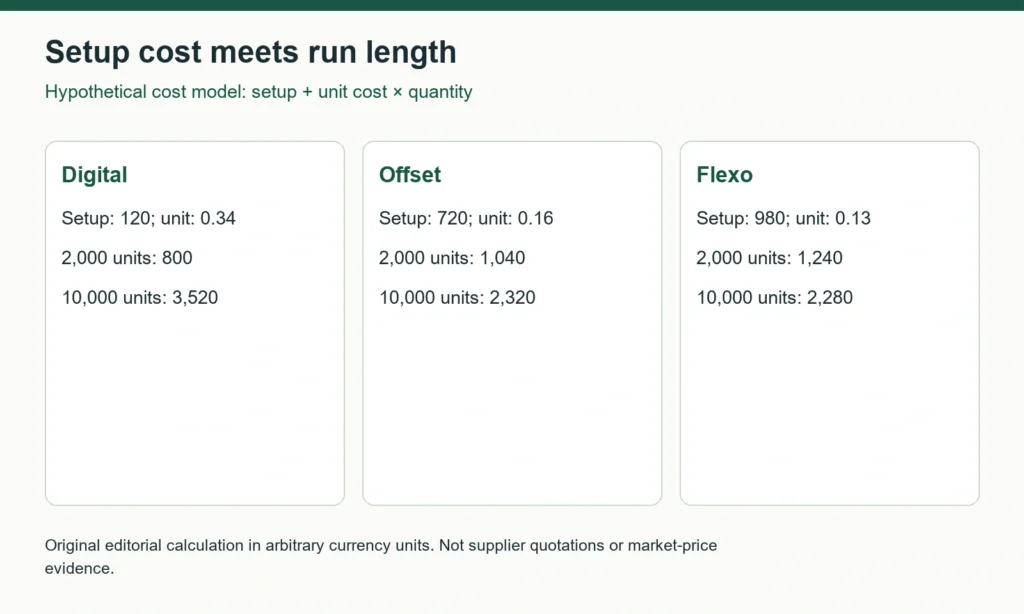
Estimated print-conversion cost = fixed setup for the job + (accepted units × quoted variable cost per accepted unit).
Suppose hypothetical quotations are prepared for one carton design, the same approved substrate and finishing scope, and the same assumed saleable yield. The following figures are invented only to show the arithmetic; they are not current vendor prices or industry averages.
| Process | Fixed setup per job | Variable print cost per accepted unit | Total at 2,000 units | Total at 10,000 units |
|---|---|---|---|---|
| Digital | $120 | $0.34 | $800 | $3,520 |
| Offset | $720 | $0.16 | $1,040 | $2,320 |
| Flexo | $980 | $0.13 | $1,240 | $2,280 |
For example, the digital 2,000-unit line is $120 + (2,000 × $0.34) = $800. Under the stated invented assumptions, digital has the lowest printing-only amount at 2,000, while flexo has the lowest at 10,000. These rankings would change if plate costs, machine availability, setup losses, approved ink systems or conversion steps were different. A marginal cost advantage of $40 at 10,000 units is especially fragile if the bids exclude different services.
Version count changes the calculation again. An order of 10,000 identical packs is not the same job as ten designs with 1,000 packs each. Conventional plate charges and make-ready may recur by artwork or colour; digital may permit multiple approved designs in one production plan, but the supplier may still charge for data handling, changeover and artwork inspection. Compare the total annual program—not a single best-case price per impression.
When requesting quotes, ask both suppliers to show: the number of chargeable jobs, any new plates or cylinders, approved substrate, number of colours, print coverage, ink system, makeready waste, effective good-unit yield, inspection, finishing and delivery. Do not use an arbitrary claim such as “digital is always best below 1,000 pieces.” There is no universal break-even volume without a matched specification and actual prices.
Food packaging: printing process does not establish food-contact compliance
Choosing flexo, offset or digital is not equivalent to choosing a food-contact-compliant package. A printed carton may have ink on its outside only; a reverse-printed film may be laminated before use; a printed label may be separated from food by a container. Migration risk depends on the finished construction, the food, time, temperature and other foreseeable conditions—not simply whether the press used water-based, UV or digital ink.
For the European Union, the consolidated Commission Regulation (EC) No 2023/2006 includes specific good-manufacturing-practice provisions for printing inks on the non-food-contact side of food-contact materials. Its Annex addresses transfer through the substrate and set-off from printed surfaces in stacked sheets or reels. Those are concrete reasons to assess curing, winding, stacking, handling and storage, rather than looking only at the finished package’s external appearance.
The European Printing Ink Association (EuPIA) provides guidance on communicating potential migrants and using manufacturing controls across the packaging supply chain. An ink supplier’s statement about a formulation is useful input; it is not automatic proof that every printed finished package complies. Claims about direct food-contact printing require a separate, explicitly qualified review.
Ask for the applicable jurisdiction and finished pack structure, intended food-contact layer, ink and coating specifications, documented risk assessment and relevant testing scope. The legally applicable rules may vary by material and destination market. This article does not certify any ink, machine, substrate or finished package as safe for food contact.
Which method is more sustainable or easier to recycle?
No printing process is inherently the environmentally preferable option in every application. One workflow may use fewer physical plates; another may generate less setup waste per delivered unit in a stable long run. Solvent handling, energy use, rejected impressions, ink coverage, wash-up, curing, and the production of the substrate all affect the picture. A useful comparison has to hold the packaged product and functional performance constant and record the production quantity and end-of-life context.
See also the differences between wash-off labels, direct printing and sleeves.
Our analysis of labels, sleeves, adhesives and inks in packaging recycling explains why the complete decoration system matters.
Recycling is a separate decision from print-production efficiency. For paper-based packaging, the 4evergreen Circularity by Design Guideline distinguishes conventional fibre recycling, flotation deinking and specialised recycling pathways; its 2026 version treats inks and varnishes as design variables. For polyolefin flexible packaging, CEFLEX’s Designing for a Circular Economy guidance likewise assesses inks alongside adhesives, coatings and other components. Neither set of guidance means that “digital,” “water-based,” or “uncoated” automatically equals recyclable in a particular local system.
Consider the full structure: a label may detach in a wash process, printed film may retain ink in recycled polymer, and a paper carton may enter a mill with or without flotation deinking. Evidence about one recovery stream cannot simply be transferred to another. If environmental impact is part of the procurement decision, ask for a comparable system boundary and evidence for the actual finished pack.
A printing-method decision checklist for packaging buyers
Before approving the print process, request answers to these questions in writing:
- What is being printed? Give the final product format, flat or formed geometry, substrate layers, grammage or film thickness, finish and intended use.
- Where is the image applied? Directly on a web, on a sheet before forming, on a label, by reverse printing before lamination or onto a formed container?
- How many designs and changes? State total units, units per SKU, language versions, promotional campaigns and forecast reorder cycles.
- What is non-negotiable visually? Supply artwork, a physical colour reference, readable type requirements, barcode needs and approval tolerances.
- Which press and ink configuration? Ask about approved substrate range, print width, colour stations, primers, drying or curing and relevant finishing compatibility.
- What does the quote include? Separate initial artwork/prepress, plates, setup, print, waste, quality checks, finishing and repeat-order charges.
- What evidence is needed? Define food-contact or other regulated-use requirements, set-off/migration review, adhesion and rub tests, and recycling or deinking assessment where relevant.
- What is the approval sample? Specify whether the approval is digital artwork, proof, real-substrate sample or production press sample, and how future changes will be controlled.
For a stable long-run flexible packaging web, start by assessing flexo against the structure and volume. For a detailed folding carton on suitable board, include offset in the comparison. For limited runs, repeated design changes or many label versions, include digital. Then check the exceptions: a converter’s actual equipment, ink qualification, downstream process and total accepted-unit cost can reverse the initial preference.
The buying decision is therefore not flexo versus offset versus digital in isolation. It is a matched comparison of three production routes for one specified packaging job, supported by real proofs, transparent cost assumptions and evidence appropriate to the finished pack.
Sources / References
Found an error? Read our corrections policy and contact the editors.