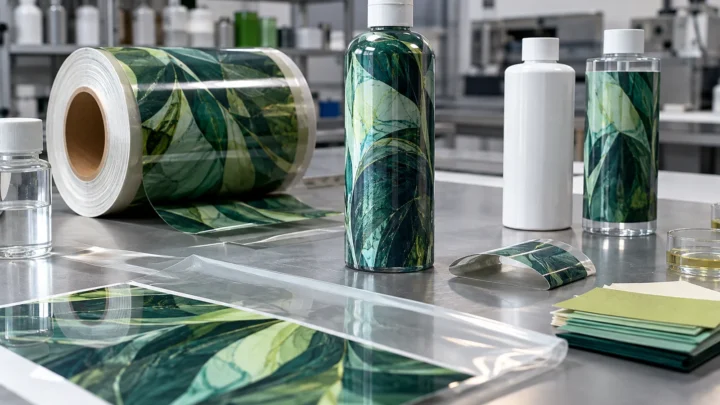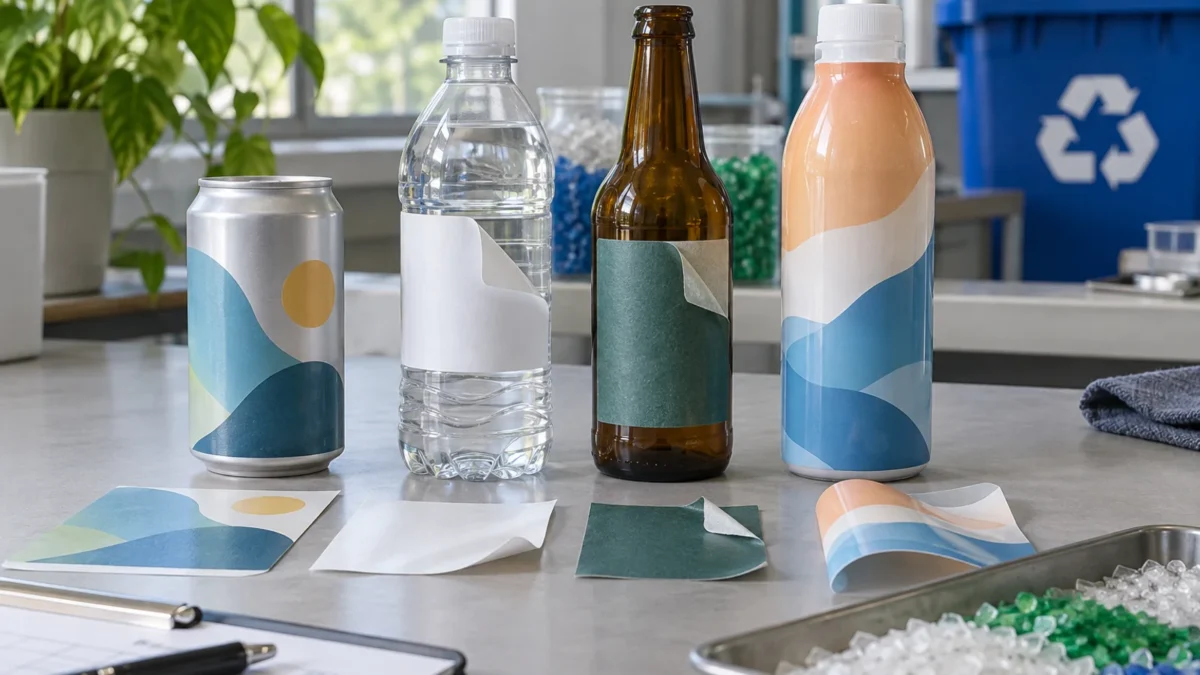
A brand team can improve a package’s shelf presence in one afternoon and accidentally make its recovery route harder at the same time. Add a full-body shrink sleeve and the bottle gains colour, opacity and 360-degree graphics—but the sorter may see the sleeve before it sees the bottle. Replace the sleeve with direct print and the adhesive disappears—but the ink now remains on the container through recycling. Integrate the decoration as an in-mould label and the label becomes durable and precise—but it may no longer separate during washing.
There is no decoration method that is automatically “recycling-safe.” The better question is: what does this decoration need to do for the brand, and what must happen to it when the package enters the intended recovery stream?
This article compares eight decoration routes—pressure-sensitive labels, wash-off labels, shrink sleeves, in-mould labels, direct print, laser marking, digital watermarks and emboss/deboss—through that design constraint.
The decoration decision is now a recovery-system decision
The EU Packaging and Packaging Waste Regulation makes the connection explicit. Its design-for-recycling framework identifies labels, sleeves, adhesives, inks, lacquers, printing and coding among the parameters that can affect sorting and recycling. The Commission’s June 2026 guidance also clarifies that the fully harmonised design-for-recycling criteria under Article 6 are still to come through delegated acts, with the relevant Article 6(2)(a) requirements applying from 2030 or later depending on the timing of those acts. [S1] [S2]
That means brands should not wait for a single future “approved decoration list.” Current design guides already show why the answer is format-specific. APR focuses on how decorations behave in North American plastic recycling. RecyClass evaluates European plastic streams by polymer and packaging type. 4evergreen separates paper packaging into conventional, flotation-deinking and specialised mill routes. The same label can therefore be a good design choice on one package and a poor one on another.
| Decoration route | Branding strength | Recovery advantage | Main recovery risk |
|---|---|---|---|
| Pressure-sensitive label | High SKU flexibility; premium films, papers and finishes | Can be designed to release or separate from the main pack | Adhesive, label density, fibre loss, coverage and ink can interfere with the target stream |
| Wash-off label | Similar graphic flexibility to conventional labels | Designed for defined wash conditions so label and/or adhesive can separate | “Wash-off” is meaningless without the exact polymer stream and test conditions |
| Shrink sleeve | Maximum surface coverage and high opacity | Can sometimes be designed for sorting and downstream separation | High coverage can hide the base container from optical sorting; sleeve polymer/density also matters |
| In-mould label | Highly durable, integrated graphics; strong moisture resistance | Can eliminate a separate post-mould adhesive application | Usually remains attached to the container, so ink and label structure enter recycling with it unless specifically engineered otherwise |
| Direct print | No label edge; durable brand graphics; fewer attached components | Eliminates label substrate and label adhesive | Ink remains on the main material and can affect colour or recyclate quality; compatibility is stream-specific |
| Laser coding / marking | Excellent for variable codes, dates and traceability; limited for full graphics | Can add information without a separate label or conventional ink system | Substrate response, readability and marking area still require validation; not every material is laser-markable |
| Digital watermark | Can be integrated into existing artwork with little visible design impact | Can carry machine-readable information for advanced sorting where compatible infrastructure is installed | Benefit depends on scanner-equipped sorting infrastructure and data/printing quality; it does not make the material recyclable by itself |
| Emboss / deboss | Premium tactile identity and permanent structural branding | Adds no separate label and can avoid some inks/adhesives | Limited colour/information capacity; geometry must still meet package-performance and sorting requirements |
Pressure-sensitive labels: the most flexible brand tool has the most interfaces to specify
Pressure-sensitive labels are attractive because they separate the packaging and decoration supply chains. A bottle or tub can stay constant while brands change graphics, language, SKU, promotion or regulatory copy. That flexibility also creates several technical interfaces: face stock, ink, varnish, adhesive, release behavior and surface coverage. [S3] [S5]
For PET bottles, current RecyClass testing protocols do not ask only whether the label itself is recyclable. They ask whether the label detaches during the relevant recycling process, whether adhesive residue remains on the label rather than on the washed PET, and whether the resulting PET flakes maintain acceptable quality. APR guidance likewise treats label material, density, adhesive and surface coverage as part of the PET bottle design.
The design implication is straightforward: approve the label system, not just the face material. Changing from one adhesive to another can change the recycling result even when the printed artwork and label film look identical.
Wash-off labels: useful when “wash-off” names a tested mechanism
“Wash-off” is one of the most useful—and most easily overgeneralised—decoration terms. It should describe a defined behavior in a defined recycling process. [S5]
For example, RecyClass’s guidance for assessed HDPE and PP container streams states that label-and-adhesive combinations should be water-soluble or water-releasable at 40°C so they can separate during washing. PET bottle recycling uses different process conditions and has its own protocol for labels and adhesives. Those are not interchangeable specifications.
- Which main package stream is being targeted—PET bottle, HDPE container, PP container or another route?
- At what wash condition is release expected?
- Does the adhesive stay predominantly with the label, dissolve into process water or remain on the package flake?
- Does the face stock float, sink, pulp or fragment in a way compatible with the target process?
- Has the exact label + adhesive + ink construction been tested under the relevant protocol?
A “wash-off adhesive” claim without those answers is not enough to establish package recyclability.

Shrink sleeves: maximum brand area can become maximum sorting interference
Full-body sleeves solve a brand problem elegantly. They can provide opacity on a clear container, hide colour variation in recycled-content bottles, create tamper evidence and give complex container shapes a continuous printable surface. [S3] [S6]
But the same coverage can create a recognition problem. APR’s NIR guidance explains that high surface-area labels and sleeves can interfere with optical identification of the underlying plastic, which is why high-coverage designs may require sortability testing. RecyClass likewise includes labels, sleeves, inks and sorting behavior in its polymer-specific assessment tools.
The brand-design lesson is not “never use sleeves.” It is to avoid treating the sleeve as invisible to the sorter. Coverage, opacity, pigments, metallisation, sleeve polymer, density and whether the sleeve separates downstream all need to be considered together.
Perforation can help a consumer remove a sleeve in some designs, but a recycling claim should not depend entirely on perfect consumer removal unless the applicable methodology explicitly supports that route. Design-for-recycling should work with the expected recovery system, not an ideal disposal behavior invented for the artwork brief.
In-mould labels: no separate adhesive does not mean no recycling interaction
In-mould labelling integrates the label while the plastic container is formed. It gives cosmetics, food, household-care and other rigid packs durable decoration that resists moisture and abrasion, while avoiding a separate post-mould labelling step. [S7] [S8]
The recovery trade-off is that conventional IML is not intended to peel off like a pressure-sensitive label. RecyClass testing on printed PP in-mould labels found that the decoration enters the recycling process with the PP container and that ink can affect recyclate quality, especially in natural-colour streams. RecyClass consequently differentiates compatibility by stream and ink loading rather than declaring IML universally compatible.
The technology is also evolving. Recent RecyClass Technology Approvals include PP IML constructions engineered so the printed label layer can separate during grinding and air-elutriation steps. Those approvals are useful evidence that IML design can be changed for recycling—but they apply to defined technologies under defined conditions, not to every in-mould label.
Direct print: removing the label moves the recycling question into the ink
Direct printing can simplify the physical bill of materials. There is no separate label face stock and no label adhesive. It can also give bottles, tubes and tubs a clean, premium appearance. [S3] [S9]
But removing the label removes the opportunity to remove its ink with the label. The printed image stays on the package body unless the printing system is designed to release. RecyClass’s March 2026 guideline update specifically included new recommendations based on laboratory testing of printing inks on HDPE and PP rigid packaging. The RecyClass online tool separately asks whether direct printing is present and which inks are used, because decoration can change the resulting recyclate.
Direct print is therefore not inherently better or worse than a removable label. It trades component reduction for ink permanence. That trade can make sense on coloured streams, premium personal-care bottles or refillable packs, but it must be judged against the intended recycling process.
Laser marking: a strong option for information, not a full replacement for artwork
Laser coding changes the decoration problem again. Instead of applying a label or conventional ink, a laser changes or etches the surface to create a visible mark. GS1 guidance recognises laser etching as a method for direct part marking of machine-readable symbols on suitable materials. [S3]
For packaging, laser marking is particularly useful for lot codes, expiry dates, serialisation, QR/Data Matrix-type information and small brand marks. RecyClass’s PET design guidance also distinguishes laser marking from direct printing in PET-bottle applications, reflecting the value of adding information without introducing a conventional ink layer to the bottle body.
The limitation is brand expression. Laser marking cannot provide the full-colour shelf impact of a pressure-sensitive label, sleeve or IML. Its recyclability advantage also should not be exaggerated: the substrate must be suitable for marking, the mark must remain readable, and any laser-responsive additive used to create contrast needs its own compatibility assessment.
Visible 2D codes and digital watermarks solve different data problems
“Digital marking” can describe two very different approaches. [S11] [S12] [S13]
A visible QR Code using GS1 Digital Link can identify a product and connect the scan to online information. GS1 positions these codes for consumer engagement, product information and other business processes, with a relatively small printed footprint. This can reduce the pressure to print every instruction, language variant or campaign message permanently across the whole package. It does not, by itself, tell an MRF to sort the pack into the correct polymer stream.
Digital watermarks are different. They can be embedded repeatedly in packaging artwork in a pattern that is difficult for consumers to notice but can be detected by suitable machine-vision equipment. The HolyGrail 2.0 initiative has tested this approach on real post-household packaging at industrial scale. Its 2024–2025 trials reported successful detection and sorting of digitally watermarked rigid and flexible plastic packaging when sorting equipment had the required detection modules.
That evidence demonstrates technical feasibility under the tested infrastructure. It does not demonstrate that digital-watermark scanners are installed across all MRFs, or that a watermarked package is recyclable when its material construction is otherwise incompatible. The data layer can improve identification; it cannot repair an unsuitable substrate, adhesive or multilayer structure.
See the HolyGrail 2.0 industrial trial report and the GS1 Digital Link standard overview for the two different roles.
Emboss and deboss: when the package itself becomes the brand surface
Embossing and debossing are often overlooked in recyclability discussions because they add shape rather than a separate film or adhesive. For premium beauty, glass, rigid plastic and paper packaging, structural branding can reduce the amount of applied decoration needed for logos, tactile cues or permanent identifiers. [S3]
Its limitation is obvious but important: shape cannot carry the colour density, legal copy or SKU variability of print. Deep structural features can also alter wall distribution, stiffness, nesting or forming behavior, so the decoration still has to respect the package’s primary function.
Emboss/deboss is therefore most useful as a decoration-reduction tool, not as proof of recyclability. If a pack still uses a large metallised label, varnish and adhesive elsewhere, an embossed logo does not erase those recovery constraints.
Paper decoration follows a different recovery logic
Plastic-decoration rules cannot simply be transferred to cartons and fibre packs. 4evergreen’s 2026 Circularity by Design Guideline distinguishes paper mills using conventional recycling, flotation-deinking and specialised processes. It separately addresses inks and varnishes, adhesives, metallic constituents and other integrated components because the recovery target is fibre and different mill routes remove contaminants differently. [S10]
This changes the choice between direct printing and a label. Direct print may avoid a separate label but increase the deinking burden. A removable label may introduce adhesive. Metallic foils can create sorting or pulping complications depending on coverage and construction. A premium carton therefore needs a paper-specific design review rather than a plastic-label checklist.
The current 4evergreen guideline is the appropriate starting point for European paper-based packaging.
The “best” decoration changes with the application
| Application | Brand / operating priority | Decoration routes worth evaluating | Recovery question to resolve |
|---|---|---|---|
| Beverage bottle | High-speed labelling, shelf recognition, regulatory copy | Wash-off PSA, low-coverage label, tested sleeve, laser code, digital watermark | Will the bottle still be identified, and will decoration separate in the PET/HDPE/PP stream? |
| Beauty / personal care | Premium graphics, moisture resistance, tactile quality, small SKUs | PSA, direct print, IML, emboss/deboss, laser code | Is premium decoration compatible with the natural/coloured rigid-plastic or paper stream actually targeted? |
| Household cleaners | Chemical/moisture durability, warning text, variable language | Durable PSA, sleeve, direct print, QR/2D data carrier | Will durable adhesive or high coverage prevent release or correct sorting? |
| Food tubs | High graphic area, moisture resistance, production speed | IML, PSA, sleeve, direct print | Does decoration remain in the PP/HDPE recyclate, or separate under the intended process? |
| Paper cartons | Large graphic field, premium finishing, product information | Direct print, emboss/deboss, limited labels, QR/2D code | How do inks, varnishes, adhesives and metallic effects behave in the target mill route? |
| Consumer goods / multi-market packs | Many languages, changing instructions, traceability | Smaller physical print area plus QR/GS1 Digital Link; digital watermark where sorting infrastructure exists | Can information move to a data carrier without creating a new material/recovery penalty? |
Brand teams need a decoration approval file, not a recyclability adjective
- Main package: material, colour, format and target recycling stream.
- Brand requirement: graphic area, opacity, tactile finish, durability, languages and variable-data needs.
- Decoration construction: face stock or IML film, ink system, varnish, adhesive, metallic effect and total coverage.
- Separation mechanism: consumer removal, wash release, density separation, grinding/air separation—or no separation.
- Sorting effect: NIR recognition, opacity, colour and metal/electronic features.
- Reprocessing effect: ink, adhesive, fibre, polymer or metallic residue in the secondary material.
- Evidence route: the applicable APR, RecyClass, CEFLEX, 4evergreen, recycler or mill protocol for the actual construction.
- Change control: define which supplier, adhesive, ink, coverage or artwork changes require the recyclability assessment to be reopened.
That last point is easy to miss. A bottle can remain mechanically identical for years while the marketing team changes the decoration twice a season. If recyclability evidence belongs to the complete package, artwork and label-supplier changes can be technical changes, not merely graphic updates. [S3] [S10] [S1] [S3]
Decoration without the recycling penalty means designing for the exit route
There is no universal hierarchy in which wash-off label beats direct print, direct print beats sleeve, or embossing beats every applied decoration. Each option moves the branding burden to a different place. [S1] [S3] [S10]
A removable label asks the recycling process to separate it. Direct print asks the recyclate to tolerate the ink. IML asks the polymer stream to tolerate an integrated decoration—or the technology to separate it later. A sleeve offers enormous brand area but can interfere with recognition. A laser mark reduces added components but carries limited graphics. A visible 2D code moves information online. A digital watermark can add sorting information, but only where the infrastructure can read it.
The best decoration is therefore the one that delivers the required brand function while making its end-of-life behavior predictable in the intended recovery system. Decoration is no longer what happens after the package is engineered. It is part of the package engineering.
Methodology and editorial note
This decision framework combines official EU rules, recycling-design protocols, GS1 specifications and HolyGrail 2.0 project-reported trials. The trials show performance under installed trial equipment, not universal deployment or full-package recyclability. Sources checked 21 October 2026. The main image is an AI-generated generic editorial illustration, not a named company, real facility or tested product. Editorial Team human review remains pending after publication.
Sources and reference notes
- [S1] European Union. Regulation (EU) 2025/40 on packaging and packaging waste. Article 6; Annex II Table 4. Accessed 21 October 2026.
- [S2] European Commission. Commission Notice — Guidance document for Regulation (EU) 2025/40 on packaging and packaging waste. Section 6, date of application of recyclability requirements. Accessed 21 October 2026.
- [S3] RecyClass. Design for Recycling Guidelines / RecyClass Online Tool. 2026 guideline updates; questions covering label, sleeve, direct printing, inks and adhesives. Accessed 21 October 2026.
- [S4] RecyClass. Is your label compatible with HDPE & PP containers recycling stream?. Wash-off criteria paragraph. Accessed 21 October 2026.
- [S5] RecyClass. RecyClass advances recyclability evaluation for labels & adhesives applied on PET bottles. Updated success criteria. Accessed 21 October 2026.
- [S6] Association of Plastic Recyclers (APR). Near Infrared (NIR) Sorting of Plastic Packaging and APR Design Guide resources. High-surface-area labels/sleeves and NIR recognition. Accessed 21 October 2026.
- [S7] RecyClass. PP Rigid Packaging with Printed In-Mould Labels tested by RecyClass. Test results / natural vs coloured PP stream discussion. Accessed 21 October 2026.
- [S8] RecyClass. Technology Approvals / current IML approvals. IML entries including technologies designed for post-grinding separation. Accessed 21 October 2026.
- [S9] RecyClass. RecyClass Roadmap / Testing Campaigns. Direct printing; label thickness; metallised decorations; label releasability. Accessed 21 October 2026.
- [S10] 4evergreen. Circularity by Design Guideline — Version 4. Guideline overview; recycling pathways; Sorting Disruptors. Accessed 21 October 2026.
- [S11] Digital Watermarks Initiative HolyGrail 2.0 / AIM. Digital Watermarks Technology demonstrates effectiveness in HolyGrail 2.0 Industrial Trials on real post-household rigid packaging waste. Industrial-trial setup and results. Accessed 21 October 2026.
- [S12] Digital Watermarks Initiative HolyGrail 2.0. Use of digital watermarks validated for advanced sorting of flexibles through industrial trials. Flexible-packaging industrial trial. Accessed 21 October 2026.
- [S13] GS1. GS1 Digital Link / 2D barcode guidance. Product identification, web connectivity, consumer information, packaging-space use. Accessed 21 October 2026.
- [S14] GS1. GS1 DataMatrix Guideline — Direct Part Marking / laser etch. Laser etch / direct part marking section. Accessed 21 October 2026.
The public corrections channel is currently inactive. Read our corrections policy.