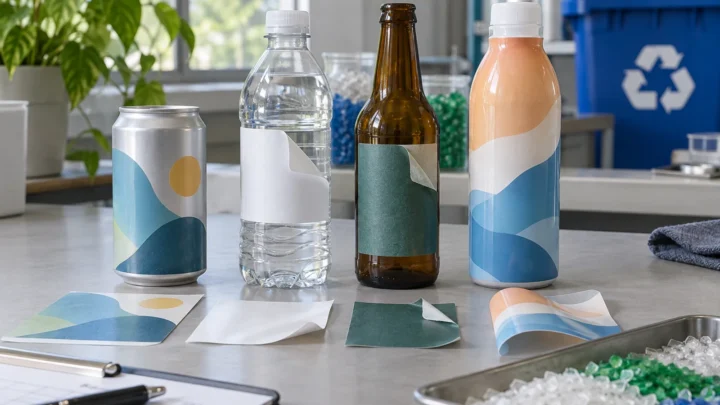

A PET bottle can be mostly PET and still miss the PET recycling stream. A PP tub can carry a label that survives the wash when the recycling process needs it to release. A paper carton can contain only a small amount of adhesive or metallic decoration yet create stickies, deinking problems or sorting errors. The main packaging material may dominate the weight, but the smallest components can determine what happens next.
That is the logic behind the “5% that breaks the 95%.” It is a design metaphor, not a universal 5% legal threshold. The relevant question is not simply how much a label, sleeve, ink or adhesive weighs. It is where that component appears in the recovery process: optical sorting, size screening, density separation, washing, pulping, melt filtration or final recyclate quality.
For packaging designers, that changes the unit of analysis. A bottle plus label plus adhesive plus ink plus tamper band is one recycling problem. So is a paper pack with varnish, glue and metallised decoration. The body resin or fibre is only the starting point.
Four places where a small component can derail the package
| Recovery stage | What the system is trying to do | How a small component can interfere |
|---|---|---|
| Recognition and sorting | Identify the main package and direct it to the correct material stream | High-coverage sleeves, dark or metallic decoration, electronics or an incompatible surface can hide or confuse the signal used by optical or metal sorting |
| Separation | Separate the main material from labels, lids, sleeves and other attachments | A label or tamper band can follow the main material into the wrong fraction if its density, attachment or geometry prevents separation |
| Washing / pulping | Remove adhesive, ink, fibre, product residue and other contaminants | Adhesive can stay on flakes, dissolve into process water, create stickies, or let fibres/ink contaminate the recovered material |
| Reprocessing | Produce a secondary material with enough quality for another use | Residual inks, incompatible polymers, metal or adhesive can discolor, degrade or contaminate recyclate even after the package was collected and sorted correctly |
The same component can be acceptable in one material stream and problematic in another. That is why “recyclable label” is incomplete language. A label must be compatible with a specific package and a specific recycling process. [S2] [S5]
PPWR now treats the “small stuff” as formal design-for-recycling parameters
The EU Packaging and Packaging Waste Regulation makes this component-level logic explicit. Annex II Table 4 lists labels, sleeves, closures and other small packaging components, adhesives, colours, barriers/coatings, inks and lacquers/printing/coding, product residues and ease of dismantling among the parameters to be considered when design-for-recycling criteria are established. [S1]
The Regulation also points to the mechanism behind those parameters: component separability, sorting and recycling efficiency, technological development and preservation of the functionality of secondary raw materials. For adhesives specifically, Annex II notes that residues can downgrade secondary-material purity and that washable adhesives can support separation from the main packaging body.
This does not mean the PPWR already supplies one final numeric label-coverage or adhesive limit for every packaging category. Article 6 requires the Commission to establish category-specific design-for-recycling criteria and performance grades through delegated acts by 1 January 2028. The current legal text is therefore a strong reason to treat decoration and small components as part of package design, but not a licence to invent universal thresholds before the category-specific rules exist. The operative text is available in Regulation (EU) 2025/40.
PET bottle autopsy: the label can fail before the bottle is ever washed
Consider a clear PET bottle with a full or near-full sleeve. The first challenge may be optical recognition. The Association of Plastic Recyclers (APR) notes that high surface-area label coverage can interfere with near-infrared sorting of PET articles, which is why its design guidance ties certain high-coverage label formats to sortability testing rather than assuming the underlying bottle will always be detected. [S2] [S3] [S4]
That means a label can affect recyclability before density separation or washing even begins. The bottle may be made from a highly established recycling resin, but if the sorting system does not identify the article correctly, the quality of the bottle polymer no longer matters.
APR’s PET guidance also illustrates a second mechanism: sink/float separation. PET sinks in water. Film labels based on low-density polyolefins can be designed to float away from PET flakes, while label materials that sink with PET require much more careful compatibility evaluation. APR identifies PVC and PLA film labels on PET as particularly problematic because they can sink with the PET fraction and degrade recycled-PET quality even at low contamination levels. See the current APR PET rigid packaging guidance.
This does not mean “polyolefin label = recyclable” in isolation. Ink and adhesive can change the finished label’s density and behavior, so the complete decoration construction still has to be assessed.

The adhesive has a job during use—and a second job during recycling
A pressure-sensitive adhesive is designed to keep a label in place through filling, transport, retail, condensation and consumer handling. Recycling may require the opposite behavior: release from the main package during a defined wash without redepositing on the flake. [S5]
RecyClass’s current PET-bottle protocol reflects this directly. Its updated evaluation for labels and adhesives checks whether labels separate effectively, whether adhesive residue remains predominantly with the label rather than the washed PET, and whether the resulting PET flakes retain acceptable quality. RecyClass warns that adhesive remaining on PET flakes can cause discoloration, while adhesive dissolved into wash water adds treatment burden. The protocol is specific to a recycling stream and test conditions; “wash-off” should therefore not be treated as a marketing adjective without a method.
For HDPE and PP containers, RecyClass also uses wash behavior as a design criterion. Its guidance states that label/adhesive combinations should be water-soluble or water-releasable at 40°C for separation in the assessed HDPE and PP recycling process, while paper labels must avoid fibre loss into the wash. That is a good example of why an adhesive approved for one construction cannot automatically be transferred to another polymer stream.
See RecyClass’s explanation of HDPE and PP label compatibility and its updated PET labels and adhesives protocol.
A paper label is not automatically the safest label for a plastic bottle
Choosing paper because it looks easier to recycle can create the opposite result when the primary package is plastic. In the PET recycling route described by APR, paper labels can pulp during hot caustic washing, loading filtration and water-treatment systems; residual fibres can remain with PET and affect the quality of the reprocessed polymer. [S2] [S5]
In other words, the question is not “Is the label material recyclable somewhere?” It is “What happens to this label in the recycling process for the main package?” A paper label may have a viable paper route when used on paper packaging, yet be a contaminant when attached to PET and entering a PET reclaimer.
Sleeves can hide the bottle they are supposed to decorate
Shrink sleeves provide a large branding area and can carry tamper evidence, product information and high-opacity graphics. That same coverage can hide the spectral signature or colour of the base container during automated sorting. [S2] [S3]
APR therefore treats label coverage and sortability as linked design variables. RecyClass likewise evaluates the sorting behavior of packaging decorations and sleeves within the relevant European polymer stream. The exact outcome depends on the base container, sleeve polymer, density, coverage, ink and whether the sleeve can separate before or during recycling.
This is why PETG, PVC, PE and PP sleeves should not be discussed as if their names alone determine compatibility. Density relative to the main polymer, wash behavior, optical recognition and the specific design guide all matter. The useful procurement question is: which stream is this package intended to enter, and what does that stream require the sleeve to do?
Inks can fail by staying, by bleeding—or by blocking sorting
Printing creates at least three different recycling questions. [S2] [S8]
- Does the printed area interfere with sorting? Dark, metallic or high-coverage decoration can affect optical or metal-based sorting.
- Does the ink stay with a removable label? In some PET label systems, retaining the ink on a film label that separates from PET can be desirable.
- Does the ink remain on the main material during reprocessing? Direct print that cannot be removed can change recyclate colour or quality even if the container itself is the correct polymer.
RecyClass’s 2026 updates on direct printing show why scope matters. Its testing led to stream-specific recommendations for direct-print inks and lacquers on coloured HDPE and PP packaging rather than one rule that can be copied across PET, paper, glass or other recycling systems. The relevant amount, ink chemistry and target stream therefore need to be checked against the current guideline for the package being designed.
The broader lesson is that “ink is only decoration” is technically wrong. Ink has chemistry, mass, colour and sometimes metallic content, all of which can affect sorting or the secondary material.
Metallic inks and foil effects can turn decoration into a sorting problem
Metal effects are especially easy to underestimate because they may be extremely thin. The relevant question is not simply metal mass. Detection systems respond to the package as presented to the sorter. [S2]
The 2026 4evergreen Circularity by Design update for paper-based packaging added stronger attention to sorting disruptors. Its guidance explains that heavy metallic surface coverage can interfere with sensor-based sorting of paper packaging, while less extensive metallisation may behave differently. The same document separates the issue of sorting from the downstream paper-recycling route, including conventional, flotation-deinking and specialised processes.
That is an important distinction: a decoration can be chemically manageable in a mill yet still cause the pack to be sent to the wrong stream before it reaches the mill. See the current 4evergreen Circularity by Design Guideline.
Paper recycling has its own adhesive and ink failure modes
Plastic-recycling rules cannot simply be copied onto paper packaging. In a paper mill, the target is fibre recovery. Adhesives can create “stickies” that must be removed from pulp; ink behavior matters differently depending on whether the package is handled in a conventional process, flotation-deinking process or a specialised recycling process. [S12]
4evergreen’s current framework explicitly separates those recycling pathways. Its 2026 guidance treats adhesives, inks and varnishes, metallic decoration, coatings and other non-fibre components as design variables rather than assuming that high paper content alone establishes recyclability.
A paper container with a pressure-sensitive label, hot-melt seam, varnish and metallic decoration should therefore be evaluated as a finished construction. The question is not whether each component has a recycling route somewhere, but whether the assembled pack is compatible with the paper stream it is expected to enter.
Flexible packaging shows why small percentages need system-specific limits
For PE- and PP-rich flexible packaging, CEFLEX’s current Designing for a Circular Economy guidelines assess more than the base film. They include inks, adhesives, coatings, barrier layers, metallisation, labels, zippers, spouts and other features, because these can alter sortability and recyclate quality. [S11]
The latest CEFLEX guidance is based on its flexible-packaging-specific testing programme and includes compatibility limits for some non-polyolefin elements. Those limits belong to the defined flexible-packaging system; they are not universal thresholds for rigid bottles, paper packs or glass. CEFLEX itself describes the guidance as an evolving design tool rather than a fixed statement that one material composition is recyclable everywhere.
The useful cross-format principle is simpler: measure minor components against the recycling process they will actually enter. See the current CEFLEX D4ACE guidelines.
RFID and NFC make the “small component” problem electronic
A smart label may add an antenna, chip, conductive material, substrate and adhesive to a pack that previously needed only ink and a barcode. It would be easy to conclude that electronics automatically make the package non-recyclable. That conclusion is too broad. [S9]
RecyClass’s 2026 Technology Approvals list includes a specific “RFID Tags Designed for PET Recycling” technology for the PET-bottle stream. That approval does not prove that all RFID or NFC labels are compatible. It proves the opposite point: compatibility has to be demonstrated for a defined tag construction and recycling stream.
Legacy or permanent RFID labels can introduce metallic residues or adhesive that does not separate from PET. A recycling-compatible construction can be engineered differently. The correct specification therefore asks for the exact inlay, face stock, adhesive, separation behavior and approval scope—not just “RFID yes/no.” RecyClass’s current Technology Approvals register shows how stream-specific that evidence is.
Tamper bands are small, but they have two opportunities to fail
A tamper-evident band can interfere at the beginning or end of the process. If it covers enough of a container, it can contribute to recognition problems. If it remains attached after grinding, its material and density can determine whether it separates from the main polymer or follows it into the recyclate. [S2]
This is one reason the PPWR’s Annex II groups closures and other small packaging components together and explicitly includes tamper-evident shrink wrap among its examples. The band has a real packaging function. Design for recycling does not require pretending that function is unnecessary; it requires specifying the function in a way that does not create an avoidable recovery penalty.
The same label needs a different answer on PET, HDPE, PP, glass and paper
| Main package | Critical label questions | What not to infer |
|---|---|---|
| PET bottle | Coverage and NIR recognition; label density; sink/float separation; adhesive wash-off; ink bleed or colour transfer | A label recyclable by itself is compatible with PET recycling |
| HDPE bottle | Container recognition; label polymer; release during the relevant wash; fibre loss from paper labels; direct-print load | PET-bottle wash-off evidence automatically applies to HDPE |
| PP tub | Label release; IML vs removable decoration; ink loading; density and polymer compatibility | PP label + PP tub guarantees no recyclate-quality impact |
| Glass bottle/jar | Sorting, label/sleeve removal, adhesive behavior and any metal/electronic attachment in the glass recovery process | A label rejected for PET is necessarily rejected for glass for the same reason |
| Paper container | Fibre yield; adhesive stickies; ink/deinking behavior; metallic decoration; non-fibre layers; target mill process | High paper percentage proves the finished pack is recyclable in a conventional paper mill |
Do not approve the container first and “add decoration later”
The most common design mistake is sequencing. A bottle, tub or paper pack is selected and tested, then the branding team adds a full sleeve, new adhesive, metallic foil, tamper band or RFID tag after the recyclability discussion is effectively finished. [S2] [S6] [S12] [S1] [S5] [S7]
A better approval file freezes the complete package configuration:
- Main body: resin, fibre or glass type; colour; format; weight and geometry.
- Label or sleeve: substrate, coverage, thickness, density and perforation/removal features.
- Adhesive: chemistry, coat weight, release/wash behavior and relevant test method.
- Ink and decoration: ink system, coverage, metallic content, varnish and direct-print amount where relevant.
- Small components: tamper band, valve, seal, liner, RFID/NFC inlay or other attachments.
- Target recovery route: geography, collection/sorting route and recycler/mill process.
- Evidence: applicable DfR guideline, protocol, test or certification for the finished construction or clearly defined component technology.
If one of those changes, the recyclability conclusion may need to be revisited. That is especially important when a brand changes decoration suppliers but keeps the same bottle SKU and assumes the recycling assessment still applies.
“Designed for recycling” still is not “recycled in practice”
Compatible labels, adhesives and inks can improve the probability that material survives sorting and reprocessing. They do not prove collection access, recycler acceptance, sufficient local volume, economic recovery or actual recycled output. [S1] [S10]
Article 71 therefore sits one level below the broader recovery question. It asks whether the package construction creates avoidable technical obstacles. A package can answer that question well and still face weak collection or end-market economics. Conversely, strong recycling infrastructure cannot fully compensate for a package that is consistently mis-sorted or contaminates the target stream.
The practical rule is to stop treating decoration as something applied after recyclability is “finished.” Labels, sleeves, adhesives, inks, tamper bands and smart tags are part of the package. If they change how the pack is recognised, separated, washed or reprocessed, they can decide whether the main material gets another life at all.
Methodology and editorial note
This analysis compares EU design-for-recycling rules with APR, RecyClass, CEFLEX and 4evergreen guidance. A protocol for one polymer stream does not certify every decorated package or establish actual local recycling. Sources checked 21 October 2026. The main image is an AI-generated generic editorial illustration, not a named company, real facility or tested product. Editorial Team human review remains pending after publication.
Sources and reference notes
- [S1] European Union. Regulation (EU) 2025/40 on packaging and packaging waste. Article 6(4); Annex II Table 4. Accessed 21 October 2026.
- [S2] Association of Plastic Recyclers (APR). APR Design® Guide — Rigid PET packaging design features / labels, inks, adhesives and attachments. APR PET packaging guidance; check the precise container stream and version.. Accessed 21 October 2026.
- [S3] Association of Plastic Recyclers. Near Infrared (NIR) Sorting of Plastic Packaging. High surface-area shrink/pressure-sensitive labels and NIR sorting discussion. Accessed 21 October 2026.
- [S4] Association of Plastic Recyclers. PET Thermoform Packaging Design Resource Document. Label/adhesive/ink discussion; lidding guidance. Accessed 21 October 2026.
- [S5] RecyClass. RecyClass advances recyclability evaluation for labels & adhesives applied on PET bottles. Revised success criteria paragraph. Accessed 21 October 2026.
- [S6] RecyClass. Is your label compatible with HDPE & PP containers recycling stream?. Wash-off compatibility criteria. Accessed 21 October 2026.
- [S7] RecyClass. RecyClass Updates Packaging Recyclability Recommendations Following Extensive Testing in 2025. Direct printing, PET closures, sealants and updated recommendations. Accessed 21 October 2026.
- [S8] RecyClass. RecyClass Updates Packaging Recyclability Recommendations Following Extensive Testing in 2025. Direct-printing findings and 2026 DfR update summary. Accessed 21 October 2026.
- [S9] RecyClass. Technology Approvals. “RFID Tags Designed for PET Recycling — Avery Dennison — PET bottle — publication date 13/07/2026”. Accessed 21 October 2026.
- [S10] RecyClass. RecyClass Online Tool — Guidelines / Changelog / Roadmap. 2026 updates and ongoing label-thickness/metallised-decoration/direct-print work. Accessed 21 October 2026.
- [S11] CEFLEX. Designing for a Circular Economy (D4ACE) Guidelines. Material selection; inks, adhesives and barrier materials; design for sortability. Accessed 21 October 2026.
- [S12] 4evergreen. Circularity by Design Guideline — Version 4. 2026 guideline overview; Sorting Disruptors; recycling pathways. Accessed 21 October 2026.
- [S13] Degradable Packaging. Why Recyclable Packaging Can Still Be Economically Unrecyclable. Article card/excerpt in current site capture. Accessed 21 October 2026.
The public corrections channel is currently inactive. Read our corrections policy.