An automated camera can inspect every package that passes a particular station without proving that every defective package will be caught. This distinction is the central challenge in AI machine-vision inspection. Modern systems can verify labels, dates, closures, fill levels, surface defects and some seal anomalies, but their usefulness depends on lighting, sample coverage, the selected inspection task and a controlled rejection process. [S1] [S2]
For related context, read our analysis of machinery flexibility and production trials.
For packaging converters and food manufacturers, the strongest business case begins with a known failure mode. A misprinted allergen label, an absent cap, a contaminated seal and a shallow dent are not the same visual problem. Each requires a defined detection threshold and a decision about what happens when the system is uncertain. An impressive demonstration video is not a validated quality system.
What machine vision can—and cannot—see
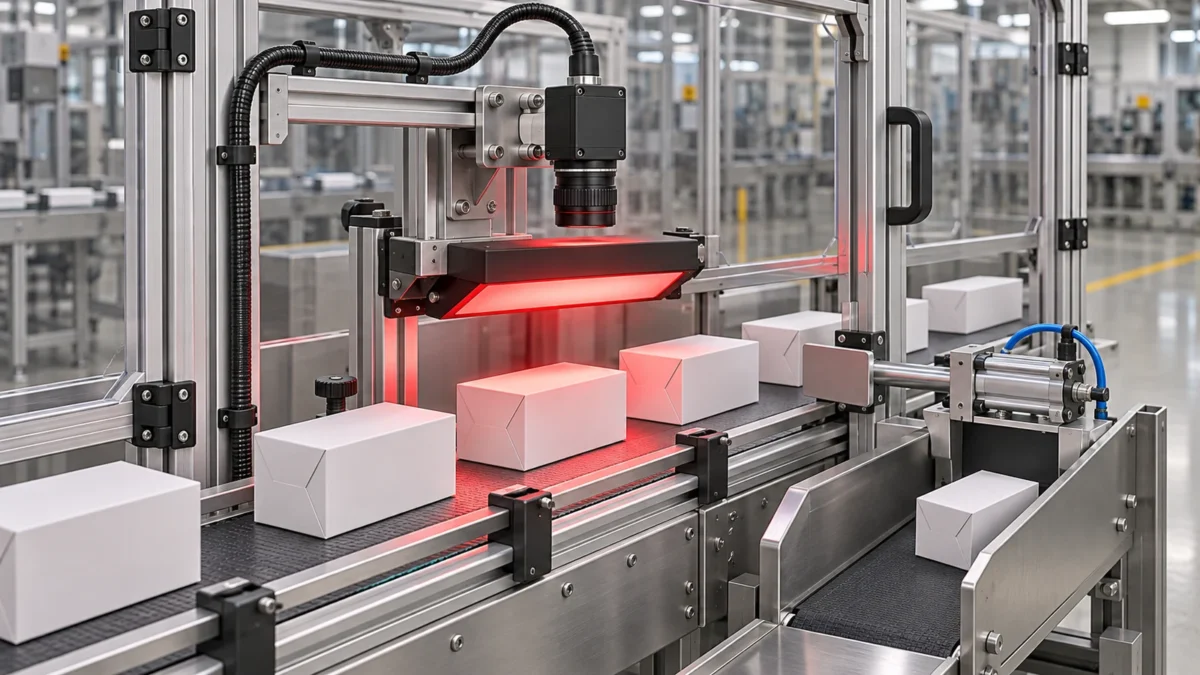
Machine vision combines illumination, cameras or other sensors, image processing and a decision rule. Traditional systems may use geometric or rule-based checks; machine-learning systems can learn complex appearance patterns from labeled examples. Hybrid installations often combine code readers, conventional measurement and AI defect classification.
Cognex identifies packaging applications including label inspection, code verification, cap and closure checks, package integrity and fill-level monitoring. Keyence likewise describes seal inspection challenges involving materials, line speed, defect visibility and environment. These are supplier descriptions of capability categories, not independent proof of detection accuracy on every package. [S1] [S2]
| Inspection question | Typical visual evidence | What a camera alone may not establish |
|---|---|---|
| Is the correct label present? | Print, position, characters, barcode | Whether the database master label is legally correct |
| Is the cap present and aligned? | Shape, orientation, height or tilt | Leak-tightness under transport pressure |
| Is the seal visibly contaminated? | Foreign matter, wrinkles, missing seal area | Every microscopic channel or actual sterile integrity |
| Is fill level within visual tolerance? | Visible liquid boundary, container geometry | Fill volume without validated optical calibration |
| Is a molded tray rim acceptable? | Shape, edge defects, contour | Food-contact compliance, barrier durability or actual leak resistance |
The table is an editorial classification of common use cases; final acceptance requires product-specific physical or regulatory testing where those properties matter.
The hardest part of the project is defining a defect
“Detect bad packaging” is not a sufficient engineering specification. The plant needs a defect library with categories, severity and ground-truth examples. A torn label may be visually obvious, but a slight misalignment could be acceptable on one SKU and unacceptable on another. Glare from clear PET, a moving reflective foil or a colored print can produce features that resemble defects.
A camera can also see a symptom but not its cause. A partly open carton may be the result of incorrect folding, a damaged blank or a downstream collision. Classifying the event is useful for root-cause investigation, but the quality team should not assume that the AI model has diagnosed the equipment fault.
Before deployment, engineers should establish the acceptable and unacceptable conditions with production, maintenance and quality staff. Examples should include the limits of allowable variation, not only ideal products and spectacular defects.
False rejects and missed defects are separate economic risks
An AI system is normally judged on two kinds of error: a false reject, where acceptable product is rejected, and a missed defect, where defective product passes. A model with excellent overall classification accuracy can still be unsuitable for a rare but critical defect.
Consider a purely illustrative packaging run of 10,000 items containing 100 truly defective packages. If a detector catches 90% of those defects and falsely rejects 1% of 9,900 good items, the outcome is:
- 90 defective packages correctly rejected;
- 10 defective packages missed;
- 99 good packages rejected by mistake;
- 189 total rejects, of which only 90 are true defects.
This is a deterministic example, not a measured performance claim about any commercial system. It shows why the quantity of packages flagged as defective does not equal the quantity of actual defects. In this hypothetical example, more than half of the rejected items are good products. If a defect has food-safety significance, the ten missed units may be far more consequential than the lost good packs.
The acceptance criteria must therefore specify defect-specific recall or sensitivity, false-reject rate, acceptable sample size and the consequence of each error. Overall accuracy is not enough.
Published research is promising—and appropriately limited
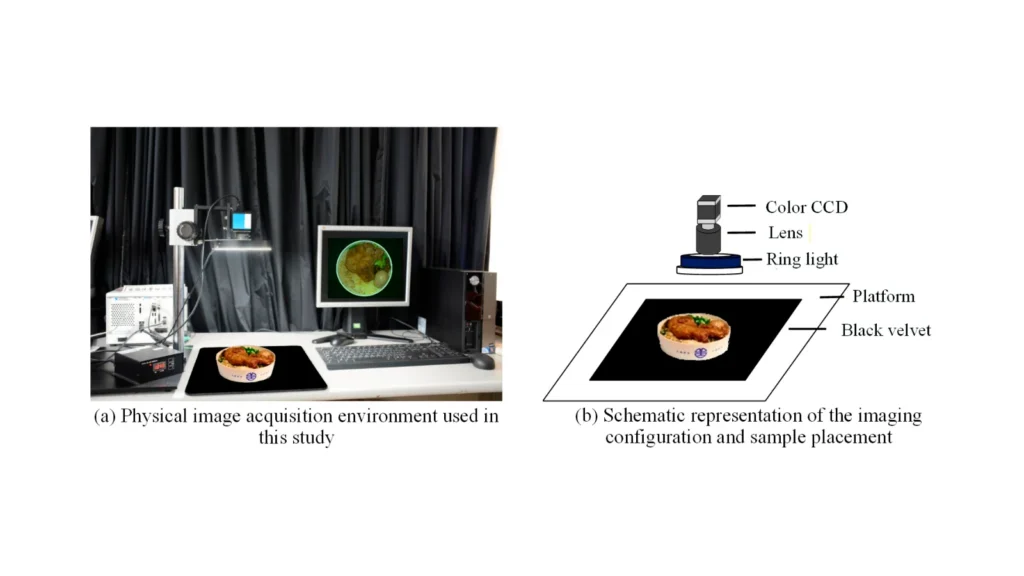
A 2026 research article in Sensors studied automated inspection of boxed meals using a combination of image processing, regional color features and a deep neural network. Under the authors’ evaluated laboratory and prototype conditions, the system reported a 97.76% defective-image detection rate and a 5.34% false-alarm rate for normal images. The researchers also examined illumination variation and differing meal configurations. [S3]
Those figures do not establish an accuracy benchmark for packaging seals, printed cartons or a different manufacturer’s line. The study concerned boxed-meal inspection and its specific dataset. Its significance is methodological: researchers reported multiple error measures and acknowledged that broader industrial validation was still required.
The authors’ foreign-object test used a plastic cockroach model under controlled conditions. Their 97.76% defective-image metric covers the defined boxed-meal defects and must not be relabelled as universal foreign-object sensitivity. Transparent fragments, reflective metal or small contaminants need separate evidence. [S3]
That level of qualification should be expected in commercial machine-vision proposals. Detection performance needs to be stated for the test population, lighting, product mix, line speed and defect severity. A claim such as “99% accurate” without those details is not a usable purchasing specification.
Where AI adds value beyond rule-based vision
A conventional visual rule can be reliable for stable features with high contrast—for example, confirming that a cap occupies a fixed position. Machine learning becomes attractive when acceptable appearance varies, defects have many shapes or the boundary between normal texture and anomaly is hard to describe with a simple geometric rule.
AI models still require training data and controlled change management. A new paper coating, printing artwork, bottle color or reflective film can change the image distribution enough to affect decisions. The model that performs well on one packaging SKU should not be silently reused across every line format.
PMMI’s February 2026 report on AI in packaging equipment discusses machine vision, knowledge capture and data governance among emerging application areas. Its published methodology includes industry interviews, not a controlled cross-vendor evaluation of vision accuracy. The report supports the observation that manufacturers are investigating AI workflows; it does not validate a particular inspection station. [S4]
Packaging-material changes create new optical problems
Material substitutions are an especially useful stress test. A transition from clear plastic to a coated fiber tray changes surface texture, reflectance, edge definition and possible defect appearance. A switch to a thinner or more reflective film can change how a heat-seal region looks under a fixed camera.
Inspecting the old material during an equipment acceptance test tells the buyer little about the new material unless it is explicitly included. The correct trial uses normal production variation: different material lots, day and night shifts, realistic contamination conditions, start-up and stop conditions, plus the worst plausible packaging geometries.
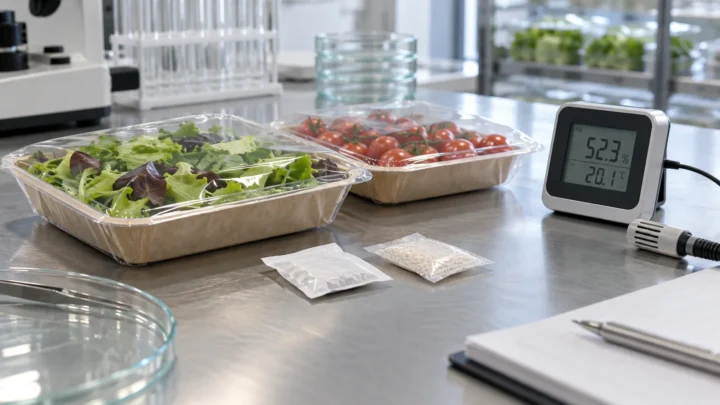
For molded-fiber foodservice packaging, examples might include underfilled corners, fiber clumps, incomplete rims and warped lids. Vision inspection can screen visible deviations; it does not replace measured grease resistance, hot-food performance, food-contact documentation or actual leak tests. The plant should define which of these outcomes it is asking the camera to predict.
The reject mechanism is part of the inspection system
Finding a defect in an image does not ensure the defective pack leaves the line. The system needs timing synchronization, positive reject confirmation and a safe response to ejector faults. If packages are close together at high speed, an image decision can be correct while the wrong item is physically removed.
A proper site acceptance test should observe the entire chain: trigger, image acquisition, classification, decision logging, reject action, reject confirmation and rework or quarantine handling. The tests should include missing or delayed images, line stops and restarts, communication interruptions and the ability to reconcile reject counts with actual items removed.
Human oversight should focus on exceptions and evolving defect definitions, not on unquestioningly accepting a model score. An operator also needs an escalation procedure if the model begins rejecting a new material lot unexpectedly.
A six-part vendor acceptance protocol
1. Define critical defects. Separate safety, regulatory, function and cosmetic classes. Establish risk-based acceptance before viewing vendor demos.
2. Build a representative test set. Include real production lots and deliberately captured examples of difficult failure modes. Hold out a sample set not used to train or tune the model.
3. Control imaging conditions. Record lighting, optics, geometry, conveyor speed, camera maintenance and environmental variation.
4. Measure the confusion matrix. Report true positives, false positives, false negatives and true negatives by important defect category. Do not rely on a single accuracy percentage.
5. Verify the reject chain. Challenge the actual ejector and confirmation feedback at normal operating speed and during fault conditions.
6. Plan version control. Define how packaging artwork, substrate, software updates, model retraining and acceptance-test records are approved before a model goes back into production.
The protocol is an editorial procurement framework, not a claim to satisfy a particular statutory quality-system standard. Product sectors subject to regulated validation require their own formal procedures.
Where the return on investment comes from
The financial case can combine reduced rework, lower giveaway, fewer customer complaints, improved traceability and more consistent quality decisions. Each benefit needs a measurement baseline. Avoid counting the same rejected pack both as scrap avoided and as additional saleable output without tracing the underlying production result.
A line may achieve a high detection rate and still be a poor investment if it falsely rejects too many acceptable items or needs extensive staff to resolve alerts. Another installation may deliver value by capturing dependable defect data that identify an upstream process fault. The right metric depends on whether the goal is containment, prevention or throughput improvement.
Editorial judgment: AI should be a measured control, not a promise
AI machine vision deserves serious evaluation because it expands the kinds of appearance variation that inspection systems can analyze. But its commercial credibility depends on the same disciplined questions that apply to any manufacturing control: which defect, which sample population, which detection threshold, which error costs and which verified response? [S1] [S2] [S3]
A practical next step is to pilot one consequential defect family on one packaging line, compare its decisions with traceable ground truth and preserve results across material lots. Scale only after the reject system, operator process and model change controls have passed an agreed test. “100% inspected” is a description of inspection coverage, not a guarantee of defect-free output.
Sources / References
- S1. Cognex, Food and Beverage Solutions and Packaging Inspection, manufacturer application descriptions, accessed 16 November 2026. Evidence for claimed use-case categories, not independent performance validation.
- S2. Keyence, Package Seal Inspection, manufacturer application description, accessed 16 November 2026. Evidence of inspection challenge types; not a certified inspection guarantee.
- S3. Sensors (2026), Vision-Based Automated Inspection of Box Meals for Food Portion Defects and Foreign Object Detection. Scholarly full-text article; laboratory/prototype performance measures and acknowledged limitations; not a validation of a named commercial packaging line.
- S4. PMMI, 2026 Building an AI Advantage in Packaging Equipment, 3 February 2026. Public report summary; 14 interviews, not an independent vendor accuracy benchmark.
Found an error? Read our corrections policy and contact the editors.