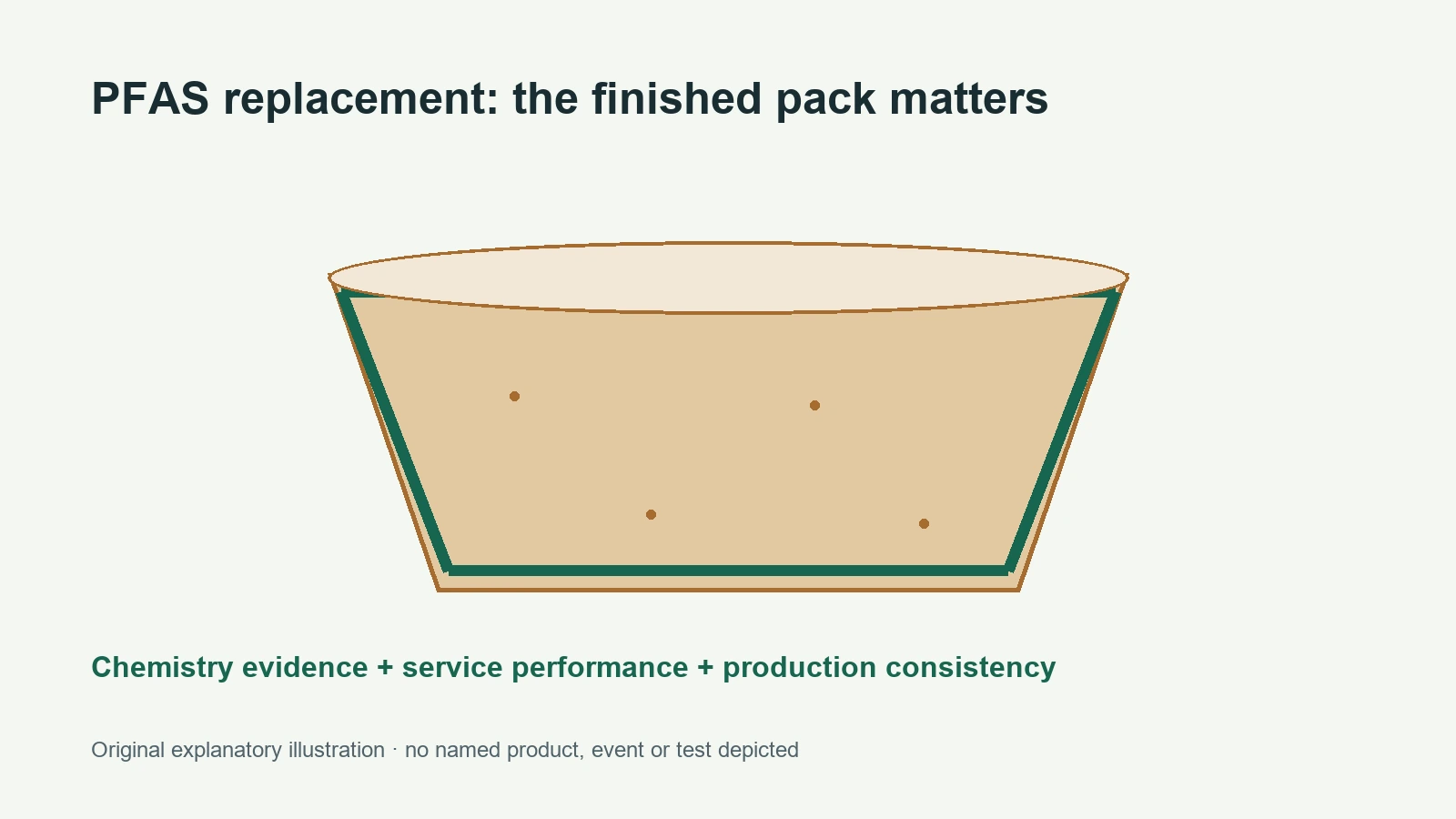
The useful question in PFAS replacement is becoming more specific than which chemistry provides a grease barrier. Packaging developers also need to know how that chemistry behaves in a finished construction, how consistently it can be manufactured and which claims the evidence actually supports. A promising coating, a commercial ingredient and a qualified food pack represent different stages of that work.
The current examples span those stages. Roquette has an existing commercial starch-based offering; an October 2026 research record describes ethyl-cellulose-coated moulded kraft bowls; an October paper-development collaboration combines grease-barrier and sealing functions. They do not establish a solved industry-wide transition. They show why industrial repeatability and application qualification deserve as much attention as peak barrier results.
The US background is a specific phase-out
The US Food and Drug Administration’s January 2025 update says that 35 food-contact notifications covering PFAS-containing grease-proofing substances for paper and paperboard packaging became ineffective following abandonment of those uses. It followed the agency’s account of manufacturers ending sales of such grease-proofing substances into the US food-contact market. This is a defined US regulatory and market history, not a worldwide ban on every PFAS use. [1]
That distinction prevents several misleading shortcuts. A voluntary sales phase-out and a regulatory authorisation decision are not the same event. Neither establishes the analytical result for an individual package. An ingredient supplied without intentionally added PFAS also does not automatically determine the contamination or detection result for the finished article.
For a manufacturer, removing a formerly used barrier route leaves a protection brief to satisfy. The relevant questions concern the food, temperature, exposure time, liquid and oil loading, forming and handling. A replacement has to deliver the intended service under those conditions while its chemical and food-contact evidence are assessed separately.
Replacement routes should not all be called coatings
Some approaches introduce functional chemistry within a pulp or fibre process. Others apply a barrier to the surface. A laminated film is a further construction choice, with a different process and material interface. Calling all of them a coating hides where the function is being added and which operation must control it.
Bio-based or starch-based describes another dimension again: the origin or identity of part of the formulation. A starch-based route can be surface-applied, for example, so it is not necessarily an alternative category to every aqueous barrier. Treating the categories as separate questions helps a buyer avoid double-counting technologies or assuming that one label explains the whole pack.

| Route | Where the barrier is introduced | Main qualification question |
|---|---|---|
| Internal additive system | Within the fibre-production process | Does the formed article deliver consistent protection throughout the relevant geometry? |
| Surface-applied aqueous barrier | As an applied layer that forms after drying | Is the dry barrier continuous and suitable after converting and use? |
| Bio-based or starch-based formulation | Depends on the selected application process | Which dry constituents and service conditions support the proposed claim? |
| Film or multilayer construction | As a distinct barrier layer or combined structure | Can the complete pack balance protection, manufacture and its intended recovery route? |
The table is not a performance ranking. Its purpose is to reveal the missing specification when a discussion begins and ends with PFAS-free. The formulation, process, geometry and end-of-life route remain necessary parts of the decision.
A commercial product is context, not a new launch by default
Roquette describes STABILYS BA 25 as a modified-starch solution for grease-resistant paper and board. Its current resource page is dated 1 October 2024. It is therefore useful as existing commercial context, not a product that this article can call newly launched in 2026. The supplier’s performance and food-contact language remains its own statement. [2]
This changes the interpretation of the trend. The presence of a commercial ingredient shows that the field is not solely a collection of new laboratory proposals. It does not establish how widely that ingredient is used, which finished products are qualified or whether the same result transfers between substrates.
The commercially relevant unit remains an application-specific construction. A formulation can be available for purchase while a buyer’s required combination of grease resistance, folding, printing and sealing still needs development. Conversely, a lack of a new launch date does not make an existing solution irrelevant to a converter assessing current routes.
Research shows why geometry and processing belong in the result
An ACS Omega paper published on 8 October 2026 describes moulded kraft bowls dip-coated with ethyl cellulose. It identifies three cycles of a 10 wt% formulation, designated K/10EC-D3, producing a continuous layer of approximately 45 μm in the reported specimen. These are reported experimental conditions, not a commercial production specification. [3]
The full text, obtained from the lawful Europe PMC repository for this review, adds an important boundary. Its fibre-recovery method used warm-water soaking, mechanical blending and solvent-assisted washing. That laboratory route is not evidence of acceptance or equivalent performance in an ordinary paper mill. The study’s migration experiment likewise does not amount to an independent food-contact approval of a commercial pack.
The experimental design points to a useful industrial question: how is coverage maintained over the actual three-dimensional article? A flat specimen and a formed bowl do not present identical surfaces or handling conditions. Corners, rims, edges, folds and the areas affected by forming should belong in the test plan for the intended package, rather than disappear behind the name of the polymer.
Moving from repeated laboratory dipping to another production process would create another qualification task. A converter would need evidence that the selected method can reproduce the relevant structure and function. The paper does not establish factory line speed, repeated-lot consistency, production cost or performance across a manufacturer’s portfolio.
Factory experience identifies operational questions
Bioleader’s manufacturer-side discussion of PFAS-free grease-resistance technologies distinguishes internal additives from surface coatings and film barriers. Its account also treats temperature, oil loading, holding time and formed-part details as relevant application variables. This is manufacturer/factory experience and sourcing guidance, not independent validation of every product sold under the label. [4]
Related-party disclosure: Bioleader is a disclosed industry/commercial related party of Degradable Packaging. Its manufacturing observations are attributed to the company; Degradable Packaging did not conduct its demonstrations or inspect its production lines.
The practical value is to make an acceptance protocol less ambiguous. A statement that a container held a food during a demonstration needs a defined food, temperature and duration to be meaningful. It is still not a standardised laboratory result unless the method and conditions support that description. Chemical screening, migration assessment and physical leakage observations also answer different questions.
A supplier’s sample-specific report cannot settle an entire range. Changes in construction, thickness, processing or use conditions can alter the question being asked. The useful procurement record ties the proposed claim to the article tested and explains what would trigger a new assessment, rather than treating a certificate or demonstration as a portable guarantee.
Joint barrier projects add a construction perspective
The UPM–Ingredion–Paramelt announcement of 20 October combines starch-based grease-barrier work with heat-seal functionality on paper and reports a Part 1 recyclability result for one construction. It is relevant to integrated barrier development. The release does not establish that this particular collaboration was a PFAS-replacement programme, so it should not be relabelled as one. [5]
Its adjacent lesson is the coordination of functions. A grease barrier and a sealing function must work within the same converted structure. Selecting them separately can leave the integration task unresolved. This is where the packaging system, rather than the ingredient, becomes the development unit.
The same reasoning applies to recovery. A renewable input does not decide what happens to the finished pack. Claims about biodegradation, compostability, recycling and plastic content have different evidence requirements. None follows simply from the absence of an intentionally added fluorinated ingredient.
Repeatability is the commercial test
A peak result answers whether a specimen met a test under its reported conditions. Manufacturing needs to establish that relevant production continues to meet the specification. That requires attention to variation in substrate, application, drying, forming and handling, with suitable checks on the part of the package most likely to determine failure.
This has consequences for lightweighting and line changes. A change that appears economically attractive can also alter geometry, barrier coverage or process conditions. It should therefore be considered with the service brief, rather than being treated as independent of the performance evidence. This is an assessment question, not a claim that every weight reduction causes failure.
Claims about PFAS need their own precise analytical language. No intentionally added PFAS, a result below a reporting limit, targeted-analyte screening and total-fluorine measurement are different statements. The method, analytes, specimen and reporting limit must be known before deciding what a result establishes. Total fluorine alone cannot identify the substances responsible for that signal.
EU PPWR thresholds and package-specific compliance conclusions are not inferred here from supplier pages. They require the binding definitions and current official guidance, read together with the relevant analytical evidence. Physical grease resistance is not proof of chemical compliance; chemical screening is not proof of leak resistance.
Watch for a connected evidence record
Commercial maturity would be better demonstrated by a connected record: identified formulation and construction, bounded chemical claims, repeated manufacturing results, qualified converting, appropriate food-contact evidence and actual customer deployment. Recovery claims would need a defined route and acceptance evidence as well.
The transition is therefore not a race to find one universally sustainable replacement. It is the work of engineering repeatable packaging around an appropriate barrier route. Recent research and collaborative development sharpen that task, while existing commercial products show that parts of it are already being attempted. The outcome will be decided by qualified applications and consistent production, not the breadth of a PFAS-free label.
Sources
- US FDA. Determination concerning 35 food-contact notifications, 3 January 2025. Defined US paper/paperboard grease-proofing uses; not a global ban.
- Roquette. STABILYS BA 25 resource. Current primary page dated 1 October 2024; supplier statements, not a new 2026 launch or independent compliance finding.
- Klayya and colleagues. Ethyl-cellulose coating for moulded kraft paper, ACS Omega, 8 October 2026, DOI 10.1021/acsomega.6c05004. Full text read in the Europe PMC repository, PMC13688466; coating preparation and sections 2.4.10–2.4.11 / 3.7–3.8. Laboratory solvent-assisted fibre recovery is not practical mill acceptance.
- Bioleader. PFAS-Free Sugarcane Tableware: Internal Additives vs Barrier Systems. Manufacturer/factory experience and route distinctions only.
- UPM. Starch-based barrier collaboration, 20 October 2026. Adjacent integrated-barrier development, not explicitly identified as PFAS replacement. Sources checked 26 October 2026.
Found an error? Read our corrections policy and contact the editors.