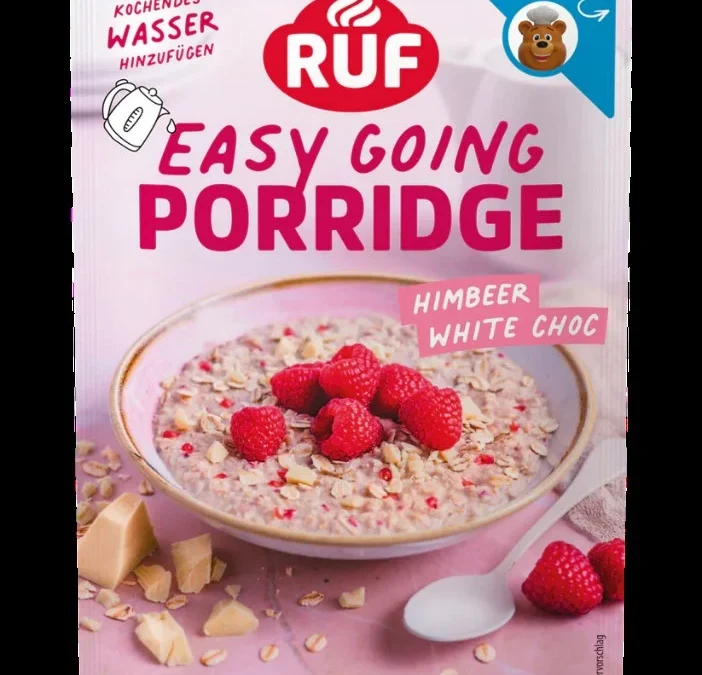
RUF’s choice of barrier paper for a porridge pouch is a specific dry-food application, not a demonstration that every flexible food pack can use the same construction. In its 20 April 2026 announcement, Koehler identifies NexPlus Seal Pure MOB as heat-sealable paper with integrated oil barriers. The development question is which functions the recipe and distribution route require from the finished pouch. [1]
Write the protection brief for the dry mix
An oil-barrier description does not supply a moisture-transmission value, an oxygen-transmission value or a shelf-life result. The announcement publishes none of those numerical records for the RUF pack. Treat the named feature as one part of the construction brief rather than a single score for all product protection. [1]
For the intended recipe, the food and packaging teams should first define the storage period and unacceptable changes in the product. Then specify the exposures that matter along its route, including temperature and humidity, and request tests on that basis. A result from a different dry food or laboratory condition cannot answer that application-specific question merely because both packages are described as paper.
The converted pouch adds another interface
Heat-sealable stock still has to become a consistently closed pack on the selected line. A qualification run should retain material version, forming geometry, seal settings and production speed, then examine completed packs after filling and handling. These are proposed acceptance records; the announcement supplies no common seal window or production-speed dataset that another converter can adopt as a validated recipe.
The application is described as packaging for dry food. That does not establish that the pouch can be filled with boiling water or used as a preparation vessel. Product preparation and the packaging’s qualified contact conditions are different parts of the brief; the source does not provide a hot-water-in-pouch test. [1]
Keep recovery evidence attached to the construction
The supplier also promotes recyclability, but the release does not attach a complete test report for the finished, printed RUF pouch. This article therefore does not turn the source’s reference to a testing approach into a product certificate or a blanket PPWR verdict. A review needs the exact substrate, coating, print, seal and other components that will enter the intended collection and processing route. [1] 4evergreen’s cross-industry protocol overview separates laboratory testing, technical evaluation and scoring across conventional, flotation-deinking and specialised processes. That wider framework makes the choice of recycling process an explicit evidence question; it does not test this particular RUF pouch or establish local collection acceptance. [3]
Approve the product-and-pouch system
A useful conversion decision joins three records: the recipe’s protection endpoint, the pouch’s manufacturing and handling results, and the recovery evidence for that construction. If a candidate meets only the oil-barrier description, the other questions remain open. The RUF case is a concrete starting point for that evaluation, with its April announcement date retained; it is not evidence of a new October launch or a measured industry-wide adoption rate.
Sources and image credit
- Koehler Paper / RUF — Barrier-paper porridge pouch selection. 20 April 2026; pp1–2 dry-food application, heat sealability/oil barrier and actual pouch image. Accessed 24 October 2026.
- Koehler Paper — Press photographs: copyright and use. Copyright, editorial grant and mandatory Koehler press photo credit. Accessed 24 October 2026.
- 4evergreen — Recyclability Evaluation Protocol overview. Laboratory testing, technical evaluation, scoring and three recycling processes. Accessed 24 October 2026.
RUF porridge pouch pictured in Koehler Paper’s 20 April 2026 press release, page 2. Source: RUF / Koehler press photo. Physical pack image extracted from the retained original press PDF and converted to WebP; pack appearance and text retained. Printed product and recycling claims are not independent test evidence. Image source.
Found an error? Read our corrections policy and contact the editors.