Returning a reusable cup at a supermarket or an unattended machine moves the service beyond the café counter. Berlin’s reuse pilot and Munich’s Viktualienmarkt project document that change in two different settings. They also show why a shared cup brand is not enough to define an open return network: machine recognition, reimbursement and the route back to clean stock have to work together. [1] [2]
Two working models, with different boundaries
EDF Europe describes the Berlin pilot as linking cafés and restaurants with selected REWE stores in Friedrichshain-Kreuzberg. It says reverse vending machines recognise serialized cups, register deposits, and add supermarket returns to the participating café network. Collection, cleaning and redistribution are performed through project partners. These are the participating organisation’s descriptions of the pilot, not independent measurements of its overall performance. [1]
The municipal Munich account describes nine return machines at five market locations, available around the clock. At the project’s May 2026 introduction, it lists ten participating stalls and deposits of €1 for cups and €5 for bowls. It also states a crucial restriction: RECUP containers obtained elsewhere without the project’s QR code are not yet accepted by those machines. [2]
These cases support a specific direction in service design: adding return locations outside the original seller. They do not establish that all branded cups can enter any machine, that either pilot covers a whole city, or that supermarket return has become standard across Germany. For a network buyer, the acceptance boundary is part of the packaging specification.
Treat the identifier as a service component
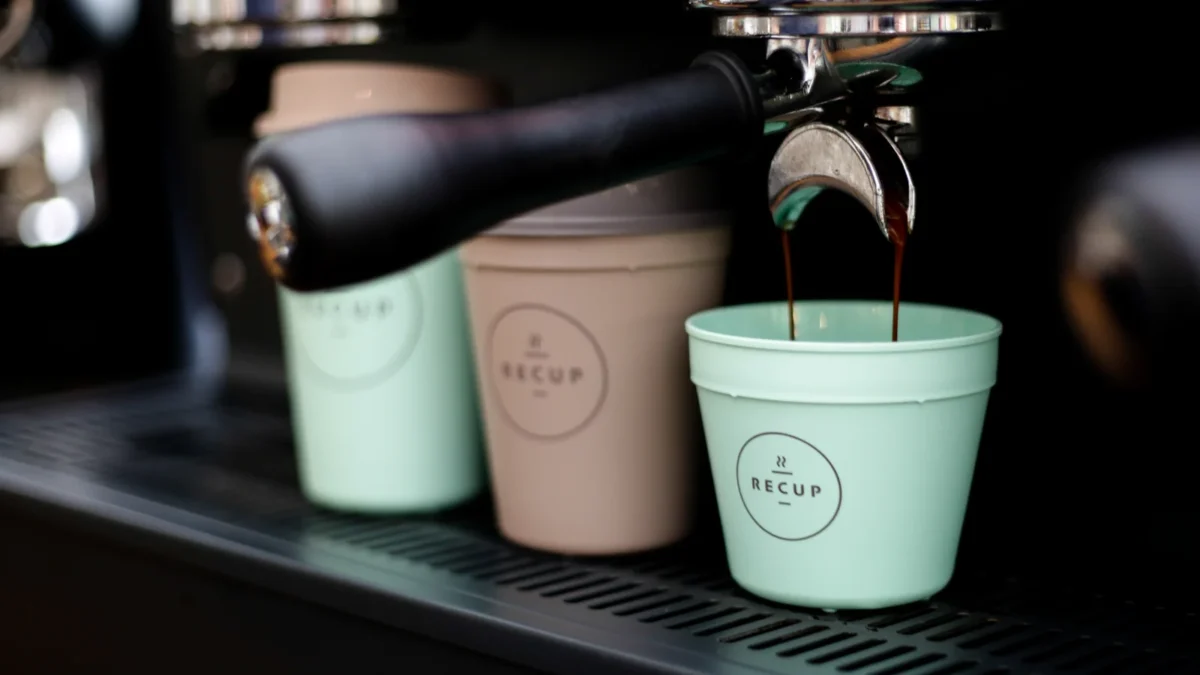
The historical RECUP photograph above shows the familiar counter-service object. It is not a photograph of the pilots or proof of machine compatibility. The newer service adds an identity-recognition requirement: before specifying a return route, establish which container versions and identifiers the machine accepts. Visual similarity or a matching brand does not answer that question.
A useful commissioning test is therefore a route test, not just a container inspection. Take each proposed cup version from issue to each advertised return point, check recognition and the user’s deposit outcome, then check how an unrecognised cup is handled. Record the tested version and location. This is a proposed acceptance procedure for the operator, not a claim that the pilots have published these test records.
Separate return access from refund access
Munich’s launch account says deposits are initially refunded in coins pending conversion to a cashless version. That dated statement should not be rewritten as confirmation that the later conversion has occurred. Berlin’s description says the machine registers the deposit; it does not, in the passages used here, establish one identical reimbursement interface across every return point. [1] [2]
For a foodservice operator, opening hours and reimbursement are separate service promises. Before advertising an unattended return, verify what the customer receives, how it can be redeemed and who resolves a failed transaction. Extending a map of return points without specifying those steps can leave the customer-facing part of the loop incomplete.
A returned cup still has to become clean stock
Märkte München assigns equipment supply to CircleCube, operation and the ordering platform to Relevo, and logistics and professional washing to Cup Company Service. This division makes the loop more concrete than an assertion that the cup is reusable: collection and cleaning are named operating tasks. [2]
The buyer should connect those tasks to reissue. Specify who collects containers, accepts them into washing, rejects damaged items and replenishes each outlet. Then ask for measured return volumes, turnaround times, losses and costs per completed loop over a defined period. Neither public account used here supplies enough quantified outcome data to establish the system’s cost advantage or environmental superiority.
The next meaningful evidence is a container moving repeatedly through that whole route, with an eligibility rule and operating record that remain clear as locations are added. These pilots demonstrate service configurations worth examining. Wider adoption, economical operation and environmental benefit each need their own evidence.
Sources and image credit
- EDF Europe — Berlin Reuse Pilot. About the pilot; What the pilot is testing; Borrow, Return and Reuse; Early lessons; Project partners. Accessed 24 October 2026.
- Märkte München — Mehrwegsystem am Viktualienmarkt. 27 May 2026 launch description; system operation; QR-code exception; refund transition and partner roles. Accessed 24 October 2026.
RECUP deposit cups photographed on 28 May 2018. Image: Greta RECUP / Wikimedia Commons, CC BY-SA 4.0 (https://creativecommons.org/licenses/by-sa/4.0/). Historical counter-service context for comparison with machine-return networks; not the 2026 pilots or evidence that these cups are machine-eligible. Resized and converted to WebP; derivative distributed under the same licence. Image source.
Found an error? Read our corrections policy and contact the editors.