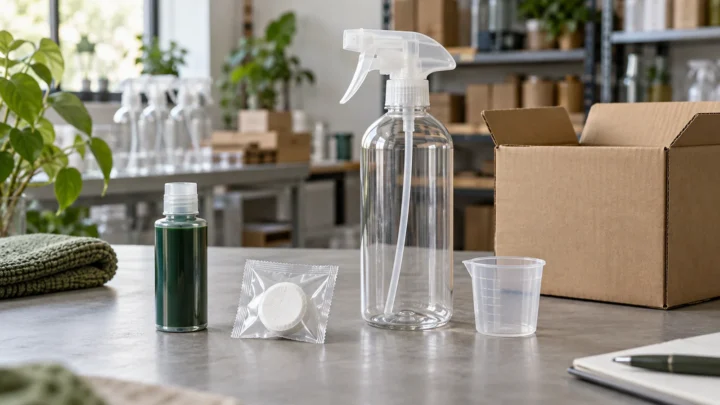
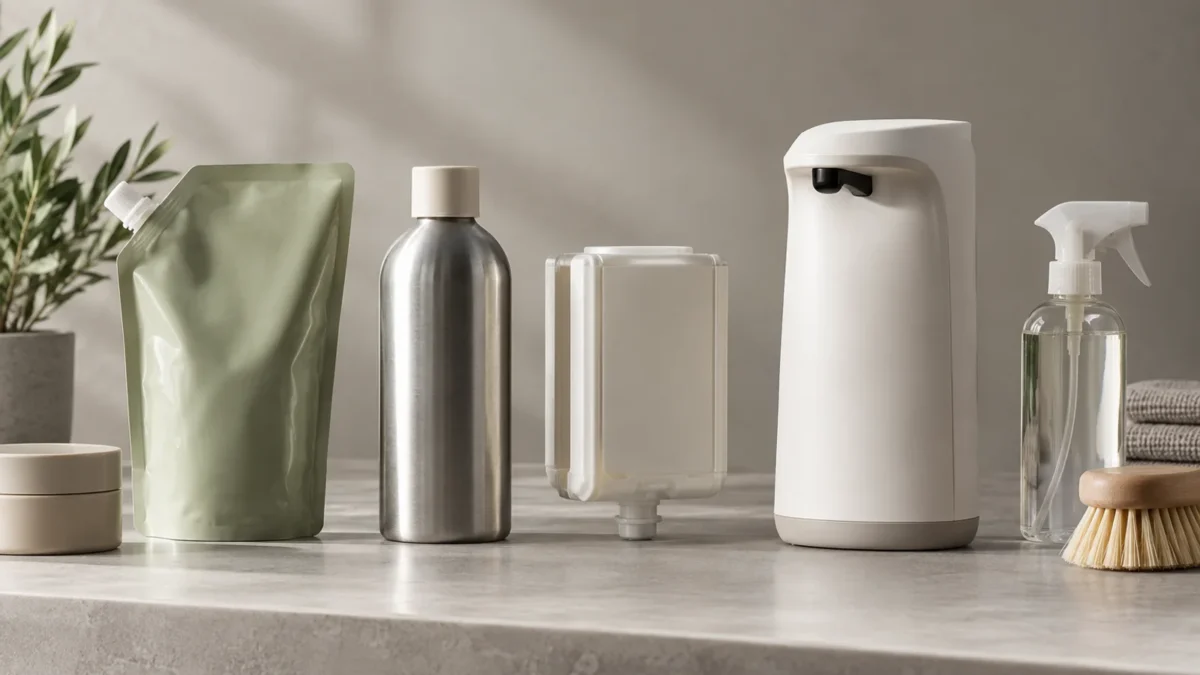
A bathroom shelf is a better place to understand refill packaging than a sustainability diagram. The shelf contains the real constraints: a shampoo pump that may last longer than the bottle, a face-cream jar whose glass and metal decoration are expensive to replace, a detergent bottle that mostly transports water, a household spray trigger that can work through many product fills, and a fragrance bottle whose value is partly emotional and aesthetic.
Refill packaging works when the durable part stays in use and the replacement part becomes materially simpler. That can mean a pouch, cartridge, inner pod, concentrate, bulk dispenser or subscription refill. But one refill purchase does not prove repeated reuse. The system only becomes meaningful when the primary package is actually retained, the refill is compatible and easy to use, and the combined material, transport and recovery burden is lower for the number of real refills achieved.
Start with a bathroom and laundry shelf audit
| Shelf item | Durable component worth keeping | Refill route to evaluate | Main failure mode |
|---|---|---|---|
| Shampoo / conditioner | Pump bottle, rigid holder or dispenser | Flexible refill pouch, replaceable inner pack, in-store bulk | Spillage, wrong viscosity, pump incompatibility, consumer abandons original bottle |
| Body wash / hand soap | Pump or wall/bench dispenser | Pouch, concentrate, bulk refill | Contamination, overdosing, messy transfer, refill pack nearly as complex as original |
| Skincare serum / cream | Decorative jar, pump, glass bottle or outer case | Cartridge, cup, inner pod, precision refill | Air exposure, seal damage, dose mechanism mismatch, premium case not retained |
| Fragrance | Heavy decorated glass bottle and atomiser | At-home bottle refill or in-store fountain | Spillage, wrong interface, valve damage, product mix-up |
| Laundry detergent | Dosing bottle/cap or durable dispenser | Large refill pouch, concentrate, bulk dispense | Wrong dose, consumer transports excess water, pouch recovery remains weak |
| Household spray cleaner | Trigger sprayer and rigid bottle | Liquid concentrate, tablet/powder concentrate, pouch refill | Incorrect dilution, formula incompatibility, reused trigger fails before bottle |
The shelf audit immediately shows why “refill packaging” is not one format. Some systems ask the consumer to pour product into a durable container. Others replace an inner cartridge without exposing the product. Some remove water from the supply chain and ask the consumer to add it at home. Others move the refill operation into a store. [S1] [S2]
Model 1: refill pouch — keep the pump, replace the bottle body
The simplest refill-at-home model keeps a rigid bottle or pump and sells the next dose in a lighter flexible pack. Shampoo, conditioner, body wash, hand soap and laundry detergent are natural applications because the product is already poured or pumped from a container and consumers buy it repeatedly. [S4] [S5]
A pouch can reduce packaging mass because it does not need the same freestanding stiffness, neck finish or pump interface as the original bottle. A peer-reviewed LCA of shampoo packaging compared a conventional pump bottle with a refill model using flexible packs and a “replace” model in which the flexible pack was installed directly into a holder. Under that study’s assumptions, both refill-based systems reduced environmental impacts relative to buying a new pump bottle each time. The result was driven largely by lower packaging material demand, not by a generic property of flexible film.
Another shampoo LCA showed how sensitive that conclusion is to the reference system. In that study, refill from a 25 L PE canister or a 500 mL PET stand-up pouch reduced the packaging-related global-warming burden substantially compared with repeatedly buying the study’s glass bottle, but the total shampoo life-cycle improvement was much smaller because packaging was only one part of the product’s overall impact.
These studies are useful because they make the boundary visible: refill packaging can materially reduce the packaging burden without necessarily dominating the total product footprint.
See the peer-reviewed studies in Cleaner and Responsible Consumption and Sustainability.
A pouch is only a refill if the durable package remains durable
The original bottle often contains the most mechanically complex component in the system: a pump, trigger, dispensing cap, precision actuator or decorated rigid shell. If that component fails after one or two refills, the material-saving model collapses quickly. [S4] [S5]
For that reason, a refill programme should test the durable package beyond its first fill. Questions include:
- Does the pump still deliver the intended dose after repeated cycles?
- Does the trigger spring, valve or dip tube remain reliable?
- Does product residue build up in a way that changes dispensing or hygiene?
- Can the consumer identify when the container should be cleaned, replaced or not refilled?
- Does the label remain legible after repeated wet bathroom or laundry-room exposure?
- Does the refill neck or spout prevent misalignment and excessive residue?
The correct durability target depends on the product and refill system. A company claim that a bottle “can be reused 20 times” is not evidence that consumers actually complete 20 refills.

Model 2: replaceable inner pod or cartridge — move the messy interface inside the package
Cartridge and inner-pod systems change the consumer task. Instead of pouring product through a narrow bottle neck, the user opens a durable outer package and inserts a prefilled inner component. [S11]
This can be especially useful for high-viscosity haircare, skincare, premium cosmetics and dispensing systems where contamination or air exposure needs tighter control. It can also preserve a high-value outer shell while changing only the product-contact component.
The trade-off is that the refill itself can become more engineered. A pod may need a rigid rim, pierceable membrane, valve, fit feature or barrier layer. If the refill cartridge approaches the mass and complexity of the original package, the material advantage can shrink. Compatibility also becomes proprietary: a cartridge designed for one actuator or case may not fit another.
Kao’s refill work illustrates how interface design can reduce transfer friction. The company has developed refill packs and dedicated holders for viscous personal-care products, including systems where the flexible refill is mounted into a holder rather than manually poured into a conventional bottle. Kao reports hundreds of refill and replacement products in its Japanese portfolio, which demonstrates commercial depth in this model but does not by itself establish the environmental performance of every SKU. See Kao’s current refill and replacement overview.
Model 3: concentrate — redesign the product as well as the package
Some of the largest logistics changes occur when the refill contains less water. [S6] [S12]
Household cleaners and detergents are strong candidates because water can be added at the point of use or a more concentrated formula can deliver the same number of uses from a smaller package. The refill then changes two variables at once: packaging mass and transported product mass or volume.
That benefit is not automatic. A concentrate has to deliver the correct dose, dissolve or mix reliably and avoid unsafe consumer improvisation. If the consumer uses too much concentrate, fails to add the right amount of water or combines it with an incompatible bottle, the product system can fail even though the packaging looks efficient.
A 2026 Journal of Cleaner Production study compared a conventional single-use detergent bottle with a concentrate pouch used in a refill-and-reuse system. Its method deliberately examined three scopes—packaging only, packaging plus transport, and the full product system—because conclusions can change when the transported product volume and use phase are included. That is exactly the boundary refill claims need.
Concentration can also reduce package size without creating a refill system. Henkel’s 2025 North American laundry redesign for all®, Persil® and Snuggle® introduced more concentrated formulas in smaller bottles. That is a material/product-efficiency change, but the bottle remains a single-use sales package unless it is actually refilled. Concentrate and refill should therefore be treated as separate design levers.
Model 4: in-store refill — eliminate the consumer refill pack, add retail infrastructure
Bulk dispensing can remove the individual refill pouch entirely. The customer brings a compatible container, selects a product quantity and refills at a shop or dispensing point. [S7]
That shifts packaging out of the consumer’s hand and into the retail supply chain. The system now needs bulk transport containers, dispensing equipment, cleaning procedures, measurement, product identification and controls against cross-contamination or wrong-product filling.
The Ellen MacArthur Foundation classifies this as “refill on the go,” distinct from refill-at-home systems. Its reuse framework also notes that refill can reduce packaging only if the refill route itself does not create a comparable new waste stream.
EU law now gives refill stations a clearer operating framework. Under Regulation (EU) 2025/40, economic operators that offer products through refill must provide users with rules covering permitted container types, hygiene standards and user responsibilities. Refill stations must meet Annex VI requirements, including clear hygiene information and a means of measuring the quantity purchased. From 1 January 2030, final distributors with sales areas above 400 m² are required to endeavour to dedicate 10% of sales area to refill stations for food and non-food products.
That provision should not be rewritten as “all large EU shops must have 10% refill by 2030.” The Regulation uses the wording “shall endeavour,” and Article 51 allows Member States to adopt additional reuse/refill measures under defined conditions. The operative text is in Regulation (EU) 2025/40.
Hygiene is a product-system question, not a reason to generalise
Refill hygiene differs sharply by product. A perfume refill is not a laundry-detergent refill. A face serum is not a floor cleaner. Water-based personal-care formulations may have different microbiological sensitivities from concentrated surfactant systems or fragrance. [S7]
For consumer-owned refill containers, the system has to define whether the container should be clean, dry, product-dedicated or visually inspected before refill. For cartridge systems, the product-contact path may remain largely inside the replaceable unit. For in-store systems, the dispensing equipment itself becomes part of the hygiene boundary.
The EU PPWR therefore establishes generic refill-station hygiene information requirements but does not replace the product-specific safety legislation that applies to cosmetics, detergents or other formulations. Packaging teams should avoid using “refillable” as a shortcut around product-compatibility or contamination validation.
Compatibility becomes more important as the outer package lives longer
A conventional single-use bottle may only need to remain compatible with one filling and one use period. A durable refillable package can encounter the formulation repeatedly over months or years. [S8]
That changes the test plan. Fragrance can interact with seals and decorative coatings. Essential oils and solvents can affect elastomers. Strong cleaners can stress trigger components. Viscous shampoos can leave residue in pumps. Repeated opening can wear threads or latch features. Refill systems should therefore validate the durable package, seals, pump and refill interface over the intended number of use cycles.
When a brand reformulates the product, package compatibility may need to be reopened even if the refill package itself is unchanged.
Premium beauty shows why keeping the expensive package can make sense
Beauty is one of the clearest places where a refill system can target the most material-intensive part of the package. Fragrance bottles, serum pumps, decorated jars and makeup cases can contain thick glass, metal parts, pumps, magnets or premium finishes that are expensive to reproduce every purchase. [S9] [S10]
L’Oréal’s 2026 refill campaign provides current commercial evidence of this direction. The company says its programme now spans skincare, fragrance, makeup and haircare across 18 brands and 28 products, and its September 2026 refill overview lists refill pouches, fragrance refills, skincare cartridges and makeup refills. Those are company-reported rollout facts, not independent proof of environmental superiority.
The engineering principle is stronger than the marketing claim: if the high-mass or high-complexity outer package remains in service while a lower-material refill performs only the product-contact function, the system has a plausible material-reduction pathway. The real result still depends on how many refills are completed.
See L’Oréal’s September 2026 refill overview.
Refill adoption is the denominator that marketing claims often omit
Consider two consumers buying the same “refillable” skincare jar. One buys the original pack and four refill cartridges. The other buys the original pack, never refills it and replaces it with another complete pack. The package design is identical; the system outcome is not. [S2] [S3]
A refill programme should therefore track at least:
| Metric | What it tells you |
|---|---|
| Refill attachment rate | Share of initial-package buyers who later buy at least one refill |
| Average refills per durable pack | Actual repeated use, not theoretical capability |
| Refill-to-full-pack sales ratio | Whether refills are displacing complete-package repurchases |
| Durable-pack failure / replacement rate | Whether pump, case, jar or bottle actually survives repeated use |
| Refill residual-product rate | How much product or packaging function is lost because the refill cannot be emptied cleanly |
| Refill packaging mass per delivered dose | Material efficiency of each subsequent purchase |
A single refill sale proves one additional fill. It does not prove a repeated-use habit.
The refill pack still has an end-of-life problem
Flexible refill pouches can reduce material mass dramatically, but low mass is not the same as high recycling performance. Multilayer barrier pouches, spouts, caps and residual product can make collection and reprocessing more difficult than for a rigid mono-material bottle in some markets. [S4] [S5]
Cartridges may combine rigid polymers, membranes and valves. Makeup refills can use small multi-material components. Concentrate sachets can be tiny but difficult to collect. Bulk refill can shift packaging upstream into larger containers rather than remove packaging entirely.
The correct comparison is therefore not “original bottle versus zero packaging.” It is:
durable primary pack amortised over achieved refills + refill packaging + transport + cleaning/reconditioning where applicable + end-of-life.
That is also why a lighter pouch can reduce material demand while still having a weaker recycling route than the bottle it replaces. Both facts can be true at the same time.
Subscription refill solves availability, not necessarily reuse
Automatic delivery can remove one behavioural barrier: remembering to buy the refill. It can also help brands forecast demand and size refill inventory more accurately. [S1] [S3]
But subscription does not automatically create reuse. If each shipment includes a complete new pump bottle, the model is recurring e-commerce rather than refill. If the customer receives lightweight refills for a retained dispenser, the subscription can support repeated use—but only if the durable pack is actually retained and the shipment frequency matches consumption.
Packaging teams should therefore separate the commercial replenishment model from the physical packaging model.
The strongest refill designs remove complexity from every purchase after the first
The shelf audit points to a practical hierarchy. Refill works best where the initial package contains something worth keeping: a pump, trigger, decorated case, precision dispenser, heavy glass bottle or durable body. The refill then needs to be lighter, simpler or more concentrated without making filling, dosing, hygiene or compatibility harder for the user. [S1] [S4] [S13]
That does not mean every product should become refillable. Kao explicitly notes that some products are not recommended for consumer refill because of product properties or safety, and in those cases the company may reuse selected components through replacement formats instead. The product and user task have to support the model.
The useful design question is therefore not “Can we sell a refill?” It is: which part of this package should remain in use, which part genuinely needs replacing, and how many times will consumers realistically complete that cycle?
When those three answers are clear, refill packaging becomes a system redesign. When they are not, “refillable” can be little more than an extra SKU on the shelf.
Methodology and editorial note
This separates documented refill formats, company-reported examples, peer-reviewed scenarios and EU rules. Company claims are attributed; no named refill is declared environmentally preferable without a like-for-like system comparison. Sources checked 21 October 2026. The main image is an AI-generated generic editorial illustration, not a named company, real facility or tested product. Editorial Team human review remains pending after publication.
Sources and reference notes
- [S1] Ellen MacArthur Foundation. Reusable packaging business models. Refill at home; refill on the go; return from home; return on the go. Accessed 21 October 2026.
- [S2] Ellen MacArthur Foundation. Global Commitment 2022 — Household and personal care insights. Moving from single-use towards reuse models. Accessed 21 October 2026.
- [S3] Ellen MacArthur Foundation. Scaling reuse for plastics. Overview of reuse development, metrics and system scaling. Accessed 21 October 2026.
- [S4] Shampoo refill/replace LCA. Life cycle assessment (LCA) of the innovative eco-designed container for shampoo. Abstract / model comparison. Accessed 21 October 2026.
- [S5] Shampoo refill options LCA. Life Cycle Assessment of a Plant-Based, Regionally Marketed Shampoo and Analysis of Refill Options. Methods; packaging scenarios; packaging production/end-of-life results. Accessed 21 October 2026.
- [S6] 2026 detergent refill/concentrate Circular-LCA. Integrating circularity indicators with life cycle assessment for plastic packaging: A refill-and-reuse system case study. Abstract. Accessed 21 October 2026.
- [S7] Detergent self-dispensing LCA. Waste prevention in liquid detergent distribution: a comparison based on life cycle assessment. Abstract. Accessed 21 October 2026.
- [S8] Laundry packaging counterexample. Comparative Life Cycle Assessment of Multiple Liquid Laundry Detergent Packaging Formats. Abstract / comparative system results. Accessed 21 October 2026.
- [S9] L’Oréal Groupe. L’Oréal calls on consumers around the world to #JoinTheRefillMovement in its biggest ever campaign for refillable beauty. Campaign scope; categories; manufacturing/refill capability. Accessed 21 October 2026.
- [S10] L’Oréal Groupe. Pioneering the refill revolution. Haircare, skincare, fragrance and refill-format examples. Accessed 21 October 2026.
- [S11] Kao Corporation. Refills and Replacements. Smart Holder; refill pouches; pour types; replacement formats. Accessed 21 October 2026.
- [S12] Henkel. Henkel Debuts New Concentrated Formulas for all®, Persil® and Snuggle® Liquid Laundry Products. Formula concentration / smaller packaging rollout. Accessed 21 October 2026.
- [S13] European Union. Regulation (EU) 2025/40 on packaging and packaging waste. – Article 3(33)–(34): refill/refill station definitions. Accessed 21 October 2026.
- [S14] European Commission. Commission Notice — Guidance document for Regulation (EU) 2025/40 on packaging and packaging waste. Article 51 reuse/refill interpretation. Accessed 21 October 2026.
The public corrections channel is currently inactive. Read our corrections policy.