
A film with two different wetting surfaces is not automatically a validated package. Yeganeh and Olson’s 2026 Cellulose study offers a useful case: experimental microfibrillated lignocellulose films had a more hydrophobic air-facing surface and a more hydrophilic plate-facing surface. The authors associate that contrast with lignin distribution during film formation. [materials]
Keep the preparation attached to the result
The researchers used aspen bleached chemithermomechanical pulp refined into MFLC, then cast and dried films. Their additional hot-pressed series used 2,500 PSI at 120 degrees Celsius for two hours. The paper reports conditioning before testing and investigates several film weights and thicknesses. [materials]
The study reports improved strength and water resistance with pressing, alongside greater brittleness and reduced tear performance. Our reading is that densification creates a trade-off rather than one universally better specimen. A surface-wetting result also does not, by itself, describe vapour transport through an entire package. [materials]
What can transfer into a specification?
For a packaging developer, the transferable question is which face contacts the product, which face is bonded or coated, and whether converting changes the tested structure. Those are proposed development questions, not results of a trial performed by this publication. [materials]
This is a reading of a study published on 24 August 2026, not a newly announced commercial material. The underlying datasets are available from the corresponding author on reasonable request. We have not reanalysed those data or established food-contact clearance, recyclability or a production-speed specification for a finished package. [materials]
Related reading: Nanocellulose Barrier Coatings: Can Cellulose Protect Paper from Oil, Oxygen and Moisture?.
Real specimens show why the process name matters
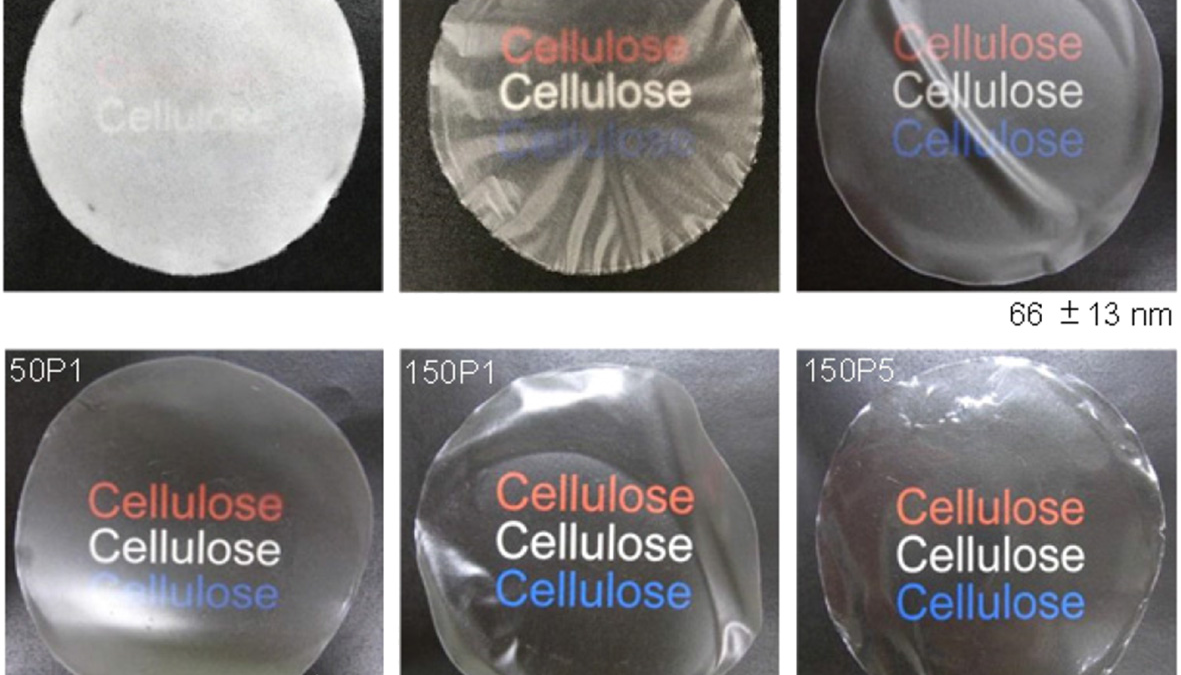
The featured photograph comes from a separate 2020 study by Wakabayashi and colleagues: it shows real TEMPO-oxidized cellulose sheets and films produced from dispersions with different degrees of fibrillation. It illustrates changes from an opaque sheet to more transparent films. These chemically oxidized, membrane-filtered specimens are not the cast MFLC films in the 2026 paper. The sample labels and scale bar belong to the 2020 experiment. [film-comparison]
That distinction prevents a common specification error: treating cellulose film as a single interchangeable product. A transparent specimen cannot stand in for the composition or behaviour of a lignin-containing specimen, and a photograph cannot establish barrier or seal performance. A development brief should pair every specimen image with its feedstock, chemical treatment, forming route and conditioning record before comparing a measured endpoint. This is a way to select comparable evidence, not a performance ranking between the two studies.
A screening sequence for a converter
For a converter, the development decision should begin with the intended function, not the label hydrophobic. Identify which film face is intended to contact a product or another layer, then match the specimen thickness, conditioning and test endpoint to that function. A surface-water result and water-vapour transmission ask different questions. Selecting a face from a wetting result does not establish the barrier performance of a sealed, converted package.
Next, keep the process route attached to the comparison. The reported two-hour hot-press treatment is a laboratory preparation condition, not a demonstrated production-line residence time. Before using the pressed specimen as a purchasing specification, a developer would need to examine whether the intended forming, bonding and handling route preserves the measured properties and whether the strength-versus-tear compromise fits that application. These are proposed qualification questions, not an industrial-feasibility result.
The useful near-term application of the paper is therefore to a development brief: request face-labelled specimens, matched test conditions and results after the proposed converting step. Food-contact suitability, recovery and compostability would require separate evidence. None follows from lignocellulose content or a wetting asymmetry, and none is established by this study reading.
Sources and scope
Fariba Yeganeh and James A. Olson / Cellulose. Micro-fibrillated lignocellulose films for high-performance sustainable packaging. 2026-08-24. Materials and methods: Preparation of MFLC films; Surface morphology and wettability; Conclusions; Data availability. No commercial adoption, finished-pack food-contact, local disposal or environmental-superiority verdict. Raw datasets are available on request, not independently reanalysed. No source figure reproduced.
Wakabayashi, Fujisawa, Saito and Isogai. Nanocellulose Film Properties Tunable by Controlling Degree of Fibrillation of TEMPO-Oxidized Cellulose. Frontiers in Chemistry 8:37, 13 February 2020, Figure 6 and specimen preparation. Photograph © 2020 the authors; CC BY 4.0. A separate comparison study, not the 2026 MFLC experiment.
The public corrections channel is currently inactive. Read our corrections policy.
